Blog

  • The Unfair Prosecution of Rebecca Grossman and How the Real Murderer Got Away

    The Unfair Prosecution of Rebecca Grossman and How the Real Murderer Got Away

    On Triunfo Canyon Road just after dusk on September 29, 2020, two brothers were crossing the street in a marked crosswalk, one on a skateboard and the other on rollerblades. Within moments, eleven year old Mark Iskander and eight year old Jacob Iskander were struck by vehicles moving through the intersection in close succession. Both boys suffered fatal injuries as a result of the collision. Their deaths immediately triggered a high profile criminal investigation that would ultimately become one of the most controversial vehicular homicide prosecutions in Los Angeles County history.

    What followed was not the comprehensive, evidence driven reconstruction typically required in complex multi vehicle roadway fatalities. Instead, investigators rapidly narrowed their focus to a single driver, Rebecca Grossman, and structured the case as though no other vehicles played a meaningful role in the collision. From the earliest hours of the investigation forward, the working theory centered on Grossman as the sole cause, shaping every subsequent evidentiary decision and prosecutorial strategy.

    Yet from the beginning, witness accounts pointed to a far more complex sequence of events. Multiple individuals described more than one vehicle traveling at high speed through the intersection in close succession. Several witnesses specifically recalled a lead SUV crossing the intersection first, followed within seconds by Grossman’s Mercedes. In high speed pedestrian collisions, vehicle sequencing is critical because the initial impact often produces the fatal trauma, while subsequent vehicles may exacerbate injuries but are not necessarily the primary cause of death. This foundational principle of collision reconstruction was never meaningfully explored.

    Physical evidence at the scene supported the involvement of another vehicle. Investigators documented a fog light cover that did not match Grossman’s Mercedes and a license plate frame inconsistent with her vehicle. Both items were photographed and logged into evidence, indicating the presence of an additional car involved in the collision sequence. Yet neither item was ever subjected to forensic testing, and both later mysteriously disappeared from the evidence chain entirely. No explanation for their loss was provided in court, and the jury never learned of their existence.
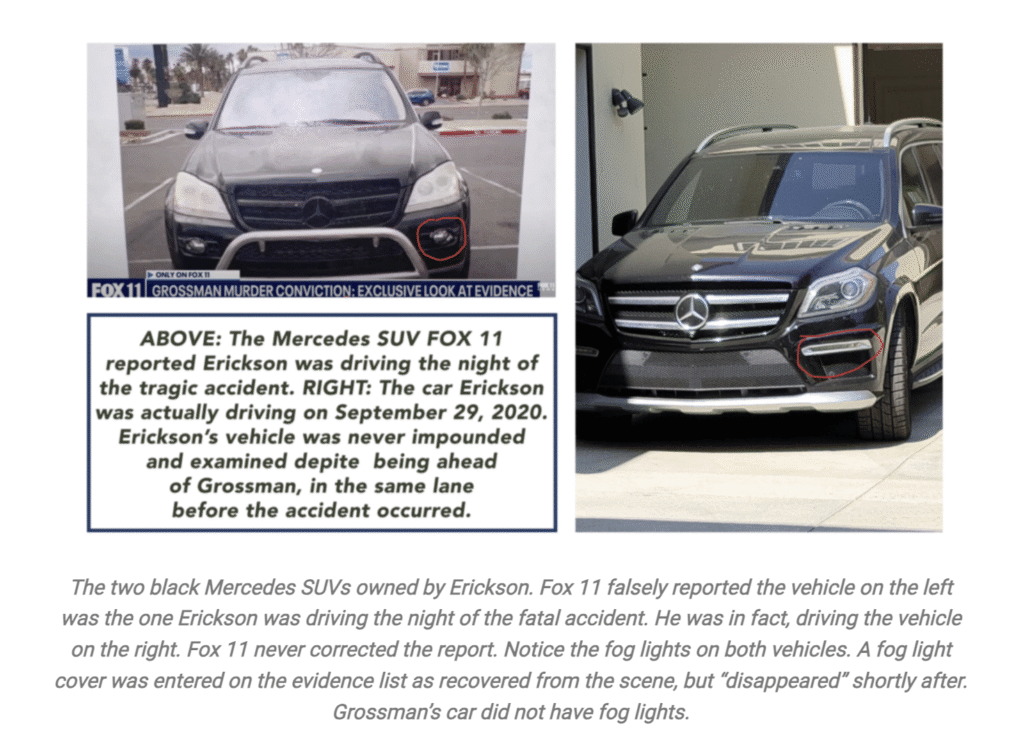
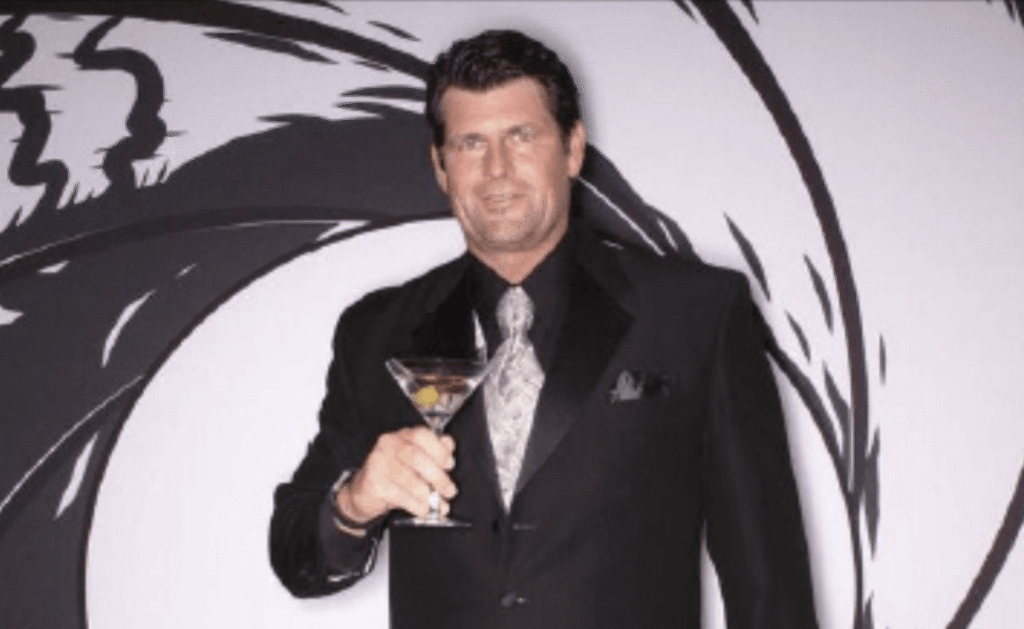
    The lead vehicle repeatedly referenced in witness statements belonged to former Major League Baseball player Scott Erickson.

    Erickson was driving an SUV just seconds ahead of Grossman in the same lane of travel when the boys were struck. Timeline analysis placed his vehicle in the immediate impact zone at the moment the children entered the crosswalk. Multiple witnesses indicated his SUV passed through first, followed almost immediately by Grossman’s Mercedes. This positioning placed Erickson’s vehicle as the likely first point of contact, a fact that should have made his SUV the primary focus of forensic investigation.

    Erickson did not pull over after the collision. Instead, he continued driving to Grossman’s home two blocks away, leaving Grossman at the scene. After Grossman pulled to the side of the road when her Mercedes emergency system activated, she spoke with Erickson by phone. He asked her directly, “Did you see the kids?” Grossman responded “No!”. The reason is significant: Erickson’s SUV was traveling directly in front of her at close proximity, obstructing her view of the crosswalk. This positioning places Erickson’s vehicle as the first through the intersection and the driver most likely responsible for striking the boys.

    Despite these red flags, Erickson was never questioned that night, and his vehicle was never seized or forensically examined, even though debris recovered at the scene was consistent with damage from his SUV and inconsistent with Grossman’s Mercedes.

    Compounding these concerns, Erickson had a documented history involving DUI and had reportedly consumed alcohol throughout the day, including shortly before the crash. Multiple witnesses confirmed his whereabouts and his alcohol consumption. Despite this, investigators did not contact or interview Erickson that evening. Under standard prosecutorial practice, such factors would demand heightened scrutiny, not indifference. Yet Erickson faced only a misdemeanor reckless driving charge. Grossman, by contrast, was charged with second degree murder, exposing her to a potential life sentence.

    The disparity was extraordinary.

    The contrast in treatment raised immediate questions about investigative focus, selective prosecution, and whether conclusions had been drawn long before evidence was fully gathered.

    Further clarity is emerging through the civil wrongful death litigation tied to the case. Depositions, discovery, and evidentiary disclosures have exposed major gaps in the original investigation. Critical evidence was never preserved. Documentation that should exist is missing. Items logged at the scene can no longer be located. Witness statements describing multiple impacts were minimized, reframed, or in some instances altered to fit the prosecution’s narrative – and in some instances, outright fabricated. Standard protocols for multi vehicle fatal collisions were not followed, further undermining the integrity of the investigation.

    Rather than an investigation that evolved with evidence, the civil proceedings suggest a process that narrowed almost immediately and then worked backward to support a predetermined narrative.

    Within hours of the crash, the investigative scope had effectively closed around Grossman as the sole responsible party. Once that determination was made, alternative explanations were no longer pursued with seriousness, and evidence inconsistent with the single driver theory quietly faded from the record.

    To elevate the case from vehicular manslaughter to murder, prosecutors relied on the legal doctrine of implied malice. This requires proof that a defendant consciously disregarded a known risk to human life. Such charges are typically reserved for repeat DUI offenders who have been explicitly warned of lethal consequences through prior convictions.

    Grossman had no prior DUI convictions. Her blood alcohol level was below the legal limit. There was no documented history of reckless conduct establishing awareness of deadly risk.

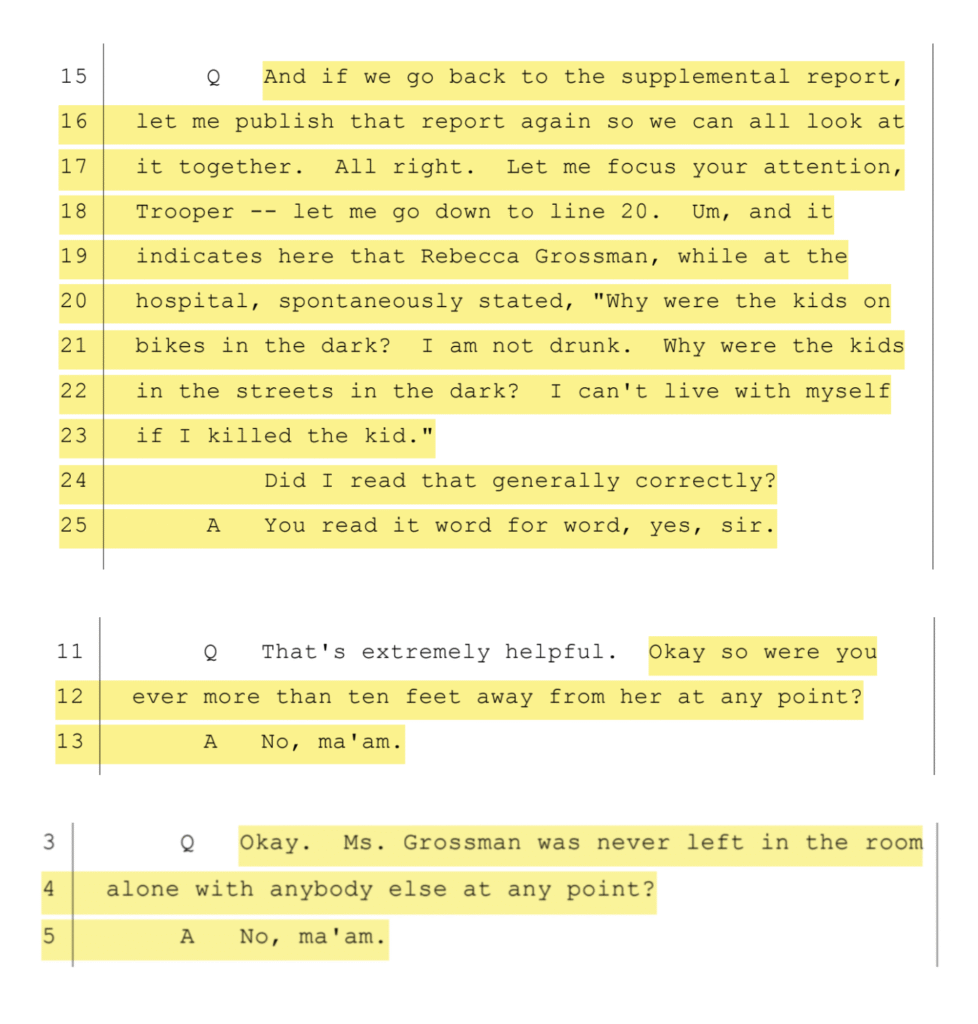
    The prosecution’s implied malice argument rested almost entirely on a single alleged statement attributed to Grossman by a hospital technician suggesting she would have been home if not for the incident, which prosecutors framed as evidence of callous indifference.

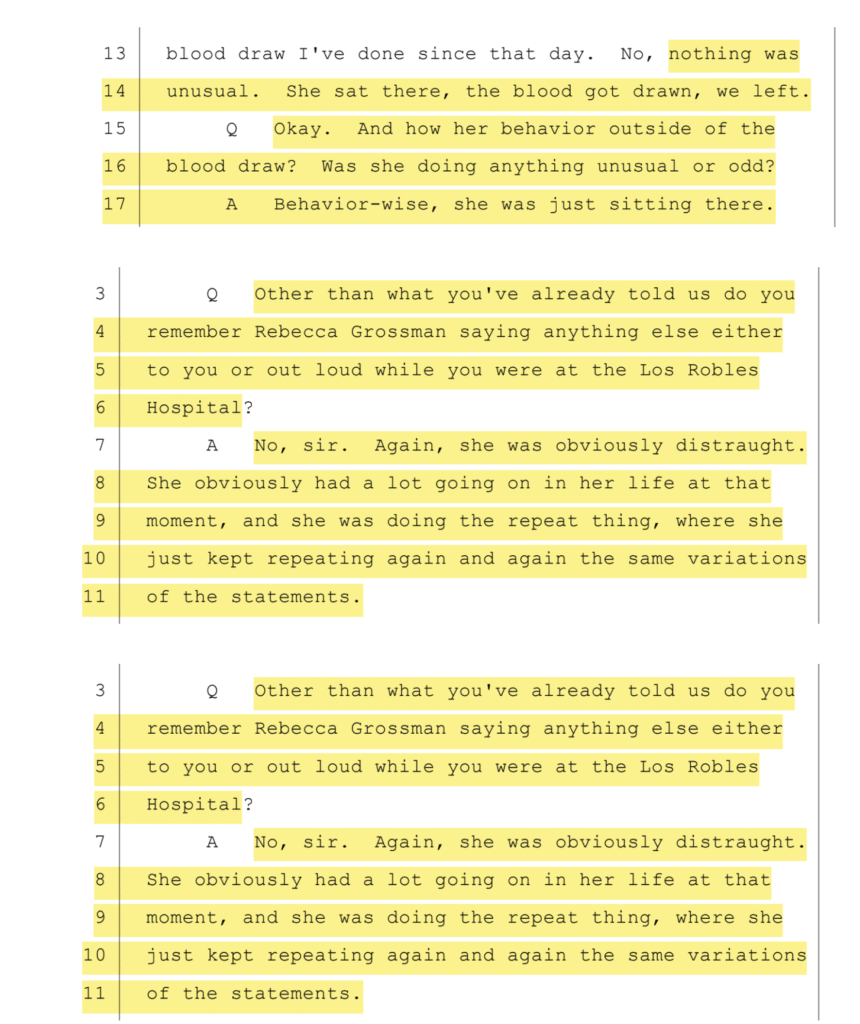
    The sheriff’s deputy who escorted Grossman continuously from the crash scene to the hospital testified that he never heard any such statement. His presence with Grossman was uninterrupted. This direct contradiction was never meaningfully presented to the jury, depriving them of critical context for assessing the credibility of the prosecution’s central malice evidence.
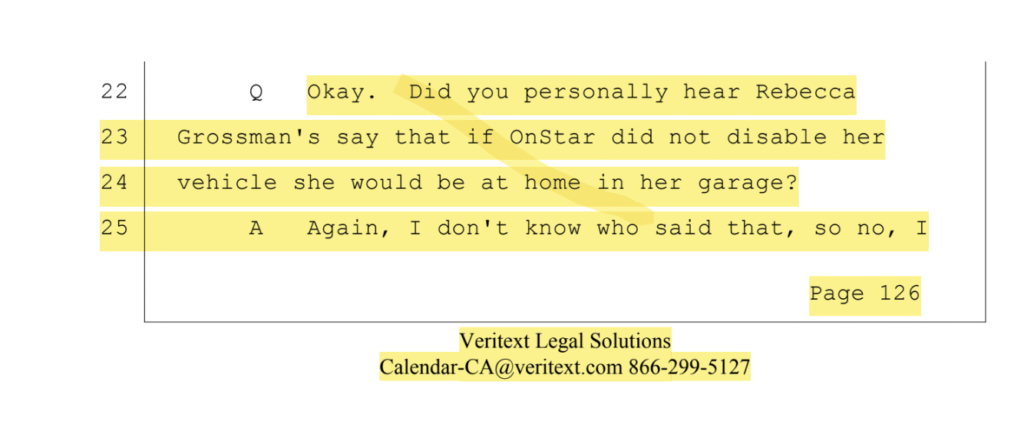
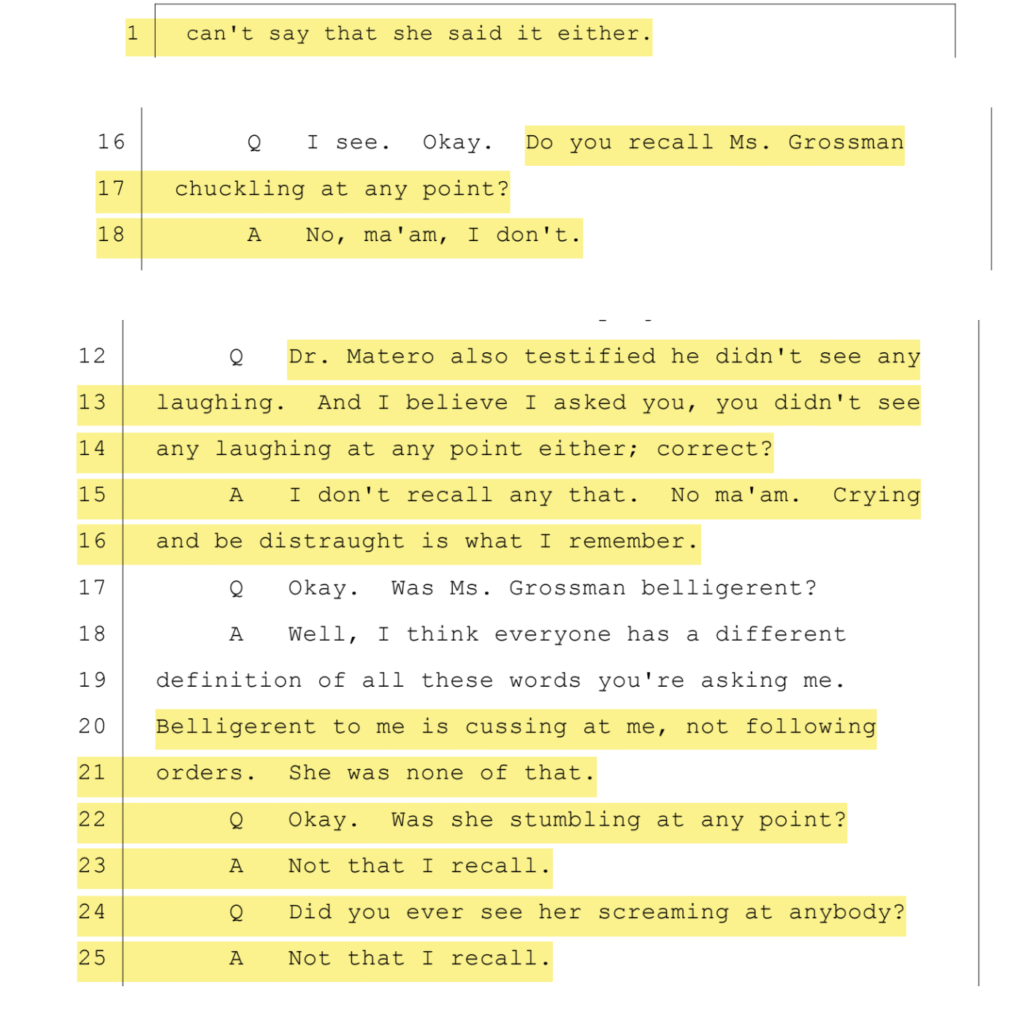
     

    Without that statement, the legal foundation for second degree murder becomes substantially weaker.

    Additionally, prosecutors attempted to convert Grossman’s post impact travel distance into “flight” to support implied malice, but California law does not define fleeing the scene by distance alone. Vehicle Code section 20001 requires a driver to stop “immediately at the scene of the accident or as close thereto as possible,” and appellate courts have repeatedly emphasized that the duty is to stop as soon as it is reasonably safe, with intent to evade responsibility or identification as the decisive element. The controlling case is People v. Scheer (1998) 68 Cal.App.4th 1009, which rejects the theory that continued movement, without evasive intent, constitutes flight. Scheer holds that stopping at the first reasonable opportunity satisfies the statute and that distance without intent is not fleeing. Applied here, the evidence described in the record shows Grossman pulled over and remained with her disabled vehicle and complied with instructions while awaiting law enforcement, conduct that aligns with statutory compliance rather than evasion under Scheer.

    The forensic handling of chemical testing introduced further problems. Grossman declined an on scene blood draw for medical reasons, a legally permissible decision. A subsequent hospital blood draw violated established chain of custody standards, including improper labeling and handling. Despite these procedural failures, the sample was admitted and relied upon as evidence.

    Meanwhile, physical evidence pointing toward another vehicle’s involvement continued to vanish from the case record.

    No internal investigation publicly addressed the missing debris. No forensic explanation was provided. No accountability followed.

    Public perception of the case was shaped largely by a media narrative that reinforced the single driver theory. Coverage emphasized wealth, speed, and tragedy while rarely examining the multi vehicle dynamics, missing evidence, or uneven treatment of involved drivers. Complexity gave way to moral simplicity.

    The broader political context further illuminates prosecutorial decisions. At the time, law enforcement officials faced intense pressure to demonstrate toughness on violent crime amid public criticism over reform policies. The Grossman case offered a highly visible platform for aggressive charging. Elevating the case to murder transformed a tragic collision into a symbolic prosecution of accountability.

    The jury ultimately received a streamlined version of events in which Grossman alone caused the deaths, contradictory evidence was excluded or minimized, and forensic uncertainty was largely absent.

    She was convicted and sentenced to fifteen years to life.

    Erickson faced no serious criminal consequences.

    Civil litigation continues to surface evidence suggesting the outcome was shaped long before trial by investigative decisions that limited the scope of inquiry. Missing evidence, suppressed contradictions, and disparate treatment of involved drivers now form a pattern that is increasingly difficult to dismiss as coincidence.

    The central question is no longer whether prosecutors pursued the case aggressively.

    It is whether they pursued it honestly.

    Two children lost their lives and deserved a full and transparent accounting of what happened that night. Instead, the justice system appears to have delivered a simplified narrative that allowed critical evidence to disappear and the most likely alternative cause to escape accountability.

    Rebecca Grossman remains incarcerated.

    Scott Erickson remains free.

    As the civil case continues to unfold, it raises the disturbing possibility that the truth of what occurred on Triunfo Canyon Road was never fully presented to the jury entrusted with deciding guilt.

    If that is so, this case will stand as a profound example of how wrongful convictions are not always created through fabricated evidence, but through selective investigation, narrative control, and institutional refusal to pursue facts that complicate a desired outcome.

    DISCLAIMER: Investigative reporting in high-profile litigation cases published by The Current Report is non-commercial, fact-based journalism; any project fees compensate research and reporting labor only, sources participate solely in accuracy verification, and final publication is approved exclusively by The Current Report after fact-checking is confirmed.

  • The Bonta Files: When State Politics Collide With Federal Law: How Rob Bonta’s Directive Could Put Local Officers in the Crosshairs

    The Bonta Files: When State Politics Collide With Federal Law: How Rob Bonta’s Directive Could Put Local Officers in the Crosshairs

    California Attorney General Rob Bonta’s latest guidance to local law enforcement, encouraging agencies to investigate and prosecute federal officers for alleged state law violations, is being framed as a bold defense of state sovereignty. In reality, it may be an invitation to legal disaster for the very deputies and police chiefs being urged to carry it out.

    Bonta’s message was unambiguous. Local and state agencies, he said, have the authority to pursue criminal cases against federal agents operating in California,  even when those agents are carrying out federal duties. His warning was paired with a direct political threat aimed at the White House: if federal officials “break the law and hurt Californians,” the state will sue and prosecute.

    What sounds like tough talk plays dangerously close to a constitutional fault line that has swallowed law enforcement leaders before.

    And Los Angeles County has already lived this movie.

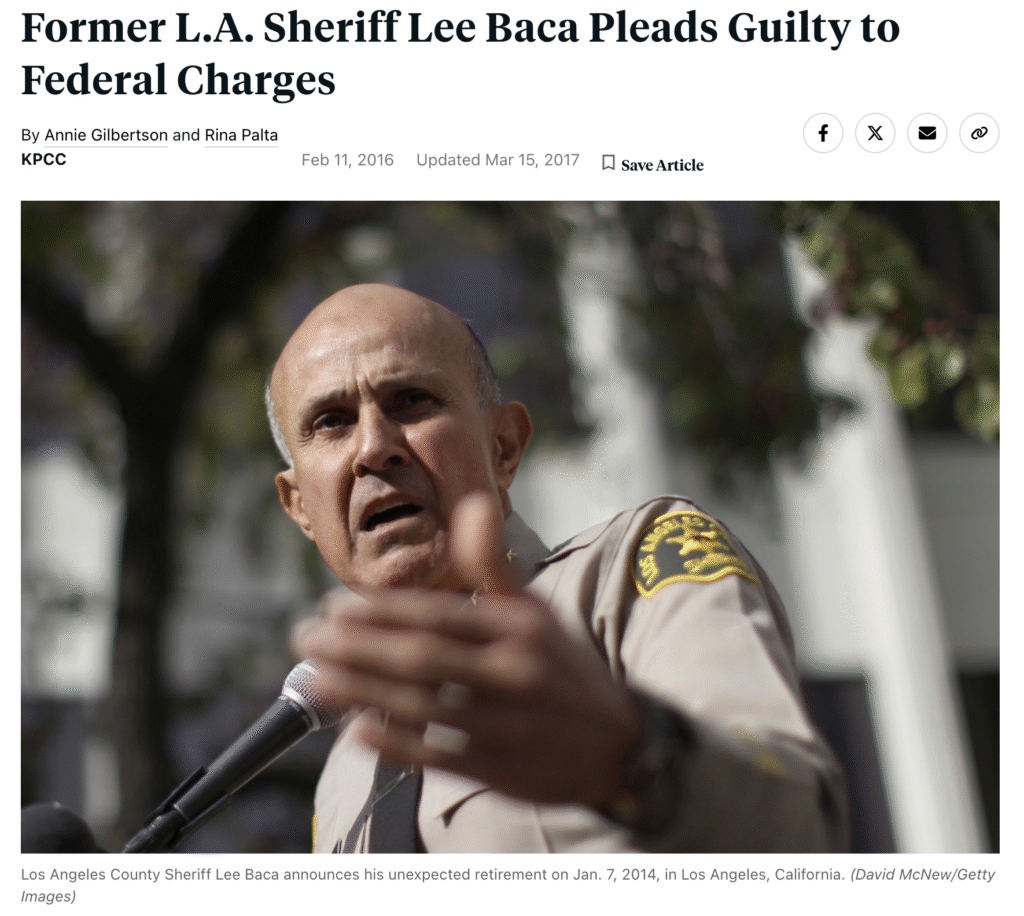
    Before any agency takes legal advice from Attorney General Rob Bonta, they may want to research how it went for LASD when they tried that under Sheriff Lee Baca.

    Let’s just put it this way… it didn’t end well.

    The Baca Precedent: When Local Power Met Federal Authority

    Under former Sheriff Lee Baca, the Los Angeles County Sheriff’s Department attempted to interfere with a federal investigation into deputy abuses inside county jails. Rather than cooperate with federal authorities, LASD executives launched surveillance on the FBI, intimidated a federal informant, concealed him from federal agents, and treated the federal probe as a threat to be neutralized instead of a lawful investigation to be addressed. What followed became one of the largest federal civil rights prosecutions in modern law enforcement history, as federal grand juries indicted top LASD commanders, multiple high-ranking officials were sent to prison, and Baca himself was ultimately convicted for obstruction of justice related to the department’s efforts to derail the investigation.

    The federal government did not hesitate in asserting its authority, and it did not lose. The message that emerged from those prosecutions was unmistakable: when local agencies obstruct, challenge, or interfere with federal operations under the belief that state authority will shield them, federal prosecutors respond with overwhelming force and personal criminal liability.

    Now, nearly a decade later, Rob Bonta is signaling that California officers should move even further down that dangerous path by pursuing criminal cases against federal agents themselves. This is not a legal gray area shaped by conflicting jurisdictions or unsettled case law, but a direct confrontation with constitutional supremacy that historically ends in federal indictments, career destruction, and courtroom defeats for those who believed political backing could override federal power.

    Federal Supremacy Is Not a Suggestion

    Under the U.S. Constitution’s Supremacy Clause, federal law, and federal officers acting within the scope of their duties — overrides state interference. While there are narrow and highly specific circumstances where state charges may apply, courts have consistently ruled that state prosecutions cannot be weaponized to obstruct or punish lawful federal enforcement. When states attempt to cross that line, the response has historically been swift and unforgiving, bringing civil rights indictments, obstruction charges, conspiracy prosecutions, and career-ending criminal cases against those who thought political cover would shield them from federal authority.

    Local officers do not receive immunity because a state attorney general encouraged aggressive enforcement theories. They receive federal charges.

    What makes Rob Bonta’s instruction especially dangerous is the illusion of protection it creates. State leaders can issue guidance, hold press conferences, and posture for headlines, but when federal prosecutors determine that a local agency has crossed into obstruction or unlawful interference, Sacramento will not be sitting at the defense table. Individual deputies, sheriffs, chiefs, and commanders will be the ones answering in federal court, where political narratives collapse under sworn testimony and constitutional law. That courtroom is not built for spin. It is built for accountability.

    History already provides the blueprint. Law enforcement executives who believed they were acting in the department’s interest discovered too late that federal prosecutors view interference with federal authority as a serious crime, not a policy dispute. Ask the LASD officials who learned that lesson the hard way.

    The consequences of challenging federal authority under the illusion of local protection can be seen clearly in the cases of Lee Baca, Paul Tanaka, and other high-ranking LASD officials who were federally charged, convicted, and incarcerated for their roles in obstructing federal operations.

    Under former Sheriff Lee Baca, the Los Angeles County Sheriff’s Department attempted to interfere with a federal investigation into deputy abuses inside county jails by refusing to cooperate, launching surveillance on the FBI, intimidating a federal informant, concealing him from federal agents, and treating the federal probe as an intrusion to be neutralized rather than a lawful inquiry to be addressed. That effort did not quietly disappear but instead exploded into one of the largest federal civil rights and obstruction prosecutions in modern law enforcement history. Federal grand juries ultimately indicted and convicted ten members of the Sheriff’s Department directly tied to the obstruction scheme, ranging from deputies to top commanders, while the broader jail investigation produced at least twenty-one federal convictions connected to civil rights violations, conspiracy, and systematic cover-ups inside the department. Former Undersheriff Paul Tanaka was convicted for orchestrating much of the obstruction campaign and sentenced to federal prison, and Baca himself was convicted for obstruction of justice and related offenses after attempting to derail the federal probe.

    The outcome left no room for misinterpretation. When local agencies interfere with federal operations under the belief that state authority will shield them, federal prosecutors respond with sweeping indictments and personal criminal liability that reaches all the way up the chain of command.

    And when this goes wrong, because legally it almost always does, the consequences will not land on politicians or press secretaries or elected officials issuing bold statements from behind microphones. The price will be paid by street-level officers ordered to act on this guidance, by supervisors who approve questionable cases, and by agencies that follow political marching orders straight into constitutional quicksand. Bonta will collect headlines. Law enforcement will collect indictments.

    California has already tested what happens when local authorities challenge federal power in the name of state interests. It ended with prison sentences, destroyed careers, and a national scandal that reshaped law enforcement oversight. Yet here we are again, with the state’s top law enforcement officer encouraging agencies to walk directly back into the same fire.

    If recent history is any guide, this will not play out as a victory for local control or political defiance. It will play out in federal courtrooms, with defendants wearing badges.

  • The Rebecca Grossman Case and How Scott Erickson May Have Walked Away From a Double Homicide

    The Rebecca Grossman Case and How Scott Erickson May Have Walked Away From a Double Homicide

    They built the Rebecca Grossman case the way LA County builds most politically convenient prosecutions: choose the villain first, then build the investigation around that conclusion until the paperwork looks like proof. The public was fed a simple story because simple stories sell, and because complexity is dangerous when it threatens a conviction. But this crash was never a one-car event, and Grossman was never the only driver whose actions mattered. There was another vehicle in the same lane in front of Grossman, and another chain of decisions unfolding seconds ahead of the defendant’s Mercedes. His name is Scott Erickson, and the most unsettling question in this entire case isn’t what he did. It’s why the justice system acted like it couldn’t afford to find out.

    This case has always had a second driver. A second vehicle. A second set of hands on the wheel moving at speed through that same dark stretch of roadway seconds before impact. A man whose name should have been central to any honest investigation but instead became the system’s most protected variable.

    Scott Erickson was not a bystander. He was not a neutral witness. He was not incidental to the chain of events. He was the person Grossman was behind. He was the driver in the black SUV that appears on surveillance footage just ahead of her in the No. 2 lane. He was part of the pack of speeders witnesses described. He was the one who left, then returned, then left again without identifying himself as the driver directly in front of the defendant when two children were struck.

    And for reasons that do not withstand scrutiny, law enforcement and prosecutors treated him as untouchable.

    The public was asked to accept a single-cause tragedy. Grossman hit the children. Grossman caused the debris. Grossman caused both impacts. Grossman bears total responsibility. But that certainty was not earned through a comprehensive forensic investigation. It was manufactured by narrowing the investigation until it could only produce one answer.

    The second vehicle theory is not a defense fantasy. It is stitched into the timeline and supported by witness accounts and evidence entries that were either ignored or allowed to disappear. Witnesses described hearing two separate impacts, spaced roughly three to five seconds apart. That timing matters because the surveillance evidence placed Erickson’s SUV in front of Grossman’s Mercedes by approximately three seconds in the same lane. In other words, the spacing between Erickson and Grossman matches the spacing between the reported impacts.

    That is not coincidence. That is sequence.

    If Erickson’s SUV struck first, or if it clipped one of the children, or if it triggered the initial collision dynamic that forced bodies into Grossman’s path, then criminal causation becomes far more complex than the prosecution wanted jurors to consider. That is why Erickson’s presence is so dangerous to the state’s theory. It injects reasonable doubt at the precise point prosecutors needed certainty most.

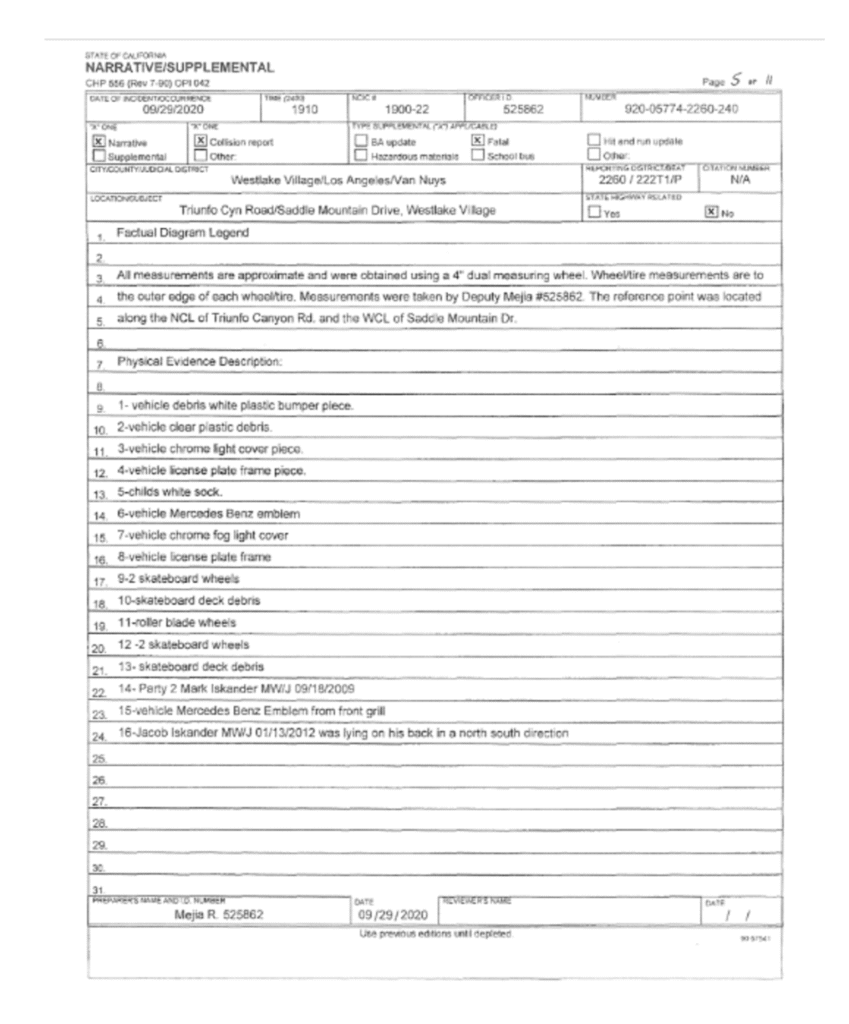
    Then comes the debris, the kind of evidence that should have set off alarms inside any competent investigative team. The evidence log from the scene included a chrome fog light cover and a license plate frame, items that did not align with Grossman’s Mercedes. Grossman’s vehicle did not have fog lights. Erickson’s Mercedes SUV models did. Those items were entered into the record and then vanished from the evidentiary chain, never meaningfully appearing in later reports in the way they should have if the investigation had been conducted like a homicide-level traffic case. Evidence does not simply evaporate in serious cases unless it is mishandled, unprotected, or inconvenient.

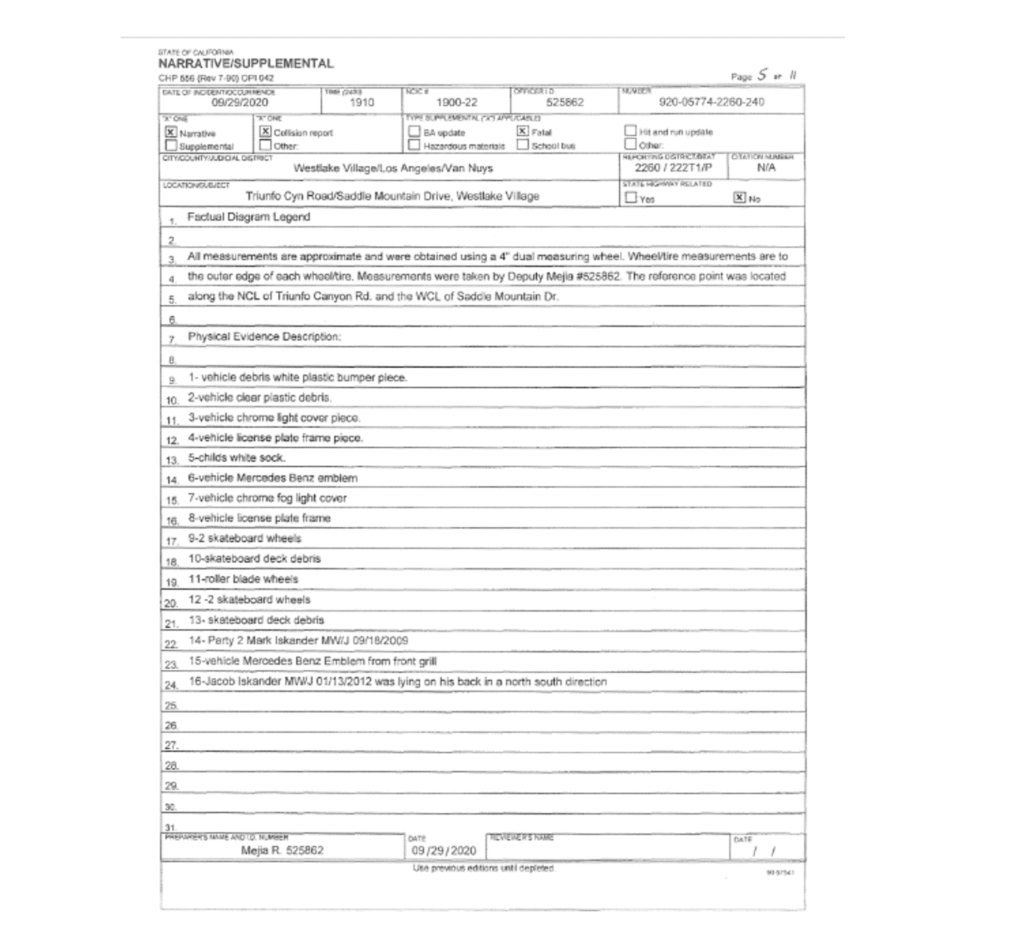
    Debris from the accident listed on the Supplemental Report written by Deputy Rafael Mejia. Items #7 and #8 are consistent with Erickson’s Mercedes SUV and subsequently went “missing” after logged into evidence.

    Even more disturbing than what was logged is what was never done.

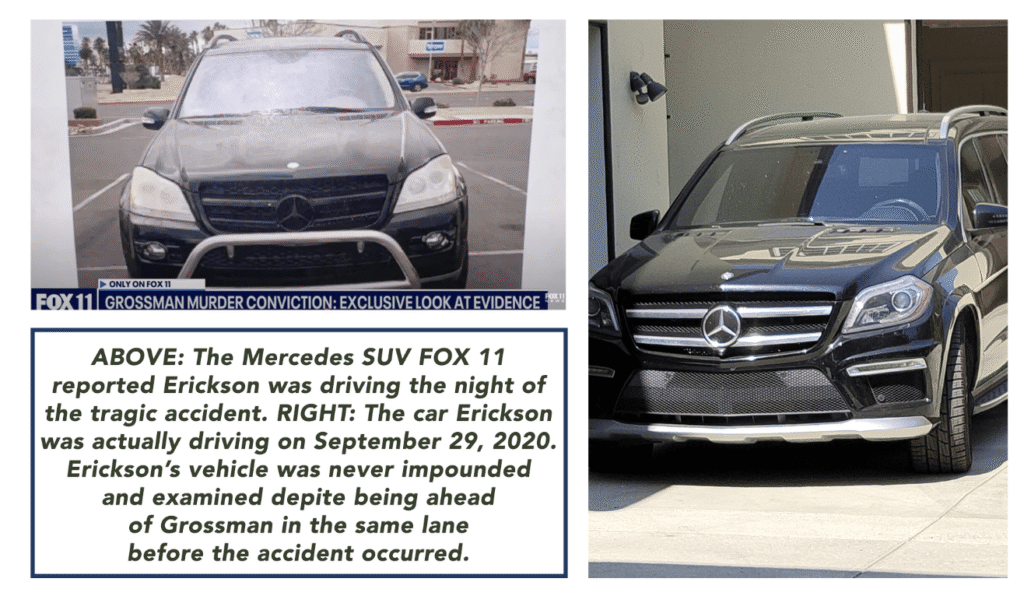
    Erickson’s vehicle, the vehicle that matters most if you care about truth, was never impounded. It was never forensically examined. No documented inspection. No collision reconstruction tied to his front end. No photographed damage analysis. No measurement of height-to-impact alignment. No forensic testing for paint transfer or biological material. No serious effort to preserve the one piece of physical evidence that could confirm or obliterate the second vehicle theory.

    The lead SUV was treated like it was exempt from investigation, as if the entire justice system silently agreed it was better not to know.

    The sworn testimony later reflected that reality. Detective Huelsen acknowledged that neither he nor anyone else examined or impounded Erickson’s SUV. Officers supposedly went to Grossman’s home looking for Erickson’s vehicle, yet no credible record exists of the vehicle being secured, photographed, or inspected. That failure does not read as oversight. It reads as deliberate omission, because no investigator in a fatal child collision forgets to examine the lead vehicle unless they have decided the lead vehicle cannot become a problem.

    Erickson’s own behavior that night makes it even harder to believe he was treated as irrelevant by accident.

    He did not stop at the scene. He kept driving. Later he returned and lingered near the crash site, blending into the crowd while deputies worked the aftermath, yet he did not identify himself as the driver who had been directly ahead of the defendant. He did not make himself available for scrutiny. He did not step forward and demand to give a statement. He did what people do when they are trying to manage exposure. He observed. He controlled. He disappeared.

    Then comes the most damning detail, the kind that makes an investigator’s spine tighten because it sounds like the language of concealment, not innocence. Erickson allegedly interacted with Grossman’s daughter near the scene and asked, “Why did she stop?” followed by a chilling directive: “You never saw me here.” Those are not the words of a man with nothing to hide. Those are the words of a man attempting to erase his presence while a crime scene is still hot.

    And while the public was expected to believe he was merely a companion who happened to be nearby, Erickson’s next move was not what innocent witnesses do. He met with high-profile defense attorney Frankie Longo the very night of the crash. Most people do not consult counsel within hours of a collision involving dead children unless they believe they are at legal risk. It signals fear. It signals liability. It signals a consciousness that the truth, if pursued honestly, would be dangerous.

    The vehicle issue grows even darker when you account for the two-SUV discrepancy. Erickson owned two black Mercedes SUVs, including a 2007 ML450 with a front metal bumper guard and a 2016 GLC63 AMG. Erickson reportedly represented to authorities that he was driving one vehicle that night, while later reporting indicates he was actually driving the other. If he lied about which SUV he drove, then the reason is obvious. He wanted to steer investigators away from a vehicle that could contain evidence.

    In a legitimate investigation, that discrepancy alone would trigger immediate impound and inspection of both vehicles, with paint transfer tests, front-end damage analysis, and full photographic documentation. That did not happen. The system allowed Erickson to control what the record became, instead of forcing the record to control him.

    Other pieces of the timeline deepen the suspicion. Erickson reportedly contacted Royce Clayton after the crash, telling him what happened and warning him not to come to Grossman’s home. Clayton’s involvement matters because he had been with Grossman and Erickson earlier in the evening at Julio’s restaurant before separating from them. The night was not a mystery. The drinking and movement of the group could have been mapped, verified, timed, and tested. But what emerged instead is a sense that the only goal was to lock onto Grossman and make the second driver disappear from meaningful forensic attention.

    Then comes the surveillance evidence disaster, a detail that makes this case look less like procedural failure and more like evidentiary sabotage. Sergeants Scott Shean and Travis Kelly reviewed surveillance footage from local sources the day after the crash, footage that allegedly captured multiple vehicles and reinforced the existence of the high-speed convoy. Instead of properly seizing, preserving, and cataloging the footage, it was recorded on personal cell phones. The original files were not adequately protected and were ultimately lost. This isn’t a minor technical lapse. When the timeline and vehicle sequence are the core truth of the case, mishandling surveillance is not a paperwork issue. It is the destruction of objectivity.

    The next 48 hours became the point of no return.

    The most critical window in any fatal collision investigation is the first two days. That is when vehicles still have unaltered evidence. That is when damage patterns are fresh and measurable. That is when debris fields still tell the truth. That is when you secure the physical facts before narratives calcify.

    But instead of doing that, the investigation hardened into a conclusion before evidence could challenge it.

    According to reporting, Scott Butler, a retired LASD detective and cousin to Royce Clayton, pressed the department to follow up on Erickson and Clayton. Clayton reportedly confirmed Erickson’s involvement and explained that Erickson was ahead of Grossman, that he returned to the scene after parking his car at Grossman’s home, and that he was part of the lead position in that convoy. Butler believed this should have triggered immediate action.

    Instead, once Sergeant Scott Shean took over as lead investigator, Erickson’s role was dismissed without the level of examination that would have been mandatory if the goal had been truth rather than conviction. The second driver was functionally written out early, before the evidence could prove too much.

    From there, the case became controlled.

    Erickson was ultimately charged with misdemeanor reckless driving, then allowed to resolve it through diversion, a quiet off-ramp that effectively erased accountability. Meanwhile, Grossman faced the full weight of second-degree murder prosecution. That contrast does not just feel disproportionate. It feels strategic.

    Because reckless driving isn’t the point. The point is leverage.

    If Erickson’s SUV was the first impact, or if his driving behavior materially contributed to the sequence that killed those children, then his legal exposure could have been enormous. And enormous exposure creates bargaining power. Bargaining power creates silence. Silence creates a clean narrative for prosecution.

    It is impossible to look at the deal and not question whether it was designed to close the door on deeper inquiry. It is impossible to look at diversion and not wonder what prosecutors were protecting, what they were trading, and what they were afraid a full investigation would reveal.

    This is where the personal history matters, not as gossip, but as context for credibility and behavior. Multiple sources have confirmed that Erickson comes from a family with a history of alcoholism, specifically involving his father and brother. That family dynamic is relevant because addiction patterns tend to echo through behavioral systems: secrecy, denial, minimization, and control. Those traits become particularly visible in crisis moments when accountability is on the line. Erickson’s conduct after the collision, from the alleged “you never saw me here” line to the immediate lawyer meeting, reads like the posture of someone reflexively managing exposure. The family history does not prove guilt. It speaks to the kind of psychological environment that can normalize concealment and the strategic avoidance of consequence.

    Even without that context, the conduct stands on its own.

    He didn’t stop. He returned without identifying himself. He allegedly urged silence. He allegedly lied about which vehicle he drove. He met with defense counsel immediately. His vehicle was never impounded. Evidence that didn’t match Grossman disappeared. Surveillance footage was mishandled and lost. The investigation narrowed instead of expanding. A diversion deal sealed the containment.

    Then the media played its role. Rather than interrogating the second vehicle theory with the seriousness it demanded, much of the coverage mocked it as desperate, as if raising a legitimate alternate causation chain in a double-impact child fatality case is somehow offensive. Grossman’s claim that she never saw the boys because the lead SUV blocked her view in the dark was treated like a flimsy excuse instead of an evidentiary question that should have been tested through reconstruction, visibility analysis, and honest sequencing.

    The system did not test the truth.

    It defended a conclusion.

    The Scott Erickson problem is that he never goes away. No matter how aggressively the narrative tries to bury him, the timeline keeps pulling him back up. The evidence log keeps pulling him back up. The missing evidence keeps pulling him back up. The surveillance mishandling keeps pulling him back up. The witness statements keep pulling him back up.

    If the Grossman case is ever fully reopened in the court of public opinion or civil litigation, it won’t be because of theatrics or social media or outrage. It will be because the facts will no longer tolerate their own suppression.

    A controlled prosecution depends on one thing: keeping the most dangerous alternative explanation off the table long enough for a verdict to harden into “truth.”

    Scott Erickson is the alternative explanation.

    And the case record reflects a justice system that treated that fact not as something to investigate, but as something to contain.

    DISCLAIMER: Investigative reporting in high-profile litigation cases published by The Current Report is non-commercial, fact-based journalism; any project fees compensate research and reporting labor only, sources participate solely in accuracy verification, and final publication is approved exclusively by The Current Report after fact-checking is confirmed.

  • “Slow Your Roll”: How Sheriff Robert Luna and the LASD are Manufacturing the Illusion of Falling Crime Rates

    “Slow Your Roll”: How Sheriff Robert Luna and the LASD are Manufacturing the Illusion of Falling Crime Rates

    “Crime is down.”

    That was the message Sheriff Robert Luna delivered to the Civilian Oversight Commission on January 22nd, 2025, wrapped in percentages, charts, and carefully framed statistics meant to reassure a public growing increasingly uneasy. According to Luna, Part 1 crimes have dropped by double digits, deputy-involved shootings are down more than forty percent, and new policies, training programs, and less-lethal tools are ushering in a safer era of policing in Los Angeles County.

    But behind the talking points, a very different directive is being quietly delivered inside sheriff’s stations across the county, one phrase repeated often enough to become operational doctrine: “Slow your roll.”

    That instruction has nothing to do with crime suddenly disappearing. It has everything to do with how crime is recorded, enforced, and ultimately presented to the public.

    This week alone, as county officials touted declining crime rates, a new string of armed robberies ripped through The Commons at Calabasas and Westlake Village, areas long marketed as insulated from exactly this kind of violence. Shoppers were confronted at gunpoint in broad daylight, property was stolen, suspects fled, and no arrests were made. These were not isolated incidents. They were coordinated, bold, and carried out with the kind of confidence that comes when criminals know enforcement is thin and consequences are unlikely.

    Yet residents were told “crime is down”.

    Inside the Los Angeles County Sheriff’s Department, deputies tell a story that explains how both things can be true on paper, and completely false in reality.

    According to multiple internal sources, deputies are being discouraged from proactive policing. Self-initiated stops are frowned upon. License plate reader hits are scrutinized. Looking for stolen vehicles, burglary crews, or suspicious activity is increasingly treated as a liability, not a duty. The safest course of action, deputies are told implicitly and sometimes explicitly, is to sit back, respond only when dispatched, and avoid generating activity that could later become an administrative problem.


    This is what “Slow your roll” actually means.

    When deputies slow down, crime statistics do too, not because crime is decreasing, but because fewer crimes are being interrupted, fewer arrests are being made, and fewer incidents are formally documented. Hard realities like 911 calls, burglaries, auto thefts, and armed robberies do not magically vanish. What disappears is enforcement.

    Sheriff Luna’s claim of a dramatic reduction in deputy-involved shootings follows the same pattern. The department credits new Tasers, crisis teams, de-escalation training, and revised use-of-force policies. But internally, deputies describe a simpler explanation: fewer proactive encounters produce fewer confrontations. If deputies are discouraged from engaging, there will naturally be fewer pursuits, fewer stops, fewer arrests, and fewer uses of force. That may look like reform from a podium, but on the street it looks like disengagement.

    This is not a theoretical debate. In areas like Malibu, Calabasas, and Westlake Village, proactive policing has historically been the difference between opportunistic criminals passing through and organized crews setting up shop. When that proactivity is stripped away, crime does not retreat, it reorganizes. It becomes more confident. More visible. More dangerous.

    Residents are noticing. They are changing their routines, warning each other online, and questioning why armed robberies are happening in places that once felt safe while officials insist everything is improving. The disconnect is not subtle. It is structural.

    The illusion of falling crime is further compounded by who is no longer reporting it at all. Undocumented residents, increasingly fearful that any contact with law enforcement could trigger immigration consequences despite public assurances to the contrary, are choosing silence over risk, leaving entire categories of crime unreported.

    At the same time, major retail chains, under direct orders from corporate headquarters, are quietly discouraging store-level crime reporting, prioritizing brand protection, insurance thresholds, and quarterly optics over accurate crime data. Theft, robberies, and repeat offenders are being logged internally, if at all, while police reports are avoided unless losses cross arbitrary financial lines. When victims are disincentivized, retailers are muzzled, and deputies are told to “slow their roll,” the resulting crime statistics do not reflect safer communities, they reflect a system designed to undercount crime by construction.

    What the public is being sold is a narrative of reform and restraint. What deputies are living under is a culture of risk aversion, administrative fear, and leadership that prioritizes clean statistics over public safety. Arrests are down countywide, not because crime has dropped, but because deputies no longer trust command staff to support them when enforcement leads to scrutiny, discipline, or political fallout.

    This is how a department can stand before an oversight commission and declare success while criminals walk away unchallenged from gunpoint robberies in upscale shopping centers.

    Crime isn’t down. Enforcement is.

    And when leadership tells deputies to “slow their roll,” the only thing that accelerates is the gap between what the public is told and what they are actually experiencing. Los Angeles County is being governed by optics, not outcomes — and the cost of that deception is being paid in fear, vulnerability, and eroding trust.

    Because when safety becomes a numbers game, truth is the first casualty.

  • LASD Internal Affairs Investigators Accused of Perjury and Obstruction of Justice in Botched Prosecution of East LA Deputies

    LASD Internal Affairs Investigators Accused of Perjury and Obstruction of Justice in Botched Prosecution of East LA Deputies

    On the eighth floor of the Hall of Justice, where LASD executives are supposed to police the department with integrity and justice has exposed a disturbing portrait of corruption, abuse of authority, and a system willing to destroy its own to protect the people in power.

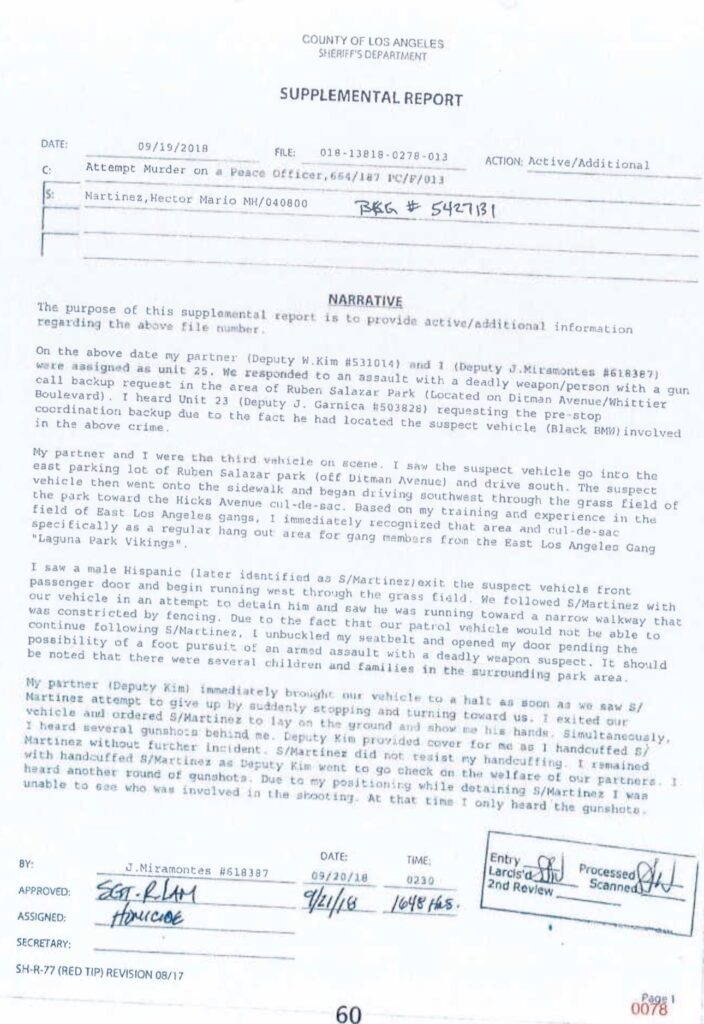
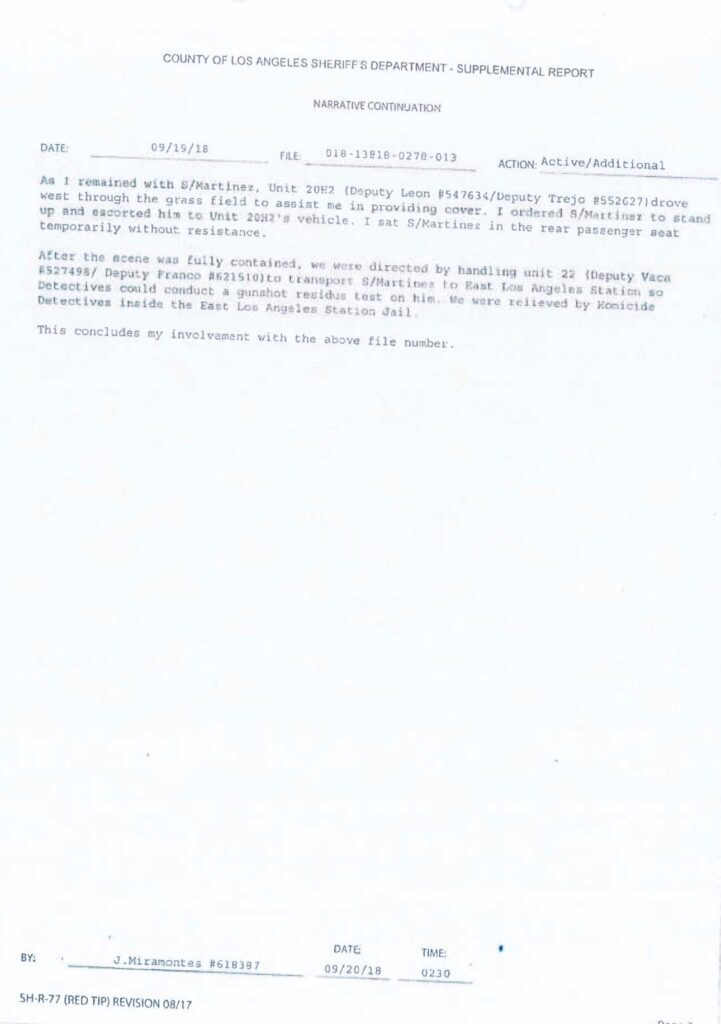
    On September 19, 2018, two dedicated deputies from the East Los Angeles station, Woodrow Woo-Kyung Kim and Jonathan Miramontes, were working in a two-man unit in the unincorporated area of East Los Angeles.  Years later, they had their lives upended by a politically motivated witch hunt that culminated in a sham trial based on fabricated evidence and outright lies under oath. Despite being acquitted by a jury in less than a day of deliberations in November 2025, the damage was done, careers stalled, reputations smeared, and families shattered, all because Internal Affairs investigator Amber Mullings allegedly perjured herself to push a false narrative.

    This case stems from a high-stakes pursuit on September 19, 2018, when Deputies Kim and Miramontes responded to an assault with a deadly weapon call involving suspects in a black BMW who had threatened a motorist with a gun. The chase ended in Ruben Salazar Park, where a passenger, Hector Mario Martinez, a known gang member, fled on foot. Surveillance video captured the moment Kim’s patrol car door made contact with Martinez, knocking him down, a split-second event in a chaotic scene filled with children and families nearby, not to mention a shootout that left two suspects dead and three law enforcement personnel injured. Two deputies were shot as a result of the deputy-involved shooting.

    The deputies’ supplemental reports detailed the incident, but prosecutors under George Gascón, a district attorney infamous for his anti-law enforcement agenda, claimed they omitted key details to cover up an “assault.” Kim was charged with assault under color of authority and filing a false report; Miramontes with the latter. The case was dismissed in 2022 for insufficient evidence, only to be reinstated by an appeals court in 2024. But the real scandal isn’t the charges, it’s the perjury that fueled the prosecution.

    Screenshot
    Screenshot

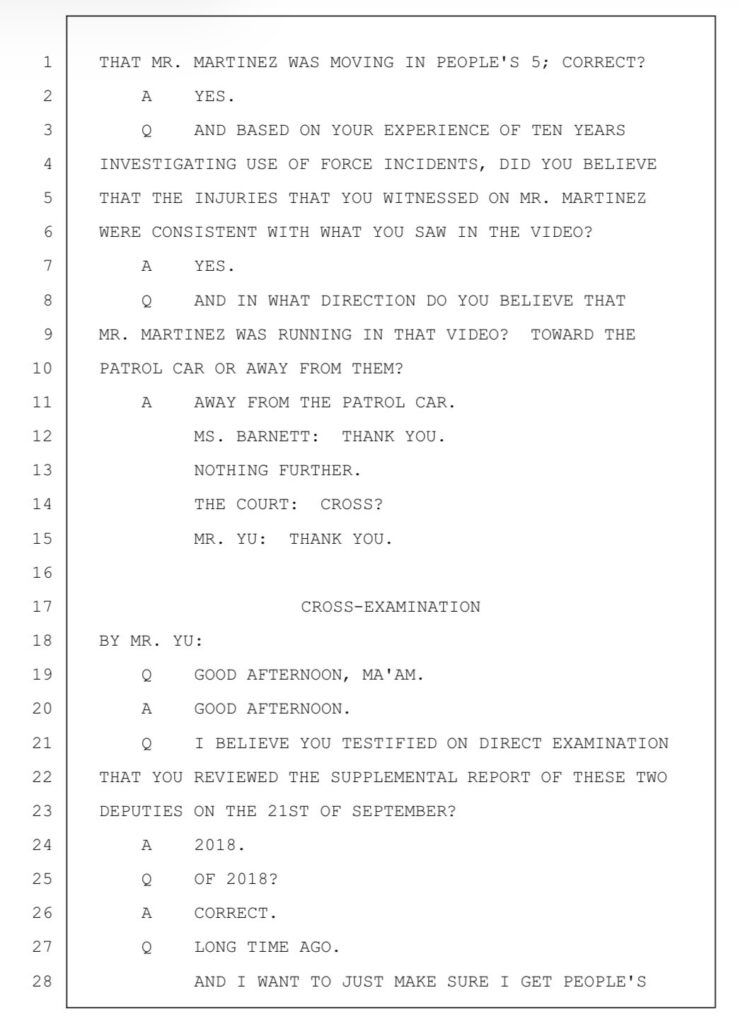
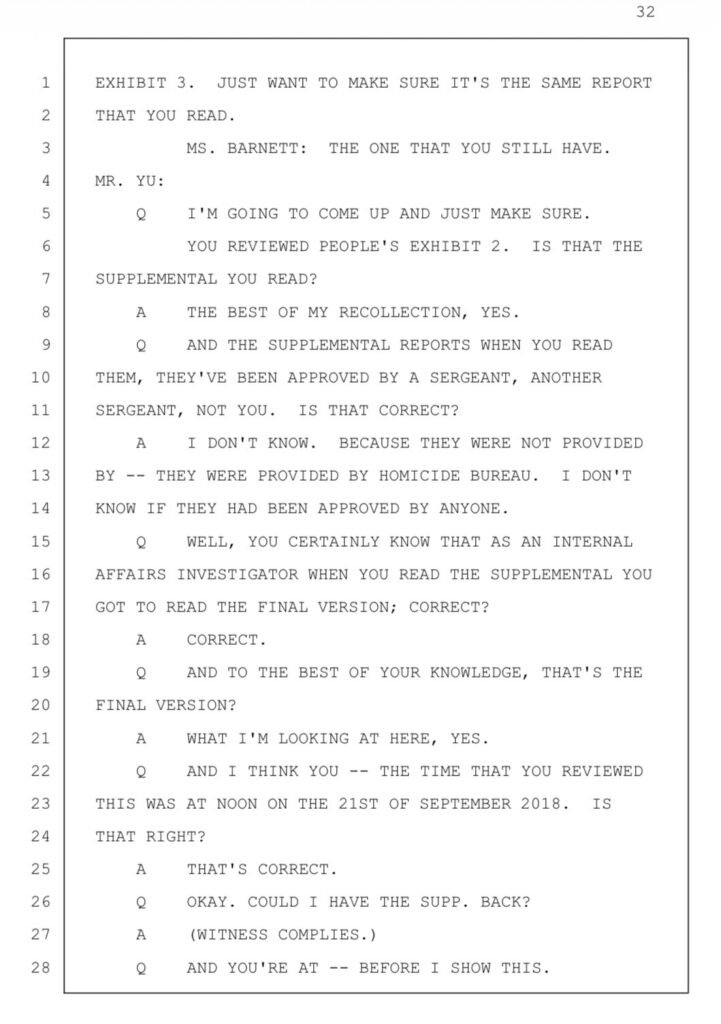
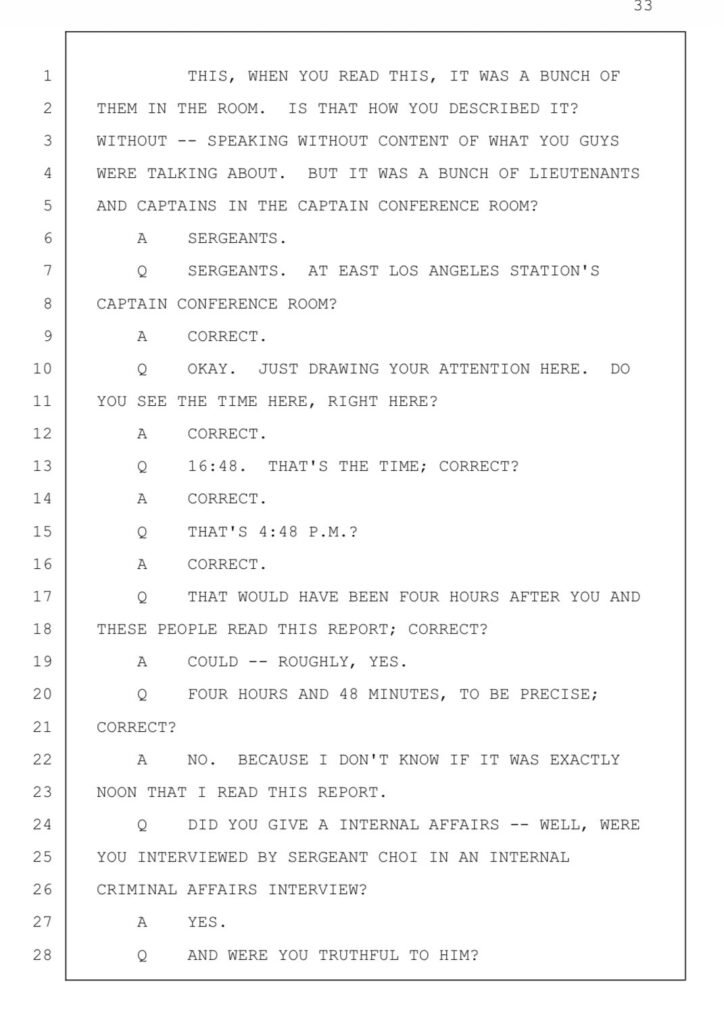
    Enter Lt. Amber Mullings, then a sergeant with Internal Affairs Bureau (IAB), and her partner, Sgt. Calvin Mah. Mah did not testify in the trial he was promoted to captain of the Major Crimes Bureau. During the trial, Mullings testified under oath that she reviewed the deputies’ supplemental reports around noon on September 21, 2018, in a meeting with other sergeants at the East L.A. station. She claimed this review revealed inconsistencies that pointed to a cover-up.  Lt. Mullings told the jury that she believed at that very moment the two deputies had lied in their reports.  But here’s the smoking gun: the report in question from Deputy Miramontes, which was labeled as People’s Exhibit 2, wasn’t approved and signed off until 4:48 p.m. that day, a full four hours and 48 minutes later. How could Mullings have reviewed a “final” version that didn’t exist yet? This isn’t a minor slip; it’s a blatant lie, sworn before a jury, that undermines the entire case.

    Defense attorney Tom Yu, representing Miramontes, hammered this point during cross-examination: “You’re telling this jury on your sworn testimony that you read this supp. at about noon hours when it was signed off at 4:48 p.m.? That’s your sworn testimony to this jury?” Mullings doubled down, insisting she wasn’t mistaken. Yet, the timestamp on the report, dated 09/20/18 and approved at 16:48, tells a different story. This perjury wasn’t isolated; it was part of a pattern to railroad two innocent deputies.


    Then there’s Calvin Mah, now a captain at the Major Crimes Bureau. Mullings testified that Mah took photographs of Martinez’s injuries, critical evidence in a use-of-force case, shortly after the incident. But those pictures? Mysteriously “lost.” When pressed by internal investigators later, Mullings admitted she couldn’t find them and made no formal report about the loss. She didn’t notify her chain of command or document the disappearance of evidence that could have exonerated the deputies by showing the injuries were consistent with an accidental collision, not intentional assault. In a department that prides itself on transparency, losing key photos without consequence reeks of a cover-up within the cover-up investigation.

    These lies didn’t just taint the trial; they devastated lives. Deputies Kim and Miramontes were relieved of duty, stripped of their peace officer powers, and dragged through years of legal hell. Their families endured financial strain, emotional turmoil, and public humiliation, all while Mullings and Mah climbed the ranks. Kim, a veteran deputy, and Miramontes, his partner, were painted as rogue cops in a narrative pushed by progressive prosecutors and internal investigators eager to score points in the post-George Floyd era. Even though the jury saw through the charade and acquitted them swiftly, the process was the punishment. Careers derailed, trust eroded, and the badge they wore with pride forever tarnished.

    Worse still, under Sheriff Robert Luna, whose administration has been criticized for prioritizing politics over policing, Mullings has been reinstated to Internal Affairs Bureau as a lieutenant, where she continues investigating her fellow deputies. Mah, meanwhile, now oversees major crimes investigations. So while Kim and Miramontes were dragged through years of professional and personal ruin, the people accused of lying under oath and mishandling evidence quietly climbed the ladder. If that doesn’t make your stomach turn, it should. This isn’t justice. It’s a betrayal of the thin blue line.

    That’s exactly why attorney Tom Yu isn’t taking this one lying down. Yu has already watched this political machine in action. He’s been fighting for former Deputy Trevor Kirk, who was wrongfully charged with civil rights abuse and turned into a convenient sacrificial lamb when Luna started taking heat from activists. Kirk used the lowest level of force to detain a robbery suspect, in accordance with department protocol, yet the optics demanded blood, and the department was more than willing to offer up a deputy’s career to satisfy the mob.

    A full, independent investigation into Mullings perjury should be mandatory. Sheriff Luna must relieve them of duty pending review, no more promotions for those who twist the truth to destroy good deputies. The East L.A. station, already plagued by scandals, can’t afford more internal rot. Deputies Kim and Miramontes deserve vindication, not just an acquittal, but a public apology and reinstatement. Allowing Mullings to continue unchecked sends a chilling message: lie under oath, climb the ladder, and ruin lives without consequence.

    In a county overrun by crime, we need law enforcement we can trust, not a system where investigators become the real criminals. The question is whether Luna will confront this head-on, or allow it to become just another cover-up in a long line of failures.

    The truth demands action, and the badge demands better.

  • “Crime is Down” Say LA County Officials – New String of Armed Robberies Rattles Calabasas Commons and Westlake Village

    “Crime is Down” Say LA County Officials – New String of Armed Robberies Rattles Calabasas Commons and Westlake Village

    Calabasas is used to be a safe bubble. The Kardashian utopia where the biggest threat was Santa Ana winds, not a man walking up to a woman in the middle of a shopping center, pulling a semi-automatic handgun, and demanding her designer handbag.

    But that’s exactly what independent news platform Royol News posted on Instagram reporting an incident Tuesday night in what is quickly looking like a string of armed robberies stretching from Calabasas Commons to Westlake Village, a pattern that’s becoming harder to dismiss as “isolated incidents”.

    According to the report, the first robbery occurred at approximately 7:39 p.m. at the Calabasas Commons shopping center. A woman in her 40s was approached by a male suspect who allegedly pointed a black semi-automatic handgun at her and demanded her designer handbag, a Louis Vuitton purse then fled on foot through the parking lot heading westbound.

    The Los Angeles County Sheriff’s Department describes the suspect as a Black male wearing all black clothing with long dreadlocks. Deputies from the Lost Hills Station responded quickly, searched the area, and still couldn’t locate the suspect.

    The report notes similarities to a previous armed robbery that occurred on January 13, when another female victim was robbed of a designer handbag at gunpoint in the same general area. Deputies reportedly apprehended the suspect on foot near the intersection of Calabasas Road and Valley Circle Boulevard. Which raises the obvious question: if this crime has happened before, in the same area, targeting the same type of victim, for the same type of item, what exactly has changed since January 13 besides the suspect’s confidence?

    Then, roughly an hour later at approximately 9:00 p.m., an attempted armed robbery was reported at the TJ Maxx near Thousand Oaks Boulevard and Lindero Canyon Road in Westlake Village. Another woman, another confrontation, another Black male suspect, this one wearing a mask, black clothing, and a beige hoodie, who allegedly attempted to rob her at gunpoint.

    This time, the victim fought back in the only way she safely could. She began honking her car horn, creating noise, drawing attention, breaking the spell criminals rely on: quiet compliance. It worked. The suspect fled, entered a white sedan, and was last seen traveling on Thousand Oaks Boulevard. No injuries were reported.

    LASD says it is unclear at this time if the cases are related. That line is supposed to be measured. Responsible. Neutral. But in reality, it reads like a reflexive attempt to soften the implications. Two incidents in one night, in neighboring areas, involving a gun, targeting women, occurring in retail environments, with overlapping suspect descriptions. At what point does “unclear” stop being cautious and start becoming denial?

    Because whether LASD wants to connect the dots publicly or not, residents are already doing it privately. They’re watching a pattern form in real time. Not just a crime problem, an audacity problem. A predator operating with enough confidence to strike in upscale shopping centers, then strike again within the hour, then slip away without consequence.

    This is how crime metastasizes into normalcy. Not through one sensational headline, but through repetition. Through the slow conditioning of the public to accept armed robbery as just another Tuesday night update, another Instagram post, another “suspect not located.”

    And if you live in Calabasas or Westlake Village, the most chilling part isn’t what happened, it’s what it suggests. That whoever is doing this believes he can keep doing it. That the environment is permissive. That the odds of getting away clean are still high enough to justify pulling a gun for a handbag.

    In Los Angeles County, that’s not paranoia. That’s pattern recognition.

  • LA City Law Enforcement Will Be Virtually Non-Existent by the Olympics: Why LAPD is Experiencing a Drastic Staffing Decline

    LA City Law Enforcement Will Be Virtually Non-Existent by the Olympics: Why LAPD is Experiencing a Drastic Staffing Decline

    Los Angeles loves a shiny narrative. We are the global capital of reinvention, the city that can host the world, solve anything with a branding campaign, and produce an inspirational montage out of literal dysfunction. But behind the official messaging and carefully staged press conferences, LAPD is bracing for something far less cinematic and far more humiliating: a staffing and financial collapse that is already reshaping day-to-day policing.

    Because while the city is busy polishing its Olympic halo, the department is quietly being managed like a business in pre-bankruptcy triage. This is no longer a “staffing challenge” or a “budget adjustment.” It is a historic crisis. A slow-motion breakdown that can’t be fixed with slogans, task forces, or another round of “community engagement.”

    And the numbers now being discussed internally should stop every resident in their tracks.

    LAPD is sitting two and a half years out from the Olympics and has already fallen off a cliff. The department is down more than 1,500 sworn officers. It is down more than 500 civilian professional staff. And even with that freefall, they are only authorized today for roughly 240 hires through the fiscal year ending June 2026, while still projected to lose 750 or more officers in that same time frame. That is not a staffing gap. That is an arterial bleed.

    This is why insiders are using the phrase no city leader dares to say publicly: LAPD is bleeding out.

    And it’s happening at the exact moment Los Angeles is trying to sell itself to the world as a safe, stable, global host city ready for prime time.

    The warning coming through the ranks is blunt: cash overtime is projected to dry up in the next six weeks. Not tighten. Not reduce. Dry up. After that, the only overtime expected to remain is tied largely to MTA-funded assignments, meaning the ability to staff beyond bare minimum becomes dependent on transit dollars rather than public safety needs.

    Overtime isn’t just extra pay in modern policing. It’s the glue holding a shrinking workforce together. It’s the pressure valve that keeps patrol coverage from snapping when staffing falls below operational reality. When overtime disappears, the city doesn’t just lose money. It loses capacity. It loses speed. It loses margin. And margin is the only thing separating “messy” from catastrophic.

    Predictably, divisions are already restricting overtime and monitoring who is allowed to earn it. The ripple effects are not theoretical. They are showing up in the places the public never thinks about until it matters. Reports get held. Property booking gets delayed. Basic case work slows down. The city doesn’t announce a policing slowdown. It engineers one. It quietly starves the department of overtime and lets reality do the dirty work.

    But this overtime cliff isn’t occurring in a vacuum. It’s landing on a department already collapsing under the weight of long-term staffing erosion. LAPD’s decline is being driven by the kind of dysfunction that can’t be solved with recruitment posters and a PR campaign.

    Recruitment has slowed dramatically. The applicant pool has shrunk. Attrition has accelerated. Officers are leaving faster than they can be replaced, and the reasons are not mysterious. They are structural, cultural, political, and economic.

    The emotional toll of policing in Los Angeles has become unbearable for many. Civil unrest didn’t just strain the department, it redefined it. Officers have operated for years in a pressure-cooker environment where scrutiny is relentless, every encounter is potentially career-ending, and leadership too often feels more concerned with optics than defense of the people doing the job. Add the city’s progressive political elite, who have spent years flirting with anti-law enforcement rhetoric as if it were a fashionable identity, and the result is predictable: morale collapses.

    That morale problem is not conjecture. It has been openly acknowledged by former command staff who lived it. Former LAPD Assistant Chief Al Labrada put it plainly: “New growth requires new soil. It is essential to dismantle and update outdated policies and move beyond past leadership mistakes to restore the morale of our frontline. If our own people wouldn’t recruit for us, it indicates that we have not yet addressed the underlying issues.” In one quote, Labrada exposes the uncomfortable truth: the recruitment crisis is not simply external. It’s internal. When a department’s own people don’t encourage others to join, the problem isn’t the applicants. The problem is the institution.

    At the same time, Los Angeles is one of the most expensive places in America to live, and the math is no longer working. Officers can stay in LA, absorb the chaos, pay the premium, and get treated like a villain. Or they can lateral out to smaller agencies, earn comparable pay or better, buy a home, and work in communities that don’t treat them like a political punching bag. LAPD is no longer the dream agency. In many cases, it’s the agency people leave.

    Then there is the department’s own internal self-sabotage. Hiring is notoriously slow. The process drags. Applicants lose momentum. Background timelines become absurd. People move on. And when the city holds candidates in limbo without enough academy classes to bring them in, you don’t just slow recruitment. You kill it.

    Because the longer recruits sit in the pipeline waiting for a class, the more likely they are to drop out, have second thoughts, accept another offer, or simply time out. Some of their test components expire. Their lives change. Their patience runs out. And that is not hypothetical. It is baked into the reality of Los Angeles City personnel, which insiders describe as one of the slowest hiring processes in the system, averaging nine to twelve months for an entry-level recruit.

    A year. Just to get in the door.

    That’s not recruitment. It’s bureaucratic birth control.

    Now, here’s where the optics machine kicks in.

    LAPD currently has six academy classes running, averaging about thirty recruits per class. The January class reportedly started with thirty-four. That sounds healthy on paper, until you realize the department is losing hundreds of experienced personnel annually and is two and a half years away from the largest international event Los Angeles will host in modern history. Thirty-person classes are a drip feed. They are not a solution.

    And with a recent City Council vote, LAPD is now on track for only two new academy classes this fiscal year. Two. That’s not a staffing plan. That’s a press release with a pulse. It is the bare minimum required to say “we’re hiring” while the department’s actual manpower continues to collapse.

    If LAPD wants additional classes beyond that, it will have to go back to City Council and request additional funding. In other words, the city is rationing academy classes the way you ration supplies in a failing hospital, then acting confused when the patient flatlines.

    And while the city stalls, the private sector is already moving in. This is the part no one in government wants discussed because it’s a quiet admission of failure: because of the staffing shortage, cities are increasingly turning to private security companies to fill gaps LAPD can’t. That’s what happens when a department loses critical mass. Public safety becomes outsourced, uneven, and dependent on who can pay. Residents get police “lite,” while institutions, businesses, and municipalities start buying their own backup plan.

    That is not law enforcement. That is societal triage.

    As if that weren’t enough, the financial squeeze is now spreading into every corner of the department.

    Subpoena control officers and detectives are now being instructed to coordinate with DAs to determine which officers are truly needed for court appearances, with the goal of eliminating overtime exposure. That means limiting subpoenas for transporting officers. That means not automatically calling both officers involved in searches. It turns court staffing into a cost-cutting negotiation.

    This is what it looks like when a city starts rationing justice.

    Inside the department, restructuring is no longer being discussed like an option. It’s being discussed like a coming reality. Divisions may be forced to merge investigative tables, combining units like MAC/CAPs and folding Autos and Burg into broader “Property Crimes.” Officially, this will be described as efficiency. In reality, it is financial triage. It is elimination of table head payroll. It is reducing supervisory capacity and loading more work onto fewer people.

    Even more explosive is the discussion of consolidating divisions entirely, with combinations like Wilshire and Olympic, Mission and Devonshire reportedly being floated. Leadership wants to avoid it, not necessarily because it’s operationally disastrous, but because of how it would look ahead of the Olympics.

    Again, not because communities will feel it. Not because response times will suffer. Because it looks bad.

    That tells you everything about the city’s priorities.

    This is a city preparing a global spotlight moment while its police department is disintegrating behind the curtain.

    And let’s be clear: this disintegration will not stay invisible much longer.

    When staffing drops low enough, you don’t just get “slower response times.” You get unfilled patrol cars. You get fewer proactive units. You get investigations shelved. You get follow-ups dropped. You get entire categories of calls treated like background noise. You get a city where public safety becomes situational and unequal.

    Insiders now believe LAPD will be in the 7,000s in the not-so-distant future. No question. And at that point, the department is no longer struggling. It is failing.

    That is what “bleeding out” looks like.

    Los Angeles can either confront this truth now or continue to hide behind Olympic branding and political spin until the collapse becomes too obvious to ignore. But the math isn’t going to change because City Hall doesn’t like it.

    Two and a half years out from the Olympics, LAPD is down more than 1,500 officers, down more than 500 civilian staff, facing a projected loss of 750 more, and authorized to hire only a fraction of what is needed. Overtime is drying up. Promotion pipelines are freezing. Hiring is glacial. And the city’s plan appears to be hope, optics, and rationed academy classes.

    The department is going to tank. There is no question about that.

    And when it does, Los Angeles won’t just be unprepared for the Olympics. It will be unprepared for itself.

  • Tunnel Vision or Misconduct? The Choices That Shaped the Rebecca Grossman Conviction

    Tunnel Vision or Misconduct? The Choices That Shaped the Rebecca Grossman Conviction

    Wrongful convictions are rarely the result of one dramatic lie told in open court. They are more often built quietly, early, and methodically, before a jury is ever seated.

    They begin in the investigative stage, where facts are supposed to be gathered, preserved, tested, and challenged. That is where truth is either protected or distorted. That is where justice either earns its credibility or loses it.

    The Rebecca Grossman investigation is a case study in distortion. By the time the public encountered it, the narrative felt settled, as if the evidence naturally led to one unavoidable conclusion. But the appearance of certainty did not come from a flawless evidentiary record. It came from an investigation shaped to eliminate contradiction, to reduce complexity, and to lock the case into a single theory before alternative explanations could survive.

    The name attached to the most consequential steering decisions is Detective Scott Shean.

    This was not merely a failure to investigate. It was an investigation structured in a way that made full investigation impossible after the fact. When that happens, the court doesn’t evaluate the truth. It inherits a record that has already been edited.

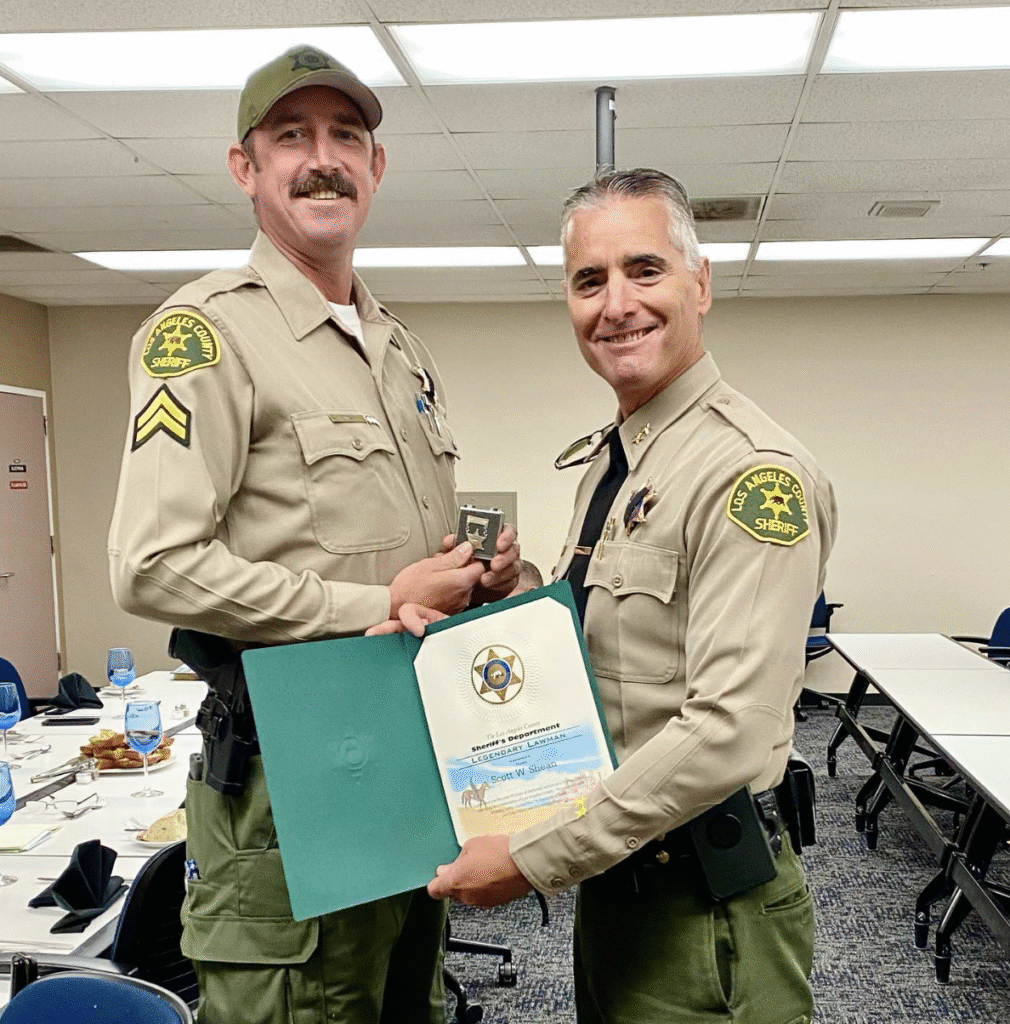
    Detective Shean, left, receiving the “Legendary Lawman” award from Chief Dennis Kneer in 2021. Kneer has since retired under a cloud of scrutiny for his overseeing multiple high profile incidents in the North Patrol Division which includes the Malibu/Lost Hills Station.

    The First 48 Hours: The Only Window That Matters

    In fatal collision cases, there is a narrow window where evidence still exists in its original form. Surveillance footage has not been overwritten. Vehicles have not been repaired. Witnesses have not been influenced by the media. Digital systems still contain intact data. A true investigator treats those first 48 hours like an emergency because the truth is perishable.

    That is why Shean’s involvement is so central. Because once he had authority over the investigation, the record shows something other than urgency toward truth. It shows an urgency toward closure. It shows a pattern where decisions consistently reduced the ability to later verify, test, and challenge the official storyline.

    Investigations that seek truth preserve evidence in its strongest state. Investigations that seek certainty preserve it in its weakest.

    The Surveillance Footage That Should Have Been Locked Down

    There is one decision in this case that should stop the conversation immediately for anyone still trying to claim this was a rigorous investigation.

    Instead of formally seizing and preserving the original surveillance footage, Shean recorded surveillance video on his personal iPhone, allowing the original source files to be erased. That is not a minor procedural slip. That is the functional destruction of objective evidence in a case where timing, sequence, lane positioning, and proximity are everything.

    Original video files contain metadata. They contain native timestamps. They maintain frame integrity. They can be examined by independent experts without the distortions created by cell phone recording, compression, angle choice, screen flicker, and human discretion. Once you reduce original video to a phone recording, the evidence no longer stands on its own. It becomes something filtered, something interpreted, something easier to argue about and harder to scientifically validate.

    And once the source files are erased, the strongest version of the truth is gone forever.

    If an investigator wanted to preserve the cleanest possible record, he would lock down the originals immediately. If an investigator wanted to preserve a narrative, he could not choose a better method than degrading the most objective evidence in the case.

    When “Recording” Evidence Becomes a Method of Controlling It

    There is a difference between capturing evidence and capturing an impression of evidence. In serious cases, investigators do not take pictures of screens and call it preservation. They do not rely on personal devices and convenience shortcuts. They extract, seize, and book the original files because evidence is only as credible as its integrity.

    By recording surveillance footage on a personal phone, Shean didn’t merely degrade quality. He controlled what became the surviving record. A cell phone recording makes choices for you. It picks angle. It distorts motion. It introduces blur. It limits what is visible at the edges. It makes time stamps harder to verify. It creates a weaker foundation that prosecutors can still use, but which defense experts can no longer fully reconstruct.

    That is not an accident. That is an outcome created by choice.

    In an investigation driven by truth, you preserve the strongest version of evidence. In an investigation driven by certainty, you preserve the weakest version that still supports your theory.

    Witnesses Reported Multiple Impacts, Yet the Investigation Stayed Single-Minded

    Multiple witnesses reported hearing separate impacts, distinct in time and sound. That is not a throwaway detail. That is not “noise.” That is evidence of sequence. It suggests a collision event that may not align with a simple one-impact, one-driver story.

    And here is where this investigation becomes indefensible: these weren’t vague impressions. These were consistent accounts, overlapping in key details, describing the same core sequence.

    Susan Manners could not describe the color of the vehicle involved, but she was clear about the most important part, she heard two distinct impacts. That matters because it supports the existence of two separate collision events, not one continuous blur.

    Yasamin Eftekhari testified to a second impact and stated that the black vehicle was directly in front of the white vehicle. Jake Sands described the black vehicle in front of the white vehicle in the far-right lane. The boys’ mother said the last thing she saw coming at her was a black vehicle.

    Even more damning, the video evidence does not contradict them. It reinforces them. The footage shows the black car directly in front of the white vehicle, not offset, not behind, not merely “in the area.” Directly in front.

    A competent investigator would treat this as urgent. It would trigger immediate follow-up. Witnesses would be revisited carefully and methodically. Timelines would be reconstructed. Their accounts would be mapped against physical evidence, damage patterns, debris distribution, and body positions. If multiple impacts occurred, the investigation would have to ask why and how.

    But Shean did not meaningfully pursue those witnesses who described separate impacts. He did not reconcile their testimony with the narrative he was already advancing. He did not treat their accounts as potentially clarifying evidence. He treated them as inconvenient variables.

    That is the behavior pattern of tunnel vision. It is what happens when an investigator stops investigating and starts managing contradiction.

    The Alternative Driver Question: Raised, Then Neutralized Through Inaction

    The most glaring red flag in this entire case is not what Shean did. It is what he refused to do.

    A credible investigation does not ignore alternative actors who are directly positioned in the sequence of events. In this case, there was a documented alternative driver directly in front of Grossman’s vehicle. A witness suggested investigators speak directly to him. That should have been pursued aggressively because that is what real investigations do. They test possibilities. They do not assume away inconvenient facts.

    But there is more.

    According to information that has circulated among those closely tracking the investigative record, Royce Clayton called in the very night of the collision identifying Scott Erickson as involved. A name was reportedly placed on the table while the scene was still fresh, while evidence still existed in its raw form, while vehicles were still where they were, before repairs, before storylines, before convenient forgetting.

    And yet, when Shean took over the investigation the next day, the record reflects something so reckless it borders on intentional: he did not treat Erickson as a meaningful investigative target requiring urgent elimination through forensic science. He did not conduct the kind of direct follow-up that serious cases demand. He did not confront him as a person of interest. He did not inspect the vehicle. He did not preserve the opportunity to test the most dangerous question in the case.

    Later attempts to frame Erickson merely as a “witness” are not credibility repairs. They are narrative protection.

    Failing to examine an alternative actor accomplishes one key thing: it prevents the record from ever proving the alternative mattered.

    A refusal to look is not the absence of evidence. It is the creation of ignorance. And ignorance becomes the prosecution’s shield.

    Evidence That Disappeared

    Then came the physical evidence logged at the scene that later went missing, reportedly inconsistent with Grossman’s vehicle. Evidence does not just vanish without consequence. When it disappears, the case becomes compromised, the chain of custody becomes suspect, and the integrity of the entire record is threatened.

    In an honest investigation, missing evidence triggers a crisis response. Investigators stop. They reassess. They reopen. They audit custody. They acknowledge that the record is now incomplete and potentially tainted.

    Shean did none of that.

    The question is not only who physically removed the evidence. The deeper question is who controlled the investigation at the time the evidence was vulnerable. Who had access. Who had authority. Who had the power to decide whether missing evidence would be treated as catastrophic or treated as irrelevant.

    Because the effect of missing evidence is always the same. It removes contradictions. It simplifies the narrative. It strengthens the chosen theory by eliminating what doesn’t fit.

    When evidence disappears and the investigator does not flinch, it is no longer an investigation. It is narrative preservation.

    Sources Point to a Larger Containment Effort

    And according to sources familiar with the broader ecosystem surrounding this case, the failure to treat Scott Erickson as a serious investigative target may not have existed in a vacuum.

    Those sources allege that former Major League Baseball player Rick Thurman, along with a well-known baseball agent Dennis Gilbert, have intimate knowledge of statements indicating Erickson privately acknowledged some level of responsibility connected to the crash. These same sources further allege that Thurman may have played a role in coordinating post-collision actions aimed at managing exposure, including assisting in the removal or disappearance of potentially critical evidence tied to the black vehicle.

    None of these claims have been adjudicated in court. They are allegations. But their existence matters for one reason: they align with what the investigative record already shows, which is that the alternative-driver question was not only raised, it was neutralized through inaction, and the evidence trail was allowed to degrade, vanish, or die before it could ever threaten the official storyline.

    If the justice system were healthy, the presence of such allegations would trigger immediate independent review. Instead, they exist in the same place where so many inconvenient truths end up, outside the courtroom, because the investigation never built a record capable of absorbing them.

    Tunnel Vision Isn’t a Psychological Mistake. It’s Professional Misconduct.

    Tunnel vision gets described as a natural human weakness. That framing is convenient because it removes accountability. It allows investigators to present steering behavior as mere cognitive error. But tunnel vision in law enforcement is conduct. It is the repeated professional choice to ignore alternatives, to minimize contradiction, and to maintain certainty even when the record demands doubt.

    Shean’s conduct fits that pattern precisely.

    He reduced original surveillance to a degraded phone recording and allowed source files to be erased. He failed to pursue witnesses describing multiple impacts and consistent vehicle positioning. He ignored direct suggestions to seriously investigate an alternative driver placed directly in the sequence. He did not forensically exclude that driver. He continued forward despite missing physical evidence that undermined the official narrative.

    Those are not oversights. Those are decisions.

    And those decisions built the case that prosecutors later presented as inevitable.

    The Conviction Was Set in Motion Before the Trial Ever Began

    Trials do not decide the truth if investigations do not preserve it.

    Once Shean made the key choices that limited evidence integrity, ignored alternative explanations, and allowed contradiction to be erased, the outcome was no longer a fair contest of competing theories. Prosecutors inherited a record already shaped for narrative clarity. Jurors inherited a record stripped of its most dangerous ambiguities. The public inherited a storyline that felt certain because the investigative process had already removed the messy parts.

    That is the mechanism of wrongful conviction. It isn’t always lies. Sometimes it’s far subtler. It’s a case built on omission and the destruction of doubt before doubt can be examined.

    Call It What It Is: Investigative Steering

    The most dangerous force in this case was not public outrage. It was investigative certainty.

    Scott Shean did not merely stop investigating. He structured the investigation so that alternative explanations could not survive and the record could not contradict him. That is how unsafe convictions are built. Not always through corruption that can be easily proven, but through decisions that turn the justice system into a narrative machine.

    If the system wants to stop wrongful convictions, it has to stop treating tunnel vision as a harmless human flaw. It has to treat it as what it is in practice: a professional failure that can kill the truth long before the courtroom ever has a chance to hear it.

    And until that standard is enforced, this case will not be the last.

    DISCLAIMER: Investigative reporting in high-profile litigation cases published by The Current Report is non-commercial, fact-based journalism; any project fees compensate research and reporting labor only, sources participate solely in accuracy verification, and final publication is approved exclusively by The Current Report after fact-checking is confirmed.
  • Deputies Express Outrage Online and in New Anonymous Just A Deputy letter: “I Will Not Enforce this Ordinance Against Federal Officers”

    Deputies Express Outrage Online and in New Anonymous Just A Deputy letter: “I Will Not Enforce this Ordinance Against Federal Officers”

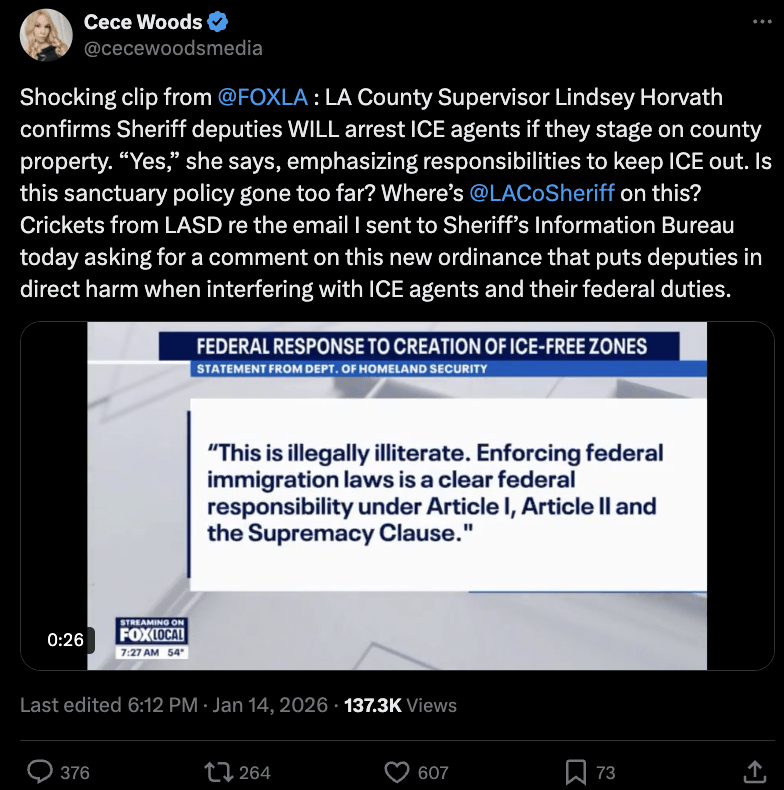
    Los Angeles County’s Board of Supervisors has now formally approved an ordinance aimed at establishing so-called “ICE-free zones” on county property, a move being sold as community protection but already teetering into dangerous political theater. The real alarm bell came when Supervisor Lindsey Horvath took that agenda to FOX LA, where she confirmed on-air that Sheriff’s deputies will arrest ICE agents if they stage operations on county property, a stunning admission that transforms this from symbolic sanctuary posturing into a direct conflict directive with federal law enforcement, with deputies left standing in the crossfire.

    Not long after the ordinance passed and Horvath’s comments hit the airwaves, the response from the law enforcement community was immediate, and openly defiant. LASD deputies and members of other agencies across LA County made it clear they have no intention of enforcing the new ordinance, with many signaling they will simply ignore it outright.

    On January 16th, The Current Report received an anonymous “Just a Deputy” letter, which reads like a warning from inside the machine: a blunt, frustrated account of what happens when the Board plays ideological hardball and LASD leadership stays silent.

    The letter captures what deputies are now being forced to confront, that this ordinance isn’t just a headline or a talking point, it’s a real-world order that is not only illegal, it could place them in direct conflict with federal agents, exposing them to violence, discipline, and lawsuits, or worse, while the politicians who engineered it remain safely behind microphones.

    “Let’s stop pretending this is anything other than a dangerous political stunt.

    The LA County Board of Supervisors has crossed from policy into reckless rhetoric, and Supervisor Horvath’s claim that ICE is committing “kidnappings” is not just absurd, it is irresponsible. That kind of language is how people get hurt. It is how confrontations are encouraged. It is how activists feel justified in inserting themselves into federal operations. And when that happens, it is never the politicians who pay the price. It is deputies. It is agents. It is people on the ground.

    You can believe whatever you want about what happened in Minneapolis or anywhere else. The point is not tactics or actions. The fact is that politicians pouring gasoline on inflammatory narratives create the conditions for violence, then act shocked when reality shows up. Calling lawful federal enforcement “kidnapping” is not leadership. It is chest-beating, headline-chasing nonsense.

    Federal agents believe they are acting lawfully. Deputies know that. The Board knows that. And yet they are intentionally creating an ordinance that puts deputies directly in the middle of a conflict they do not have the authority to win. That is not public safety. That is a cowardly delegation of risk.

    And where is the Sheriff in all of this?

    Sheriff Luna has been silent when deputies needed immediate, unambiguous leadership. There should have been a clear, department-wide message stating that deputies will not be used as pawns, will not be ordered into unconstitutional confrontations, and will be protected if this ordinance collides with federal authority. Instead, we got nothing.
    Worse, we are watching this department be run through nepotism and insulation at the top. The Sheriff’s Chief of Staff, Sergio Escobedo, and his wife, the Captain of SIB Escobedo, have done precisely what insiders always do — protect the optics, toe the line, protect the politics, insulate the Sheriff, and leave the line personnel exposed. No guidance. No clarity. No reassurance. Just silence while deputies are left guessing how much personal risk the department expects them to absorb.

    That silence is dangerous.

    This ordinance is dangerous.

    This rhetoric is dangerous.

    And the failure to immediately protect deputies is unacceptable.

    So let me be absolutely clear, since leadership will not say it:

    I will not enforce this ordinance against federal immigration officers.

    I will not obstruct, detain, or arrest federal agents because politicians want a narrative.

    I will not be sacrificed to protect political relationships or careers.

    If the Board wants to fight federal immigration law, it can do so in Congress. If the Sheriff wants to lead, he needs to do so now, not after someone gets hurt, charged, or ruined.

    Be politicians if that is what you want to be.
    But stop using deputies as pawns.

    I am not the one!

    – Just a Deputy”

  • Sheriff Luna’s Deadly Silence Ignites LASD Chaos: Hiring Pro-ICE Steve James While Lindsey Horvath Orders Sheriff’s Deputies to Arrest Federal Agents

    Sheriff Luna’s Deadly Silence Ignites LASD Chaos: Hiring Pro-ICE Steve James While Lindsey Horvath Orders Sheriff’s Deputies to Arrest Federal Agents

    In the swirling chaos that is Los Angeles County politics, Supervisor Lindsey Horvath’s reckless and potentially illegal orders are putting Los Angeles County Sheriff’s Department (LASD) deputies directly in harm’s way.

    In a shocking interview aired on FOX LA, Horvath confirmed that LASD deputies could be called upon to arrest ICE agents if they violate the county’s new “ICE-Free Zones” ordinance on county property. “Yes,” she said emphatically, underscoring the county’s “responsibilities to keep ICE out.”

    This isn’t just tough talk; it’s a direct challenge to federal authority, potentially forcing LASD deputies into armed confrontations with ICE personnel. The Board writes the rules, but it’s the deputies who get thrown into the fray, risking their lives, careers, and even federal charges in a constitutional showdown the county is unlikely to win.

    Horvath’s rhetoric goes beyond policy, it’s a powder keg. Spearheading the ordinance, unanimously approved by the Board of Supervisors, she prohibits ICE from using county-owned properties for operations, effectively turning public spaces like parks, clinics, and buildings into no-go zones for federal agents. Horvath didn’t mince words in her statements: “Our federal government is killing its own citizens… freely, without cause, murdering its own citizens in broad daylight.” She’s referenced fatal ICE shootings across the country, framing immigration enforcement as a deadly threat that terrorizes communities and deters people from accessing services. If deputies follow what many see as these illegal orders from politicians like Horvath, orders that pit them against federal law, they’re the ones who’ll face the consequences.

    Sheriff Robert Luna has remained silent as this dangerous escalation unfolds, leaving deputies in a precarious legal and physical limbo while his administration continues to stumble from one self-inflicted crisis to the next.

    A prime example of the confusion and internal conflict Luna has created is his decision to hire Steve James, a former Long Beach police officer turned labor consultant with deep ties to the Fraternal Order of Police (FOP), an organization that openly champions aggressive ICE tactics, as a key advisor. Revealed just weeks ago, the hire has ignited a glaring internal conflict within LASD, especially as Horvath escalates her inflammatory anti-federal rhetoric.

    Steve James isn’t just a consultant, he’s an embedded insider with access, influence, and a paycheck from Sheriff Luna. He’s been sitting inside the department’s labor and union ecosystem, attending internal meetings, shaping narratives, influencing policy direction, and even riding along with deputies, all while collecting a paycheck as Luna’s paid labor consultant. This isn’t an outsider offering occasional advice. This is a positioned operative with real access.

    Public records show James has effectively been installed as the department’s labor liaison, working hand-in-glove with Luna’s command staff while hovering around union business like he owns a seat at the table. Deputies are watching this unfold in real time, and they’re not confused because they don’t understand it. They’re confused because it makes no sense unless the confusion is the point.

    Because here’s the problem Luna can’t explain away: James is tied to the Fraternal Order of Police, an organization that doesn’t just “support enforcement,” it openly champions aggressive ICE tactics and robust federal immigration operations. Meaning the same sheriff who postures as aligned with sanctuary politics is simultaneously paying and empowering someone affiliated with a group that cheers for the very ICE activity LA County claims to be resisting.

    Sheriff Luna’s silence isn’t “neutrality.” It’s dereliction. He’s leaving deputies exposed while the department is turned into a political punching bag. The result isn’t just confusion, it’s internal disorder, broken trust, and a workforce left asking the most dangerous question of all: is the sheriff leading this department, or using it?

    Even more concerning, deputies are staring down a reckless political showdown that could put them in direct conflict with federal agents, ALADS and PPOA are nowhere to be found. The Association for Los Angeles Deputy Sheriffs (ALADS) and the Professional Peace Officers Association (PPOA) have been notably silent about the monumental political mess deputies have been thrust into since the ordinance passed Tuesday. No public statement addressing concerns for deputies rights especially when asked, or even worse, ordered to interfere with ICE agents and their federal duties. It is glaringly obvious that deputies’ dues are not paying for protection, they are paying for union reps to stay out of the fray and hope the crisis politely resolves itself. The silence screams the unions are more interested in staying comfortable with the political class than standing up for the people who actually wear the uniform.

    As a result of Horvath’s dangerous directives have triggered widespread outrage on social media yet, Sheriff Luna remains silent, offering no direction to his deputies, or the citizens of LA County as to how LASD will navigate this escalating political and public safety conundrum.

    That silence isn’t strategic. It’s cowardly. And at this point, it’s complicit.

    Former Sheriff Alex Villanueva made this observation regarding Luna’s pattern of silence during critical and catastrophic events. “As he has exhibited throughout his troubling career, Sheriff Luna is nowhere to be found in moments of crisis.  From riots, fires, and now political ones, Luna’s response is always the same: assume the fetal position and suck his thumb, most likely under his desk.  What is needed is a clear, unequivocal statement from the sheriff informing the board of supervisors that his deputies will not interfere with federal immigration enforcement, full stop.”

    While politicians play chicken with federal authority and the sheriff refuses to lead, it’s deputies who are left exposed – legally, physically, professionally – with no clear protection, no unified message, and no one willing to draw a line in the sand. The unions are watching deputies get set up for disaster and responding with the same energy as a shrug.

    Since Sheriff Luna took office in December of 2022, his administration has been plagued by controversies, from feeding his own deputy to the Feds to appease local activists and the far left progressive pro-criminal narrative, to allegations of union corruption and collusion. Now, add the latest political stunt by the Board of Supervisors expecting law enforcement to interfere with ICE agents federal duties, you can expect the historic deputy vacancy numbers crippling LASD, a level not seen since the 80’s, to plummet even further . The department is hemorrhaging personnel, with staffing levels at dangerously low points operating well below minimum requirements. Recruitment drives are in full swing, but burnout is rampant, with special units like the Special Enforcement Bureau down to skeletal crews. Luna’s inability to fill ranks amid these scandals only exacerbates the crisis, leaving overworked deputies even more vulnerable to the fallout from policies like ICE-Free Zones.

    Horvath’s anti-ICE crusade, paired with Luna’s and the unions’ deafening silence, is a recipe for disaster. Deputies are being used as pawns in the latest political stunt, one that could end in violence, lawsuits, or both.

    If Luna won’t speak up, the public must.

    If you’re concerned about this rhetoric and its impact on public safety, make your voice heard. Contact Sheriff Robert Luna directly at mailto:Rluna@lasd.org. Reach out to the Sheriff’s Information Bureau at (213) 229-1850 or via email at mailto:PIO@lasd.org. Captain Nancy Escobedo, head of the Sheriff’s Information Bureau, can be contacted at mailto:nescobedo@lasd.org. For complaints or concerns regarding Supervisor Lindsey Horvath’s statements, email her at mailto:ThirdDistrict@bos.lacounty.gov or call (213) 974-3333.