Category: Ventura County

  • The Ventura Probate Machine: A Pattern of Isolation, Financial Control, and Medical Decline

    The Ventura Probate Machine: A Pattern of Isolation, Financial Control, and Medical Decline

    When families enter probate court, they expect protection. They expect oversight. They expect a system designed to safeguard vulnerable adults who cannot protect themselves.

    What many families say they do not expect, according to sworn filings now before California courts, is isolation, financial consolidation, rapid medical deterioration, and a wall of administrative opacity.

    For some, the moment is unforgettable. A judge speaks. A ruling is made. And in an instant, a mother, a father, a son, or a daughter, a human being who has fought to survive, becomes a ward of the county. Families who reorganized their entire lives around caregiving are suddenly reduced to observers. The people who knew the conservatee’s medical triggers, emergency thresholds, daily rhythms, and hard won progress are deemed unfit, often without a meaningful opportunity to be heard.

    Decision making authority over health care, living arrangements, doctors, and treatment shifts to court appointed professionals previously unknown to the family. Introductions are not required. Approval is not sought. Oversight is assumed. Families walk out of court stunned, disoriented, and often traumatized, grappling with how years of intimate, hands on care could be erased in minutes by a procedural ruling.

    That experience forms the backdrop of what is now before the courts in Ventura County in the matter of Joshua Saeta, a medically fragile, wholly dependent adult.

    Joshua did not enter the probate system because of age, dementia, or gradual decline. According to sworn filings and medical records submitted to the court, he became wholly dependent after suffering a catastrophic cardiac arrest in 2017 that resulted in a severe anoxic brain injury. His brain was deprived of oxygen long enough to cause permanent neurological impairment. He survived, but survival came at a cost.

    From that point forward, Joshua required round the clock care, complex medical management, and constant monitoring to remain alive. He could not advocate for himself. He could not manage his medical needs independently. His survival depended entirely on the consistency, precision, and continuity of the care surrounding him.

    In the years that followed, Joshua did not languish. According to physician letters and court filings, he achieved relative medical stability under a physician directed, home based care model. That model emphasized continuity, familiar caregivers, specialized nutrition protocols, carefully monitored therapies, and immediate response to subtle changes that could signal medical emergency.

    Central to that care was his sister, Jennifer Saeta, who became his primary caregiver and medical advocate. For more than eight years, she lived beside him, learning his baseline condition, emergency warning signs, and recovery thresholds. Treating clinicians relied on her longitudinal knowledge to prevent life threatening decline. The stability Joshua achieved, according to the record, was not accidental. It was built deliberately, over years, through constant hands on care.

    Left: Joshua under the care of his sister in August, 2015. Right: Joshua rapidly declining under Ventura County Probate care.

    This is not a social media dispute or a family disagreement reframed as legal drama. What has been filed in Ventura County Superior Court under Case No. 201700495761PRCE, and in related appellate proceedings, is an extensive emergency record alleging a repeatable pattern within probate administration, one that according to the filings begins with caregiver removal and culminates in severe medical decline.

    The allegations are not informal. They are sworn, structured, and supported by documentary exhibits.

    According to Jennifer Saeta’s sworn filings, Joshua’s stability deteriorated after conservatorship authority shifted. The care structure was altered. Placement changed. Family access was restricted. She asserts that this sequence functioned as a divide and conquer process, first removing the individuals most knowledgeable about Joshua’s daily medical management, then isolating him from the continuity of care that had sustained him for years.

    Jennifer further alleges that no meaningful investigation preceded her removal and that she was denied a full opportunity to advocate for her brother before decisions affecting his life and care were finalized. These assertions are presented as allegations, not adjudicated findings.

    Families caught in this process often describe the same refrain. You may visit, but you may not intervene. Advocacy is reframed as obstruction. Objection is characterized as noncompliance. While families are told to support court appointed conservators, they allege they are instead forced to watch as quality of life diminishes under the control of strangers with no prior relationship to the conservatee.

    The emergency petition in the Saeta matter does not accuse criminal conspiracy. It documents patterns.

    On February 10, 2026, Andrew Rose submitted a sworn declaration in support of emergency appellate review. Under penalty of perjury, he describes recurring similarities he states he has observed across unrelated Ventura County probate matters. Long standing caregivers characterized as uncooperative. Sudden exclusion from medical decision making. Institutional placement. Rapid medical decline. Restricted communication. Difficulty obtaining records.

    Attached to that declaration is a Unified Pattern Summary, which explicitly states that it does not allege criminal conduct or reach legal conclusions. It consolidates recurring factual similarities across cases and leaves questions of culpability to judicial or investigative review.

    In the Saeta matter specifically, Jennifer Saeta alleges that a court appointed professional charged with safeguarding Joshua’s interests failed to function as an independent advocate. She does not allege explicit collusion or criminal coordination. Instead, she asserts that the professional’s actions and billing records reflected conduct inconsistent with independent advocacy, leading her to conclude that Joshua’s interests were not being meaningfully advanced. That distinction is central to the filings, which frame the issue as systemic misalignment rather than overt misconduct.

    The financial dimension of the case is significant, though partially shielded by confidentiality provisions. Court exhibits confirm that Joshua is associated with a high value trust governed by a nondisclosure agreement. Jennifer Saeta alleges that while Joshua’s physical condition declined, substantial administrative and professional fees were drawn from the trust. She argues that the pattern reflects incentive rather than coincidence. These claims remain allegations and have not been adjudicated.

    Additional exhibits include a certified Ventura County Clerk Recorder search documenting numerous estate related filings associated with a recurring fiduciary name. The filings themselves are not alleged to be unlawful. They are presented to demonstrate frequency, volume, and concentration of fiduciary activity within a limited professional ecosystem.

    As the legal record expanded, the medical situation intensified.

    While declarations were being prepared and exhibits compiled, Joshua’s medical condition deteriorated. According to physician letters submitted to the court, based on photographic review, longitudinal treatment history, and clinical assessment, he now exhibits extensive muscle wasting, depleted subcutaneous fat stores, and findings consistent with severe malnutrition.

    The filings state that Joshua has declined to the point of requiring total parenteral nutrition, an intravenous intervention typically reserved for cases in which the gastrointestinal system can no longer sustain life through enteral feeding. The reviewing clinician characterized his condition as an imminent threat to life, citing aspiration risk, pressure ulcer risk, and medical instability associated with prolonged bed confinement.

    Jennifer Saeta attributes this decline to the sequence of legal and medical decisions she is challenging. That attribution is presented as her allegation.

    The filings cite statutory frameworks governing elder and dependent adult protection in California. Those statutes impose affirmative duties to prevent neglect, broadly defined, and to investigate when a dependent adult experiences unexplained decline. The filings do not assert that Ventura County or its officials have been criminally charged. They ask whether statutory obligations were fulfilled when a wholly dependent adult declined precipitously under court supervised care.

    What began as a dispute over authority within a complex probate structure has, according to the petitioner, evolved into an urgent life safety matter. Jennifer Saeta states that after she sought independent legal counsel and challenged decisions affecting Joshua’s care, she was removed from participation in his daily medical oversight. She argues that what appears procedurally administrative on paper has, in practice, resulted in prolonged separation from the person most familiar with Joshua’s medical baseline.

    One of the most consequential aspects of the emergency petition is procedural rather than financial. The Unified Pattern Summary notes that in multiple probate matters, conservatees allegedly declined beyond recovery before appellate review could occur. By the time higher courts addressed the issues, the medical outcomes rendered the legal questions effectively moot.

    That is the urgency now before the courts.

    Read the legal docs HERE.

    DISCLAIMER: Investigative reporting in high-profile litigation cases published by The Current Report is non-commercial, fact-based journalism; any project fees compensate research and reporting labor only, sources participate solely in accuracy verification, and final publication is approved exclusively by The Current Report after fact-checking is confirmed.

  • The Ventura County Corruption Machine: How a Teacher Became the Target

    Ventura County sells itself as polished, safe, and righteous. Good schools, “family values,” and public institutions that supposedly function with professionalism and integrity. But beneath that carefully managed image is a darker reality, an insulated political ecosystem where government agencies protect each other first, and the truth comes last.

    That is what Greg Dettorre says happened to him. A teacher. A father. A man who insists he never laid a hand on his children, never committed a crime, and was never charged or arrested for abuse, yet still became the target of what he describes as a coordinated, premeditated campaign involving the Sheriff’s Office, CPS, and the District Attorney’s Office.

    Dettorre’s story isn’t just about a custody dispute or a contentious divorce. It’s about power. It’s about law enforcement being weaponized. It’s about bureaucratic institutions acting like a cartel, closing ranks to bury misconduct, destroy reputations, and silence anyone who refuses to play along.

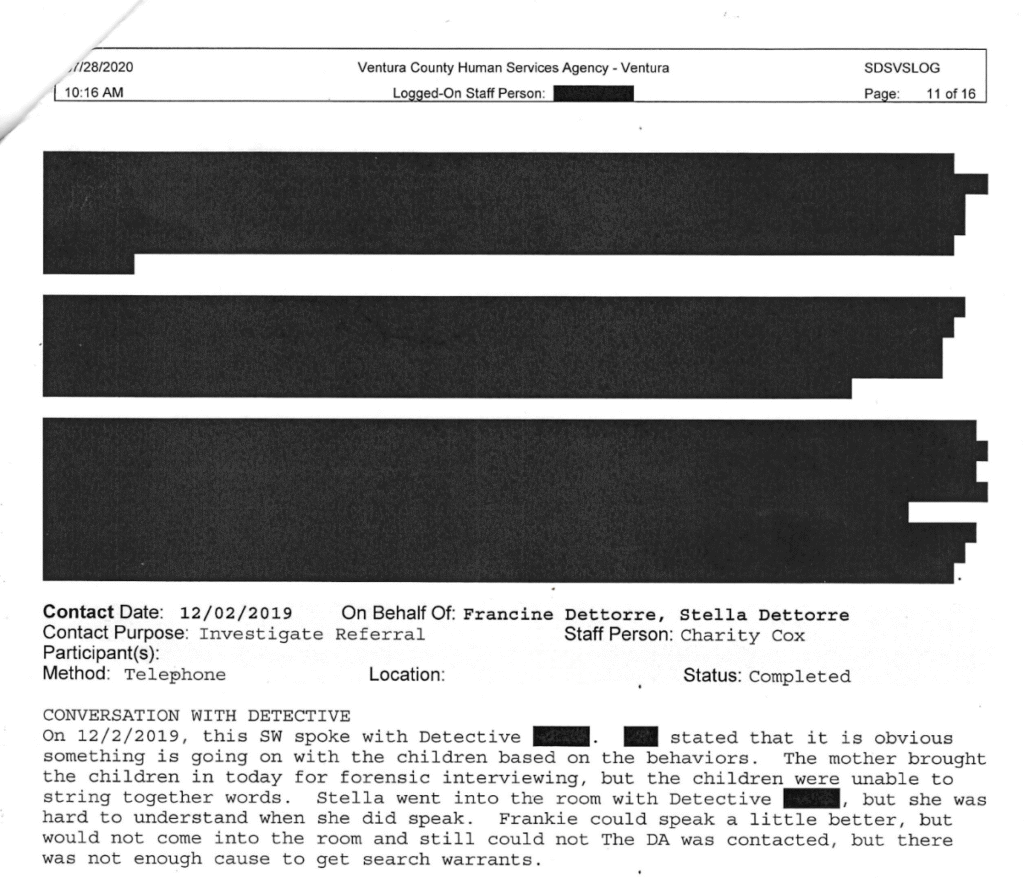
    The moment he says he knew his life was about to be dismantled came on Friday, January 24, 2020. Dettorre received a phone call from Ventura County CPS whistleblower Charity Cox, who had been placed in charge of abuse allegations tied to Dettorre’s ex-wife.

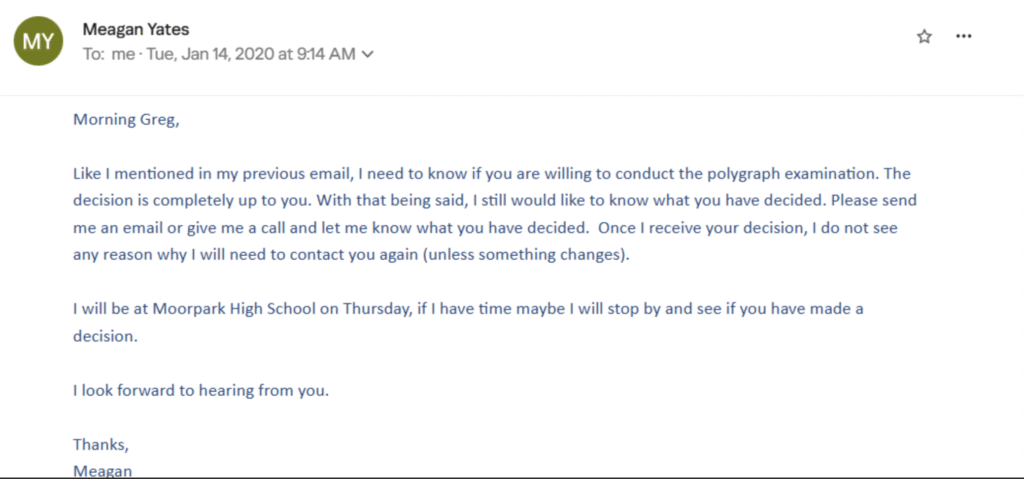
    According to Dettorre, the call was brief but chilling. Cox allegedly told him Detective Meagan Yates pressured her to alter the results of her report. Four days later, Dettorre says the Ventura County Major Crimes Unit executed a warrant on his parents’ home, where he was living after the divorce. From that point forward, he believed the system had made its decision.

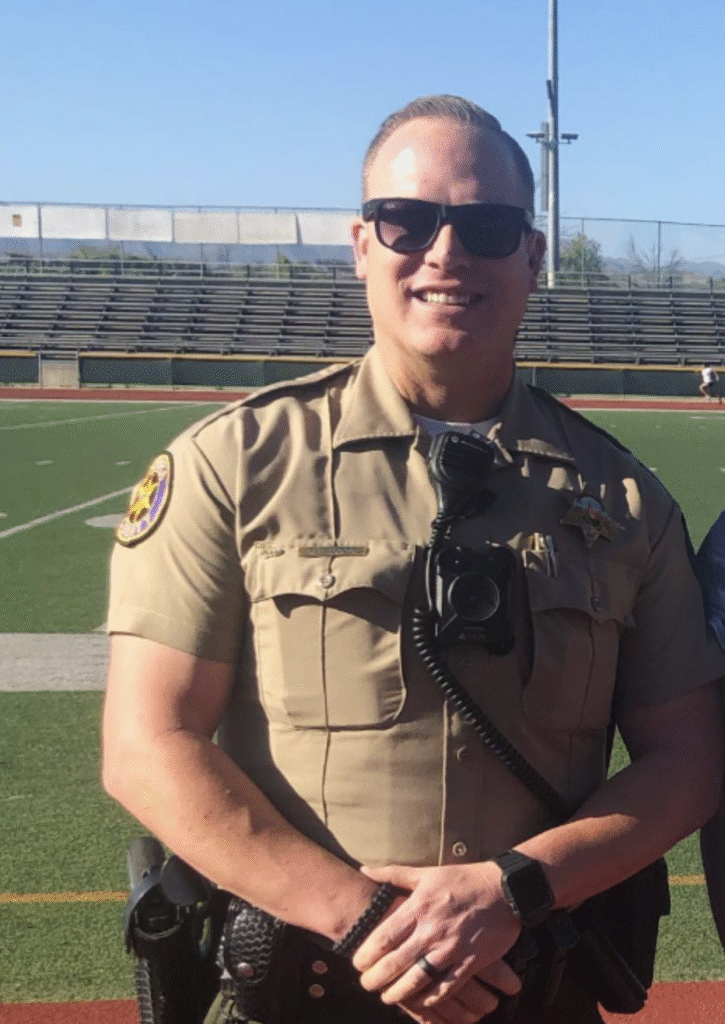
    Detective Meagan Yates

    Dettorre maintains he has never been charged with or arrested for any crime related to his daughters, or any other child. Not once. Yet he alleges the Ventura County Superior Court and its allies inside the Sheriff’s Office and District Attorney’s Office suppressed and/or destroyed evidence to ensure the truth never surfaced. Not because the evidence supported guilt, but because the machinery depends on narrative, not justice.

    At the center of Dettorre’s allegations is Detective Meagan Yates, a name he says represents everything rotten about the “Ventura County Corruption Machine.” He claims Yates pursued him with a fixation that was not rooted in evidence, but in agenda, an agenda he believes was aligned with his ex-wife from the start.

    Dettorre alleges Yates and his ex-wife had improper contact for years before and after the investigation. He describes it as an “open secret” that even third parties knew about, including the children’s therapist, Nancy Lopez, who allegedly contacted him to say Yates remained involved. If true, this isn’t a harmless ethical lapse. This is case contamination. It is the kind of relationship that makes every decision suspect and every action look premeditated.

    This wasn’t even the beginning of Yates’ involvement in Dettore’s life. Years before the alleged abuse investigation, Yates responded to a 911 self-harm call Dettorre made in October 2017, at his home in Moorpark, during what he describes as an unbearable collapse; bankruptcy, loss of his home, and his ex-wife fleeing with their twin daughters.

    He expected medical assistance. Instead, he says he was met by then-Deputy Meagan Yates pointing her service weapon at his face. Dettorre describes the moment as both humiliating and defining, because it established a personal, adversarial connection between him and the very person who would later investigate him.

    Then comes the conflict of interest that Ventura County allegedly ignored entirely. Yates wasn’t just a detective assigned to a case. She was also the Campus Resource Officer for the Moorpark Unified School District, the same district that hired Dettorre as an engineering teacher in December 2018.

    That means the investigator and the target existed in the same school district ecosystem at the same time. A man’s future, his employment, his reputation, and his children’s lives were put in the hands of someone who had already confronted him during a mental health crisis, and who was professionally linked to the same institution employing him.

    Any credible system would have recognized what this was and removed her immediately. Not because of politics. Not because of public pressure. Because ethics and due process demand it. But Dettorre alleges Ventura County isn’t built for fairness. It’s built for control.

    Dettorre claims Yates began attempting to build a case against him months before the warrant was executed. He says she initiated the effort in September 2019 and was eventually told in December of 2019 by the District Attorney’s Office, then under Greg Totten, that Yates lacked cause for a search warrant. Despite the accuser alleging the children were making sentence long statements against their father, the children, who had just turned 2 years old, were documented to have little to no discernable speech in the forensic examination. 

    If that is true, it should have ended there. It should have died quietly like countless other weak allegations that fail under scrutiny. But Dettorre says Yates simply found another route, using CPS as a workaround to restart efforts to secure a search warrant that the DA’s office allegedly denied her.

    Days after being denied the search warrant, Dettorre alleges Yates encouraged his ex-wife to re-ignite the allegations through CPS. The CPS complaint again alleges that the children were describing abuse in sentence-long detail, contradictory to the fact that the children were documented 2 weeks prior in a forensic examination, with Yates present, to have little to no speech ability.

    Despite the fact that this allegation conflicted with reality, Yates used it to keep the investigation open. In other words, the same person who couldn’t get traction through normal investigative channels allegedly leveraged provably false statements through a different agency to get the outcome she wanted.

    Dettorre believes this was not sloppy procedure. He claims it was premeditated misconduct, a deliberate act intended to manipulate the system into granting an emergency warrant. He alleges the CPS report was altered to support the appearance of urgency, not because there was genuine danger, but because urgency is the easiest way to short-circuit accountability.

    And even with that, Dettorre says Yates needed more. She needed law enforcement testimony to help secure the warrant affidavit. She needed other uniforms to validate the story. She needed the system to echo itself, so the paperwork looked legitimate.

    Dettorre alleges Yates harassed him relentlessly, including sending Dettorre an email threatening to appear at the Moorpark campus while he was teaching and interrogate him in front of students about abuse allegations. That isn’t policing. That is intimidation. That is public humiliation as strategy. Dettorre says he was forced to retain a criminal defense attorney simply to protect himself from the Sheriff’s Office, and to keep Yates from harassing him in front of his students on the Moorpark Campus. 

    Then something happened that Dettorre says confirms the operation was already in motion. At the exact time and date Yates allegedly threatened to show up at the school on January 16, 2020, a Moorpark campus deputy, Marc Riggs, entered Dettorre’s classroom, escorted by Assistant Principal Tara Thomas.

    Dettorre describes Riggs as armed, uniformed, and lingering in the classroom for two hours while asking vague questions about Dettorre’s family and even questioning students about whether Dettorre was a “good guy.” Riggs allegedly wandered in circles, repeatedly talking about how much he wanted to volunteer in the class but couldn’t. Dettorre says the entire encounter felt staged, unnatural, and designed to provoke fear while collecting “character” information that could be later used to justify action.

    Moorpark Campus Deputy Marc Riggs

    Dettorre believes Riggs’ involvement extended beyond the classroom, possibly into sworn testimony supporting the search warrant affidavit. He cannot confirm it, he says, because the Sheriff’s Office refuses to turn over the case file—despite Dettorre never being charged or arrested.

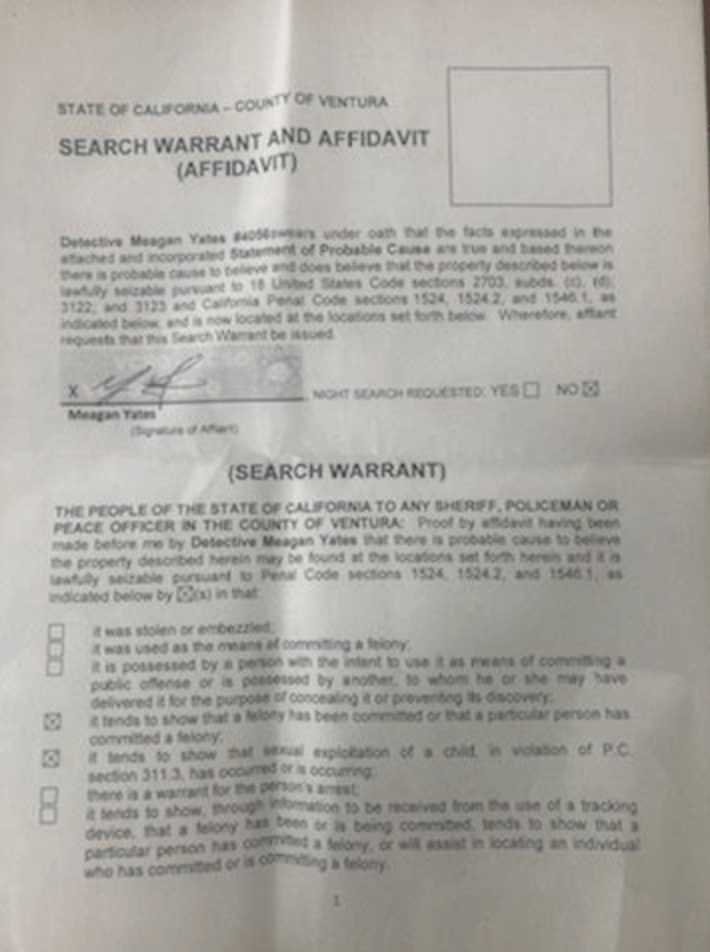
    Dettorre believes Cox, despite being strong-armed by Yates to alter her results, was still trying to do the right thing by tipping-off Dettorre about the altered CPS documents. Cox, within the CPS report, described the warrant as follows:

    “It was a 40 page document. It was a stretch to get it”.

    Dettorre alleges that “stretch” was Yates changing the results of a CPS investigation to secure the warrant.

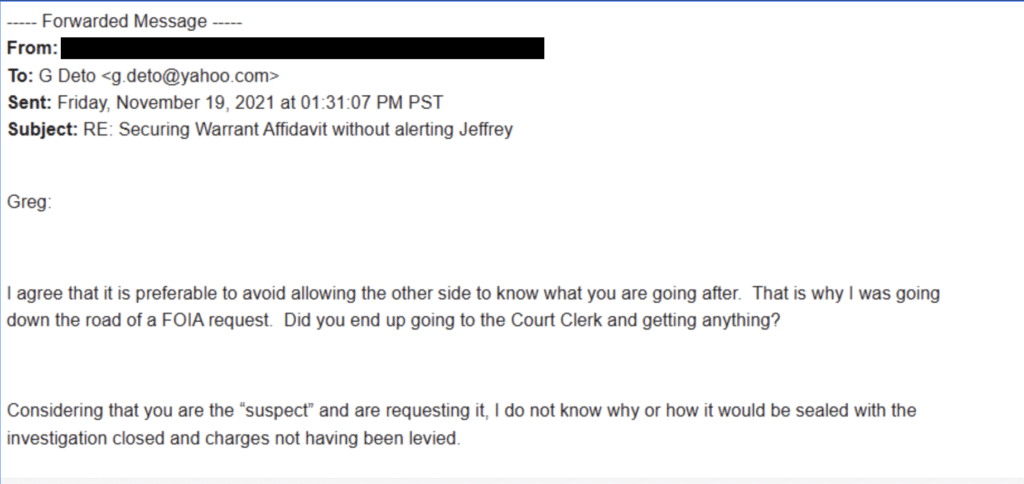
    When Mr. Dettorre’s lawyer at the time attempted to retrieve the case file in 2021, the S.O.’s  justification for withholding it was that the case file was sealed, despite the fact that there were no charges levied.

    That refusal, Dettorre argues, is the loudest confession Ventura County could make. The Sheriff’s Office Clerk’s in-person response to Dettorre, moths prior to his lawyer’s email communication with the S.O., claimed that it was a CPS investigation, not a Sheriff’s investigation, therefore the records are not theirs to provide.

    But reality makes that excuse laughable. It wasn’t CPS who raided a home with armored personnel. It wasn’t CPS who executed a warrant. It wasn’t CPS who brought force and intimidation to Dettorre’s doorstep.

    That was the Ventura County Sheriff’s Department. And they know it.

    The deeper link between the Sheriff’s Office and Moorpark Unified School District makes the story even more disturbing. When the warrant was executed, Dettorre was living in his parents’ home. His father, Scott Dettorre, was listed as a suspect too.

    Scott Dettorre, a respected, decorated, and recently retired Fire Captain of the Ventura County Fire Department who spent 30 years with the organization, was the Moorpark Unified School District Board President at the time. 

    According to the warrant receipt and email communication documented in the CPS report, Yates believed beyond any shadow of a doubt that the children were being abused.

    Through documented communication within the CPS report, Cox wrote the “Detective stated that it’s obvious something is going on with their (children’s) behaviors.”

    The list of justification for arresting a suspect on-site when executing the warrant is lengthy. This even includes an “unnatural interest in children’s activities.” According to Dettorre, Yates recovered over a decade’s worth of internet-connected devices, including phones, tablets, computers, and hard drives.

    If there was one instance of wrongdoing by Dettorre, even logging into a chat room where minors convene, he would have been arrested on the spot. In the end, Yates had absolutely nothing and was now forced to close the investigation four months later, on May 19, 2020.

    Ironically, the Dettorre family approached the S.O. immediately following Yates’ closure of the case and begged them to keep the investigation open to find the children’s true abuser.

    The Dettorre family agreed that the children were showing signs of exploitation, and wanted the abuser brought to justice.

    Under the failed leadership of then-Sheriff Bill Ayub, the department refused to investigate the case further. If Yates swore on a warrant affidavit that the children were being exploited and abused, why was she, or her superiors within the department, not interested in finding the perpetrator?

    Why was there no investigation into the accuser after Dettorre was cleared?

    Because it didn’t fit the narrative. For Yates, if she was unable to arrest Dettorre, then there was no other abuser.

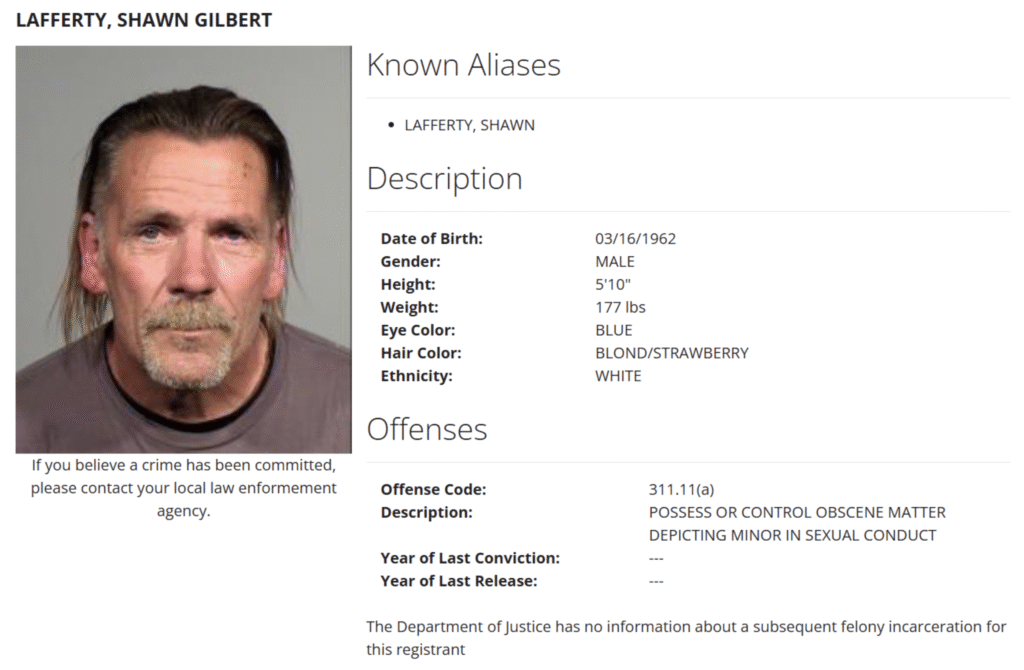
    The next part will churn any parent’s stomach: The accuser’s maternal uncle, a twice arrested registered sex offender who visited the children regularly, was not considered a suspect by Yates.

    The accuser’s allegations started at nearly the same time that her uncle, Shawn Lafferty, who lived less than two miles from the accuser’s home, was arrested for a second time in a D.A. sweep of registered offenders for possession of child pornography.

    Somehow, even after his second arrest for possession of child pornography, Yates did not consider him a suspect, and Lafferty still remains free to roam the county, living on a boat in Channel Islands Harbor.

    Tragically, Dettorre is unsurprised by the continued failure of the Ventura County D.A.’s office to protect children, citing Erik Nasarenko’s refusal to charge Ventura City Attorney Andrew Heglund for allegedly exposing himself to children inside a Chik-Fil-A.

    Dettorre asserts that if the investigation had been continued by an ethical detective, it could have led to Lafferty, but this was a politically unacceptable outcome for both the D.A.’s office as well as the S.O.

    If a twice-arrested sex offender was arrested for crimes against Dettorre’s daughters, it would have started an avalanche of both legal and political liability for both law enforcement agencies.

    A case involving a detective tied to the Moorpark School District, a teacher employed by the district, a campus deputy appearing inside the classroom, and then a warrant executed at the home of the sitting school board president is not “random.” It is not “routine.” It is not coincidence.

    It looks like institutional muscle being flexed against a target who refused to submit, and against a family the system decided to punish.

    Dettorre says the end result is exactly what Ventura County’s machine was designed to produce: no accountability for government actors, no transparency for the public, and maximum devastation for the individual standing in the way.

    He lost his career. He lost his life as he knew it. And most painfully, he lost his daughters, not because he was convicted, not because he was charged, but because once the corruption machine starts moving, it doesn’t need proof. It only needs compliance.

    And in Ventura County, compliance is the currency.

  • When Procedure Replaces Proof: How Ventura County Family Court Manufactures Custody Outcomes

    When Procedure Replaces Proof: How Ventura County Family Court Manufactures Custody Outcomes

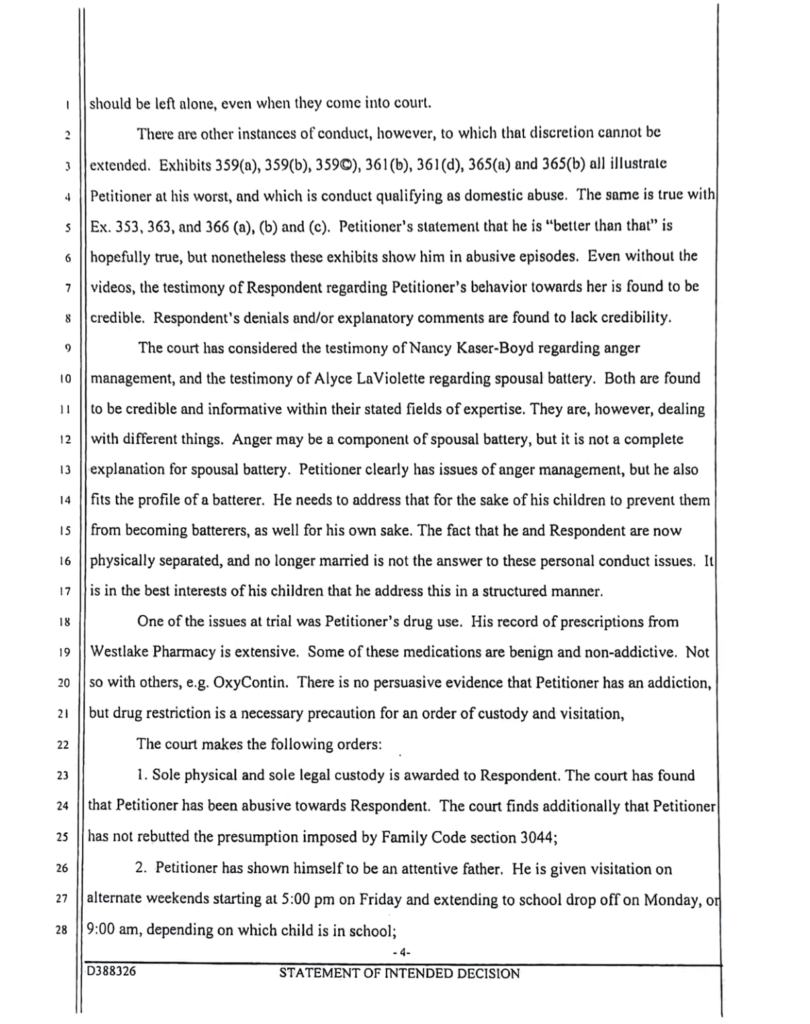
    Ventura County Family Court does not need to falsify evidence to destroy a parent’s relationship with their children. It does not need to make explicit findings of unfitness, danger, or neglect. It has something far more effective at its disposal: procedure. In case after case, including that of professional MMA fighter Amir Rahnavardi, custody outcomes are not decided through evidence tested on the merits, but through timing, execution, and delay. The system does not decide. It allows reality to calcify before anyone is forced to justify it.

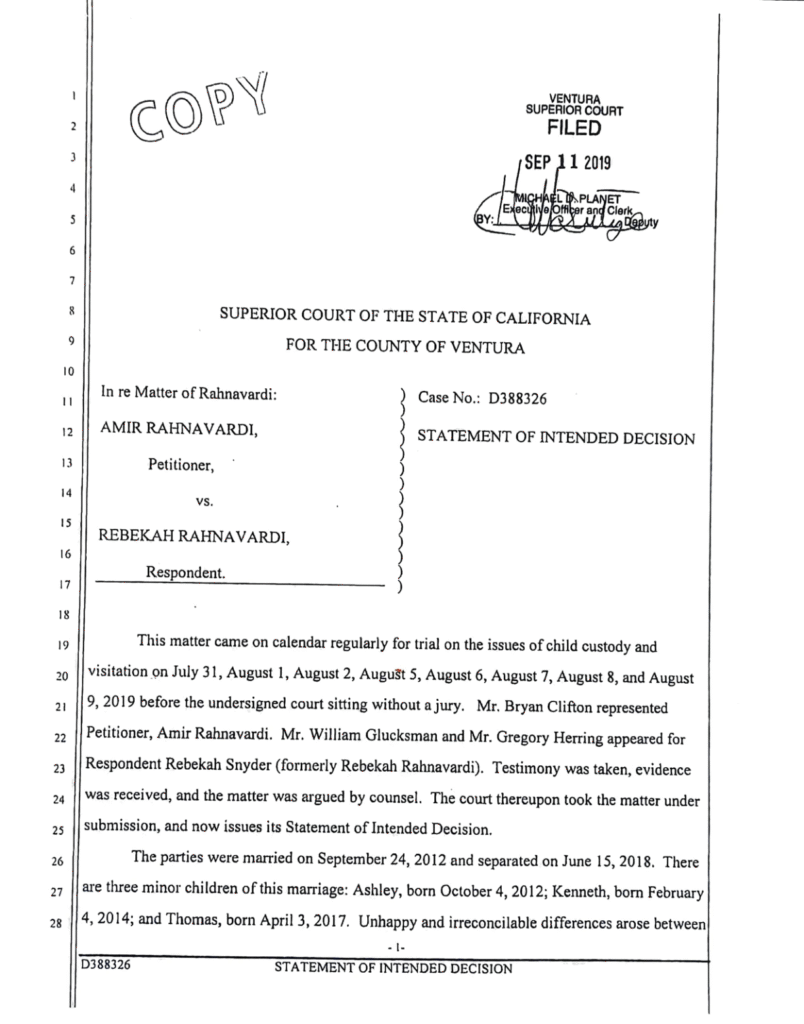
    Rahnavardi’s case began in September 2019 with custody orders issued by Judge Henry Walsh following allegations tied to a domestic incident. Those allegations were contested. They were never fully adjudicated in a comprehensive evidentiary hearing. Yet those early orders became untouchable. Everything that followed treated them not as provisional findings, but as settled truth. The court never returned to the starting line. It simply kept moving forward as if the foundation had already been proven sound.

    From there, access narrowed gradually, then predictably. What the written orders permitted and what actually occurred began to diverge. Missed visits went uncorrected. Reduced access became normalized. Enforcement was inconsistent and often dependent on the unilateral actions of one party. The court did not intervene to restore balance. Instead, it absorbed the imbalance into the case itself. Over time, deprivation became the “status quo.”

    Between late 2019 and September 2020, a substantial body of contemporaneous evidence accumulated. Video recordings, journals, communications—material documenting the family dynamic as it was unfolding in real time. Some recordings contained statements referencing violence and coercion. This was not marginal material. It was central. And yet it was never subjected to the one thing that gives evidence meaning: adversarial testing. There was no full evidentiary hearing. No credibility determinations. No findings resolving what was true and what was not. The evidence was neither admitted nor excluded. It simply existed in a procedural fog, influencing outcomes without ever being decided.

    By 2021, the court’s procedural bias hardened into something unmistakable. When the children were relocated out of state, Rahnavardi sought emergency relief through an ex parte filing. The matter was heard on a day when the assigned judge, Judge Michael Lief, was not available. A substitute judge denied emergency relief. The denial did not resolve whether relocation was appropriate. It did not conduct a best-interest analysis. It did not weigh evidence. It merely allowed the move to proceed.

    Once the children were gone, the court treated relocation as a fait accompli. Time did what the court refused to do. What should have required justification instead became the baseline. Subsequent proceedings no longer asked whether the move should have happened, only how to manage the consequences of a reality already imposed. This is how family court manufactures permanence without findings. Delay becomes doctrine.

    This was not a one-off. It became a recurring sequence. Emergency filings were denied on narrow procedural grounds. Review was deferred. Hearings were delayed. Meanwhile, the consequences of those denials deepened. Each day without access strengthened the argument that access should remain limited. Each delay fortified the very conditions that justified further restriction. The system rewarded obstruction and punished persistence.

    At one point, the court openly acknowledged the public scrutiny surrounding the case. An ex parte request was filed seeking to restrict investigative reporting related to the proceedings. That request was denied. The court knew eyes were on it. Reporting continued. Transparency, at least in theory, was permitted. Yet nothing about the underlying process changed. Visibility did not trigger accountability. It merely coexisted with dysfunction.

    The pattern reached a new level of absurdity and cruelty in late December, when an ex parte drug-test order was executed on Christmas Eve. The test was compelled at a facility near LAX, bypassing closer options. The test was observed. Compliance was immediate. The result was negative. None of it mattered. Visitation was still disrupted. Access was not restored. The order did not articulate imminent risk findings sufficient to justify the disruption that followed. The concern the order purported to address was resolved, yet the punishment remained. This was not about safety. It was about leverage.

    Then, in January 2025, the same maneuver repeated. As a January 12 hearing approached, visitation was altered again. Access was withheld pending judicial review. By the time the court was prepared to look at the issue, the ground had already shifted. The court was no longer evaluating whether access should be reduced. It was responding to a reduction already imposed. Once again, execution came first. Justification never arrived.

    Viewed individually, each step can be defended as procedural. Emergency denials happen. Hearings get delayed. Judges are unavailable. Orders are temporary. But when the same sequence repeats across years and across unrelated cases, the explanation collapses. As documented in multiple investigations into Ventura County Family Court, this is not a series of accidents. It is a system operating exactly as designed.

    When emergency mechanisms repeatedly create irreversible custody outcomes before evidence is tested, the process ceases to be neutral. Procedure becomes outcome. Timing replaces truth. Absence replaces adjudication. And by the time the court is prepared to “consider” the merits, the system insists it is too late to undo what was done.

    Families live with the consequences of that choice. Children grow up. Bonds erode. And the court points to the passage of time as proof that nothing can be changed—never acknowledging that it was time, not truth, that decided the case.

    That is the scandal now unfolding in plain sight. Not just what Ventura County Family Court decides, but how it avoids deciding at all.


  • CONCEALED IN PLAIN SIGHT: How Sworn Admissions, Digital Forensics, and Expert Evidence Were Buried While a Father Lost His Children

    CONCEALED IN PLAIN SIGHT: How Sworn Admissions, Digital Forensics, and Expert Evidence Were Buried While a Father Lost His Children

    The Ventura County court is now under fire for widespread civil rights abuses and a brazen failure of due process that cuts across every corner of its legal system.

    In one of the most egregious failures, a father lost his children not because of truth, but because the court embraced corrupted evidence and helped conceal the proof that would have cleared him.

    That is not a metaphor. It is the factual spine of this case.

    What follows is not interpretation, inference, or theory. It is sworn testimony, independent forensic confirmation, a documented criminal investigation, and a judicial record defined less by what it weighed than by what it refused to touch.

    The Admission That Should Have Changed Everything

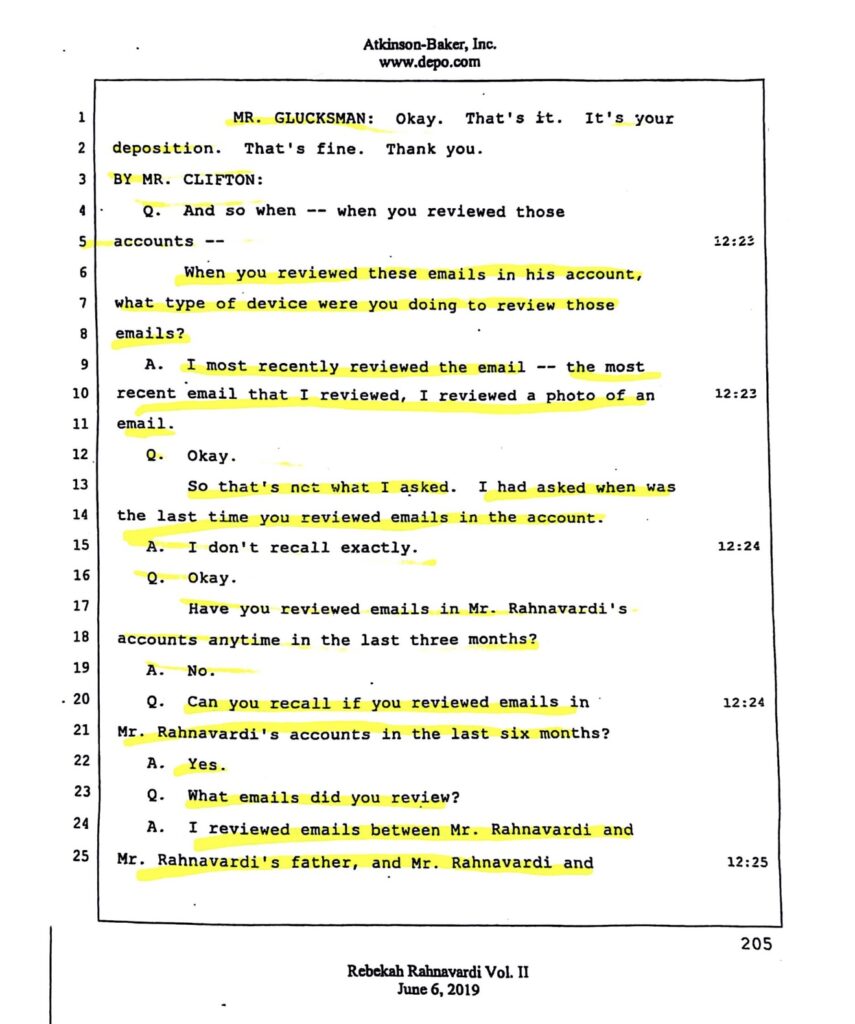
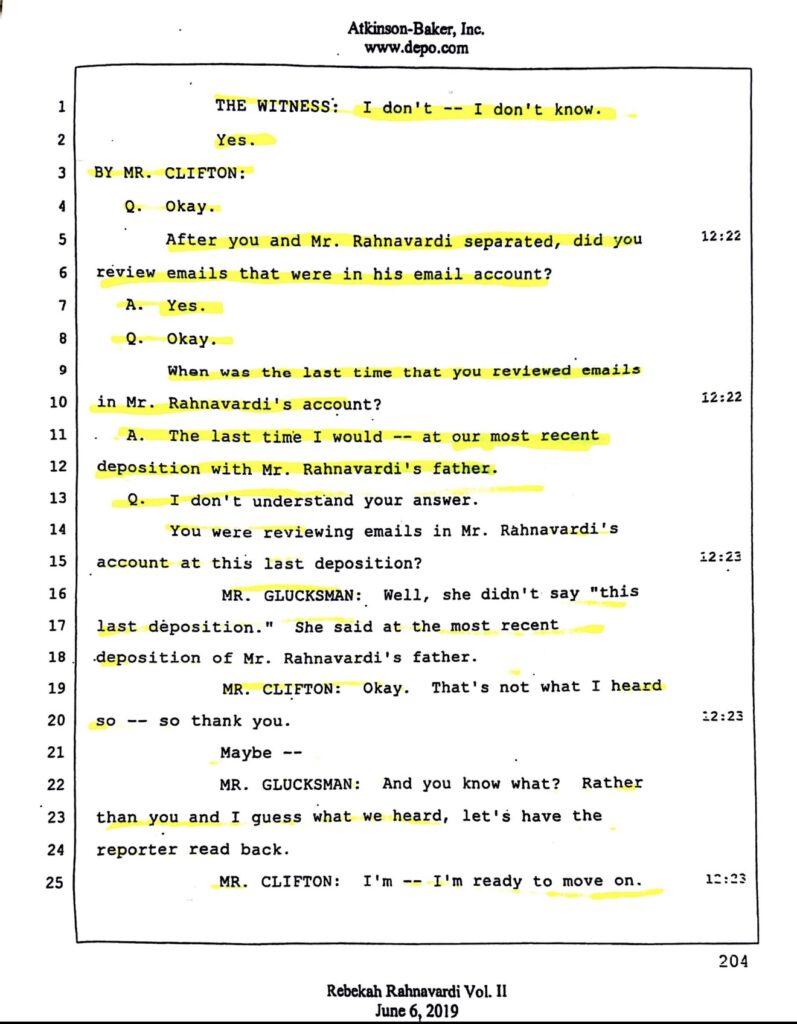
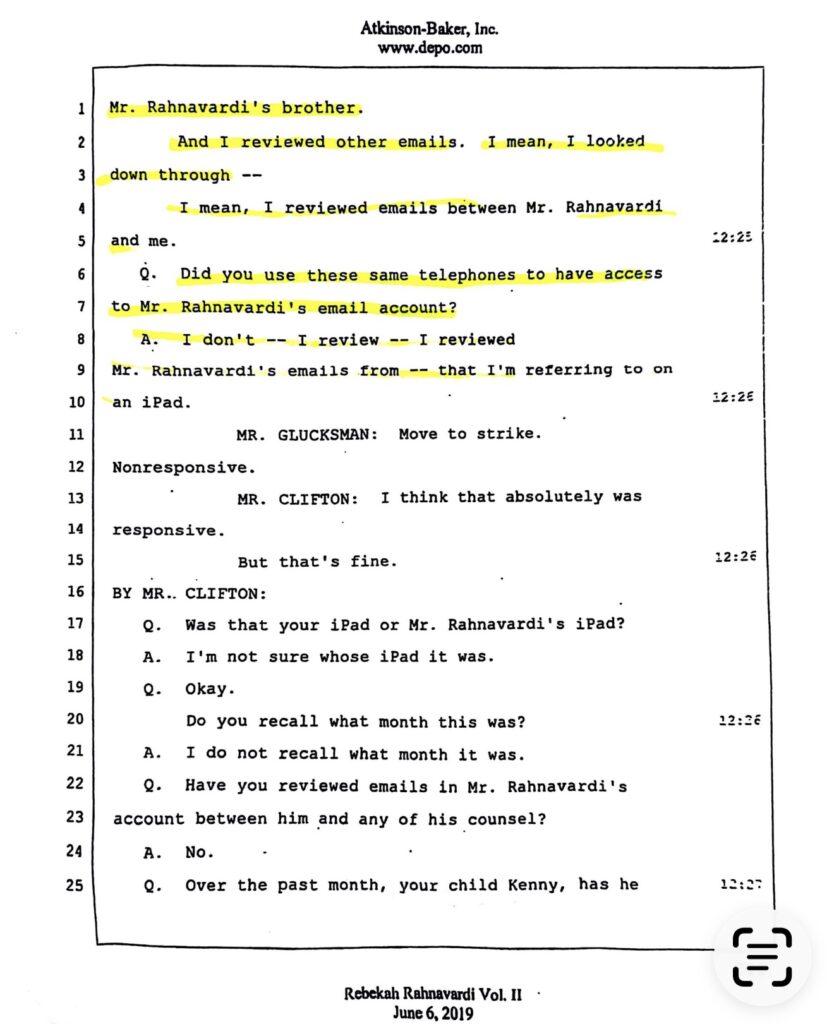
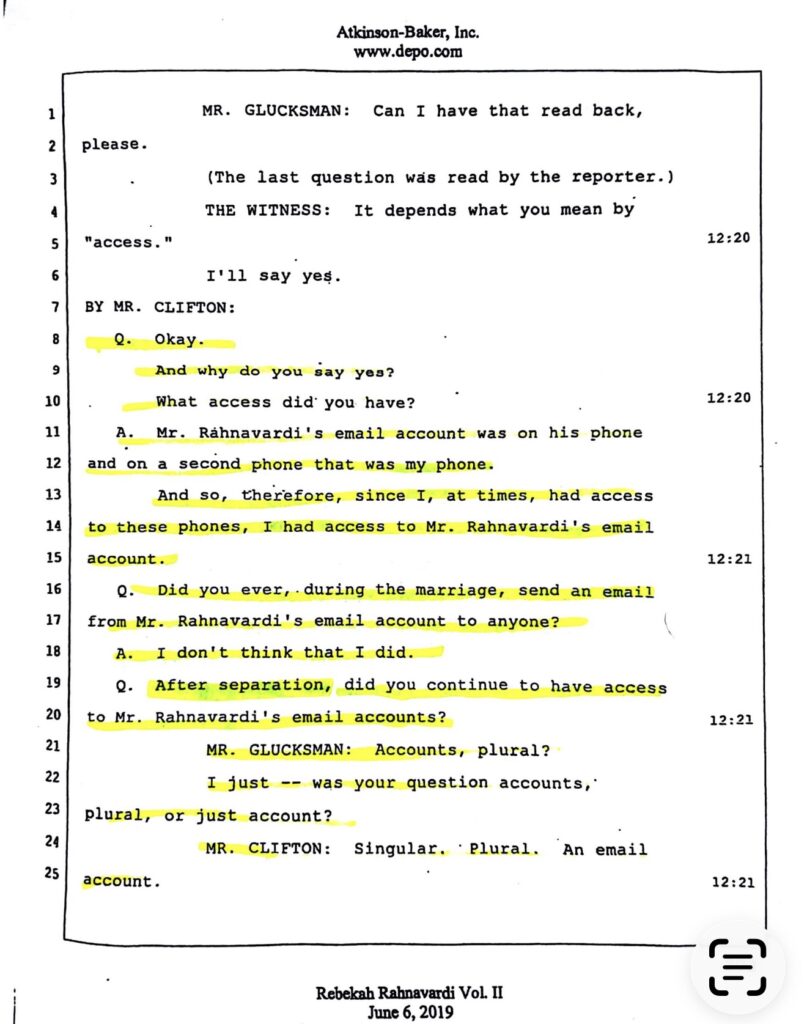
    In a 2019 deposition, pages 202 through 206, Rahnavardi’s wife ex-wife Rebekah testified under oath. Not ambiguously. Not hypothetically. Directly.

    She admitted she had access to Rahnavardi’s email on more than one phone.
    She admitted she reviewed his emails after separation.
    She admitted seeing emails between Amir and his family.
    She described accessing accounts through an iPad she could not clearly identify.

    This was not hearsay. This was not an allegation made by Rahnavardi. This was sworn testimony.

    And it mattered, because the family court’s later rulings relied heavily on digital communications attributed to Rahnavardi – messages, screenshots, and reconstructed threads that would become the backbone of restrictions imposed on his parental access.


    The Forensics That Confirmed the Admission

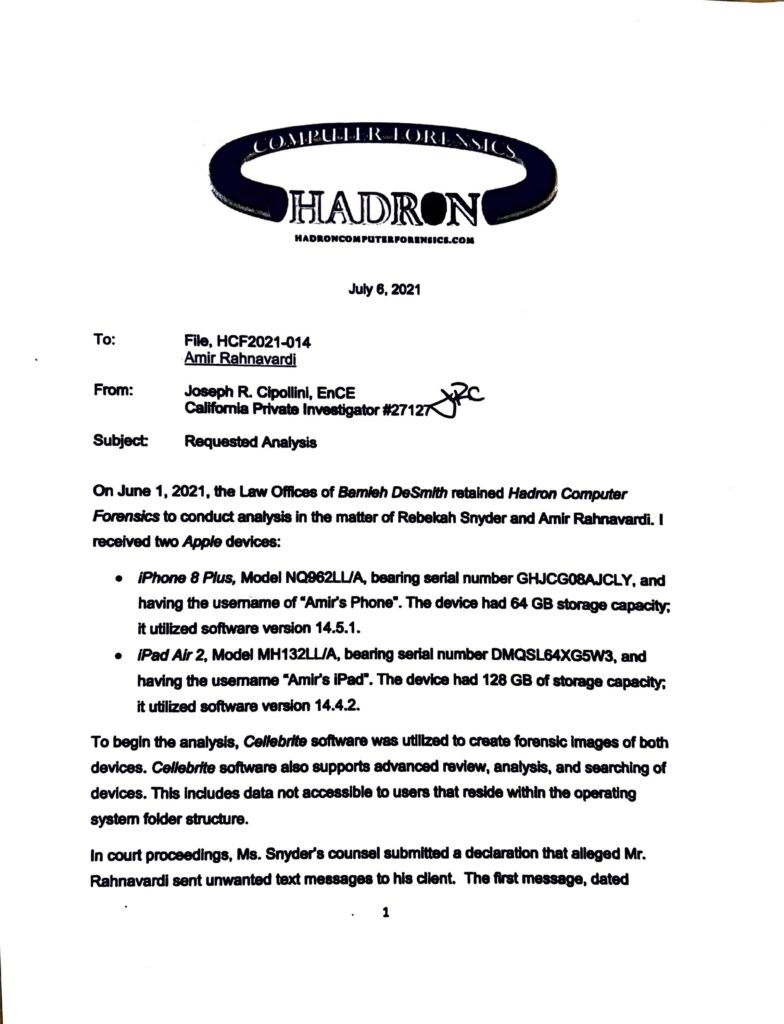
    Independent digital forensic expert Joseph Cipollini examined the underlying data. His findings were not speculative and they were not subtle.

    Unauthorized access activity dating back to 2019.
    iCloud access from devices Rahnavardi did not own.
    Messaging irregularities consistent with altered or reconstructed threads.
    Activity patterns consistent with access from locations associated with his ex-wife Rebekah.

    The connective tissue here is critical. The sworn admission and the forensic findings align. One explains the other.

    This is how manipulation becomes possible. This is how altered timestamps appear. This is how screenshots replace native files. This is how messages emerge that were never sent.

    The Recusal That Never Happened

    According to Rahnavardi’s account – clearly labeled as such – Cipollini told him in 2021, “If Lief is your judge, he’ll have to recuse himself.”

    What is not disputed is what followed.

    Judge Michael Lief did not recuse.
    No disclosure appears on the record.
    Cipollini’s forensic evidence was suppressed.

    The investigative question writes itself. If a recusal concern was raised, why did the judge remain on the case – and why was the forensic evidence erased from view?

    When Law Enforcement Found a Crime

    This was not confined to family court.

    Detective Michael Spears opened Case #922-00259-2261-115 and documented unauthorized computer access under Penal Code 502(c)(1). The report included theft of Rahnavard’s iPad and unauthorized access to his accounts. Spears prepared the case for submission to the District Attorney.

    The DA declined prosecution due to lack of prior criminal record. Not because no crime occurred.

    That distinction matters. A declination is not an exoneration. It is a prosecutorial decision – and the underlying offense remains documented.

    Yet the family court ignored the police report entirely.

    How the Evidence Was Weaponized

    Across the evidence used against Amir, the pattern is unmistakable.

    Screenshots instead of native files.
    Altered timestamps.
    Threads Amir never sent.
    Metadata inconsistent with his devices.

    These manipulations were only possible because of the unauthorized access admitted under oath and confirmed by forensics. Without that access, the evidence collapses.

    With it, the court built years of restriction.

    A Pattern of Judicial Suppression

    Based on the record, Rahnavardi alleges that Judge Lief blocked forensic evidence, ignored the Penal Code 502(c)(1) police report, prevented exculpatory material from entering the record, maintained supervised visitation without evidentiary basis, failed to rule on a 2021 phone-contact request for nearly four years, and issued rulings without hearings in 2022.

    Added to that record is a stark procedural fact: the “Dusty” ruling was issued without holding any evidentiary hearing at all.

    The issue is not what evidence existed. It is what the court refused to look at.

    Science Rejected, Allegation Accepted

    One allegation became foundational: that a family dog, Dusty, had bitten a child.

    Two experts dismantled it.

    Jill Miller, a canine bite-pattern expert, reviewed the injuries and concluded they were not dog bites. The findings were inconsistent with any canine bite pattern. She refused payment and expressed alarm. Her evidence was suppressed.

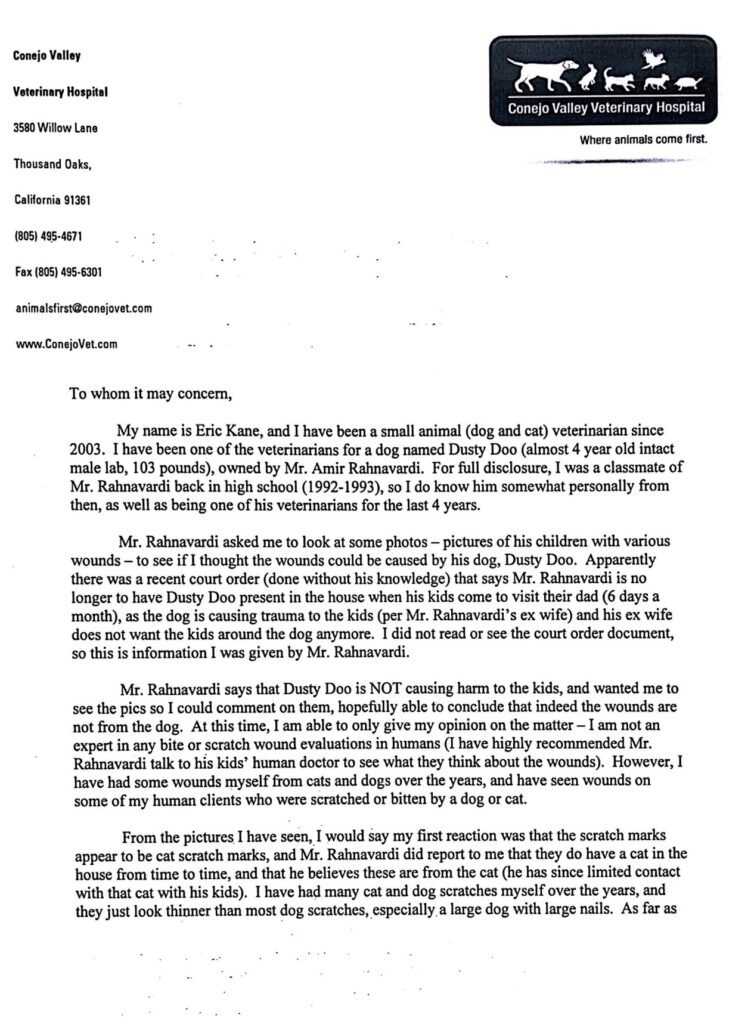
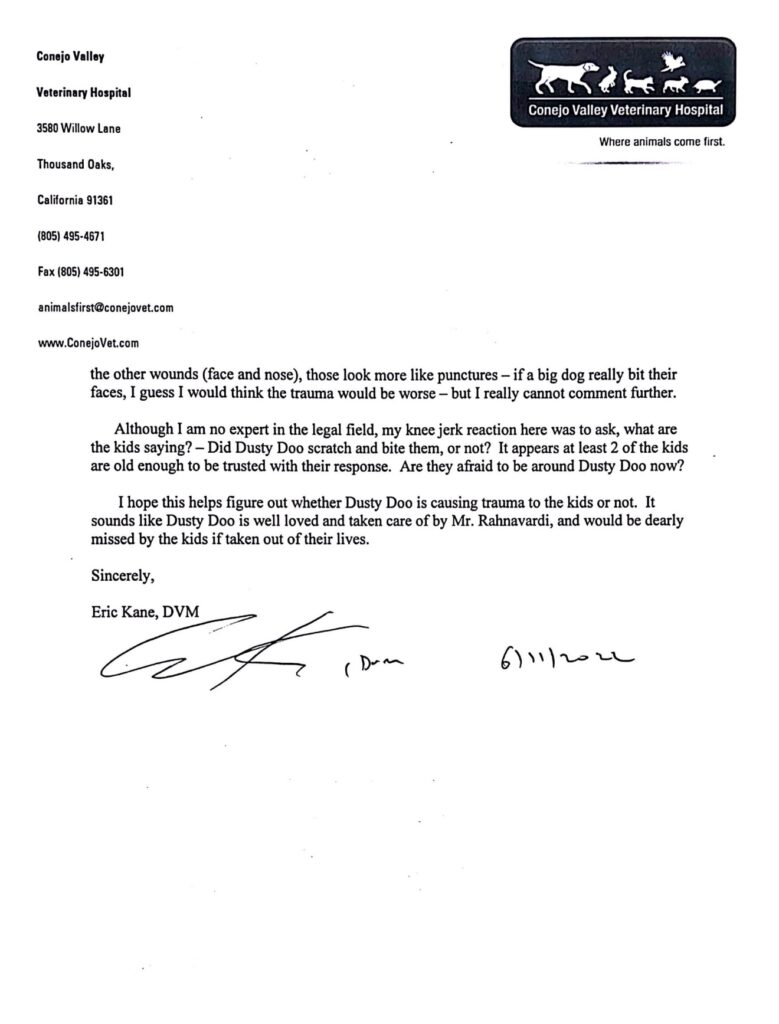
    Dr. Eric Kane, DVM, found no aggression history, no bite history, and injuries inconsistent with canine bites. His evidence was also suppressed.

    False allegation. Two experts contradict it. Experts excluded. Allegation elevated into years of restriction.

    This is how outcomes are engineered.

    The Cost That Never Makes the Docket

    Amir has been deprived of normal parental access for years. His children endured prolonged alienation. His father spent his final years watching injustice inflicted on his son and grandchildren, powerless to stop it.

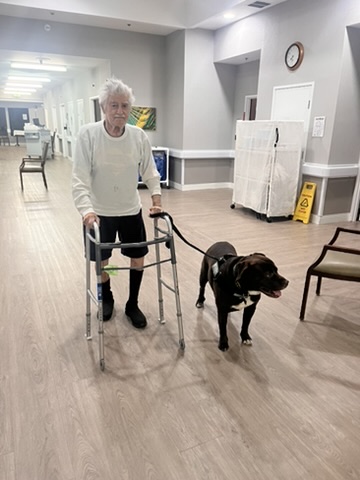
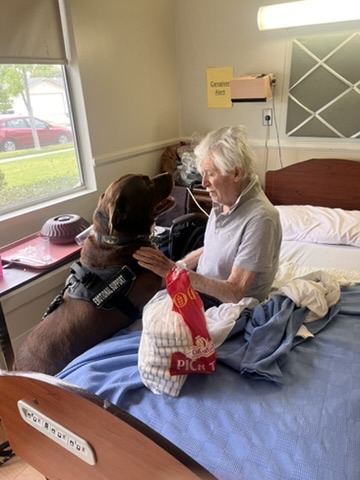
    Dusty was not incidental. He was a stabilizing emotional presence through home care, hospice, and family life – a constant when everything else was stripped away.

    This harm was not abstract. It was lived daily.


    The Man Who Lost Faith

    This is where faith in institutions breaks – not with a single ruling, but with the realization that every safeguard failed at once. That sworn testimony could be ignored. That forensic science could be buried. That police findings could be treated as irrelevant. That experts could be silenced while accusations stood alone.

    A Moral Witness Beyond Borders

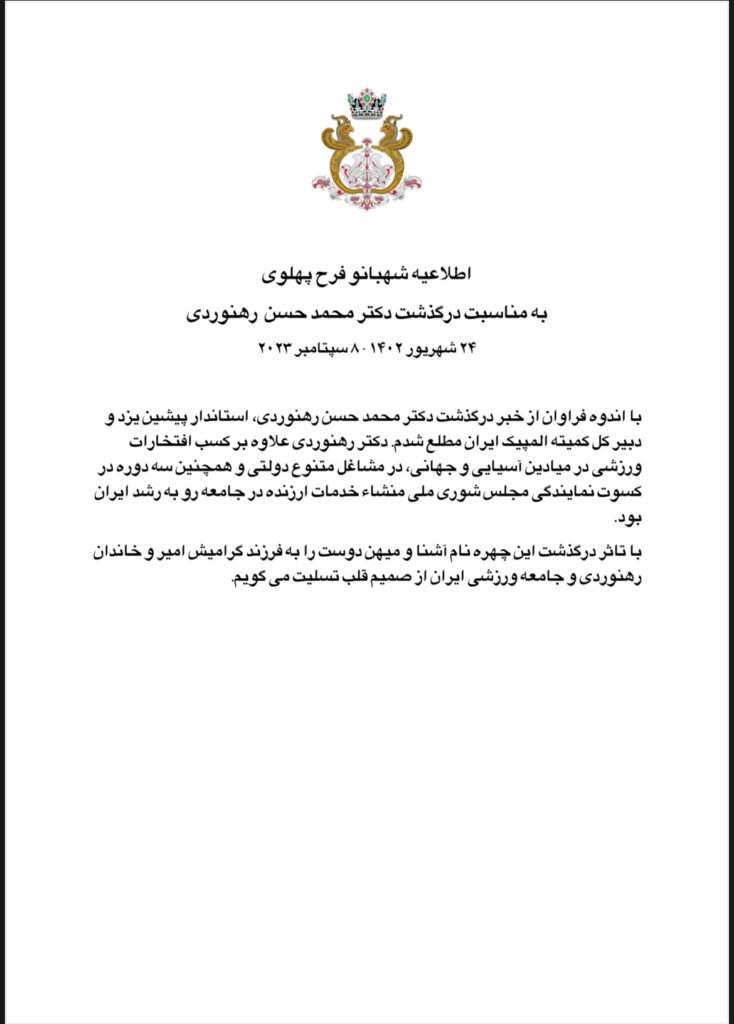
    In a letter written in English and Farsi, Her Imperial Majesty Queen Farah Pahlavi recognized Amir’s father’s stature and expressed grief and concern over the injustice and hardship inflicted during his final years.

    It was not political. It was moral.

    And it underscored what the record already shows: this was not merely a legal dispute. It was a human one.

    The Question That Ends the Story

  • The Ventura County Playbook: Inside the Coordinated Machine of Judicial Abuse Targeting Three Unrelated Litigants

    The Ventura County Playbook: Inside the Coordinated Machine of Judicial Abuse Targeting Three Unrelated Litigants

    In Ventura County’s courthouse, a place that likes to bill itself as a model of procedural integrity and judicial professionalism, a very different system operates behind the scenes. It’s a system where judges hold secret hearings, clerks block filings on command, evidence is quietly smothered, fraudulent documents slip through unchecked, and law enforcement is deployed not for justice, but for retaliation.

    Three unrelated cases, Amir RahnavardiAnica Barbosa, and Sherri LaZelle, walked into Ventura courtrooms at different times, facing different circumstances, and different adversaries. What they didn’t know is that they were stepping into the same machine. Their stories are separate, yet disturbingly interchangeable, a mirrored pattern of constitutional violations that exposes a judiciary operating without oversight, without accountability, and without any regard for due process.

    This isn’t judicial error. It’s a systematic playbook.

    AMIR RAHNAVARDI – WHERE THE PLAYBOOK SHOWS ITS TEETH

    When Amir Rahnavardi challenged the fabricated abuse narrative used against him, he assumed that facts, evidence, and hearings would matter. Instead, he collided with the Ventura courthouse’s shadow system, one driven by ex parte influence and rulings crafted behind closed doors.

    Judge Joann Johnson openly admitted she consulted Judge Michael Lief privately before issuing a restraining-order ruling, a confession that should have set off alarms across the county. Opposing counsel enjoyed direct, private access to the judge, a privilege Amir could never dream of as a self-represented father forced to watch rulings appear minutes after closed-door conversations.

    It got worse. Supervised visitation was extended for years without a single evidentiary hearing, even though seventy-five clean monitor reports and seven monitors all confirmed there was no risk, no conduct issue, nothing to justify the restrictions. His journal, nine hundred pages, video evidence, photo timelines, digital corroboration of abuse patterns: all suppressed by Referee Leon Bennett without findings, without explanation, without record.

    And then there was the “evidence” that justified a devastating custody loss, photos of minor cat scratches, presented by opposing counsel as “dog bites” from a violent attack. In open court, Amir told Judge Lief exactly what everyone in the room knew:

    “You can’t tell the difference between dog bites and cat scratches – that’s terrifying.”

    Terrifying, yes. But in Ventura County, entirely on brand.

    Judge Henry Walsh, publicly admonished by the Commission on Judicial Performance for failing to disclose campaign contributions from more than 150 attorneys, had already accepted the superficial photos as proof of a “two-hour beating.” No police investigation. No authentication. Just a narrative slipped neatly into the machine, processed, and stamped as fact.

    ANICA BARBOSA – WHEN A SECRET HEARING BECOMES AN EVICTION ORDER

    If Amir’s case revealed ex parte communication as a routine operating tool, Anica Barbosa’s case revealed how far the court was willing to go to keep its decisions hidden.

    On April 23, she walked into a courtroom expecting a routine hearing, only to discover later that Judge Lief had already planned a secret one behind her back. A false 11:00 AM minute order was filed as a decoy to send her home and clear the path for an undisclosed proceeding.

    Judge Denise de Bellefeuille helped set the stage by falsely claiming the court file was “missing,” then clearing the courtroom under the guise of a recess. While Anica was physically removed from the process, a hearing took place without her. Her eviction, stripped of procedural rights, stripped of due process, stripped of jurisdiction, was engineered in her absence.

    And when she tried to challenge the judge?

    A clerk told her:

    “I was told not to take any paperwork from you.”

    Her judicial challenge was blocked. Her filings refused. Her rights erased.

    Then came the enforcement.

    Attorney Stephanie White, acting less like an officer of the court and more like a bounty hunter with a badge, arrived at Anica’s home with a squad of sheriff’s deputies — five to ten of them — shouting from the kitchen:

    “Get out now and don’t come back!”

    No jurisdiction. No service. No minute order. No due process.

    But in Ventura County, everything was going exactly according to plan.

    SHERRI LaZELLE – THE FULL BLUEPRINT OF FRAUD

    If Amir exposed judicial coordination and Anica exposed secret process, Sherri LaZelle exposed the Ventura machine in its most brazen form: forged documents, resurrected cases, fraudulent service, retaliatory warrants, and an unbroken chain of unlawful acts carried out in broad daylight.

    Sherri discovered restraining orders being enforced against her that were never signed by the petitioner, never signed by a judge, filed more than a thousand days apart, and riddled with altered pages and impossible dates. They were the legal equivalent of counterfeits, and the court treated them as gospel.

    Two dismissed TROs were secretly resurrected. Unauthorized attorneys were permitted to appear without substitution. Filing clerks were instructed to block her access to the court. A judge appointed counsel after the hearing ended, a maneuver so blatantly unlawful it reads like a parody of due process.

    Her federal case was derailed by criminal charges engineered inside the same courthouse she was suing, a retaliatory loop designed not to seek justice, but to silence the whistleblower at the center of it.

    When she exposed an admission of child abuse, mandatory reporting laws vanished. When she reported hacking and theft, law enforcement interest disappeared. When she challenged fraudulent documents, the court looked away.

    Because in Ventura County, accountability isn’t the goal. Control is.

    THE PATTERN: THREE CASES, ONE PLAYBOOK

    Separately, the cases look troubling. Together, they form a blueprint.

    Every case encountered the same distinctive hallmarks:

    Secret ex parte communications.
    Hearings held without notice.
    Minute orders that vanish or never existed.
    Evidence suppressed or destroyed.
    Filings blocked by clerks acting on private directives.
    Forged or fabricated documents accepted as fact.
    Law enforcement mobilized as a weapon – not for public safety, but for judicial retaliation.
    Void orders treated as enforceable.
    Federal lawsuits met with local retaliation.
    Judges acting far outside of jurisdiction and outside the law.

    Different cases.
    Same judges.
    Same clerks.
    Same playbook.

    This is not coincidence. It is pattern and practice, the legal threshold for systemic constitutional violations and Monell liability.

    It is also the clearest window yet into a courthouse that has stopped even pretending to follow the law.

    THE SYSTEM THEY BUILT – AND THE ONE ABOUT TO COLLAPSE

    Ventura County has operated under the public illusion of procedural normalcy while running a second, hidden system that substitutes legality with loyalty and oversight with improvisation. The three cases now surfacing are not outliers. They are evidence.

    Courts do not commit this many identical violations against three unrelated people by accident.

    This is a machine.

    This is policy.

    This is systemic.

    THE REAL VERDICT: THIS ISN’T A BROKEN SYSTEM – IT’S A CRIMINAL ENTERPRISE

    It’s time to stop pretending Ventura County’s judiciary is merely “flawed” or in need of a little procedural housekeeping. What these three individuals endured, the forged documents, the fabricated evidence, the secret hearings, the retaliatory warrants, the weaponized sheriffs, the clerks taking illegal directives, the judges operating with no jurisdiction and even less accountability, doesn’t reflect a system that’s slipping. It reflects a system that has already fallen.

    A system that consistently produces the same abuses isn’t malfunctioning.
    It’s functioning exactly as designed.

    These aren’t isolated bad actors or the occasional rogue judge. This is a coordinated network of power operating off the books and beyond the law — a structure so normalized inside Ventura County that its participants no longer bother hiding it. They don’t fear consequences because, until now, there have been none.

    And that is precisely why this can’t be brushed aside as another “judicial reform” issue.
    No amount of ethics training, bench guides, or wrist-slap admonishments will fix a judiciary that behaves like a protection racket.

    This demands something far more serious: a full-scale federal investigation into whether Ventura County’s judicial and clerical apparatus has crossed the line from government institution into organized criminal enterprise.

    Because when judges coordinate in secret, when clerks block filings on command, when evidence disappears, when forged documents drive outcomes, when sheriffs are dispatched to enforce void orders, when retaliation replaces due process, and when the victims of this machine are the ones punished for exposing it — that’s not law.

    That’s racketeering in robes.

    The question is no longer whether the Ventura County Superior Court needs oversight.
    The question is whether we are witnessing the public façade of a criminal organization masquerading as a justice system.

    And now that the pattern has been exposed, now that the names, dates, actions, and mechanisms have been documented, the next move belongs to the federal government.

  • EXCLUSIVE: Evidence Buried, Due Process Denied – How a Private Referee Helped Shield a Judge From His Own Rulings and Destroyed Lives

    EXCLUSIVE: Evidence Buried, Due Process Denied – How a Private Referee Helped Shield a Judge From His Own Rulings and Destroyed Lives

    For three years, inside a quiet California courthouse where the promise of justice was supposed to hold steady, one man with no immunity, no oversight, and no constitutional authority shaped the fate of an entire case. His name was Leon Bennett, a private discovery referee who, on paper, was merely assigned to referee disputes. In practice, he became the single most powerful figure in the courtroom, the gatekeeper who controlled every document, every delay, every piece of evidence, and every outcome. His decisions didn’t just affect the litigation. They protected the judge who appointed him and derailed the lives of two families.

    A thorough review of the case file reveals a disturbing reality: Bennett was not a neutral arbiter. He became the bottleneck, the filter, and ultimately the wall between truth and the judge who needed to see it. What transpired was not an accident. It was a structure — a system designed to ensure that the most critical evidence would never reach the bench.

    The case was built on a mountain of corroboration. From the start, Amir Rahnavardi documented everything: a full year of video evidence, daily journals, timestamped photos, audio recordings, transcripts, even digital forensics proving someone had accessed his accounts without authorization. His evidentiary record formed one of the most comprehensive paper trails any judge could hope for. It should have been impossible to ignore.

    But Bennett made sure the court never had to reckon with it. The videos stayed sealed off. The journals never reached judicial review. The audio recordings were sidelined. The photos and digital logs never made it into the hands of the judge who ultimately ruled against him. Every accusation of non-compliance leveled at Rahnavardi by the opposition, and there were many, was built on a foundation of fiction. The delays were manufactured. The disputes were staged. And every funnel led to the same destination: through Bennett, and then nowhere.

    This structure existed for one reason. Judge Michael Lief had already issued sweeping rulings against Amir early in the case. Once the video evidence and corroborating material were seen, those rulings would have collapsed under their own weight. So the evidence had to be kept out. The referee’s role became the perfect shield, a private lawyer acting as an unaccountable barrier between the truth and the judge whose decisions would have been disproven by it. It was not neutrality. It was self-preservation disguised as procedure.

    The consequences were staggering. A temporary restraining order that should have been reviewed within days remained unresolved for two and a half years. Instead of receiving timely judicial oversight, the TRO was buried beneath an avalanche of procedural accusations and evidence bottlenecks. When the case finally moved from Judge Lief to Judge Joann Johnson, the most critical evidence, especially the videos, still had never been placed in the record. Not because Amir failed to provide it. Because Bennett made sure the judge never saw it.

    One piece of evidence, however, broke through the blockade: the Becky Odum letter. The document, typed but covered in Rebekah’s handwritten notes and initials, revealed real-time manipulation, with Rebekah shifting between speaking as herself and attempting to write as if she were Amir. Attorney Richard Masson spotted a rare procedural opening and forced the letter into the record. Overnight, opposing counsel’s panic made it obvious that this single document threatened to unravel their entire narrative.

    Judge Johnson allowed the letter late on a Wednesday afternoon. When court reconvened Thursday, she recessed for lunch before issuing her ruling, and announced, on the record, that she had just spoken with Judge Lief. Minutes later, she delivered a ruling that neutralized the very letter she had allowed into evidence the day before. Whatever confusion she may have had earlier in the process, that communication with Lief sealed her position. As the supervising judge stepping in after Walsh and Lief, she had a clear opportunity to clean up the mess. Instead, she aligned herself with the suppression structure and validated an incomplete record.

    The targeting didn’t stop with Rahnavardi. It expanded to encompass Becky Odum, a Board Certified Behavioral Analyst and collateral damage in the court’s effort to isolate and pressure him. Judge Lief, operating within the same machinery Bennett helped maintain, ordered Becky to turn over confidential HIPAA-protected patient records for anyone named Ashley, Thomas, or Kenny. Becky refused on ethical grounds and was sanctioned more than $20,000 for protecting her patients’ privacy. When she moved to Arizona for safety and family support, the harassment followed. They even deposed her niece, who had just given birth. To protect her family, Becky moved again, this time to North Carolina, and still the attorneys pursuing her flew across the country with Rebekah in tow for yet another deposition. None of it ever produced meaningful evidence against Amir. The purpose was pressure, not truth. And the message was unmistakable: anyone who stood near him would be targeted.

    After examining every part of the record, one conclusion becomes unavoidable. This case was never decided on evidence. It was decided on evidence that the structure ensured no judge would ever see. A private discovery referee without judicial immunity became the choke point for the entire case file. His decisions shielded Judge Lief from the consequences of his own rulings, and when Judge Johnson inherited the case, she embraced the same structure instead of dismantling it. The outcome rendered by three judges and one private referee does not match the actual evidentiary record Amir had compiled, because the record they relied on was deliberately engineered to be incomplete.

    This case is not over. It is finally coming into focus. This is larger than a discovery referee, a single judge, or a set of rulings. It is a story of what happens when courts outsource their most fundamental responsibilities and allow private actors to hold unchecked power inside the judicial system. When evidence is filtered, obstructed, or buried, and when those in authority choose protection over transparency, justice becomes a narrative controlled by those who benefit from the darkness.

    The contradictions, the extraordinary 2½-year TRO delay, the targeting of a behavioral analyst for protected patient records, the buried videos, the inter-judge communications, and a final ruling that cannot be reconciled with the full evidence all point in the same direction.

    This was not justice. It was a controlled outcome crafted from an incomplete record. And now, for the first time, the truth is emerging into the light.

    Table of Contents: Attachments

    Master Conspiracy & Cover-Up Map – Full two-page visual showing the web of actors (Lief, Bennett, Herring, Walsh, Barrella) and cover-ups. (From Conspiracy_CoverUp_Map.pdf)

    Police Reports & Early Incidents (2013-2014) – 9-page bundle of early reports showing no injuries or arrests. (From Police Reports & Early Incidents (2013-2014).pdf)

    The Robing Room Lief screenshot – Full scroll with 2.3 rating and comments on Lief’s bias against victims. (From The Robing Room.pdf)

    Appellate Brief cover page (B340171, June 6, 2025) – The ongoing challenge to the suppression. (From 250606_CL_Opening Brief 2.pdf)

    Becky Odum Letter – Handwritten Edits, the 7-page document with Rebekah’s notes. (From letter written to Becky Odum.pdf and Exhibit B – Becky Odum Letter.pdf)

    Appellate Brief – Odum Sanctions Page from B340171, detailing $60k fees, 4 depositions, $10k+ sanctions. (From 250606_CL_Opening Brief 2.pdf)

    CJP Admonishment for Walsh – Full 3-page 2016 public admonishment for undisclosed contributions. (From Walsh_02-10-16 admonishment.pdf)

    Robing Room Walsh Screenshot – Full scroll with 2.2 rating and 34 comments criticizing Walsh’s bias. (From The Robing Room 2.pdf)

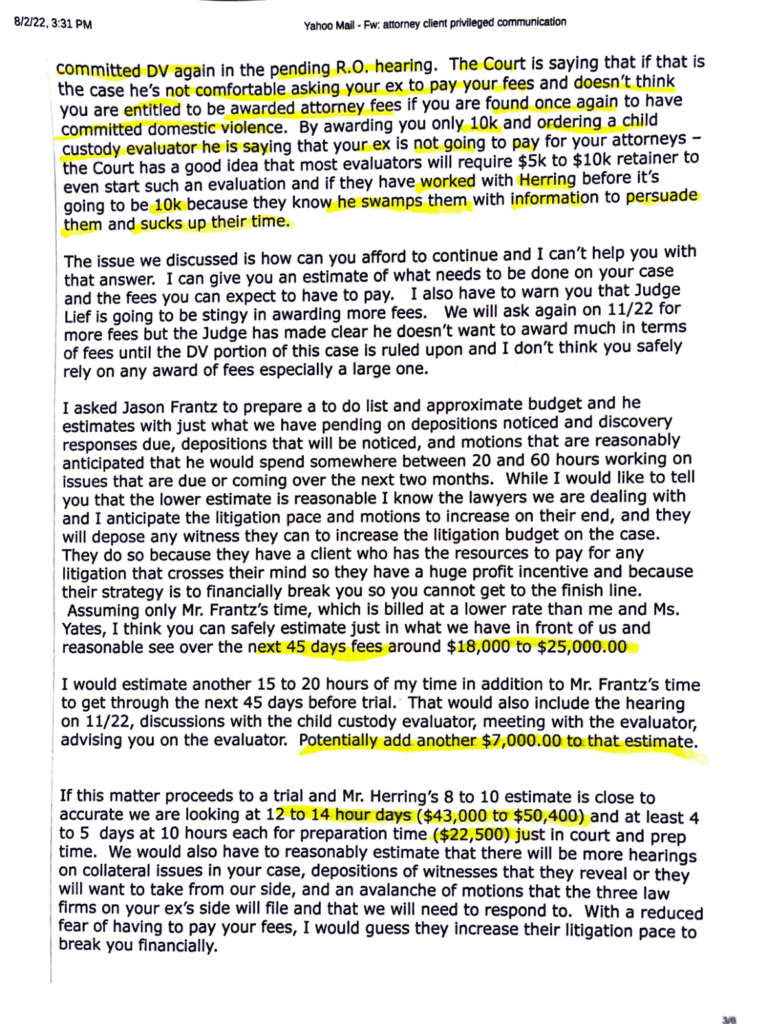
    Bamieh Letter Analysis – Yellow-highlighted callouts on Ron Bamieh’s 2021 email admitting extreme DV finding and no-win setup. (From bamieh_letter_exhibit.pdf)

    Evidence Bundle Part2 – 20-page texts on ex parte ruling without hearing, denying due process. (From Evidence_Bundle_Part2.pdf)

    Scott Barrella Evidence Packet – Summary and text screenshots proving post-class contact he denied under oath. (From SCOTT_BARELLA_EVIDENCE.pdf)


  • The Fix Was In: A Six-Year Pattern of Judicial Bias in MMA Fighter Amir Rahnavardi’s Ventura County Case

    The Fix Was In: A Six-Year Pattern of Judicial Bias in MMA Fighter Amir Rahnavardi’s Ventura County Case

    When Judge Henry Walsh branded Muay Thai world champion and father of three, Amir Rahnavardi, a domestic violence perpetrator, it wasn’t based on evidence, it was built on bias. There were no visible injuries, no credible witnesses, and a series of police reports showing the alleged victim, Rebekah, had been the aggressor. Yet Walsh’s ruling would ignite a years-long legal war that exposed something far darker than a custody dispute—it revealed how Ventura County’s family court system weaponizes power and suppresses truth.

    Judge Walsh’s conduct in this case mirrored a reputation already tarnished. In 2016, he was publicly admonished by the California Commission on Judicial Performance for improper courtroom behavior. But long before that rebuke, he had already set the stage for Rahnavardi’s destruction. According to 2013 and 2014 Ventura County Sheriff’s reports, deputies who responded to multiple domestic disturbance calls found no evidence of physical violence. One report explicitly noted Rebekah appeared “scattered,” “contradictory,” and “not completely truthful.” Officers documented that she declined medical attention and admitted the argument had been verbal, not physical.


    Alleged DV injuries filed by opposing counsel (Exhibits 1–3).
    These images do not show real trauma consistent with a “two-hour beating.”
    They are superficial and inconsistent with the level of force alleged. These were the only photos ever used to claim that Rahnavardi “beat Rebekah for two hours.” They were never verified or authenticated, and it remains unclear whether any official police photos were ever taken. The pictures originated from Rebekah’s brother, who never appeared in court to testify or confirm them.

    Actual fight/impact photos (Exhibits 4–6).
    These show Rahnavardi’s real opponents from his professional fighting career—what genuine impact looks like when he actually lands a strike. The difference speaks for itself. Exhibit 6 (her hands) aligns with Rahnavardi’s account that Rebekah punched him, and that he then said, “Oh yeah? Let me help you with that,” using her own hands to strike his face. These photos reflect the truth, not Herring’s fabricated story.

    Alleged DV injuries filed by opposing counsel (Exhibits 1–3).
    These images do not show real trauma consistent with a “two-hour beating.”
    They are superficial and inconsistent with the level of force alleged. These were the only photos ever used to claim that Rahnavardi “beat Rebekah for two hours.” They were never verified or authenticated, and it remains unclear whether any official police photos were ever taken. The pictures originated from Rebekah’s brother, who never appeared in court to testify or confirm them.Actual fight/impact photos (Exhibits 4–6).
    These show Rahnavardi’s real opponents from his professional fighting career—what genuine impact looks like when he actually lands a strike. The difference speaks for itself. Exhibit 6 (her hands) aligns with Rahnavardi’s account that Rebekah punched him, and that he then said, “Oh yeah? Let me help you with that,” using her own hands to strike his face. These photos reflect the truth, not Herring’s fabricated story.

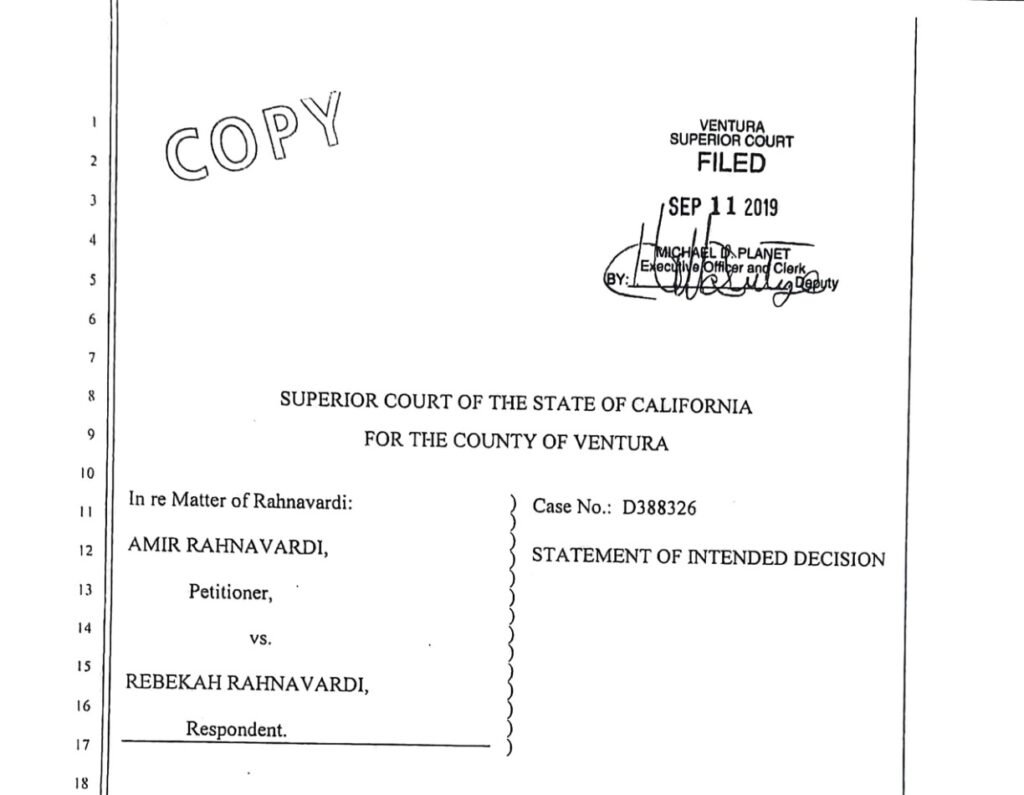
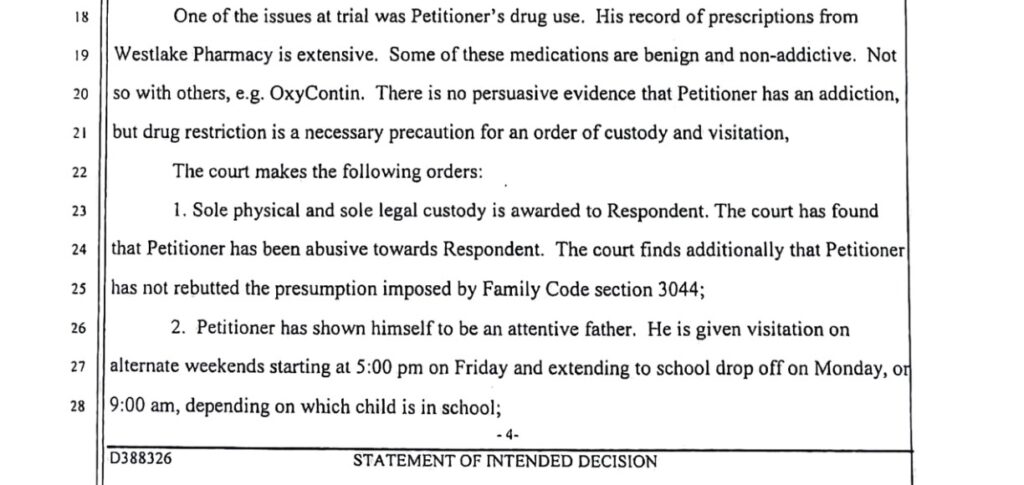
    Despite those records, Judge Walsh ignored the reports entirely and ruled that Rahnavardi had committed “severe acts of domestic violence.” His reasoning was as thin as the evidence he refused to review. In October 2021, former Ventura County District Attorney Ron Bamieh, who briefly represented Rahnavardi, put in writing what most attorneys would never admit on record.  After reviewing Judge Walsh’s ruling, Bamieh wrote:, “This is the type of ruling you see when men choke and beat women severely, and that was not the case for you.” Walsh rejected the defense’s expert witness, Dr. Nancy Kaiser-Boyd, who specialized in trauma psychology, and instead relied on controversial gender-theory advocate Alice LaViolette, whose testimony has been criticized in other high-profile cases for favoring female accusers regardless of evidence. Walsh also cherry-picked video clips over full recordings, excluded exculpatory footage, and issued a Statement of Intended Decision on September 11, 2019, which became the legal framework subsequent judges followed like scripture.

    When the case shifted to Judge Michael Lief, a former Ventura County prosecutor and Navy veteran, any hope for balance disintegrated—and the injustice continues to this day. Lief has presided over Rahnavardi’s case since 2020, and for more than five years, his courtroom has been the epicenter of procedural abuse and judicial overreach. He suppressed over a year of journal entries, videos, and forensic evidence documenting Rebekah’s aggression, ignored 75 supervised visitation reports confirming Rahnavardi posed no threat, and dismissed the 2013–2014 police reports as “not relevant.”

    Lief terminated sanctions motions without ever holding a hearing, blocked discovery that would have exposed collusion between opposing counsel and referee Leon Bennett, and continued to enforce supervised visitation even after every professional involved cleared Rahnavardi of wrongdoing. As of 2025, Lief still restricts him to seeing his children just three days a month for eight hours total, despite zero legal or psychological justification. Each new ruling compounds the damage—proof that Lief’s courtroom is not a place of justice but a mechanism of continued punishment. His ongoing interference shows that the corruption in Ventura County’s family courts isn’t a closed chapter, it’s an active crime against fairness itself.

    The court’s appointment of Leon Bennett as a “neutral” discovery referee in 2023 turned bias into collusion. Emails from June 8–14 of that year, obtained through court records, reveal Bennett was in direct communication with opposing counsel Greg Herring and the forensic firm Verdict Resources. In one exchange dated June 14, 2023, Rahnavardi wrote to Verdict’s John Troxel: “I have court today at 1:30. Will you be available this morning 10:15–10:30 to do the credentials?” The message was copied to Herring’s entire team—and to Bennett. The discovery referee, tasked with neutrality, was quietly working in coordination with one side of the case. When this came to light, sanctions motions tied to Bennett’s conduct were abruptly terminated, and an independent forensic review of the digital evidence was blocked. Bennett’s actions were not judicial oversight—they were obstruction under the guise of procedure.

    In 2024, the case was reassigned to Judge Joann Johnson, who initially appeared impartial. Johnson admitted a pivotal piece of evidence known as the “Becky Odum letter,” a typed document with Rebekah’s handwritten edits that switched voices between Amir and herself—an unmistakable sign of manipulation and fabrication. The letter exposed emotional and psychological control tactics that had underpinned years of false claims. But the integrity didn’t last. After a private meeting with Judge Lief, Johnson’s rulings shifted dramatically. She downplayed the letter’s significance and began echoing prior judicial language that aligned with Walsh’s original bias. Even the one judge who seemed committed to fairness eventually folded under pressure, confirming how deeply the network of control in Ventura’s family courts runs.

    An internal analysis known as the Judicial Bias Scoreboard offers visual proof of that systemic prejudice. The dataset tracks rulings between 2019 and 2024, color-coded by outcome. Green represents rulings in favor of Rebekah; red represents those for Amir. The imbalance is staggering, nearly every one of her filings granted, nearly every one of his denied. Custody motions, sanctions, ex parte applications, discovery disputes, it didn’t matter. Across four judges and a referee, the results tell the same story: Ventura County’s family courts are not dispensing justice. They’re protecting each other.

    The evidence suppressed in this case forms a damning archive of what the courts refused to confront. Police reports from 2013 and 2014 documenting no domestic violence. The forensic report proving iCloud and YouTube intrusions. An official L.A. Sheriff’s cybercrime report confirming data theft. Seventy-five supervised visitation reports showing safe, loving parenting. Letters from experts, including veterinarians and behavioral specialists—proving that Rahnavardi’s dog, Dusty, was never a danger to the children. Each of these documents dismantles the false narrative built against him, and each was buried to preserve it.

    The cost of this judicial corruption extends far beyond one man’s reputation. It bankrupted Rahnavardi, destroyed his relationship with his children, and erased his right to due process. But more dangerously, it exposed how entrenched bias operates in plain sight—judges protecting their own, referees colluding with counsel, and evidence withheld when it undermines the predetermined outcome. Ventura County’s family court system has turned justice into a performance, and Rahnavardi was cast as the villain before the script was even written.

    In the end, this case is not about custody, it’s about power. A father’s life was dismantled by a judicial machine more invested in maintaining its authority than the truth. What happened in those courtrooms is not an anomaly. It’s a warning to every citizen who believes the system still plays fair.