In American courtrooms, justice is supposed to unfold on the public record. Motions are filed, evidence is introduced, witnesses testify under oath, and judges issue rulings in open court. Yet in many of the country’s most consequential criminal and civil cases, the official record captures only a fraction of what actually matters. The rest is buried in transcripts few people read, filings few journalists have time to parse, and contradictions that surface only when someone is willing to look closely enough.
Running parallel to formal proceedings is a lesser-known but long-standing practice: independent investigative journalists retained, funded, or facilitated by parties to a case, often defendants, to examine records and publish reporting under their own editorial control. Despite frequent attempts to cast this work as improper or unethical, it remains lawful, established, and constitutionally protected.
This form of journalism exists because courts are not designed to investigate themselves, and modern newsrooms are rarely resourced to reconstruct complex cases from thousands of pages of filings. Independent journalists step into that gap, operating outside the courtroom but anchored to the record.
In high-profile criminal cases, particularly those involving claims of wrongful conviction or procedural failure, independent investigative reporting has often functioned as the first serious re-examination of the facts after a verdict is entered. The reinvestigation of the case against Adnan Syed offers one of the clearest examples. Journalists behind Serial conducted a meticulous review of trial testimony, phone records, timelines, and witness statements that had not been meaningfully scrutinized in earlier coverage. Although the reporting was facilitated through defense-side access and funding, the journalists retained full editorial control and published their findings independently. The reporting surfaced factual gaps and disclosure issues that later became central to post-conviction litigation. No court sanctioned the work. No regulator intervened. It was treated as journalism doing what the legal process had failed to do on its own.
A similar pattern emerged in the prosecution of Michael Peterson, where independent journalists revisited police conduct, forensic assumptions, and evidentiary inconsistencies years after conviction. The reporting produced by the journalists behind The Staircaserelied on access to trial records and post-trial evidence facilitated by the defense, but editorial control remained firmly with the journalists. Their work exposed flaws in forensic testimony, undisclosed conflicts involving expert witnesses, and evidentiary issues that had not been fully examined at trial. The reporting intersected with post-conviction relief efforts and reshaped public understanding of the case. Again, the decisive factor was not who facilitated the work, but whether the reporting was accurate, fact-based, and grounded in the record.
In civil litigation, this practice is even more common, though far less discussed. Defamation defendants, probate litigants, civil-rights defendants, and parties in complex personal-liability disputes regularly engage independent journalists to examine records and publish findings in the public interest. These journalists publish under their own bylines and often reach conclusions that complicate, rather than advance, a litigant’s legal position. Courts have consistently permitted this parallel reporting to proceed, even during active litigation, because there is no statute, regulation, or body of case law prohibiting it.
That legal framework explains my role in reporting on the Grossman case. In the criminal prosecution ofRebecca Grossman, and in the related civil proceedings that followed, public coverage has often relied on narrative compression rather than evidentiary precision. My work as an independent investigative journalist has focused on the same materials the courts rely on: sworn testimony, trial transcripts, filings, timelines, and the points at which public claims diverge from the record itself.
The reporting has involved sustained examination of testimony given under oath, comparison of contemporaneous records with later public statements, and analysis of how evidence was framed in media coverage versus how it appeared in court. The conclusions published under my byline reflect the core principle of independent journalism.
When journalists independently verify and publish irrefutable facts, supported by documents, evidence, and sworn testimony, funding alone does not invalidate the work.
Attempts to portray this reporting as regulated or prohibited consistently collapse under scrutiny. The Federal Trade Commission does not regulate journalism. Its authority is limited to commercial speech, advertising, and consumer deception. Investigative reporting about criminal or civil litigation does not fall within its jurisdiction, and the agency has never brought an enforcement action involving a litigant funding factual journalism about a legal case.
Journalism ethics codes offer no prohibition either. The standards articulated by the Society of Professional Journalists emphasize independence, accuracy, and accountability, but they are voluntary by design and intentionally non-enforceable. They do not ban commissioned investigations, funded reporting, or work originating from interested parties. Any attempt to impose such restrictions would raise immediate constitutional concerns under the First Amendment, which protects not only publication but the process of newsgathering itself.
The safeguard in this system is not prohibition. It is independence. When journalists control their reporting, verify facts, and publish transparently, funding alone does not undermine the legitimacy of the work. Courts recognize this distinction. Regulators respect it. Constitutional law protects it.
What is striking is not that defendants sometimes support independent investigative journalism, but that this long-standing practice is so frequently mischaracterized when reporting unsettles dominant narratives or challenges entrenched interests. For decades, independent journalists have functioned as a parallel public record, operating outside the courtroom but often closer to the evidentiary truth than the headlines suggest.
They are not officers of the court. They are not advocates. And they are not regulated away for a reason.
Because the moment they are, the public loses one of its last independent windows into how justice is actually administered.
In response to the targeted smear campaign launched by Julie Cohen on the Justice for Mark and Jacob Iskander page regarding my coverage of the Rebecca Grossman case:
I am an independent journalist. For more than 15 years, I have reported on public corruption as a community service, largely free of charge. I do not have advertisers, sponsors, or financial backers influencing my work.
Covering high-profile, complex cases is central to the mission and content of my website. When I am approached to cover a story in an investigative capacity, I vet the project and, when appropriate, assess a project fee to research, write, and publish across my platforms. This policy is fully disclosed on my media website. It is public information.
Every article I have ever published is fact-based and supported by documents, evidence, and photographs. Not once have I received a demand letter requesting a retraction, deletion, or takedown of any article related to the Grossman case, because the reporting is accurate.
This is not “favorable” or slanted coverage. It is factual reporting, facts that much of the mainstream media deliberately omitted under the progressive prosecutorial narrative advanced during George Gascón’s tenure.
Julie Cohen, along with anyone else for whom I have documented proof of disseminating false statements about me or my work, will be receiving a formal cease-and-desist letter next week.
Screenshots and records are being preserved. If an Anti-SLAPP action becomes necessary, it will be pursued.
I have a 15-year, rock-solid reporting record with zero legal issues. Every media outlet covering this case has paid reporters to write about it. The difference is that their platforms are advertiser-driven, which inherently shapes coverage. I am self-employed, independent, and free to report without interference or financial pressure.
That independence is precisely why this reporting exists, and why it matters.
The cyberbullying by Cohen and her associates will not deter or silence coverage on my platform, including continued reporting on the Rebecca Grossman case.
Inside the vast and politically charged machinery of the Los Angeles County Sheriff’s Department, where credibility is currency and accountability is supposed to be non-negotiable, troubling questions about favoritism and internal power networks are now impossible to ignore as insider dealings have emerged under Sheriff Robert Luna’s watch. Elected in 2022 on promises of reform and transparency, Luna’s administration has instead been plagued by allegations of cronyism, nepotism, pay-to-play practices, and selective enforcement of policies designed to prevent exactly such abuses. At the center of this storm are two key figures: Captain Ryan Vienna and Captain Michael Moen, whose intertwined careers and personal connections raise serious questions about merit-based promotions, conflicts of interest, and the erosion of departmental integrity.
Drawing from internal San Dimas city documents, public records requests, redacted emails, and text messages obtained through the California Public Records Act (CPRA), this exposé reveals a story of high school buddies leveraging political clout, campaign loyalties, and city council influence to secure plum positions. It’s a tale that not only violates the spirit, if not the letter, of LASD’s own nepotism policy but also disadvantages dedicated lieutenants without the “right” connections. As Luna gears up for potential re-election amid mounting scandals, including federal indictments of his donors and ongoing lawsuits over deputy misconduct, this case exemplifies how personal relationships can trump professional qualifications in one of America’s largest law enforcement agencies.
The Players: A Brotherhood Forged in Youth and Cemented in Power
Ryan Vienna and Michael Moen aren’t just colleagues, they’re lifelong friends whose bond dates back to their days at Glendora High School in the San Gabriel Valley. Both pursued careers in law enforcement, rising through the ranks of LASD. Vienna, an egotistic figure with a dual role as a city council member in San Dimas since 2017 (re-elected in 2022), has cultivated a public image of civic leadership. His official bio on the San Dimas city website touts his “wealth of experience in public service,” including his work as a LASD captain. But behind the résumé lies a network of influence that extends from local politics to the sheriff’s inner circle.
Moen, meanwhile, was promoted to captain of the San Dimas Sheriff’s Station in late 2025, along with Ryan Vienna as captain of the Crescenta Valley Sheriff’s Station, a move that placed him directly in Vienna’s backyard. As captain, Moen oversees law enforcement in the very city where Vienna wields significant political power as a councilmember. This arrangement screams conflict of interest, yet it sailed through with apparent ease. Why? The answer lies in Vienna’s strategic alliances, particularly with Sheriff Luna.
In 2022, as Luna campaigned against incumbent Sheriff Alex Villanueva, Vienna hosted a high-profile campaign party for Luna. This event, held in San Dimas at Vienna’s father’s house, wasn’t just a casual gathering; it was a show of support that aligned Vienna with Luna. Sources familiar with the campaign describe it as a pivotal networking opportunity, where local leaders and law enforcement figures mingled to back Luna’s bid. When Luna won and took office in December 2022, Vienna’s loyalty paid dividends. Almost immediately, Vienna was assigned special projects directly under Luna and even filled in as the sheriff’s lieutenant aide, a role that granted him unprecedented access to the department’s top brass. Insiders said Vienna was following Sheriff Luna around like a lost puppy.
This proximity to power didn’t go unnoticed. Other lieutenants, lacking such personal ties or the means to host campaign events, found themselves at a stark disadvantage. In an agency where promotions are ostensibly based on merit, interviews, and performance, Vienna’s fast track exemplified the “pay-to-play” culture that Luna had vowed to dismantle. As one source from the eighth floor of HOJ said, “If you didn’t throw parties or kiss the ring, you were sidelined while the favorites climbed.”
The Promotion Plot: City Council Influence and a Rigged Selection?
Fast-forward to 2025, when the captain position at San Dimas Station opened up. The selection process, detailed in redacted emails from LASD Commander Walid S. Ashrafnia, was meant to be equitable: a panel of odd-numbered members (typically five), including representatives from the city, business or clergy members, and LASD liaisons. Interviews were scheduled for August 18, 2025, at San Dimas City Hall.
But documents reveal a process tainted by Vienna’s influence. As a San Dimas councilmember, Vienna had the ear of his colleagues, including Mayor Emmett Badar and Mayor Pro Tem Eric Weber, both close friends who endorsed Vienna’s re-election campaigns and, according to insiders, “would do anything he asked.” Badar, in particular, features prominently in a text message dated August 19, 2025, where he thanks Ryan Vienna for leaving messages with “the chief and Rob” (likely referring to Luna or a high-ranking executive) to commend the department for sending “5 well-qualified candidates.” Badar adds, “We believe we selected the candidate that we are sure was the right fit for San Dimas. I’m sure you will or have already confirmed our thoughts.” Badar confirmed Ryan Vienna relayed the message to Sheriff Robert “Rob” Luna in choosing his best friend, Michael Moen.
Text message exchange between Mayor Emmett Badar and Ryan Vienna.
This message, in a CPRA response, reeks of preordained outcomes. Why would Badar assume confirmation from Vienna unless the councilmember was pulling strings behind the scenes? Further, the emails coordinating the panel, redacted in places, show selective transparency. Names like Anabel Martinez from the LA County Board of Supervisors’ office are visible, but others are blacked out, including those of panel members and senders. Entire pages in the provided documents are fully redacted, prompting the question: What is San Dimas trying to hide? Was Vienna’s involvement scrubbed to avoid scrutiny?
The collusion deepens with Moen’s selection. As Vienna’s high school best friend, Moen was the “right fit” Badar alluded to. Vienna, leveraging his council position, allegedly influenced the panel to favor Moen, ensuring his promotion by Luna. This move not only placed Moen in command of San Dimas, where Vienna could benefit from a friendly captain, but also violated LASD’s nepotism policy (Manual of Policy and Procedures, Section 3-02/010.06).
Worse, on the very day of the interviews, Monday, August 18, 2025, Vienna was actively texting another candidate, Lieutenant Louis Serrano, informing him that the selection was between him and Michael Moen before the fifth candidate had even been interviewed. Text messages show the conversation escalating as early as Mon, Aug. 18, at 1:58 PM (“Good luck today! You got this. Hope it goes well!”), followed shortly after Serrano’s interview by Vienna’s revelation: “Nice… How do you feel? I think it’s between you and Moen.” This exchange occurred before 2:00 PM, when the final (fifth) candidate was still scheduled to interview. What you don’t see are any text messages between Vienna and Moen. Vienna appears to be trying to hide his communications with him.
This appears to have completely undermined the integrity of the captain selection process, as it suggested the fifth candidate had no real chance. LASD is known for throwing “filler” candidates into the top five odd-numbered selections designed to narrow the field and ensure the department’s preferred pick (in this case, Moen) prevails. Four out of the five candidates had no genuine shot at the job; they were props in a rigged game. The early disclosure to Serrano proves the outcome was pre-decided, with Vienna feeding inside information to his preferred contender while the process was still underway.
The policy explicitly prohibits “Qualified Personal Relationships” (QPRs) that could create conflicts of interest, favoritism, or impair departmental checks and balances. Defined broadly, QPRs include blood relatives, marriages, and even “influential” friendships or cohabitations. The guidelines warn against situations where one party can influence another’s professional environment, such as promotions or assignments. In Vienna and Moen’s case, their longstanding friendship, coupled with Vienna’s political role in the city Moen now polices, fits this definition squarely. The policy states: “Department members shall not participate in or influence any workplace decisions involving a relative and/or someone with whom they have a QPR… This includes, but is not limited to, transfers, reinstatements, promotions.”
Yet, no disclosure form (SH-AD-758) appears in the records, and the department’s response to inquiries has been evasive. Other lieutenants, without such insider access, were left in the dust, their qualifications overshadowed by cronyism.
The Cover-Up: Denied PRA Requests and Deleted Messages
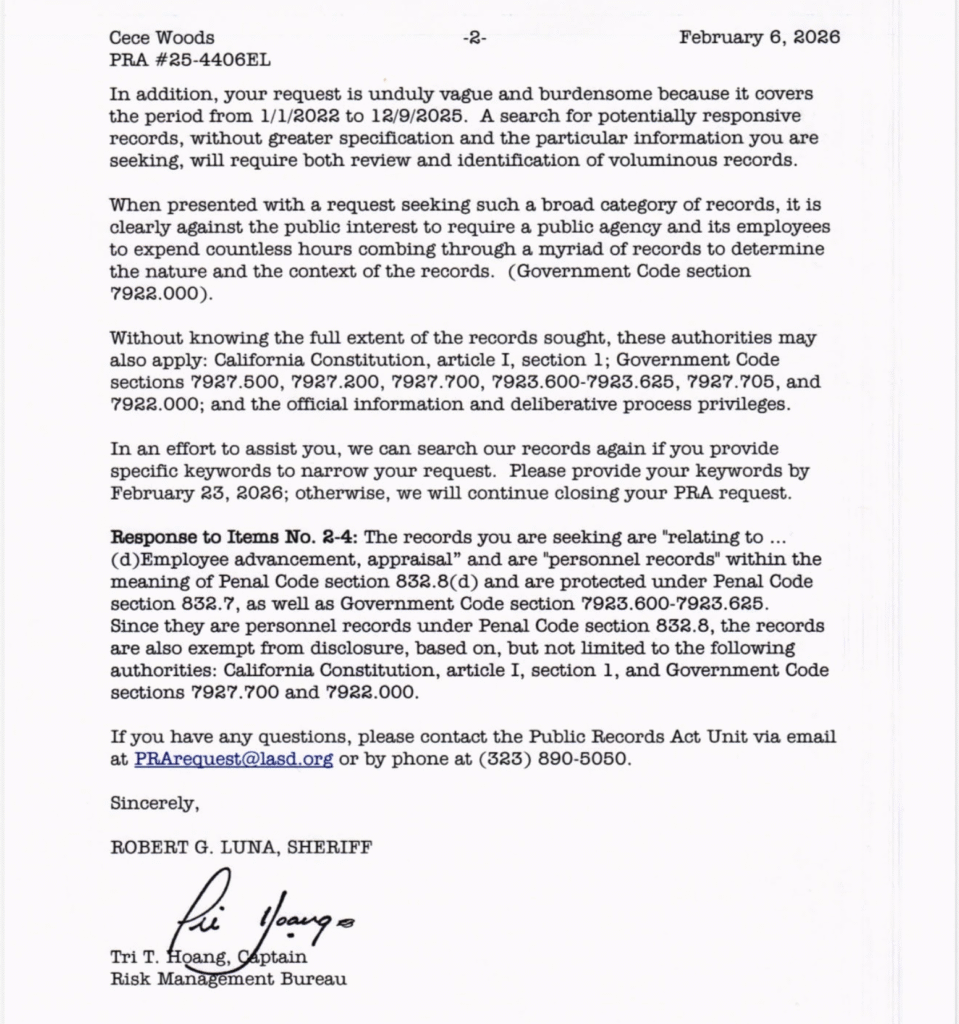
Attempts to uncover the truth have been met with stonewalling. A CPRA request filed on December 9, 2025 (PRA #25-4406EL) sought emails between Vienna and Moen from January 1, 2022, to the present; communications regarding their promotions; recommendation emails from executives or council members; and names of participants in the San Dimas and Crescenta Valley selection processes.
LASD’s response, dated February 6, 2026, and signed by Captain Tri T. Hoang under Luna’s authority, denied nearly everything. Item 1 was deemed “unduly burdensome and voluminous,” citing Government Code section 7922.530(a) for lacking specificity. Items 2–4 were classified as “personnel records” under Penal Code section 832.8(d), exempt from disclosure to protect privacy and deliberative processes. The letter invoked the California Constitution and various codes, effectively burying the request in legal jargon.
This denial is a blatant cover-up. Why refuse communications between two captains during their promotion periods unless they reveal improper influence? Notably, the attached text messages in the response include exchanges with interviewers but conspicuously omit any between Vienna and Moen. Sources allege Vienna deleted these messages and failed to disclose them in a separate PRA request to the City of San Dimas, further obscuring the trail.
The redactions are inconsistent: some names are blacked out, others not, suggesting selective editing to protect key players and fuel suspicions of hidden endorsements or directives from Vienna to the panel.
Broader Implications: A Department Riddled with Favoritism
This isn’t isolated. Luna’s tenure has been dogged by cronyism allegations, from promoting figures tied to alleged deputy gangs (as detailed in a 2024 WitnessLA report) to accepting donations from indicted developers like those at Shangri-La Industries (indicted in October 2025 for fraud) and the promotion of his Chief of Staff’s wife, Nancy Escobedo, to command the Sheriff’s Information Bureau. Insiders said Sheriff Luna did not allow other lieutenants to interview for the position. A federal lawsuit accuses Luna of withholding records from oversight commissions, echoing the transparency issues here.
Sheriff Robert Luna and Captain Nancy Escobedo.
In Vienna and Moen’s case, the nepotism policy meant to “ensure relationships do not create an adverse impact on a professional work environment” has been flagrantly ignored. As the policy notes, “Nepotism is the practice of individuals with power or influence providing unfair advantage… or employment to a relative.” Vienna’s influence over the San Dimas Council, combined with his Luna ties, handed Moen an unfair edge.
Badar and Weber’s endorsements of Vienna amplify the echo chamber. In Vienna’s 2022 re-election announcement on Facebook (February 19, 2022), he thanks Badar, Weber, and others for their support, highlighting their tight-knit group. These “very good friends” likely deferred to Vienna’s preference for Moen, prioritizing loyalty over impartiality.
A Call for Accountability
The Vienna-Moen saga is a microcosm of Luna’s flawed leadership: promises of reform undone by old-school favoritism. Other lieutenants, without campaign parties or high school chums in high places, face systemic disadvantages, eroding morale and public safety. The department’s cover-up through denied PRAs, redactions, and deletions demands an independent investigation by the California Attorney General or federal authorities.
As Luna faces scrutiny in his 2026 re-election bid, voters must ask: Is this the transparency we were promised? Or just another chapter in LASD’s long history of corruption? The documents speak for themselves. Now it’s time for the truth to prevail.
Editor’s Note: I submitted a formal complaint to the Office of Inspector General for an internal investigation. Sheriff Luna was included in the email. Will he follow the law and investigate my complaint?
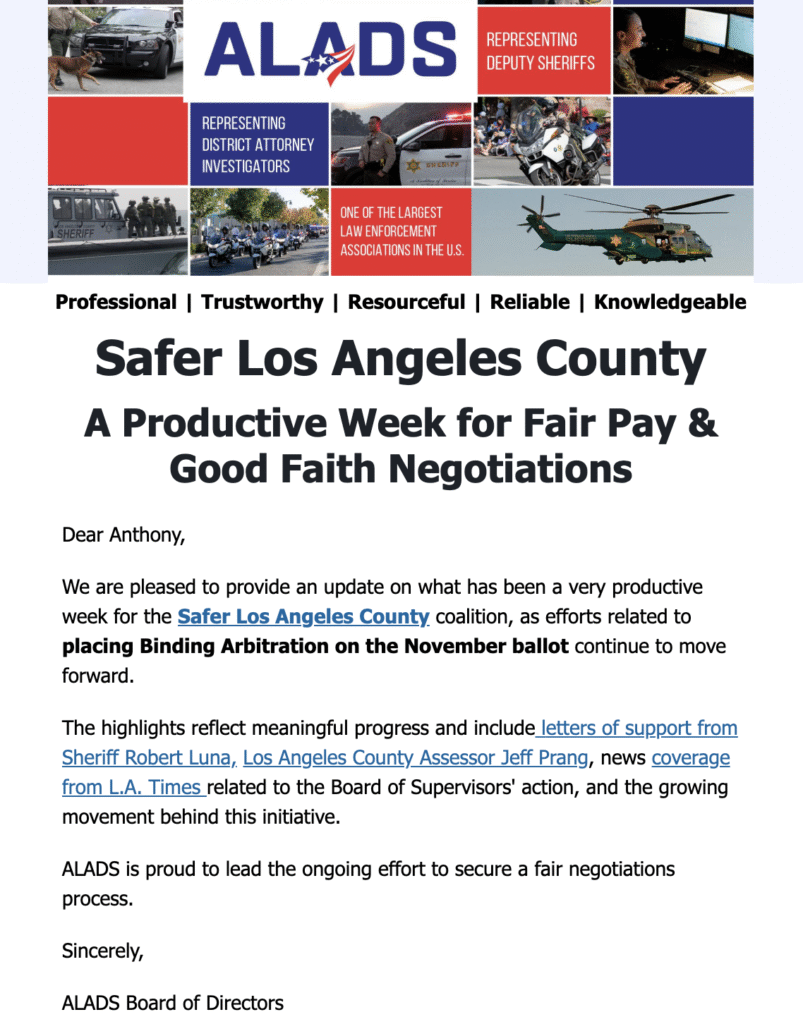
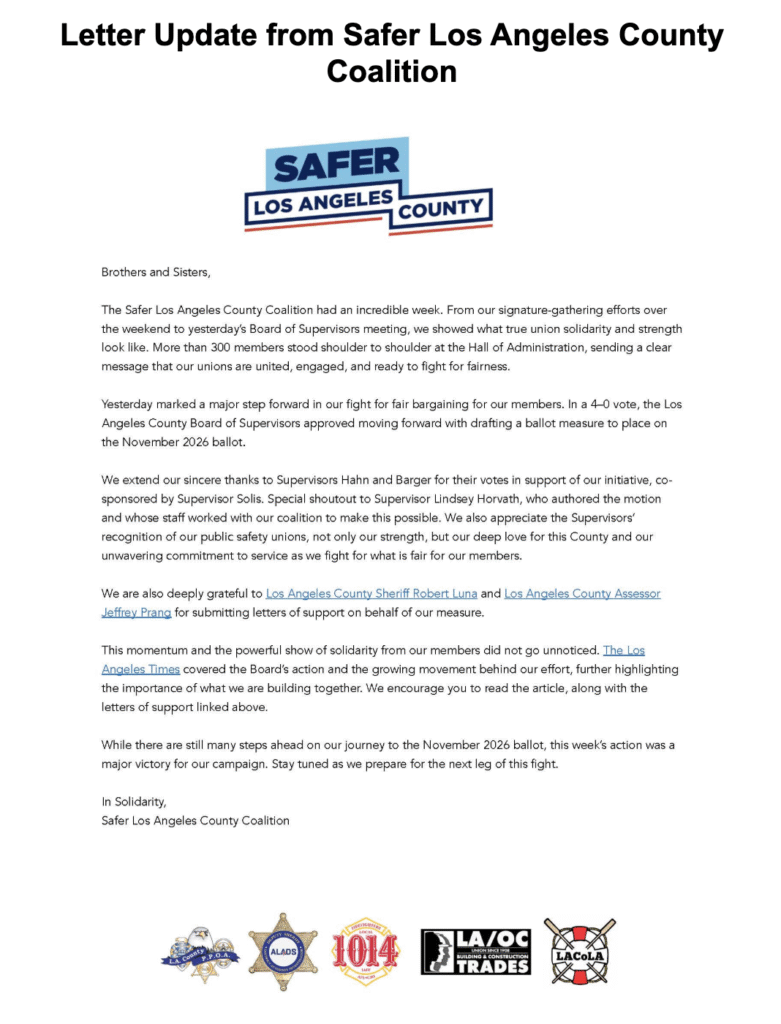
The email from the Association for Los Angeles Deputy Sheriffs arrived wrapped in confident branding and institutional polish, declaring a “productive week” and touting momentum behind a ballot measure that would place binding arbitration before voters in November 2026, highlighting a 4-0 vote by the Los Angeles County Board of Supervisors to move the measure forward, thanking Supervisors Hahn and Barger for their support, crediting Supervisor Solis as co-sponsor, recognizing Supervisor Lindsey Horvath for authoring the motion, and emphasizing letters of support from Sheriff Robert Luna and Assessor Jeff Prang along with media coverage from the Los Angeles Times as evidence of growing strength behind the initiative.
The communication frames the effort as meaningful progress toward fair negotiations, presenting solidarity and coalition building as proof that deputies are closer to resolution, yet it carefully avoids the most pressing operational issue facing the department, which is time.
Even if the ballot measure passes in November of 2026, the process does not conclude with voter approval, because the union and the county would still need to complete binding arbitration, a process that would realistically extend into sometime in 2027, leaving roughly one year before the 2028 Olympics to recruit, hire, train, and deploy enough qualified personnel to staff Los Angeles County at levels necessary to handle routine public safety demands along with the extraordinary pressures of a global event.
That timeline raises significant concerns because recruitment pipelines in law enforcement are not instantaneous, academy classes require months of preparation and instruction, field training extends for additional months under supervision, and the layered processes of background investigations, psychological evaluations, medical clearances, and administrative onboarding all demand sustained resources and coordination, making it unrealistic to believe that a single year could reverse years of staffing instability and produce a fully operational force prepared for Olympic scale deployment.
The clock is ticking, and the margin for error is shrinking with each passing month, yet the official narrative continues to center campaign milestones rather than operational metrics.
The question that should be asked repeatedly and publicly is straightforward, which is what the current rate of attrition within the Sheriff’s Department actually is, how many deputies are leaving for other agencies, resigning altogether, or retiring, how many new applicants are entering the academy, how many of those recruits successfully complete the academy, and what the true net gain or loss of personnel is when departures are measured against successful graduations.
There is growing belief among experienced members of the department that the numbers would show more deputies are leaving than entering, that the net gain of new deputies is either negative or marginal at best, and that under current trends the department could be decades away from being fully staffed, which would place enormous strain on existing personnel and undermine long-term planning for both routine operations and major events.
Sgt. Tony Romo has been one of the most direct voices expressing these concerns, offering a response to the celebratory messaging that reflects frustration within the ranks rather than applause. He gave this exclusive statement to The Current Report.
“Congratulations to ALADS for patting themselves on the back in contributing to the longest length of time that the Deputy Sheriff’s have gone without a contract in the last Thirty five years.
Congratulations to the BOS and Sheriff Luna for guaranteeing that the county will get another year of working the Deputies to death without a legitimate contract. They along with the Unions collusion are destroying the department ensuring recruitment and retention issues will not be solved in time for the 2028 Olympics.
They are just throwing up a giant smoke screen. Pretending to care. If the Sheriff and the BOS really wanted to make LA COUNTY a safe place they have the power and ability to correct the disastrous last three years. They don’t need a ballot measure or binding arbitration to fix this.
The truth hurts and they don’t want to hear it.”
Romo’s perspective carries institutional weight because he was born and raised in Los Angeles County and has spent more than forty years employed with law enforcement agencies within the county, including thirty-six years with the Sheriff’s Department and twenty-three years serving as a Sergeant, making him one of the two longest serving Sergeants currently in the department, with experience spanning Custody, Patrol, Court Services, Investigations, Administrative assignments, Special Operations Division, Transit Services, Emergency Operations Bureau, Community Relations, Youth Services, and extensive involvement in employee relations matters, and he is currently off on work-related medical leave.
His argument is rooted less in ideology and more in arithmetic, because even under the most optimistic scenario in which arbitration concludes in 2027, the department would face the near impossible task of rebuilding staffing levels within a single year before the Olympics, a timeline that does not align with the realities of recruitment cycles, academy throughput, training demands, and retention challenges.
While the official update emphasizes solidarity, momentum, and campaign victory, it does not disclose staffing deficit figures, academy completion rates, resignation trends, retirement projections, or realistic modeling of how arbitration timing intersects with Olympic operational planning, and without those data points the public is left with promotional language rather than measurable accountability.
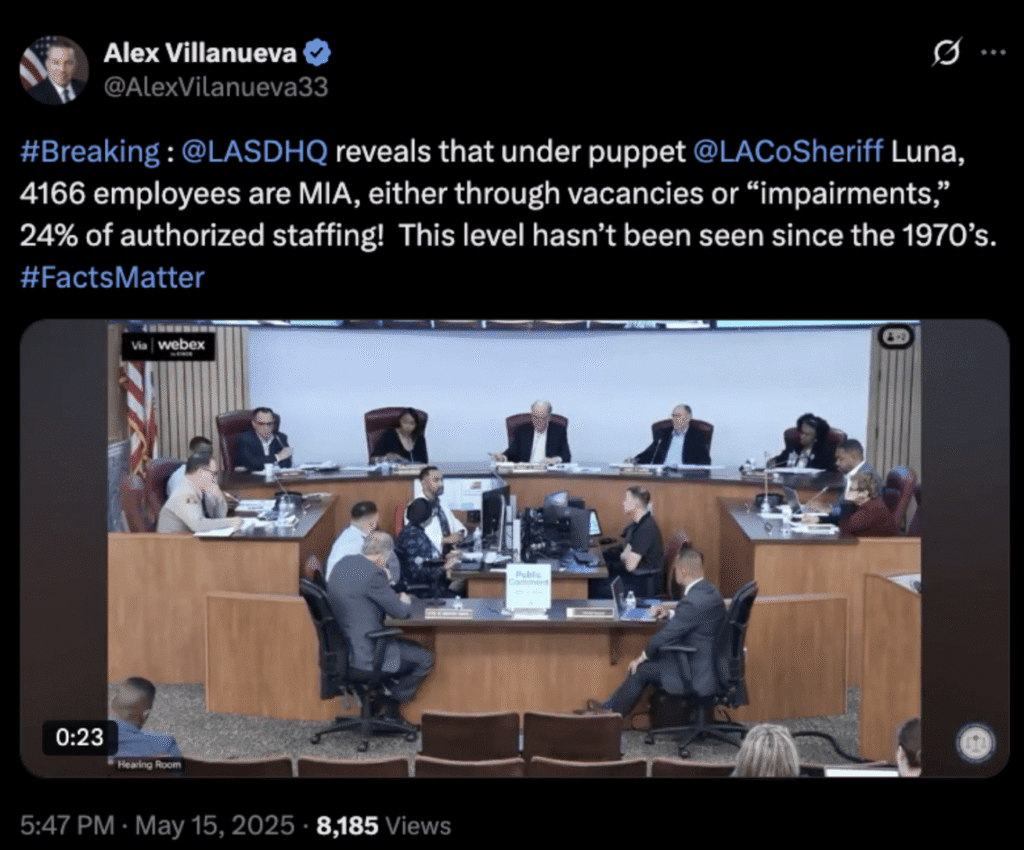
The smell of desperation is in the air at LASD who is experiencing a historic staffing crisis under Sheriff Robert Luna.
Los Angeles County’s public safety infrastructure depends on more than coalition messaging and political endorsements, because patrol shifts must be filled daily, custody facilities must remain adequately staffed, court operations must function, specialized units must remain deployable, and emergency operations must be prepared for contingencies that cannot be postponed to fit a ballot calendar, all while preparing for a global event that will test every layer of the department’s operational capacity.
The distinction between a productive week for a campaign and a productive solution for a department lies in transparent numbers, realistic timelines, and measurable staffing recovery, and until those metrics are openly presented and reconciled with the Olympic countdown, the debate over binding arbitration will continue to unfold under the shadow of an unanswered question about whether the strategy addresses the urgency of the moment or merely extends it.
As Los Angeles County barrels toward a global stage in 2028, the question is no longer whether the staffing crisis is real. It is whether county leadership is prepared to confront it honestly, or whether optics will continue to take precedence over operational reality. Arbitration clocks, press conferences, and carefully worded announcements do not put deputies in patrol cars. They do not restore morale. They do not reverse attrition. And they certainly do not prepare a depleted department for the security demands of a World Cup, a Super Bowl, and an Olympic Games.
Former Sheriff Alex Villanueva weighed in bluntly on what he believes is really happening: “This is political theater designed to give the appearance of progress to influence the upcoming elections. The board has had the authority to negotiate in good faith all along, this gives them a chance to kick the can down the road.”
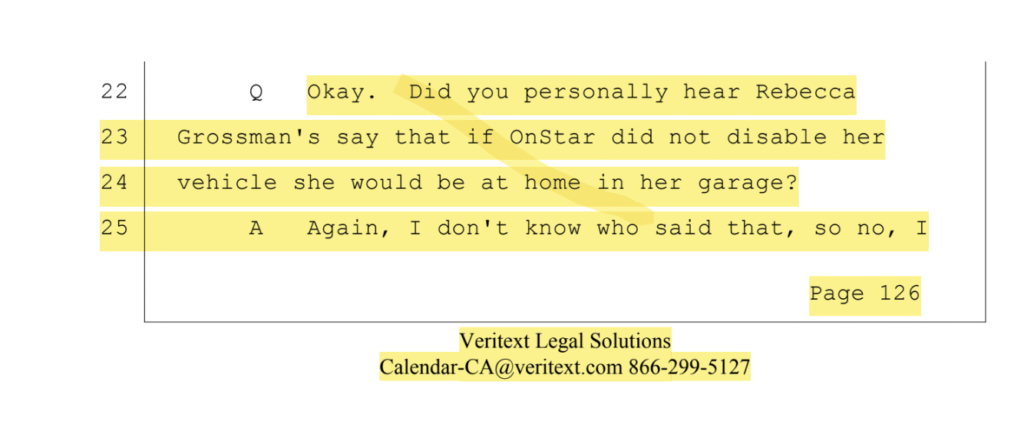
The prosecution’s implied malice theory in the Rebecca Grossman case did not rest on forensic certainty or undisputed conduct. It rested on a sentence. A single, emotionally loaded line attributed to Grossman in a hospital setting, that she would have been “at home in my garage” if her Mercedes had not disabled her vehicle. That quote did more than color the narrative. It supplied the moral shortcut prosecutors needed to bridge tragedy to depravity, accident to murder. Without it, the case looks fundamentally different, because without it the prosecution loses its cleanest emotional bridge to state of mind and its easiest way to argue that what happened was not simply catastrophic, but callous.
Approximately two years after the accident that killed Mark and Jacob Iskander, activist Julie Denny Cohen assumed control of the Justice for Mark and Jacob Iskander Facebook page and transformed it into a platform that amplified Teryl Grasso’s alleged hospital recollection into a public mantra of condemnation. The page did not simply memorialize the children, it pushed a specific narrative of Grossman’s guilt, elevating the alleged “garage” comment as settled fact and branding those who questioned it as deniers. The allegation was repeated, reinforced, and circulated widely long before a jury was empaneled, and long before the public was presented with the full context of what was known, what was assumed, and what was never validated. What emerged was not organic grief but a curated narrative environment where outrage was treated as evidence, repetition was treated as proof, and the most damaging interpretation was treated as the only acceptable one.
Grasso herself posted about the alleged hospital statement on Cohen’s “Justice” page. That post was later removed. Yet neither Grasso nor Cohen has clearly articulated what the post actually said. The public exchange did not reflect contemporaneous documentation of a precise quote. It reflected uncertainty about wording and substance. What was presented publicly as confirmation functioned as repetition without precision, amplification rather than corroboration. That distinction matters because repetition does not convert an uncertain recollection into established fact, and it does not convert a social media echo into a reliable evidentiary foundation for implied malice.
With the Iskanders’ decision to move forward to a civil trial, a door has opened that remained sealed during the criminal case, the ability to interview witnesses who were never called to the stand and to put them under oath in a setting where questions can no longer be avoided. Those witnesses were not peripheral observers. They were the individuals who remained with Rebecca Grossman during the critical window when the alleged statement was supposedly made, and their accounts go directly to whether the prosecution’s most emotionally useful sentence was ever actually spoken by the defendant, or whether it metastasized into “fact” through repetition, narrative convenience, and time.
During the criminal trial, one of the most important witnesses, Sergeant Grehtel Barraza, was not called to testify. Dr. David Matero, the emergency room physician responsible for Grossman’s medical clearance, was not directly asked whether he heard the alleged statement. Deputy Jason McGee was not asked that specific validation question in a way that required a clear confirmation or denial. The jury was never presented with a structured, direct conflict between Grasso’s account and the testimony of the individuals positioned to hear the statement. It cannot honestly be said that the jury chose Grasso over these witnesses because that evidentiary comparison was never fully developed before them, and that omission is not a technical detail, it is the difference between a jury weighing a contested statement and a jury being handed a statement as unchallenged narrative weight.
During recent civil proceedings, Sergeant Barraza testified she worked for the Los Angeles County Sheriff’s Department for sixteen years and had been promoted from Deputy Sheriff just three weeks before her testimony. At the time of the incident she was a training officer supervising Deputy Jason McGee. That distinction is significant because it placed her in a position of heightened responsibility and constant proximity during the most critical phases of the encounter, and because it frames her role as more than a bystander, she was accountable for oversight, for custody decisions, and for the documentation of a detainee’s conduct and statements.
Deputy Barazza receiving the “Deputy of the Year” award in 2016.
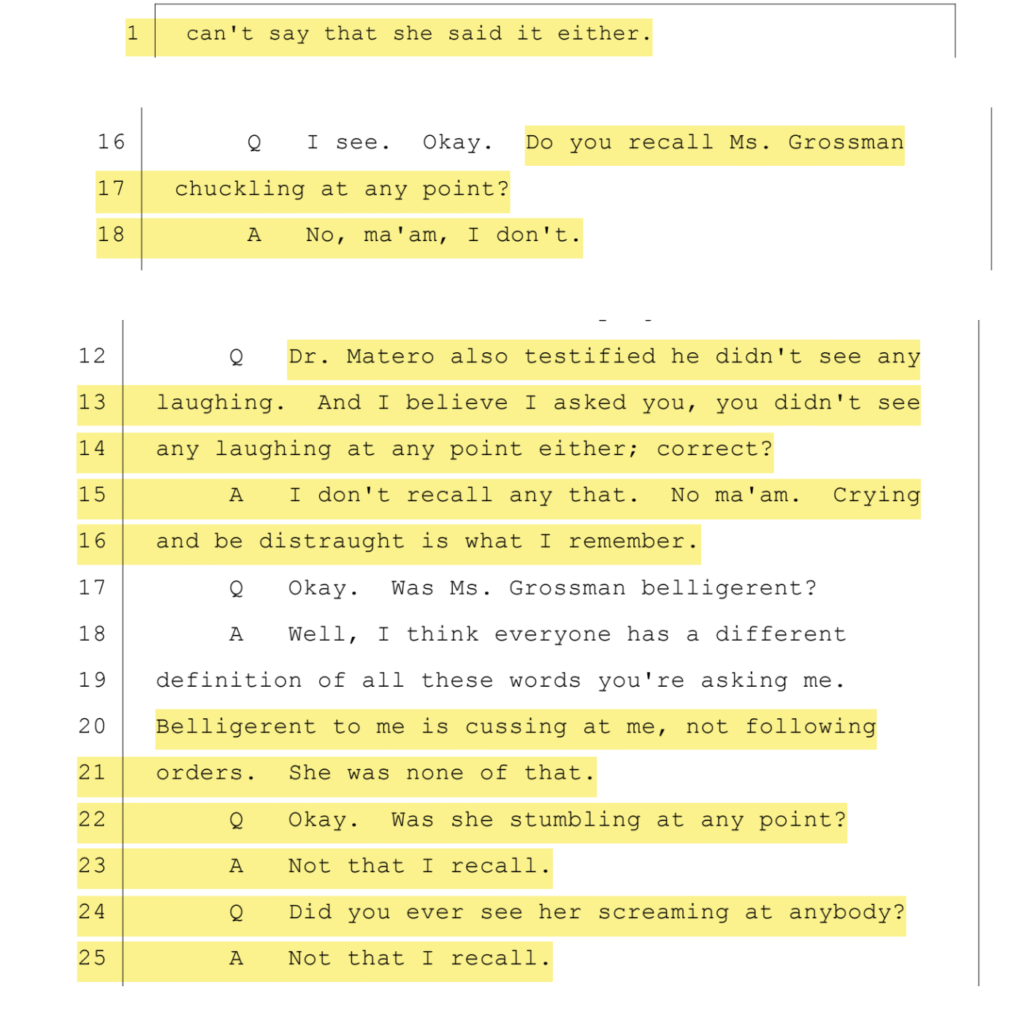
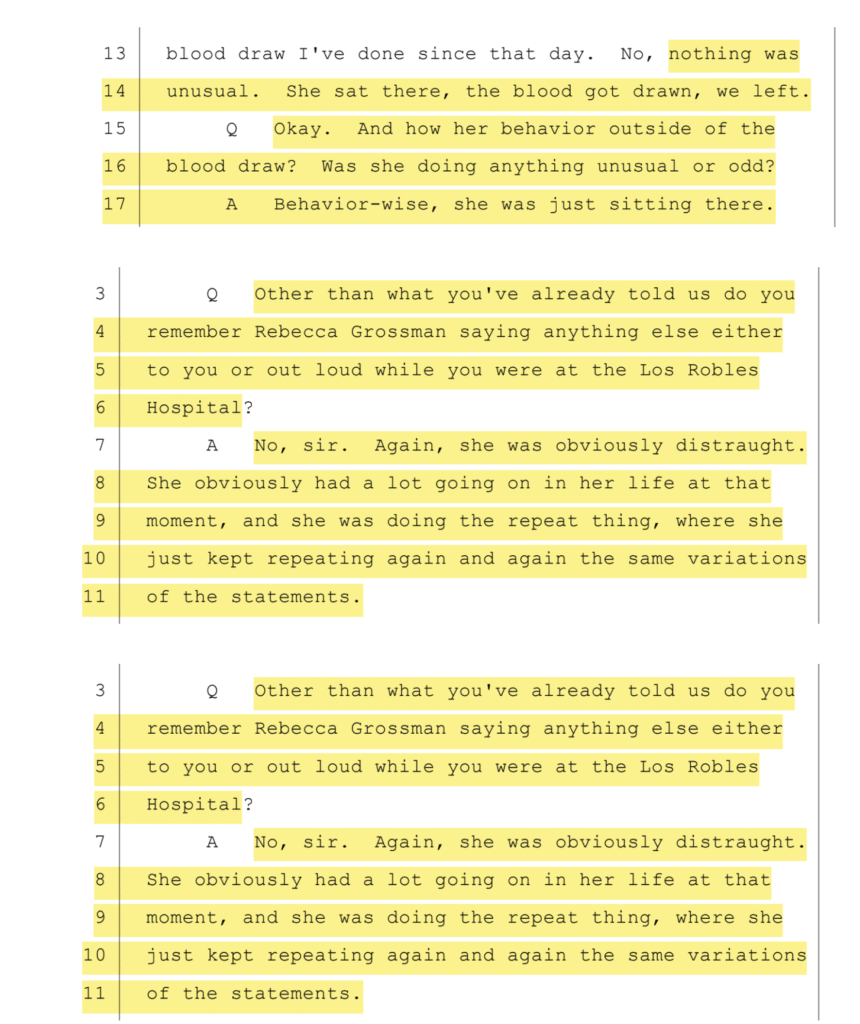
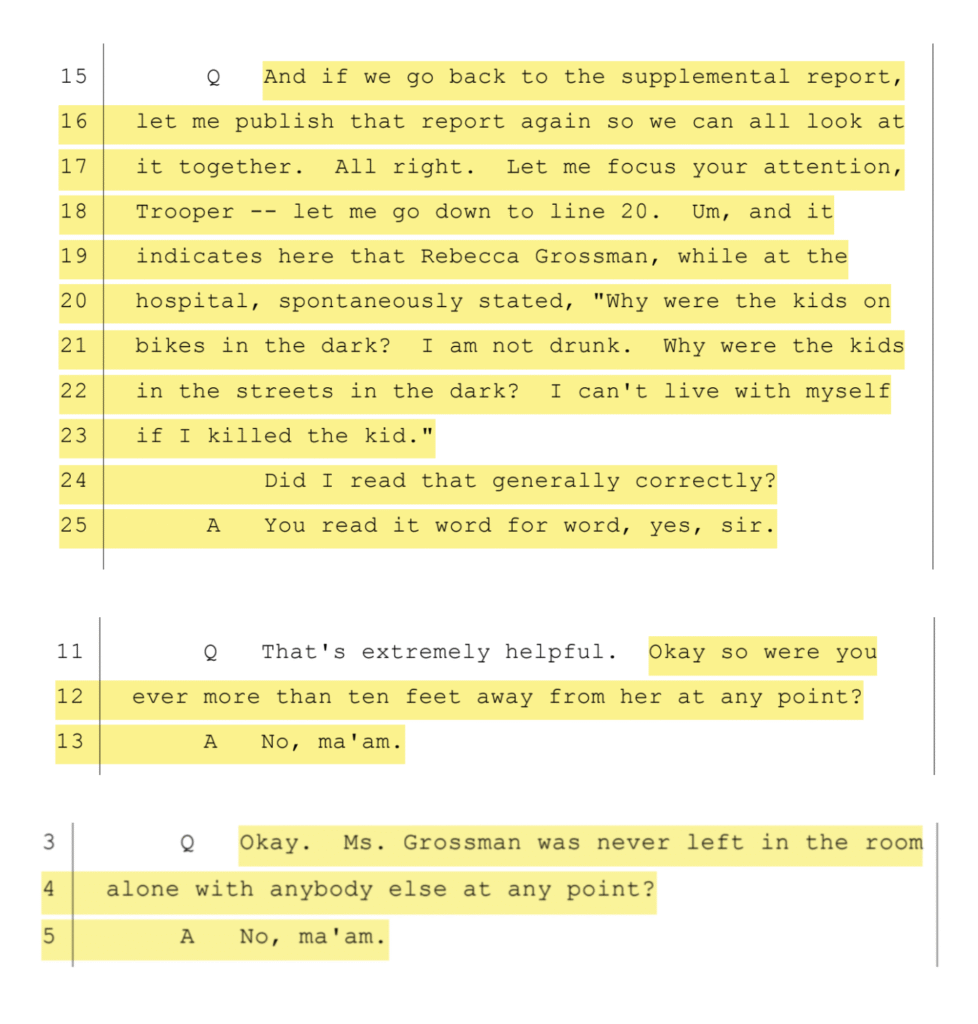
Barraza testified she and McGee responded together after hearing a dispatch request for assistance at a reported vehicle pedestrian collision near Triunfo Canyon Road. They initially assisted with traffic control before Barraza received instructions from Deputy Rafael Mejia to provide security for the suspected female driver later identified as Rebecca Grossman. Barraza testified she and McGee transported Grossman to Los Robles Hospital for a blood draw and medical clearance prior to booking. She testified unequivocally that she and McGee remained with Grossman continuously from the moment of arrest through hospital processing and booking into jail, with only two brief exceptions, approximately ten minutes when Barraza left Grossman with McGee to obtain a blood draw warrant, and the short time McGee retrieved the transport vehicle. Grossman was not left alone, she was not unescorted, she was not beyond earshot of law enforcement, and that matters because the prosecution’s most damaging quote is alleged to have been spoken during precisely the period when Grossman was under continuous custodial supervision.
Barraza testified Grossman cried during transport from the scene to the hospital. She testified Grossman did not laugh and did not make any statement resembling the alleged “garage” comment in her presence. Her testimony was direct and unequivocal, and it does not leave room for the prosecution to argue that a dramatic line was spoken clearly in the presence of the deputy responsible for custody and yet somehow missed.
Deputy McGee, also deposed in the civil proceedings, indicated that the phrase sounded familiar to him and that he believed he may have heard it somewhere. When pressed, however, he clarified that he did not hear the statement from Rebecca Grossman. He did not testify that she made that statement in his presence. That distinction matters because it draws a line between recognizing a phrase that has circulated through media and courtrooms and personally hearing a statement from a defendant during custodial supervision, and those are not the same thing, especially when the phrase in question is being used as emotional proof of malice.
Dr. David Matero testified in his civil deposition that he did not recall Grossman making the alleged statement during his evaluation. He acknowledged that the phrase sounded familiar to him, but explained that familiarity came from hearing it later in court, not from hearing it that night at the hospital. He testified that law enforcement was present throughout his interactions with Grossman and that if she had made such a statement in a manner reflecting indifference or consciousness of guilt, he would have reported it. He did not. He described the hospital as an active trauma setting with approximately twenty staff members present and multiple conversations occurring simultaneously, not an isolated private exchange where a single dramatic sentence could reliably be memorialized as an exact quote years later. He also testified that he did not recall interacting with Grasso that night, a point that matters because it further isolates her claimed recollection from the professionals who were tasked with evaluating and documenting Grossman in real time.
The significance of this alignment is not that three witnesses contradicted Grasso before a jury. The significance is that the jury was never asked to weigh that alignment in a direct and focused way. The core concern therefore shifts to prosecutorial process. If the District Attorney’s Office spoke to Barraza, McGee, and Matero before trial, did they specifically seek validation of Grasso’s claim. If they did and received no corroboration, why was the statement still advanced as central to implied malice. If they did not seek that validation, why was that step omitted when the statement became so critical to establishing state of mind, and why was the most reliable method of corroboration, asking the people who were physically present and professionally obligated to notice, simply not forced into the record.
The timeline of Grasso’s contact with prosecutors also requires precision. Her outreach to Deputy District Attorney Ryan Gould occurred years after the accident. The recollection was not contemporaneous to the incident itself. A delayed recollection does not automatically invalidate testimony, but when that recollection becomes the emotional foundation of a murder theory, corroboration from those present becomes essential, because the higher the charge, the higher the obligation to verify that the most damning claim is not merely memorable, but true.
When a murder case leans heavily on a single alleged sentence, that sentence must withstand proximity, consistency, and contemporaneous confirmation. The civil proceedings now provide an opportunity to determine whether that scrutiny occurred before the statement was allowed to anchor a theory of malice, and whether the case was built on evidence that was tested, or on narrative that was allowed to harden into fact through repetition.
DISCLAIMER: Investigative reporting in high-profile litigation cases published by The Current Report is non-commercial, fact-based journalism; any project fees compensate research and reporting labor only, sources participate solely in accuracy verification, and final publication is approved exclusively by The Current Report after fact-checking is confirmed.
What surfaced quietly inside a Northern California police chiefs’ meeting recently should have sent shockwaves through Los Angeles County leadership, because it revealed just how dire the staffing collapse inside the Los Angeles County Sheriff’s Department has become.
According to multiple law enforcement sources, the department has begun reaching out to agencies in Northern California asking officers and deputies to sign short-term contract commitments, some as brief as two weeks, to come south and assist with routine staffing as preparations for the 2028 Olympics accelerate.
The reaction from law enforcement was not hesitation but alarm. The chaotic and increasingly unstable policing environment in Los Angeles has reached a breaking point, and this outreach made that reality impossible to ignore. It is now openly acknowledged within law enforcement circles that the LASD, the largest sheriff’s department in the nation, can no longer staff itself. What the Olympics are revealing is not a temporary strain, but a systemic collapse years in the making.
That collapse traces directly back to the Defund the Police movement of 2020, which has since evolved into a full-scale Demonize the Police agenda, fueled by sustained attacks on federal immigration enforcement and policies repeatedly advanced by the LA County Board of Supervisors. Morale has cratered. Attrition has surged. Operational capacity has been hollowed out.
And as the consequences mount, leadership has vanished from the battlefield.
During critical Board of Supervisors meetings where new, and legally questionable, immigration directives were advanced, Sheriff Luna failed to appear and publicly warn of the real dangers those policies create for deputies on the street. Instead of defending his department, he allowed political narratives to replace operational reality, leaving rank-and-file personnel to absorb the fallout alone.
What deputies are witnessing is not reform. It is institutional abandonment, and the steady unraveling of public safety in the nation’s largest sheriff’s department.
That collapse tracks directly with the leadership of Sheriff Robert Luna. When Luna took office, the LASD was already strained by a hiring freeze and budget cuts imposed by the Board of Supervisors, measures widely viewed as efforts to weaken the department under former Sheriff Alex Villanueva, who had openly challenged the Board throughout his tenure. Yet despite those constraints, the LASD was still functioning. Staffing levels hovered just under 10,000 deputies, and while morale had taken a hit during the pandemic-era backlash against law enforcement, the department was bruised, not broken.
Now, with staffing falling below 7,000, the warning signs are no longer theoretical. They are operational red flags.
When Luna came into office, rather than stabilize the department, his early tenure was marked by political silence in moments when deputies needed leadership to advocate for their legal and operational protection.
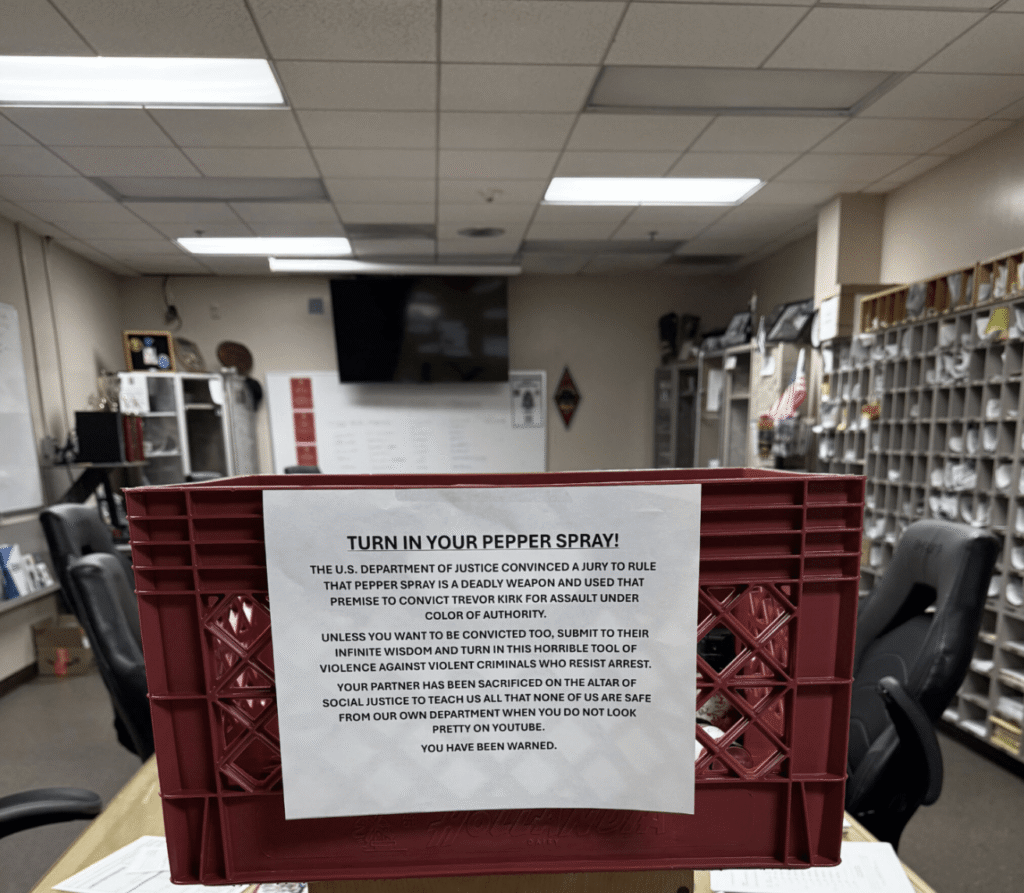
The turning point that shattered remaining trust came with the federal prosecution of Deputy Trevor Kirk. Instead of publicly defending his deputy or challenging the legal framework being used to criminalize routine enforcement actions, Luna distanced himself and allowed the department to cooperate fully with federal prosecutors. Inside LASD, that moment was interpreted as a betrayal that sent a chilling message through the ranks: when politics collide with law enforcement reality, deputies are expendable.
In the months that followed, attrition accelerated dramatically. Lateral transfers to neighboring agencies increased as experienced deputies sought departments where leadership would stand behind them. Early retirements surged, specialized units lost seasoned personnel, and recruitment pipelines weakened further as word spread throughout California law enforcement that LASD had become an agency where command staff would not protect its own people when pressure mounted. Morale, already fragile, collapsed completely.
Rather than confront the trust crisis driving this exodus, department leadership leaned harder on overtime to keep patrols operational. Letters authorizing back-to-back overtime periods became routine, exhaustion became normalized, patrol coverage thinned, and response times stretched. The Current Report documented this deterioration repeatedly while county officials publicly promoted narratives of reform and progress that bore little resemblance to the reality deputies were living.
By the time serious Olympic security planning entered its early stages, LASD was no longer focused on building capacity. It was focused on survival. This is how a department that once hired more than a thousand deputies in advance of the 1984 Olympics now finds itself begging outside agencies for short-term staffing help. In the early 1980s, leadership anticipated demand, stacked academy classes, boosted morale, and invested in manpower because they understood public safety requires preparation, not improvisation.
Under Luna’s leadership, the opposite has occurred. Trust has eroded, experience has walked out the door, overtime has replaced sustainable staffing, and temporary labor is now being floated as a substitute for long-term planning. Law enforcement leaders across Northern California recognize this for what it is: a department in institutional decline.
That recognition explains why police chiefs are actively discouraging their officers from taking even temporary assignments in Los Angeles, including those connected to the Olympics. When seasoned law enforcement professionals advise their people to stay away entirely, it signals far more than inconvenience. It reflects concerns about leadership, legal exposure, working conditions, and systemic dysfunction.
Publicly, county officials continue to sell a narrative of stability and progress, but privately they are scrambling for bodies to fill patrol cars. The Olympics did not create this crisis. They are simply shining a bright, unavoidable spotlight on a collapse that has been years in the making.
If LASD were healthy, academy expansions would already be underway. If it were stable, retention would be the central priority. If it were prepared, outside agencies would not be quietly filling routine staffing gaps. Instead, the nation’s largest sheriff’s department is operating in emergency mode, and law enforcement professionals across California want no part of it.
Los Angeles law enforcement has become so dysfunctional that even short-term assignments are being rejected no matter how high-profile. This is not about the work. It is about the institution itself and the leadership choices that drove it here.
The staffing crisis consuming LASD is not a mystery. It is the direct consequence of decisions made under Sheriff Luna’s watch, from political silence to the public abandonment of a deputy that shattered morale across the department. As the world prepares to descend on Los Angeles for the Olympics, the truth is finally becoming impossible to hide. Law enforcement no longer wants to work here, not full-time, not part-time, and not even temporarily – and that includes a once in a lifetime opportunity like the Olympics.
The first thing the public needs to understand about the “No Kings” protests is that they were never organic eruptions of public anger. From the beginning, they were built as national mobilizations, announced in advance, replicated across thousands of locations, and engineered to return in scheduled waves.
The first major action unfolded on June 14, 2025, deliberately timed to coincide with the U.S. Army’s 250th anniversary parade in Washington, D.C., as well as President Donald Trump’s birthday. Demonstrations were promoted nationally, coordinated across cities, and supported by an operational backbone that included major advocacy organizations such as Indivisible and the American Civil Liberties Union.
National coverage documented synchronized protests across all 50 states, making clear this was not a loose collection of local grievances but a planned political action.
Four months later, on October 18, 2025, the movement returned, larger and even more coordinated. Once again, thousands of locations hosted protests on the same day, with standardized messaging, legal guidance, safety coordination, and national communications amplification. Organizers framed it openly as a second nationwide wave.
Major outlets described it as a coalition-driven mobilization drawing millions.
Now the next phase has already been publicly scheduled.
March 28, 2026 is being promoted by the coalition itself as the next “national mass mobilization,” complete with volunteer trainings, digital organizing tools, legal resources, and a flagship event in the Twin Cities. The stated trigger involves recent fatal immigration enforcement incidents in Minnesota, but the infrastructure surrounding it is unmistakably pre-built and expanding.
Labor unions, education associations, faith groups, activist coalitions, and long-established political nonprofits are now embedded in the structure. Some organizers are already predicting it could become the largest coordinated protest day in U.S. history.
That timeline alone dismantles the claim of spontaneity.
Spontaneous protests do not return on pre-announced national dates. They do not come with training programs, digital toolkits, legal infrastructure, coalition onboarding, and national comms pipelines. What is being marketed as grassroots outrage is, in reality, a repeatable political activation model.
Which brings us to the money, where social media gets loud and careless, but where real investigative reporting exposes something far more consequential.
Across X and other platforms, a figure continues to circulate: roughly $294 million allegedly tied to the “No Kings” network. The number is usually presented as proof that billionaire donors financed the protests themselves, naming familiar philanthropic ecosystems, Arabella-linked entities, Soros-associated funds, Tides, and legacy foundations.
As framed online, the claim is misleading. The total aggregates grants given over many years to a web of advocacy organizations that engage in political organizing broadly. It does not establish direct payments for any specific protest.
But dismissing the viral framing misses the far bigger – and very real – financial reality.
What is clearly documented is the sustained underwriting of the infrastructure that makes nationwide mobilization possible.
One of the clearest examples sits in nonprofit grant reporting. Indivisible, a central organizing and communications hub of the coalition, is publicly listed as having received a $3 million grant from the Open Society Action Fund designated to support its “social welfare activities.
And Indivisible is only one node in a much larger ecosystem of permanently funded political nonprofits now forming the backbone of the “No Kings” coalition.
This is where the public conversation keeps getting misdirected.
The issue is not whether a billionaire wrote a check labeled “No Kings protest.” That is not how modern political mobilization operates.
The real issue is that a year-round, professionalized nonprofit infrastructure, funded continuously through major philanthropic pipelines, exists specifically to deploy mass political action on demand.
When a movement can roll out synchronized national protests in June, return with a second nationwide wave in October, and already lock in the next mass action for March, complete with staffing, communications, training, and coalition expansion, you are not witnessing spontaneous civic unrest.
You are witnessing institutional political mobilization.
The operational machinery is visible: centralized organizing hubs, professional comms teams, massive email and SMS lists, legal rapid-response units, standardized messaging kits, volunteer onboarding systems, and national media amplification. None of that exists without sustained funding.
Even without newly disclosed event-specific grants for 2026, the long-term financial structure enabling the mobilization machine is fully visible in nonprofit filings and grant flows.
That is why the viral spreadsheets resonate, even when they oversimplify. People instinctively recognize that this scale of coordination does not happen organically.
The concern is not that billionaires “bought a rally.”
The concern is that a permanent political infrastructure, professionally funded and institutionally staffed, is being marketed as spontaneous grassroots resistance.
And the dates make it undeniable.
June 14, 2025 was not an accident.
October 18, 2025 was not an aftershock.
March 28, 2026 is not speculation.
It is scheduled.
What gets scheduled can be staffed.
What gets staffed requires funding.
What requires funding stops being spontaneous.
This is not a protest movement in the traditional sense.
It is a mobilization industry, capable of manufacturing national political moments on command while selling the illusion of grassroots uprising.
That is the real financial story behind “No Kings.”
On Triunfo Canyon Road just after dusk on September 29, 2020, two brothers were crossing the street in a marked crosswalk, one on a skateboard and the other on rollerblades. Within moments, eleven year old Mark Iskander and eight year old Jacob Iskander were struck by vehicles moving through the intersection in close succession. Both boys suffered fatal injuries as a result of the collision. Their deaths immediately triggered a high profile criminal investigation that would ultimately become one of the most controversial vehicular homicide prosecutions in Los Angeles County history.
What followed was not the comprehensive, evidence driven reconstruction typically required in complex multi vehicle roadway fatalities. Instead, investigators rapidly narrowed their focus to a single driver, Rebecca Grossman, and structured the case as though no other vehicles played a meaningful role in the collision. From the earliest hours of the investigation forward, the working theory centered on Grossman as the sole cause, shaping every subsequent evidentiary decision and prosecutorial strategy.
Yet from the beginning, witness accounts pointed to a far more complex sequence of events. Multiple individuals described more than one vehicle traveling at high speed through the intersection in close succession. Several witnesses specifically recalled a lead SUV crossing the intersection first, followed within seconds by Grossman’s Mercedes. In high speed pedestrian collisions, vehicle sequencing is critical because the initial impact often produces the fatal trauma, while subsequent vehicles may exacerbate injuries but are not necessarily the primary cause of death. This foundational principle of collision reconstruction was never meaningfully explored.
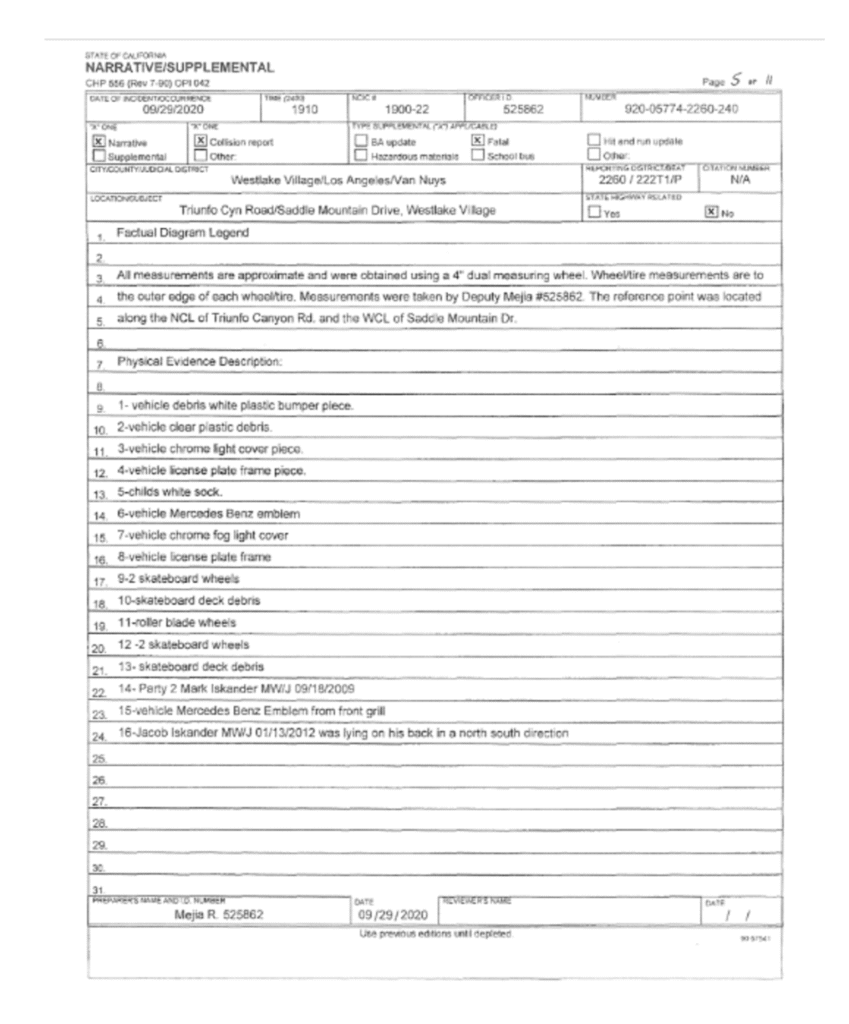
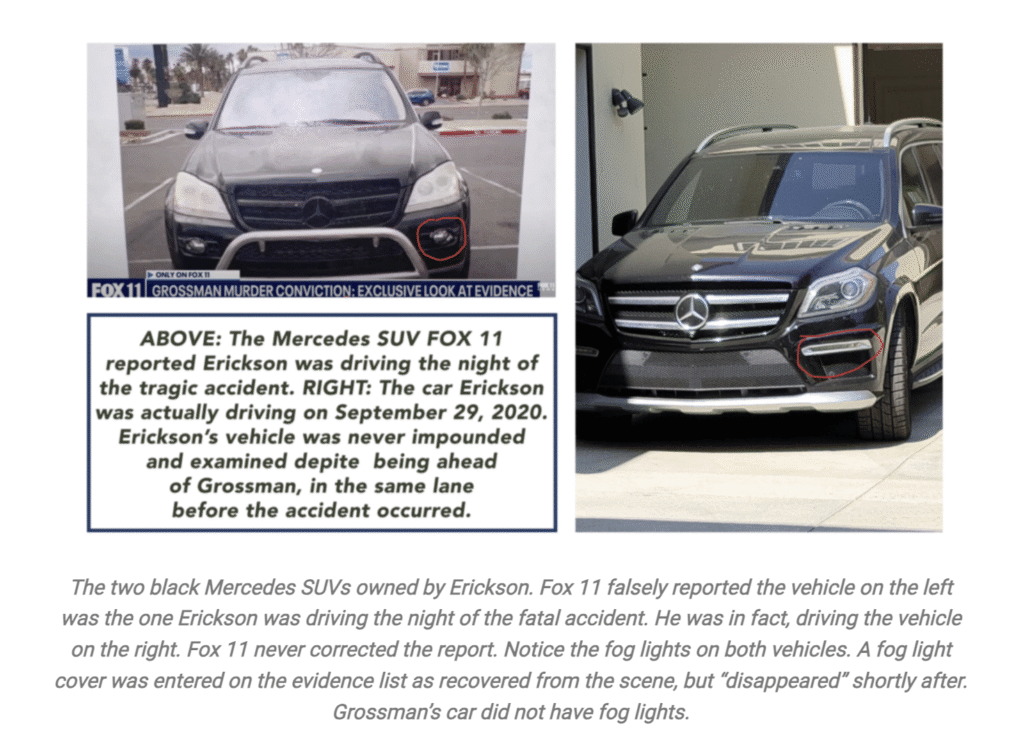
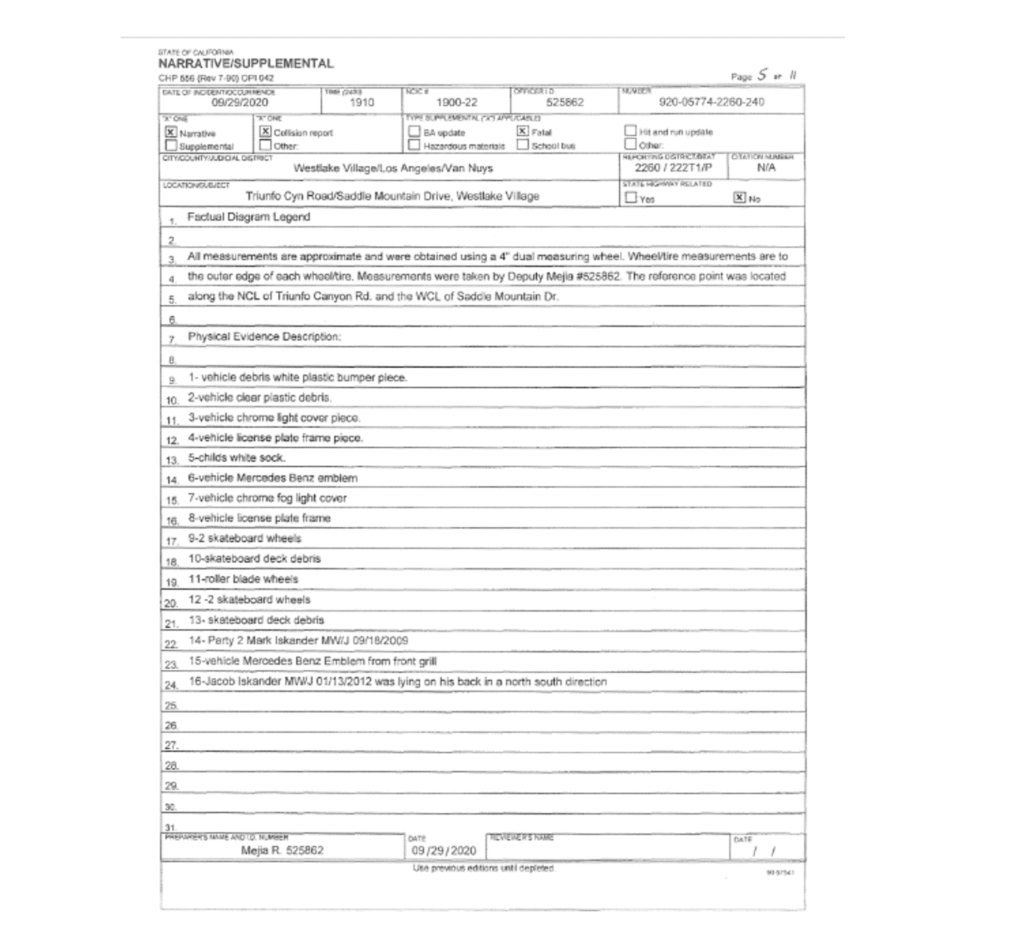
Physical evidence at the scene supported the involvement of another vehicle. Investigators documented a fog light cover that did not match Grossman’s Mercedes and a license plate frame inconsistent with her vehicle. Both items were photographed and logged into evidence, indicating the presence of an additional car involved in the collision sequence. Yet neither item was ever subjected to forensic testing, and both later mysteriously disappeared from the evidence chain entirely. No explanation for their loss was provided in court, and the jury never learned of their existence.
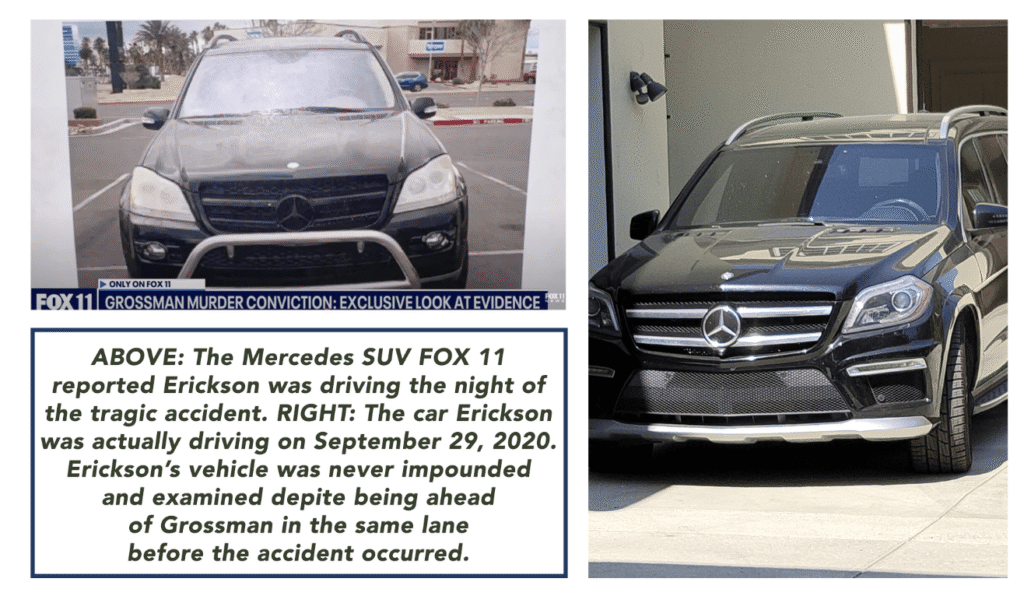
The lead vehicle repeatedly referenced in witness statements belonged to former Major League Baseball player Scott Erickson.
Erickson was driving an SUV just seconds ahead of Grossman in the same lane of travel when the boys were struck. Timeline analysis placed his vehicle in the immediate impact zone at the moment the children entered the crosswalk. Multiple witnesses indicated his SUV passed through first, followed almost immediately by Grossman’s Mercedes. This positioning placed Erickson’s vehicle as the likely first point of contact, a fact that should have made his SUV the primary focus of forensic investigation.
Erickson did not pull over after the collision. Instead, he continued driving to Grossman’s home two blocks away, leaving Grossman at the scene. After Grossman pulled to the side of the road when her Mercedes emergency system activated, she spoke with Erickson by phone. He asked her directly, “Did you see the kids?” Grossman responded “No!”. The reason is significant: Erickson’s SUV was traveling directly in front of her at close proximity, obstructing her view of the crosswalk. This positioning places Erickson’s vehicle as the first through the intersection and the driver most likely responsible for striking the boys.
Despite these red flags, Erickson was never questioned that night, and his vehicle was never seized or forensically examined, even though debris recovered at the scene was consistent with damage from his SUV and inconsistent with Grossman’s Mercedes.
Compounding these concerns, Erickson had a documented history involving DUI and had reportedly consumed alcohol throughout the day, including shortly before the crash. Multiple witnesses confirmed his whereabouts and his alcohol consumption. Despite this, investigators did not contact or interview Erickson that evening. Under standard prosecutorial practice, such factors would demand heightened scrutiny, not indifference. Yet Erickson faced only a misdemeanor reckless driving charge. Grossman, by contrast, was charged with second degree murder, exposing her to a potential life sentence.
The disparity was extraordinary.
The contrast in treatment raised immediate questions about investigative focus, selective prosecution, and whether conclusions had been drawn long before evidence was fully gathered.
Further clarity is emerging through the civil wrongful death litigation tied to the case. Depositions, discovery, and evidentiary disclosures have exposed major gaps in the original investigation. Critical evidence was never preserved. Documentation that should exist is missing. Items logged at the scene can no longer be located. Witness statements describing multiple impacts were minimized, reframed, or in some instances altered to fit the prosecution’s narrative – and in some instances, outright fabricated. Standard protocols for multi vehicle fatal collisions were not followed, further undermining the integrity of the investigation.
Rather than an investigation that evolved with evidence, the civil proceedings suggest a process that narrowed almost immediately and then worked backward to support a predetermined narrative.
Within hours of the crash, the investigative scope had effectively closed around Grossman as the sole responsible party. Once that determination was made, alternative explanations were no longer pursued with seriousness, and evidence inconsistent with the single driver theory quietly faded from the record.
To elevate the case from vehicular manslaughter to murder, prosecutors relied on the legal doctrine of implied malice. This requires proof that a defendant consciously disregarded a known risk to human life. Such charges are typically reserved for repeat DUI offenders who have been explicitly warned of lethal consequences through prior convictions.
Grossman had no prior DUI convictions. Her blood alcohol level was below the legal limit. There was no documented history of reckless conduct establishing awareness of deadly risk.
The prosecution’s implied malice argument rested almost entirely on a single alleged statement attributed to Grossman by a hospital technician suggesting she would have been home if not for the incident, which prosecutors framed as evidence of callous indifference.
The sheriff’s deputy who escorted Grossman continuously from the crash scene to the hospital testified that he never heard any such statement. His presence with Grossman was uninterrupted. This direct contradiction was never meaningfully presented to the jury, depriving them of critical context for assessing the credibility of the prosecution’s central malice evidence.
Without that statement, the legal foundation for second degree murder becomes substantially weaker.
Additionally, prosecutors attempted to convert Grossman’s post impact travel distance into “flight” to support implied malice, but California law does not define fleeing the scene by distance alone. Vehicle Code section 20001 requires a driver to stop “immediately at the scene of the accident or as close thereto as possible,” and appellate courts have repeatedly emphasized that the duty is to stop as soon as it is reasonably safe, with intent to evade responsibility or identification as the decisive element. The controlling case is People v. Scheer (1998) 68 Cal.App.4th 1009, which rejects the theory that continued movement, without evasive intent, constitutes flight. Scheer holds that stopping at the first reasonable opportunity satisfies the statute and that distance without intent is not fleeing. Applied here, the evidence described in the record shows Grossman pulled over and remained with her disabled vehicle and complied with instructions while awaiting law enforcement, conduct that aligns with statutory compliance rather than evasion under Scheer.
The forensic handling of chemical testing introduced further problems. Grossman declined an on scene blood draw for medical reasons, a legally permissible decision. A subsequent hospital blood draw violated established chain of custody standards, including improper labeling and handling. Despite these procedural failures, the sample was admitted and relied upon as evidence.
Meanwhile, physical evidence pointing toward another vehicle’s involvement continued to vanish from the case record.
No internal investigation publicly addressed the missing debris. No forensic explanation was provided. No accountability followed.
Public perception of the case was shaped largely by a media narrative that reinforced the single driver theory. Coverage emphasized wealth, speed, and tragedy while rarely examining the multi vehicle dynamics, missing evidence, or uneven treatment of involved drivers. Complexity gave way to moral simplicity.
The broader political context further illuminates prosecutorial decisions. At the time, law enforcement officials faced intense pressure to demonstrate toughness on violent crime amid public criticism over reform policies. The Grossman case offered a highly visible platform for aggressive charging. Elevating the case to murder transformed a tragic collision into a symbolic prosecution of accountability.
The jury ultimately received a streamlined version of events in which Grossman alone caused the deaths, contradictory evidence was excluded or minimized, and forensic uncertainty was largely absent.
She was convicted and sentenced to fifteen years to life.
Erickson faced no serious criminal consequences.
Civil litigation continues to surface evidence suggesting the outcome was shaped long before trial by investigative decisions that limited the scope of inquiry. Missing evidence, suppressed contradictions, and disparate treatment of involved drivers now form a pattern that is increasingly difficult to dismiss as coincidence.
The central question is no longer whether prosecutors pursued the case aggressively.
It is whether they pursued it honestly.
Two children lost their lives and deserved a full and transparent accounting of what happened that night. Instead, the justice system appears to have delivered a simplified narrative that allowed critical evidence to disappear and the most likely alternative cause to escape accountability.
Rebecca Grossman remains incarcerated.
Scott Erickson remains free.
As the civil case continues to unfold, it raises the disturbing possibility that the truth of what occurred on Triunfo Canyon Road was never fully presented to the jury entrusted with deciding guilt.
If that is so, this case will stand as a profound example of how wrongful convictions are not always created through fabricated evidence, but through selective investigation, narrative control, and institutional refusal to pursue facts that complicate a desired outcome.
DISCLAIMER: Investigative reporting in high-profile litigation cases published by The Current Report is non-commercial, fact-based journalism; any project fees compensate research and reporting labor only, sources participate solely in accuracy verification, and final publication is approved exclusively by The Current Report after fact-checking is confirmed.
California Attorney General Rob Bonta’s latest guidance to local law enforcement, encouraging agencies to investigate and prosecute federal officers for alleged state law violations, is being framed as a bold defense of state sovereignty. In reality, it may be an invitation to legal disaster for the very deputies and police chiefs being urged to carry it out.
Bonta’s message was unambiguous. Local and state agencies, he said, have the authority to pursue criminal cases against federal agents operating in California, even when those agents are carrying out federal duties. His warning was paired with a direct political threat aimed at the White House: if federal officials “break the law and hurt Californians,” the state will sue and prosecute.
What sounds like tough talk plays dangerously close to a constitutional fault line that has swallowed law enforcement leaders before.
And Los Angeles County has already lived this movie.
Before any agency takes legal advice from Attorney General Rob Bonta, they may want to research how it went for LASD when they tried that under Sheriff Lee Baca.
Let’s just put it this way… it didn’t end well.
The Baca Precedent: When Local Power Met Federal Authority
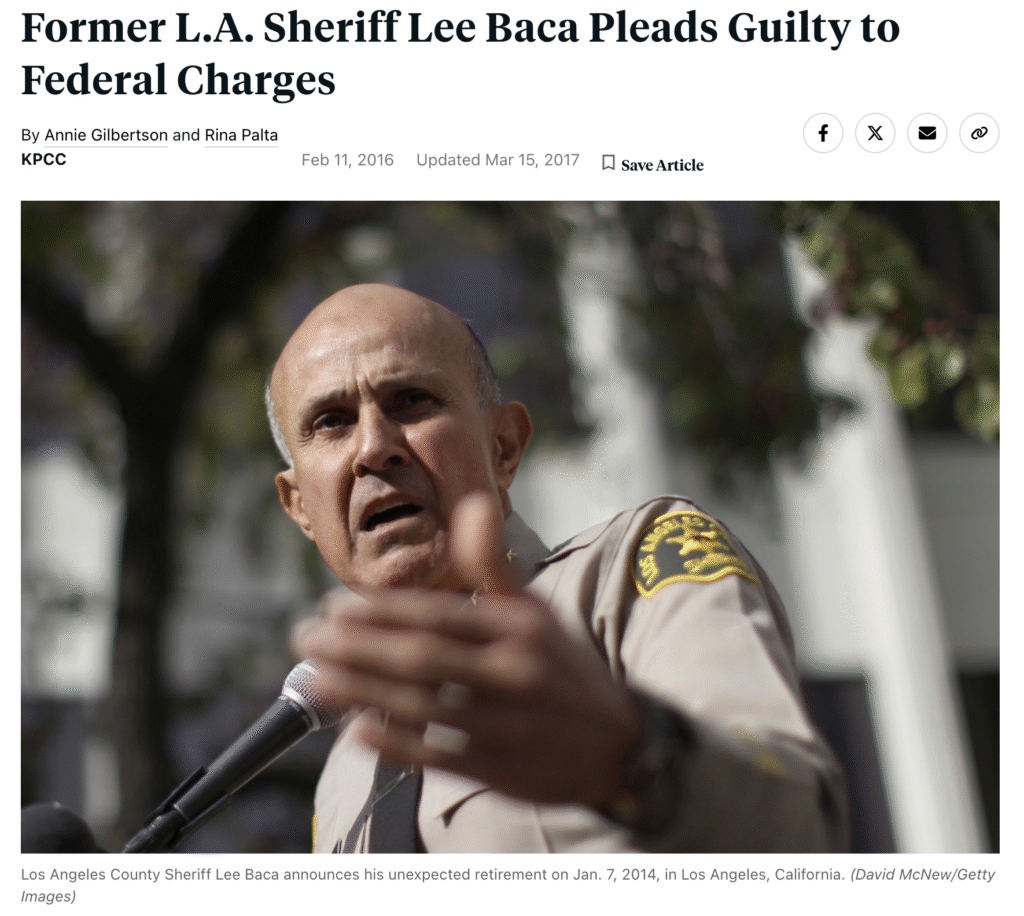
Under former Sheriff Lee Baca, the Los Angeles County Sheriff’s Department attempted to interfere with a federal investigation into deputy abuses inside county jails. Rather than cooperate with federal authorities, LASD executives launched surveillance on the FBI, intimidated a federal informant, concealed him from federal agents, and treated the federal probe as a threat to be neutralized instead of a lawful investigation to be addressed. What followed became one of the largest federal civil rights prosecutions in modern law enforcement history, as federal grand juries indicted top LASD commanders, multiple high-ranking officials were sent to prison, and Baca himself was ultimately convicted for obstruction of justice related to the department’s efforts to derail the investigation.
The federal government did not hesitate in asserting its authority, and it did not lose. The message that emerged from those prosecutions was unmistakable: when local agencies obstruct, challenge, or interfere with federal operations under the belief that state authority will shield them, federal prosecutors respond with overwhelming force and personal criminal liability.
Now, nearly a decade later, Rob Bonta is signaling that California officers should move even further down that dangerous path by pursuing criminal cases against federal agents themselves. This is not a legal gray area shaped by conflicting jurisdictions or unsettled case law, but a direct confrontation with constitutional supremacy that historically ends in federal indictments, career destruction, and courtroom defeats for those who believed political backing could override federal power.
Federal Supremacy Is Not a Suggestion
Under the U.S. Constitution’s Supremacy Clause, federal law, and federal officers acting within the scope of their duties — overrides state interference. While there are narrow and highly specific circumstances where state charges may apply, courts have consistently ruled that state prosecutions cannot be weaponized to obstruct or punish lawful federal enforcement. When states attempt to cross that line, the response has historically been swift and unforgiving, bringing civil rights indictments, obstruction charges, conspiracy prosecutions, and career-ending criminal cases against those who thought political cover would shield them from federal authority.
Local officers do not receive immunity because a state attorney general encouraged aggressive enforcement theories. They receive federal charges.
What makes Rob Bonta’s instruction especially dangerous is the illusion of protection it creates. State leaders can issue guidance, hold press conferences, and posture for headlines, but when federal prosecutors determine that a local agency has crossed into obstruction or unlawful interference, Sacramento will not be sitting at the defense table. Individual deputies, sheriffs, chiefs, and commanders will be the ones answering in federal court, where political narratives collapse under sworn testimony and constitutional law. That courtroom is not built for spin. It is built for accountability.
History already provides the blueprint. Law enforcement executives who believed they were acting in the department’s interest discovered too late that federal prosecutors view interference with federal authority as a serious crime, not a policy dispute. Ask the LASD officials who learned that lesson the hard way.
The consequences of challenging federal authority under the illusion of local protection can be seen clearly in the cases of Lee Baca, Paul Tanaka, and other high-ranking LASD officials who were federally charged, convicted, and incarcerated for their roles in obstructing federal operations.
Under former Sheriff Lee Baca, the Los Angeles County Sheriff’s Department attempted to interfere with a federal investigation into deputy abuses inside county jails by refusing to cooperate, launching surveillance on the FBI, intimidating a federal informant, concealing him from federal agents, and treating the federal probe as an intrusion to be neutralized rather than a lawful inquiry to be addressed. That effort did not quietly disappear but instead exploded into one of the largest federal civil rights and obstruction prosecutions in modern law enforcement history. Federal grand juries ultimately indicted and convicted ten members of the Sheriff’s Department directly tied to the obstruction scheme, ranging from deputies to top commanders, while the broader jail investigation produced at least twenty-one federal convictions connected to civil rights violations, conspiracy, and systematic cover-ups inside the department. Former Undersheriff Paul Tanaka was convicted for orchestrating much of the obstruction campaign and sentenced to federal prison, and Baca himself was convicted for obstruction of justice and related offenses after attempting to derail the federal probe.
The outcome left no room for misinterpretation. When local agencies interfere with federal operations under the belief that state authority will shield them, federal prosecutors respond with sweeping indictments and personal criminal liability that reaches all the way up the chain of command.
And when this goes wrong, because legally it almost always does, the consequences will not land on politicians or press secretaries or elected officials issuing bold statements from behind microphones. The price will be paid by street-level officers ordered to act on this guidance, by supervisors who approve questionable cases, and by agencies that follow political marching orders straight into constitutional quicksand. Bonta will collect headlines. Law enforcement will collect indictments.
California has already tested what happens when local authorities challenge federal power in the name of state interests. It ended with prison sentences, destroyed careers, and a national scandal that reshaped law enforcement oversight. Yet here we are again, with the state’s top law enforcement officer encouraging agencies to walk directly back into the same fire.
If recent history is any guide, this will not play out as a victory for local control or political defiance. It will play out in federal courtrooms, with defendants wearing badges.
They built the Rebecca Grossman case the way LA County builds most politically convenient prosecutions: choose the villain first, then build the investigation around that conclusion until the paperwork looks like proof. The public was fed a simple story because simple stories sell, and because complexity is dangerous when it threatens a conviction. But this crash was never a one-car event, and Grossman was never the only driver whose actions mattered. There was another vehicle in the same lane in front of Grossman, and another chain of decisions unfolding seconds ahead of the defendant’s Mercedes. His name is Scott Erickson, and the most unsettling question in this entire case isn’t what he did. It’s why the justice system acted like it couldn’t afford to find out.
This case has always had a second driver. A second vehicle. A second set of hands on the wheel moving at speed through that same dark stretch of roadway seconds before impact. A man whose name should have been central to any honest investigation but instead became the system’s most protected variable.
Scott Erickson was not a bystander. He was not a neutral witness. He was not incidental to the chain of events. He was the person Grossman was behind. He was the driver in the black SUV that appears on surveillance footage just ahead of her in the No. 2 lane. He was part of the pack of speeders witnesses described. He was the one who left, then returned, then left again without identifying himself as the driver directly in front of the defendant when two children were struck.
And for reasons that do not withstand scrutiny, law enforcement and prosecutors treated him as untouchable.
The public was asked to accept a single-cause tragedy. Grossman hit the children. Grossman caused the debris. Grossman caused both impacts. Grossman bears total responsibility. But that certainty was not earned through a comprehensive forensic investigation. It was manufactured by narrowing the investigation until it could only produce one answer.
The second vehicle theory is not a defense fantasy. It is stitched into the timeline and supported by witness accounts and evidence entries that were either ignored or allowed to disappear. Witnesses described hearing two separate impacts, spaced roughly three to five seconds apart. That timing matters because the surveillance evidence placed Erickson’s SUV in front of Grossman’s Mercedes by approximately three seconds in the same lane. In other words, the spacing between Erickson and Grossman matches the spacing between the reported impacts.
That is not coincidence. That is sequence.
If Erickson’s SUV struck first, or if it clipped one of the children, or if it triggered the initial collision dynamic that forced bodies into Grossman’s path, then criminal causation becomes far more complex than the prosecution wanted jurors to consider. That is why Erickson’s presence is so dangerous to the state’s theory. It injects reasonable doubt at the precise point prosecutors needed certainty most.
Then comes the debris, the kind of evidence that should have set off alarms inside any competent investigative team. The evidence log from the scene included a chrome fog light cover and a license plate frame, items that did not align with Grossman’s Mercedes. Grossman’s vehicle did not have fog lights. Erickson’s Mercedes SUV models did. Those items were entered into the record and then vanished from the evidentiary chain, never meaningfully appearing in later reports in the way they should have if the investigation had been conducted like a homicide-level traffic case. Evidence does not simply evaporate in serious cases unless it is mishandled, unprotected, or inconvenient.
Debris from the accident listed on the Supplemental Report written by Deputy Rafael Mejia. Items #7 and #8 are consistent with Erickson’s Mercedes SUV and subsequently went “missing” after logged into evidence.
Even more disturbing than what was logged is what was never done.
Erickson’s vehicle, the vehicle that matters most if you care about truth, was never impounded. It was never forensically examined. No documented inspection. No collision reconstruction tied to his front end. No photographed damage analysis. No measurement of height-to-impact alignment. No forensic testing for paint transfer or biological material. No serious effort to preserve the one piece of physical evidence that could confirm or obliterate the second vehicle theory.
The lead SUV was treated like it was exempt from investigation, as if the entire justice system silently agreed it was better not to know.
The sworn testimony later reflected that reality. Detective Huelsen acknowledged that neither he nor anyone else examined or impounded Erickson’s SUV. Officers supposedly went to Grossman’s home looking for Erickson’s vehicle, yet no credible record exists of the vehicle being secured, photographed, or inspected. That failure does not read as oversight. It reads as deliberate omission, because no investigator in a fatal child collision forgets to examine the lead vehicle unless they have decided the lead vehicle cannot become a problem.
Erickson’s own behavior that night makes it even harder to believe he was treated as irrelevant by accident.
He did not stop at the scene. He kept driving. Later he returned and lingered near the crash site, blending into the crowd while deputies worked the aftermath, yet he did not identify himself as the driver who had been directly ahead of the defendant. He did not make himself available for scrutiny. He did not step forward and demand to give a statement. He did what people do when they are trying to manage exposure. He observed. He controlled. He disappeared.
Then comes the most damning detail, the kind that makes an investigator’s spine tighten because it sounds like the language of concealment, not innocence. Erickson allegedly interacted with Grossman’s daughter near the scene and asked, “Why did she stop?” followed by a chilling directive: “You never saw me here.” Those are not the words of a man with nothing to hide. Those are the words of a man attempting to erase his presence while a crime scene is still hot.
And while the public was expected to believe he was merely a companion who happened to be nearby, Erickson’s next move was not what innocent witnesses do. He met with high-profile defense attorney Frankie Longo the very night of the crash. Most people do not consult counsel within hours of a collision involving dead children unless they believe they are at legal risk. It signals fear. It signals liability. It signals a consciousness that the truth, if pursued honestly, would be dangerous.
The vehicle issue grows even darker when you account for the two-SUV discrepancy. Erickson owned two black Mercedes SUVs, including a 2007 ML450 with a front metal bumper guard and a 2016 GLC63 AMG. Erickson reportedly represented to authorities that he was driving one vehicle that night, while later reporting indicates he was actually driving the other. If he lied about which SUV he drove, then the reason is obvious. He wanted to steer investigators away from a vehicle that could contain evidence.
In a legitimate investigation, that discrepancy alone would trigger immediate impound and inspection of both vehicles, with paint transfer tests, front-end damage analysis, and full photographic documentation. That did not happen. The system allowed Erickson to control what the record became, instead of forcing the record to control him.
Other pieces of the timeline deepen the suspicion. Erickson reportedly contacted Royce Clayton after the crash, telling him what happened and warning him not to come to Grossman’s home. Clayton’s involvement matters because he had been with Grossman and Erickson earlier in the evening at Julio’s restaurant before separating from them. The night was not a mystery. The drinking and movement of the group could have been mapped, verified, timed, and tested. But what emerged instead is a sense that the only goal was to lock onto Grossman and make the second driver disappear from meaningful forensic attention.
Then comes the surveillance evidence disaster, a detail that makes this case look less like procedural failure and more like evidentiary sabotage. Sergeants Scott Shean and Travis Kelly reviewed surveillance footage from local sources the day after the crash, footage that allegedly captured multiple vehicles and reinforced the existence of the high-speed convoy. Instead of properly seizing, preserving, and cataloging the footage, it was recorded on personal cell phones. The original files were not adequately protected and were ultimately lost. This isn’t a minor technical lapse. When the timeline and vehicle sequence are the core truth of the case, mishandling surveillance is not a paperwork issue. It is the destruction of objectivity.
The next 48 hours became the point of no return.
The most critical window in any fatal collision investigation is the first two days. That is when vehicles still have unaltered evidence. That is when damage patterns are fresh and measurable. That is when debris fields still tell the truth. That is when you secure the physical facts before narratives calcify.
But instead of doing that, the investigation hardened into a conclusion before evidence could challenge it.
According to reporting, Scott Butler, a retired LASD detective and cousin to Royce Clayton, pressed the department to follow up on Erickson and Clayton. Clayton reportedly confirmed Erickson’s involvement and explained that Erickson was ahead of Grossman, that he returned to the scene after parking his car at Grossman’s home, and that he was part of the lead position in that convoy. Butler believed this should have triggered immediate action.
Instead, once Sergeant Scott Shean took over as lead investigator, Erickson’s role was dismissed without the level of examination that would have been mandatory if the goal had been truth rather than conviction. The second driver was functionally written out early, before the evidence could prove too much.
From there, the case became controlled.
Erickson was ultimately charged with misdemeanor reckless driving, then allowed to resolve it through diversion, a quiet off-ramp that effectively erased accountability. Meanwhile, Grossman faced the full weight of second-degree murder prosecution. That contrast does not just feel disproportionate. It feels strategic.
Because reckless driving isn’t the point. The point is leverage.
If Erickson’s SUV was the first impact, or if his driving behavior materially contributed to the sequence that killed those children, then his legal exposure could have been enormous. And enormous exposure creates bargaining power. Bargaining power creates silence. Silence creates a clean narrative for prosecution.
It is impossible to look at the deal and not question whether it was designed to close the door on deeper inquiry. It is impossible to look at diversion and not wonder what prosecutors were protecting, what they were trading, and what they were afraid a full investigation would reveal.
This is where the personal history matters, not as gossip, but as context for credibility and behavior. Multiple sources have confirmed that Erickson comes from a family with a history of alcoholism, specifically involving his father and brother. That family dynamic is relevant because addiction patterns tend to echo through behavioral systems: secrecy, denial, minimization, and control. Those traits become particularly visible in crisis moments when accountability is on the line. Erickson’s conduct after the collision, from the alleged “you never saw me here” line to the immediate lawyer meeting, reads like the posture of someone reflexively managing exposure. The family history does not prove guilt. It speaks to the kind of psychological environment that can normalize concealment and the strategic avoidance of consequence.
Even without that context, the conduct stands on its own.
He didn’t stop. He returned without identifying himself. He allegedly urged silence. He allegedly lied about which vehicle he drove. He met with defense counsel immediately. His vehicle was never impounded. Evidence that didn’t match Grossman disappeared. Surveillance footage was mishandled and lost. The investigation narrowed instead of expanding. A diversion deal sealed the containment.
Then the media played its role. Rather than interrogating the second vehicle theory with the seriousness it demanded, much of the coverage mocked it as desperate, as if raising a legitimate alternate causation chain in a double-impact child fatality case is somehow offensive. Grossman’s claim that she never saw the boys because the lead SUV blocked her view in the dark was treated like a flimsy excuse instead of an evidentiary question that should have been tested through reconstruction, visibility analysis, and honest sequencing.
The system did not test the truth.
It defended a conclusion.
The Scott Erickson problem is that he never goes away. No matter how aggressively the narrative tries to bury him, the timeline keeps pulling him back up. The evidence log keeps pulling him back up. The missing evidence keeps pulling him back up. The surveillance mishandling keeps pulling him back up. The witness statements keep pulling him back up.
If the Grossman case is ever fully reopened in the court of public opinion or civil litigation, it won’t be because of theatrics or social media or outrage. It will be because the facts will no longer tolerate their own suppression.
A controlled prosecution depends on one thing: keeping the most dangerous alternative explanation off the table long enough for a verdict to harden into “truth.”
Scott Erickson is the alternative explanation.
And the case record reflects a justice system that treated that fact not as something to investigate, but as something to contain.
DISCLAIMER: Investigative reporting in high-profile litigation cases published by The Current Report is non-commercial, fact-based journalism; any project fees compensate research and reporting labor only, sources participate solely in accuracy verification, and final publication is approved exclusively by The Current Report after fact-checking is confirmed.