Category: FireWire

  • LAFD Chief Drops Bombshell: Palisades Fire Report Doctored to Shield Incompetent Leadership Under Bass and Newsom’s Watch

    LAFD Chief Drops Bombshell: Palisades Fire Report Doctored to Shield Incompetent Leadership Under Bass and Newsom’s Watch

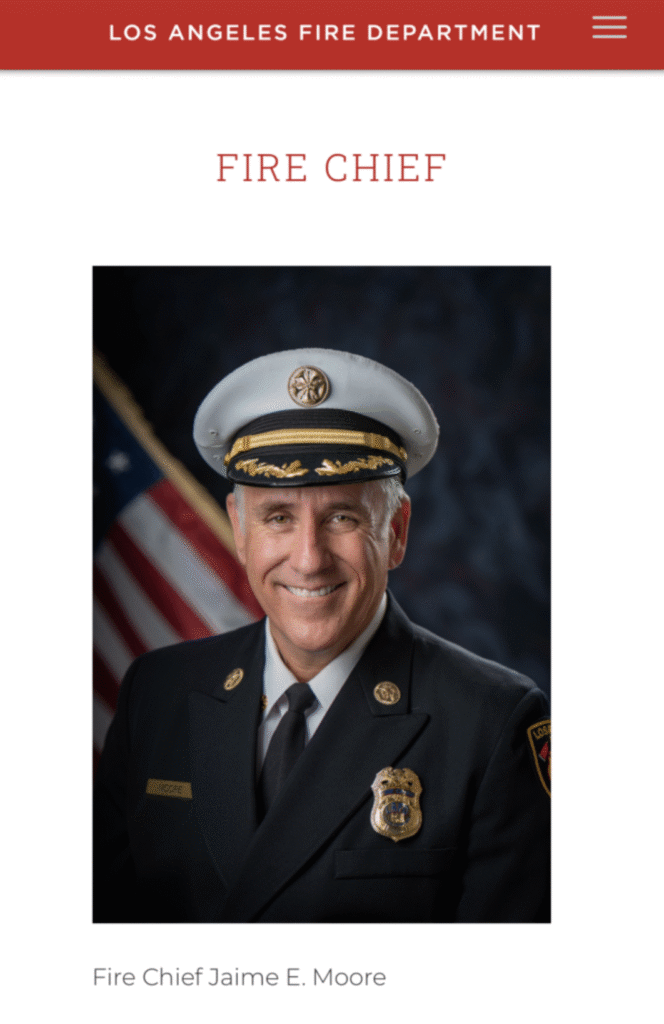
    In a stunning admission that confirms what fire-ravaged communities have suspected all along, Los Angeles Fire Department Chief Jaime Moore acknowledged this week that the official after-action report on the catastrophic Palisades Fire was repeatedly edited to soften, and in some cases erase, criticism of department leadership. This wasn’t a clerical cleanup. It was narrative laundering.
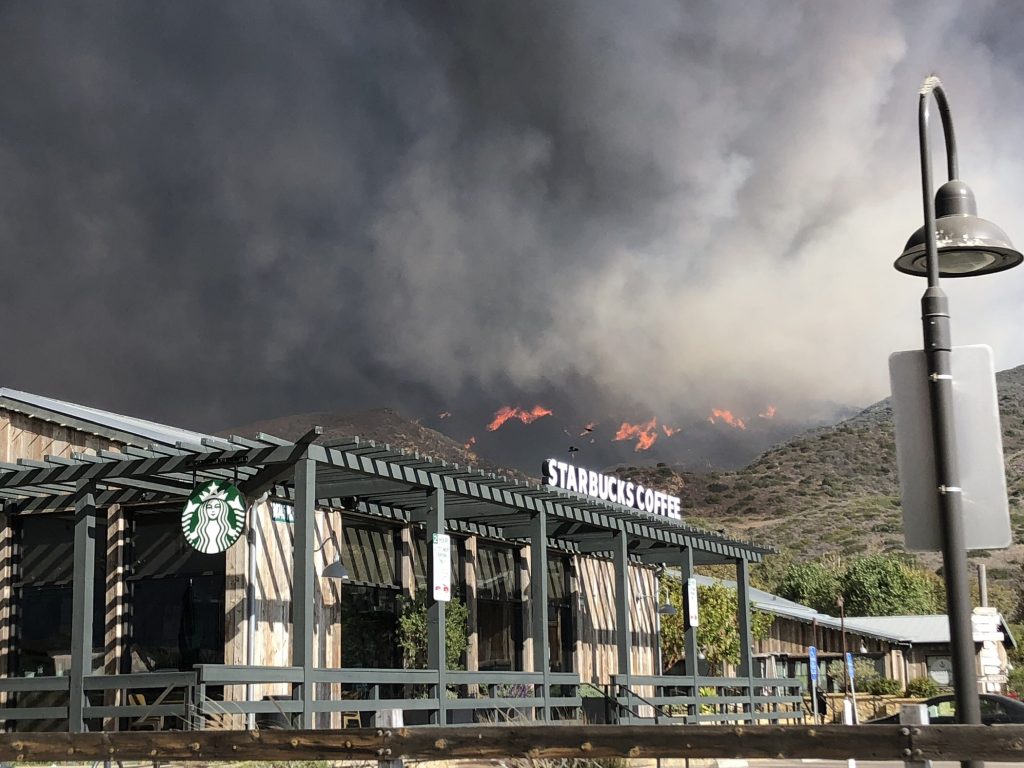
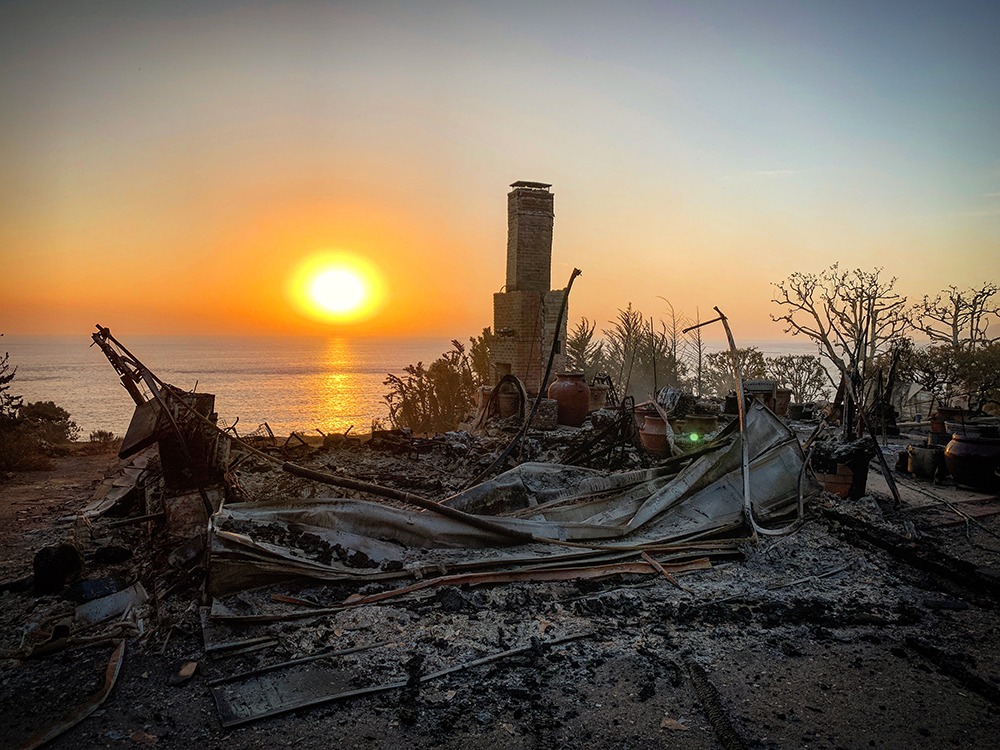
    The Palisades Fire, which ignited January 7th, 2025, now stands among the most destructive blazes in California history. According to CAL FIRE, it tore through thousands of acres, destroyed more than 7,000 structures, and claimed at least a dozen lives. The devastation didn’t begin with a freak act of nature. It began with a preventable failure, however, the mishandling of the earlier Lachman Fire on New Year’s Day, which LAFD leadership prematurely declared “contained.”

    We now know that declaration was false.

    Smoldering roots and heat-retaining tree stumps were left behind. Crews were ordered to pick up hoses and stand down. The question is not whether the fire was fully extinguished – it wasn’t. The real question is why leadership ignored the risk entirely. Weather models available to state and local agencies had already flagged a significant Santa Ana wind event days in advance. The National Weather Service issued formal alerts as early as January 2, continuing right up until the Palisades Fire ignited. Yet no contingency plan was implemented. No follow-up inspection occurred. A known ignition zone was inexplicably treated as a closed case, despite extreme wind warnings saturating news coverage and social media feeds. The question isn’t whether the risk was foreseeable — it was impossible to miss. The question is why leadership chose to ignore it.
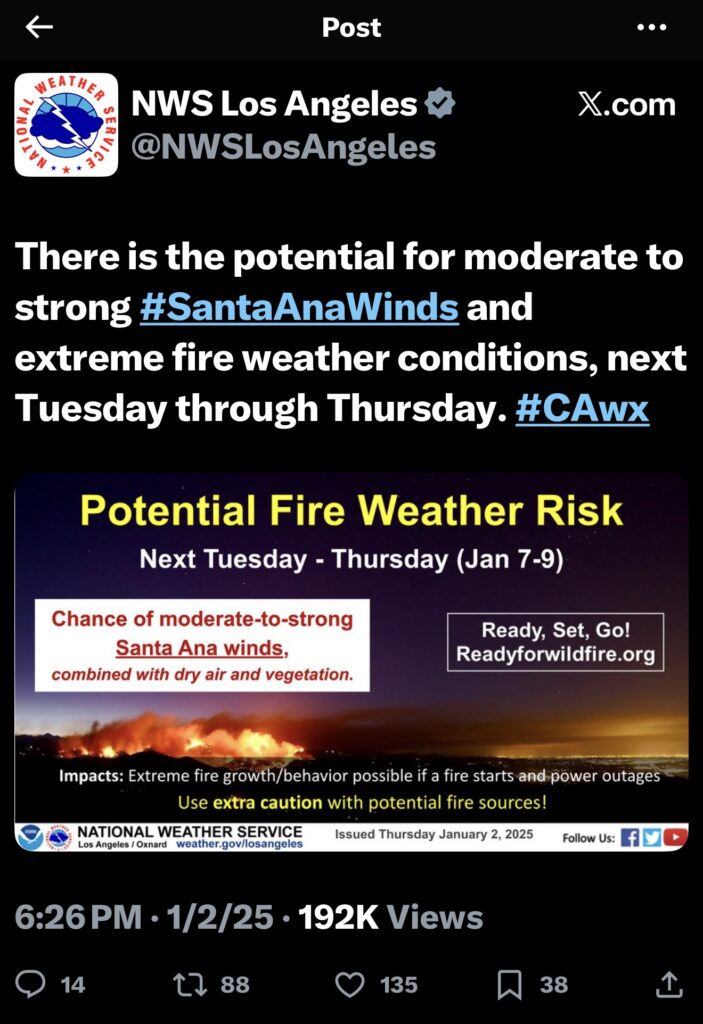
     

    Six days later, those warnings became reality. Powerful Santa Ana winds, combined with heavy fuel loads and brush that had not been cleared by the state around Topanga State Park, reignited the abandoned embers from the Lachman Fire. What followed was a full-scale inferno that tore through the Palisades and into Malibu, overwhelming communities with terrifying speed.

    That cascading failure, predictable, documented, and entirely avoidable, should have been the centerpiece of a brutally honest after-action report. Instead, it was softened, sanitized, and buried beneath edits designed to protect leadership rather than tell the truth.

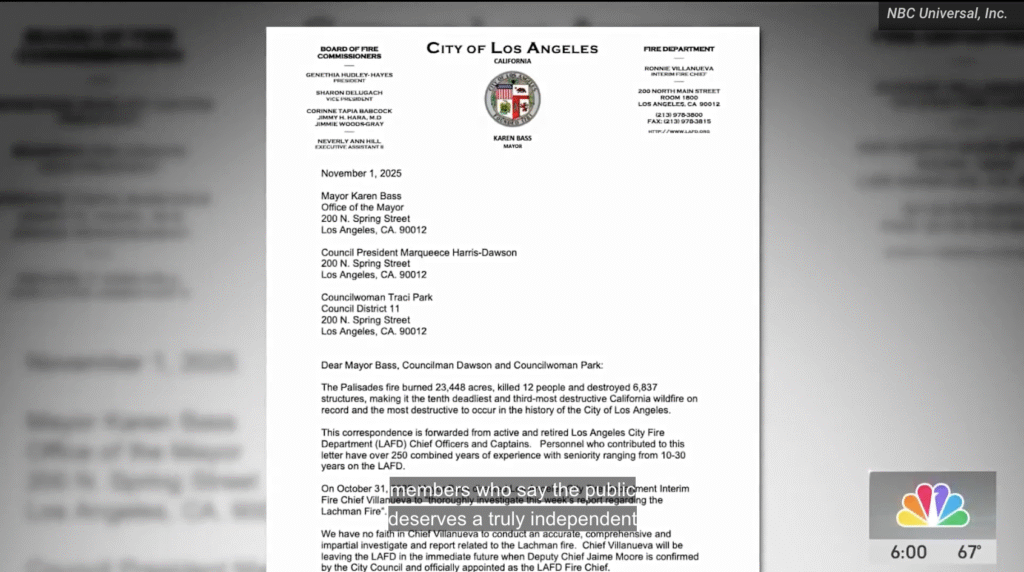
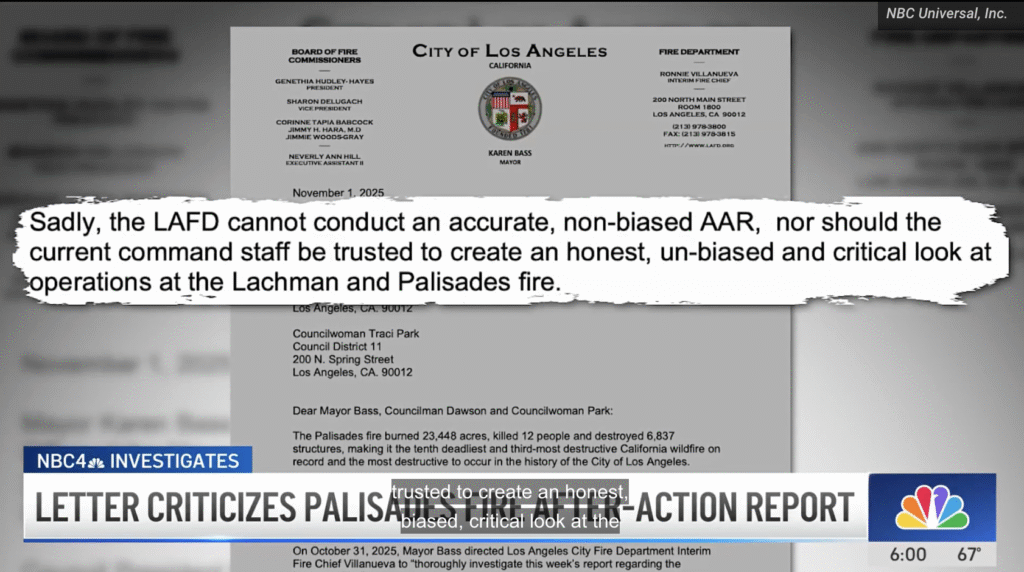
    Chief Moore made the admission during a public meeting of the Los Angeles Fire Commission, reported by KNBC: multiple drafts of the after-action report were altered “to soften language and reduce explicit criticism of the department leadership.” The edits occurred before Moore took command, under the previous administration, but they served a familiar purpose: protect the people at the top.

    Those people include Karen Bass, whose oversight of the department coincided with the disaster, and Gavin Newsom, who has presided over a state where wildfire season has become a permanent condition. Moore has promised such editorial manipulation won’t happen again on her watch. Californians have heard that pledge before.

    This revelation didn’t come out of nowhere. Last November, an anonymous whistleblower sent a detailed letter to the mayor’s office and city council members, warning that the Palisades report was compromised from the start. The review was supervised by officials whose decisions were under scrutiny, a glaring conflict that guaranteed the outcome. It was never designed to expose failure; it was designed to contain it.
     

    And while residents sifted through ash, Bass was overseas. Her widely criticized trip to Ghana during the height of the emergency became a symbol of absence at the exact moment leadership was required. Later soundbites and regret-tinged slogans couldn’t undo the damage, or the perception that image management mattered more than public safety.

    The governor’s office fares no better. Under Newsom, California’s wildfire response has devolved into a cycle of emergency declarations, press conferences, and policy slogans while foundational problems fester. Forest management remains politicized. Agencies remain understaffed. Bureaucracy outpaces action. Each year, the fires get worse, and each year, accountability gets thinner.

    Moore also conceded what firefighters on the ground already knew: the department’s handling of the Lachman Fire was flawed. Crews were told to stand down based on outdated procedures and an assumption the fire was out. But internal messages later reviewed by Los Angeles Times showed battalion chiefs pushing evacuations despite lingering heat, a decision that proved catastrophic. Only after lives were lost did LAFD announce revamped mop-up protocols and expanded drone surveillance. Progress, perhaps, but bought at an unforgivable cost.

    For communities like Pacific Palisades and Malibu, this isn’t partisan theater. It’s lived reality. Homes are gone. Families displaced. Landscapes forever altered. And now we learn that even the official record was massaged to spare reputations.

    California doesn’t just have a wildfire problem. It has a records and accountability problem. When after-action reports are edited to soften criticism, when known risk factors are ignored, and when decisions made before a catastrophe are rewritten after the fact, the issue is no longer mismanagement, it is exposure. Because fires don’t just destroy homes. They generate timelines, metadata, emails, draft histories, and sworn testimony. And those records have a way of resurfacing.

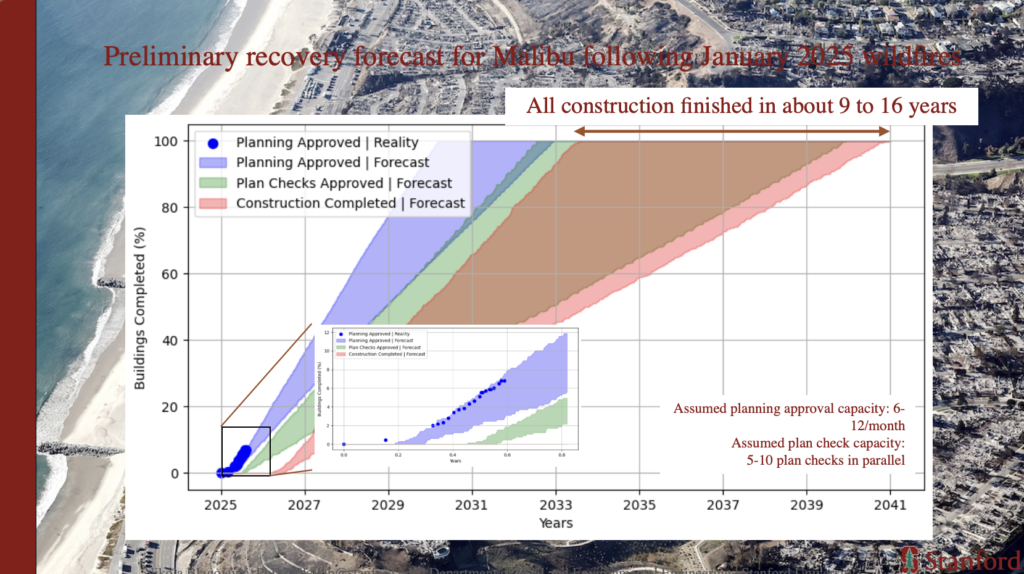
     

  • Palisades Fire Rebuilds on Track to Take 9-16 Years to Complete – Malibu Rebuilding Ambassador Exposes City Hall Derailing Fire Victims

    Palisades Fire Rebuilds on Track to Take 9-16 Years to Complete – Malibu Rebuilding Ambassador Exposes City Hall Derailing Fire Victims

    The announcement blindsided residents and council members alike, arriving just before the September 29th Council meeting which amended its agenda to include a ceremonial commendation for Roy’s service.

    To many, the move reeked of politics. Families who trusted him to challenge a system “complicated by design” were left reeling. As one resident asked, “Why would the city remove a fellow resident that fire victims trust to deal with the collective power of City Hall?”

    The decision was not a coincidence. It was clearly orchestrated from the top. A decision was made after interim city manager Candace Bond complained directly to Mayor Marianne Riggins that Roy was “micromanaging” staff, resulting in Riggins taking a personal interest to eliminate his role. Council member Doug Stewart backed her, lending political cover to the mayor’s maneuver.

    By siding with Riggins instead of the very residents still fighting to rebuild, Stewart positioned himself not as an advocate for the displaced, but as complicit in their abandonment. What makes this betrayal all the more galling is Riggins’ own admission it took her more than five months to visit the burn areas. To Malibu’s displaced families, that confession was not simply tone-deaf, it was moral negligence. How can a mayor strip away their only advocate without ever standing in the ashes of their destroyed homes? How can Stewart defend her decision while families sleep in rentals and motels, their insurance running out, their futures uncertain? For victims, this is leadership in name only, absent when it counts, and dismissive when challenged.

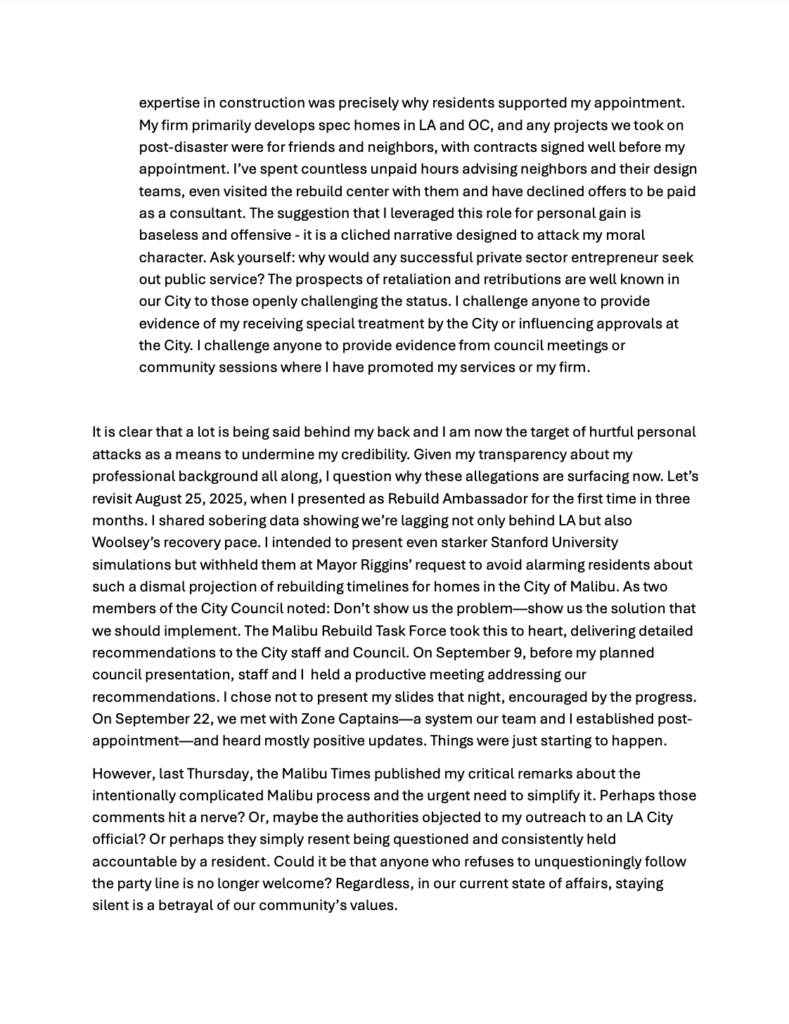
    Worse, Riggins was the one who personally demanded that Roy remove the damning slide from his first presentation to Council the slide that showed, based on Malibu’s current process, it would take nine to sixteen years for fire victims to rebuild. That single act of suppression transformed the crisis from incompetence into deception. By hiding the truth from the public, Riggins deliberately denied victims the transparency they deserve. This was not an isolated act either. Riggins has a history of orchestrating deals behind the scenes to benefit developers and staff over residents, most notably with the skate park project and in dealings with developer Steve Gillen, a pattern long noted by community watchdog Andy Lyon.

    The slide presented by Malibu Rebuild Ambassador Abe Roy that was removed from his presentation.

    For that reason alone, Riggins should be immediately removed from the city’s fire rebuild ad hoc committee. Her lack of empathy, her blatant disregard for fire victims, and her disdain for their truth were made clear in her attempt to eliminate Abe Roy without accountability or public input. A mayor who silences victims and buries the facts has no business overseeing Malibu’s path back from fire devastation.

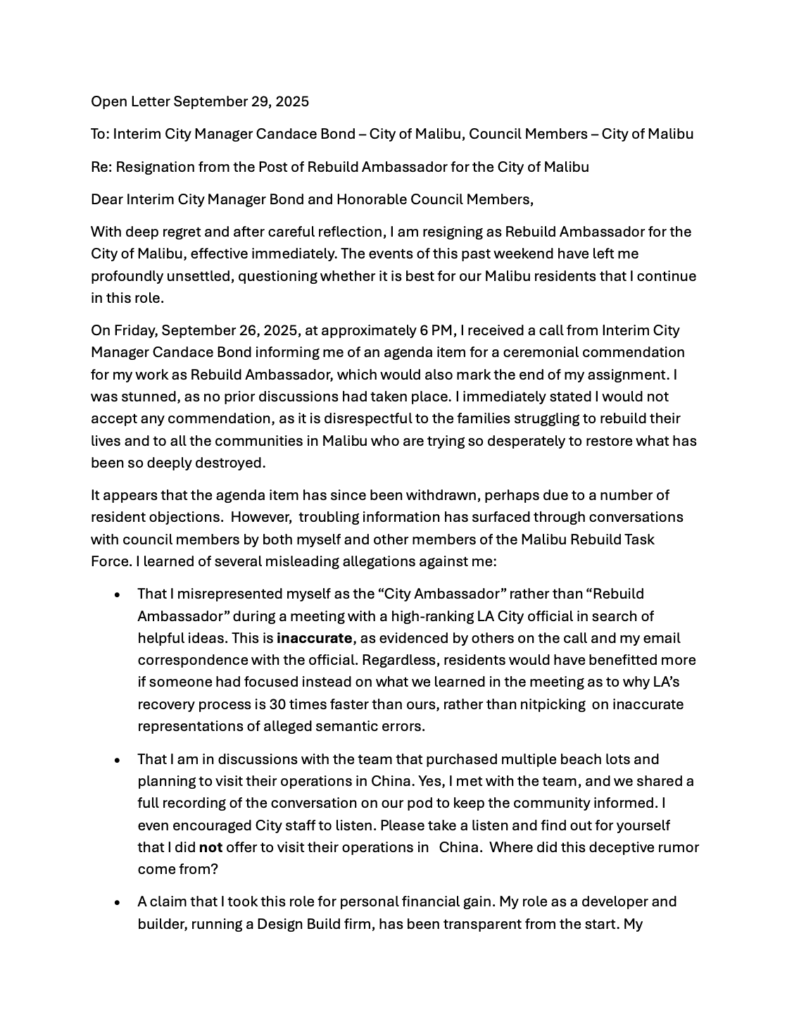
    Roy’s brief tenure had already produced results organizing Zone Captains in fire areas, created direct lines of communication between victims and staff, and pressed for reforms to cut through unnecessary red tape. He identified the stark contrast between Malibu’s process and Los Angeles City’s: LA has approved 40 percent of rebuild applications, while Malibu has managed just one percent, two permits out of 150 applications in nine months. “We’ve worked so hard to give residents hope and support. Why walk back the trust we’re building?” Roy asked.

    The dismissal of Roy has further inflamed anger. Residents credit him with preventing delays and forcing staff to address problems. Colin Drummond, a Big Rock resident, addressed the Council directly: “This whole Abe Roy fiasco is disturbing. It’s premature, and it’s confusing. Abe has been telling the truth, that the rebuilding process is complicated by design and needs to be uncomplicated for fire victims. He’s offered practical solutions, consolidating corrections, reducing consultant dependency, and putting fire rebuilds ahead of discretionary projects. Our homes are burning down faster than we can build them. We face unreliable water, brush we can’t clear, homes without defensible space. And we have no city manager. Five good people up here can only speak to each other every two weeks. My nephew would call this a Gong Show. Ending Abe’s role at this moment sends the worst possible message. Malibu needs vision and leadership, not silence.”

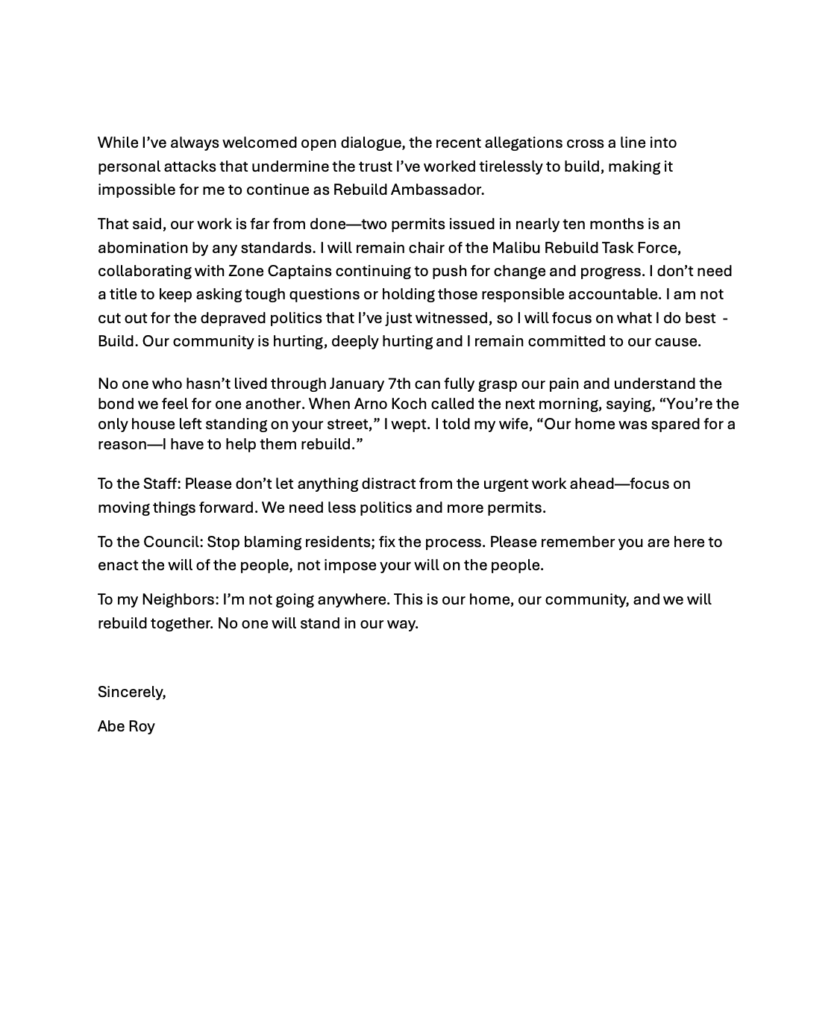
    Roy himself has suggested that his removal was retaliation for speaking too candidly. In his resignation letter, he pointed to “intentionally complicated” processes, allegations spread behind closed doors, and efforts by city leadership to downplay data showing just how far Malibu has fallen behind. He noted that after he published remarks criticizing the City’s rebuild system, rumors surfaced accusing him of misrepresenting his title, seeking personal financial gain, or planning foreign business trips. He dismissed each as false. “The suggestion that I leveraged this role for personal gain is offensive,” Roy wrote. “Ask yourself: why would any successful private sector entrepreneur seek out public service? The prospects of retaliation are well known in our City to those challenging the status quo.”

    The numbers speak louder than any defense. Malibu has roughly 4,300 households. Nearly one in four families remain displaced from recent fires. From the Palisades Fire alone, two permits have been issued in nearly a year. The Woolsey Fire, now seven years past, still has more than 70 applications unresolved. At Malibu’s current pace, families will be waiting decades.

    The longer the process drags, the more families will be forced out. Rental insurance is running dry. Parents with children in Malibu schools are preparing to leave permanently. The people who gave Malibu its identity and “soul” are disappearing. As Roy warned, “Stop blaming residents; fix the process. You are here to enact the will of the people, not impose your will on the people.”

    The Malibu Rebuild Task Force has outlined clear solutions: accept existing soils data, and give options to waive geotechnical reports using existing soils and compaction data, fast-track rebuilds where homes stood safely for decades, use neighbor reports as benchmarks, and publish progress transparently, reduce the administrative steps such as difficulties in uploading documents, etc., requiring multiple affidavits, and streamlining corrections to one review – this alone will save fire victims at minimum 6-12 months in the application process to achieve a rebuild permit. Instead, Council has chosen to silence one of the few advocates who had credibility with fire families.

    For residents who lost everything, it’s about survival. Malibu has already failed one generation of fire victims. If City Hall continues to stall, it risks failing another. Families are not asking for shortcuts, they are asking for fairness, urgency, and compassion. Whether Malibu’s leaders can deliver on that will decide if these families come home, or if the city loses them forever.

  • Using Crisis as a Career Opportunity: Former Embattled Malibu City Manager Resurfaces in Yet Another Fire Related Scandal

    Using Crisis as a Career Opportunity: Former Embattled Malibu City Manager Resurfaces in Yet Another Fire Related Scandal

    They say lightning doesn’t strike twice, but Malibu knows better.

    In just seven years, another wildfire scorched through the region, this time gutting areas that had barely escaped the wrath of Woolsey. But the flames weren’t the only thing making a comeback.

    Adding insult to injury, Reva Feldman, the former Malibu city manager whose disastrous handling of the Woolsey Fire cemented her infamy, is now entangled in yet another fire related scandal. This time, it’s the misappropriation of FireAid funding meant to go to those directly impacted by the Palisades and Eaton Fires. Instead, the money was quietly funneled to a nonprofit hundreds of miles away, where Feldman just happens to sit on the board.

    “After the Fire”, a non-profit based in Sonoma, sounds like a noble cause, but when you dig beneath the branding, the organization reveals itself as a buzzword factory, spewing phrases like “coaching,” “collaborating,” “multigenerational power building,” and “civic engagement.” What it doesn’t do is provide direct relief to fire victims, which is exactly what FireAid donors were told their money would support.

    And yet “After the Fire” got a chunk of the FireAid windfall, despite operating hundreds of miles from the neighborhoods obliterated by the January firestorms.

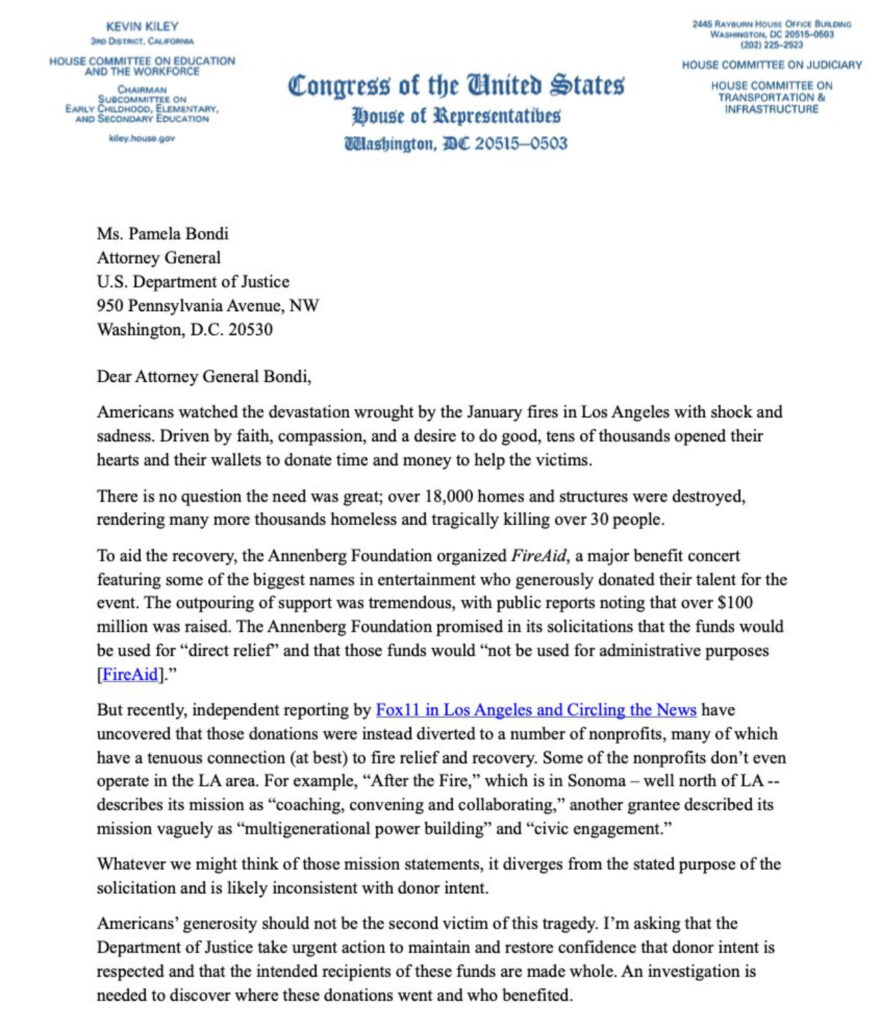
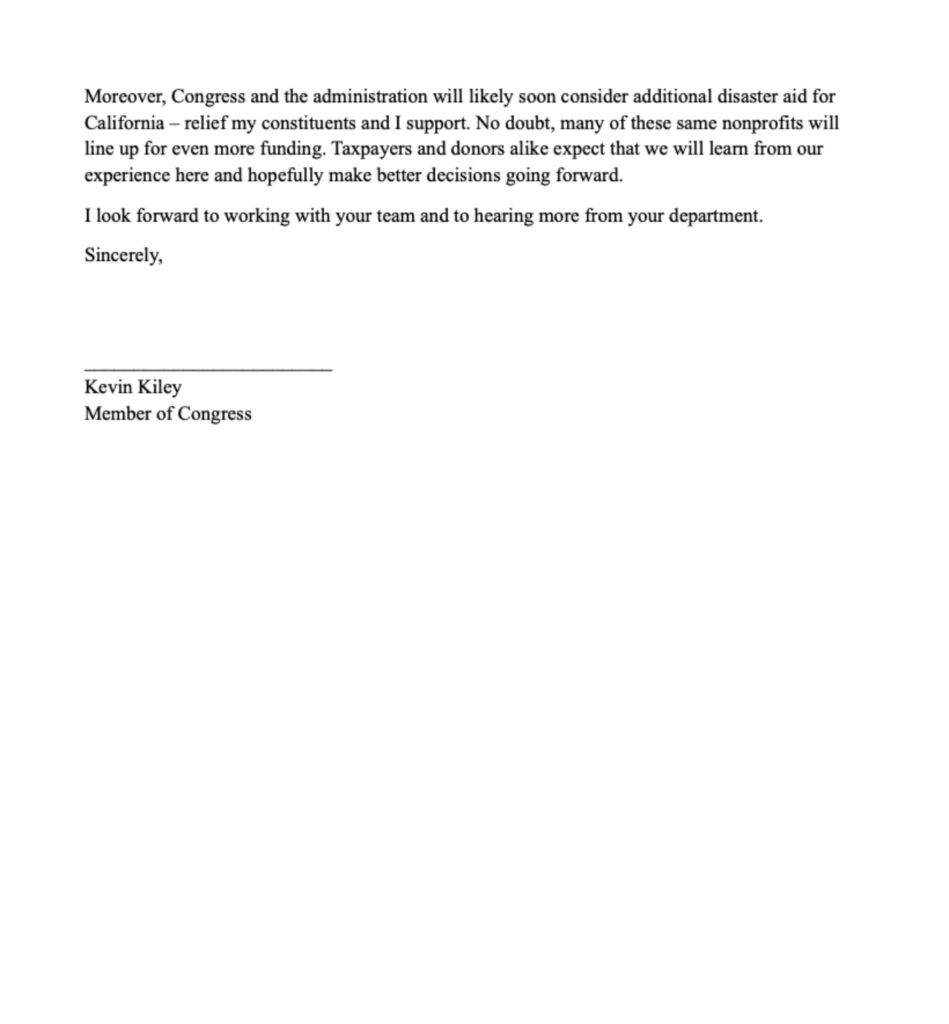
    It’s a bait-and-switch flagged by Congressman Kevin Kiley, who issued a scathing letter to Attorney General Pamela Bondi this week demanding an investigation.

    In his words, groups like “After the Fire” have “a tenuous connection (at best) to fire relief and recovery.”


    The letter also sharply criticizes the diversion of funds from intended victims, warning that this disconnect between solicitation and disbursement may violate donor intent, and calls for a federal investigation into where the money actually went, and who benefited.

    REVA RESURFACES IN YET ANOTHER FIRE RELATED SCANDAL

    Feldman’s tenure in Malibu was marred by public outcry over her handling of the 2018 Woolsey Fire, failure to advocate for Malibu during crisis evacuations, and controversial city hall conduct that ultimately forced her resignation. Her departure came with a hefty payout, funded by taxpayers, and a separation agreement that avoided further scrutiny of her performance.

    Now, Feldman resurfaces in yet another fire-related scandal, this time tied to a nonprofit that benefited from a highly publicized disaster relief fund. Coincidence? Unlikely, given her track record of leveraging tragedy for personal gain and profiting off disaster at the expense of the very community she was entrusted to serve.


    It’s unclear what role Feldman played in securing funds for After the Fire. What is clear, however, is that the organization is among the nonprofits Congressman Kiley now says need to be scrutinized for misalignment with the original purpose of the FireAid campaign.

    COMPLICIT OR CLUELESS?

    The Annenberg Foundation has remained silent as the FireAid scandal erupts into a firestorm of controversy.

    But the facts demand answers.

    Who chose the grantees?  Who reviewed their qualifications? And why were groups like “After the Fire”, based far outside the disaster zone, deemed worthy of donation dollars, while families in Pacific Palisades, Topanga, and Malibu were denied assistance?

    Taxpayers and donors didn’t shell out to fund a networking nonprofit in wine country. They gave with the expectation that their money would go to the victims of the January firestorms, not disappear into a boardroom full of buzzwords masquerading as disaster relief.

    The people deserve transparency, not just from the nonprofits, but from the Annenberg Foundation itself, which has yet to explain why groups like “After the Fire’, with no direct connection to the affected areas, were given a seat at the table.

    And if Reva Feldman thought no one would notice her fingerprints on this fire fund fiasco, she clearly underestimated those of us who never stop watching where political corruption leads next.

  • Public and Private Wildfire Detection Strategies Increase as Early Fire Season Begins in SoCal

    Public and Private Wildfire Detection Strategies Increase as Early Fire Season Begins in SoCal

    Although Southern California suffered through massive flooding throughout much of the winter thanks to an active El Nino weather pattern, the soaked hillsides did not do much to thwart the beginning of California’s most dangerous season.

    The first major wildfire of 2024, the Post Fire, erupted on Saturday near Gorman, California and is over 15,000 acres. Currently, multiple active wildfires are burning throughout forcing California fire authorities to officially announce an “early start” to wildfire season.

    Communities are adding multiple resources to their assets as fires season kicks off. These resources provide a wealth of information online regarding on fire prevention, evacuation routes, and some municipalities installing early detection cameras.

    On June 7th, Assembly member Al Muratsuchi, and the mayors of four Palos Verdes Peninsula cities gathered to officially launch a Peninsula-wide network of wildfire detection cameras.

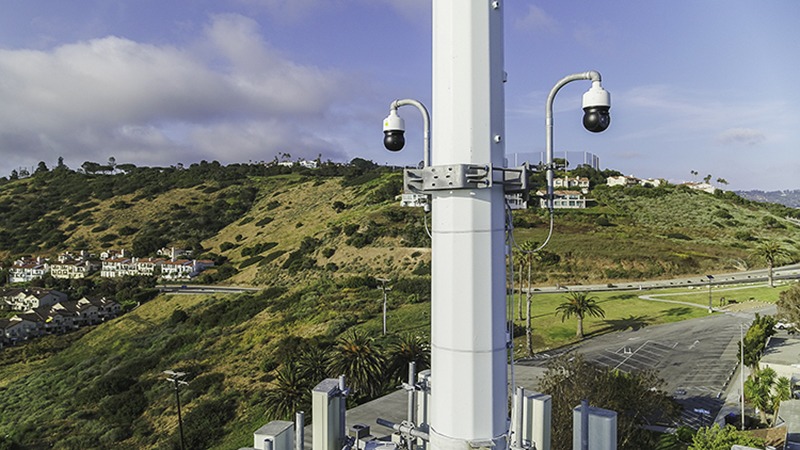
    Pano AI wildfire detection cameras installed in Ranchoo Palos Verdes

    The project was approved by Rancho Palos Verdes City Council in 2022 and the installation of the cameras began in 2023 supported by a $1.5 million state budget allocation secured by Assembly Member Al Muratsuchi. The event was held beneath four sets of high-mounted, 360-degree cameras made by tech company Pano AI, installed last year at key vantage points.

    The majority of the Peninsula is located within a Very High Fire Hazard Severity Zone with the last major fire taking place in August 2009, burning about 230 acres and forcing approximately 1,200 people to evacuate.

    Supported by artificial intelligence, the ultra-high-definition cameras continuously scan the landscape to spot, evaluate, and signal wildfire activity within a 15 mile radius so first responders can be alerted to a brush fire as soon as possible. Two cameras attached to a tower at Ken Dyda Civic Center in Rancho Palos Verdes is providing the Los Angeles County Fire Department, and four area cities with a panoramic view of the Palos Verdes Peninsula.

    Pano AI will fully manage hardware, permitting, installation, monitoring, operations and repairs at a cost of approximately $700,000 for the next five years.

    PRIVATIZED DISASTER PROTECTION

    The disaster-prone Santa Mountains region was heavily impacted by the winter’s devastating flooding, forcing the closure of major arteries, some for months.

    Now, as we enter wildfire season, the opportunity for disaster increases with high heat and winds and with city and county resources have been wearing thin for some time noow to battle Southern California blazes, and with slim pickings for insurance coverage in the disaster prone state, private companies are stepping in to fill the gaps where protection is thin.

    International Protective Service, Inc. (IPS) , based in Albuquerque, New Mexico , offering services to various cities across the US, including Malibu and the surrounding areas of LA County, recently announced the expansion of their security solutions. These services include the highest level of protection for their clients in catastrophic conditions like wildfires, flooding and potentially other emergency situations. This includes some capabilities the U.S. government does not even have access to, or at least chooses not to use.

    IPS’s Global Aviation Division includes a fleet of drones, high-performance aircraft like the Challenger and Westwind II jets, as well as Sikorsky S76, AS365 and AS350 helicopters.

    IPS Global Aviation high-resolution cameras, thermal imaging technology, forward looking infrared (FLIR) and real-time data transmission capabilities.

    The state-of-the-art drones, conceivably the first step in wildfire prevention, are equipped with high-resolution cameras, thermal imaging technology, forward looking infrared (FLIR) and real-time data transmission capabilities. This allows for immediate AI and human analysis and response to potential threats. They can effectively monitor large or small areas, detect potential threats, and respond swiftly to an incident.

    The fleet includes aircraft with the capabilities to drop water/fire retardant, and if absolutely necessary, extract clients from dangerous or life threatening situations.

    The control center, based out of based out of Southern California and managed by Chief Pilot Denis Oliver, receives live data, ready to dispatch within seconds and is accessible only to selected operators and controllers with the highest level of accreditation, to protect IPS customers and their privacy.

    IPS Global CEO Aaron Jones at the IPS Global Aviation control center in Southern California. Photo: Jeff Serpa.

    “Over the past few years, and especially after the Woolsey Fires in Malibu, we’ve seen a real need for a service like ours. The insurance industry has absolutely failed this community and state. It is a travesty as to what has occurred, and continues to occur on many levels.

    We are here to help, plain and simple. We are not the government. We have no intent to intrude on people’s privacy.

    Our drones and aircraft are for detecting fires, floods and potential criminal or natural situations that create peril to lives and property.”California is all about quality of life and experiencing everything this beautiful state has to offer, especially the area along the Santa Monica Mountain Basin all the way to the Pacific. IPS wants to protect that.”

    IPS Global Sikorsky S-J76 at IPS Global Aviation Headquarters in Southern California.

    IPS is currently in the pilot program stages and are offering subscription based clients these specialized services, a necessity in affluent rural communities who remain a consistent target for natural and man-made disasters.

  • Malibu’s First Taste of Wildfire Season Was a Potential Recipe For Disaster (Again)

    Malibu’s First Taste of Wildfire Season Was a Potential Recipe For Disaster (Again)

    Last Thursday afternoon, wildfire worries became a reality when the Santa Ana season officially swung into action.

    With a single wind shift, not one, but two potential wildfire threats to our area produced monumental concerns for residents just 11 months after the Woolsey Fire devastated our community. Last year’s fire destroyed approximately 1643 homes and 97000 acres burned overall between November 8-10th, 2018.

    Wendy Worries

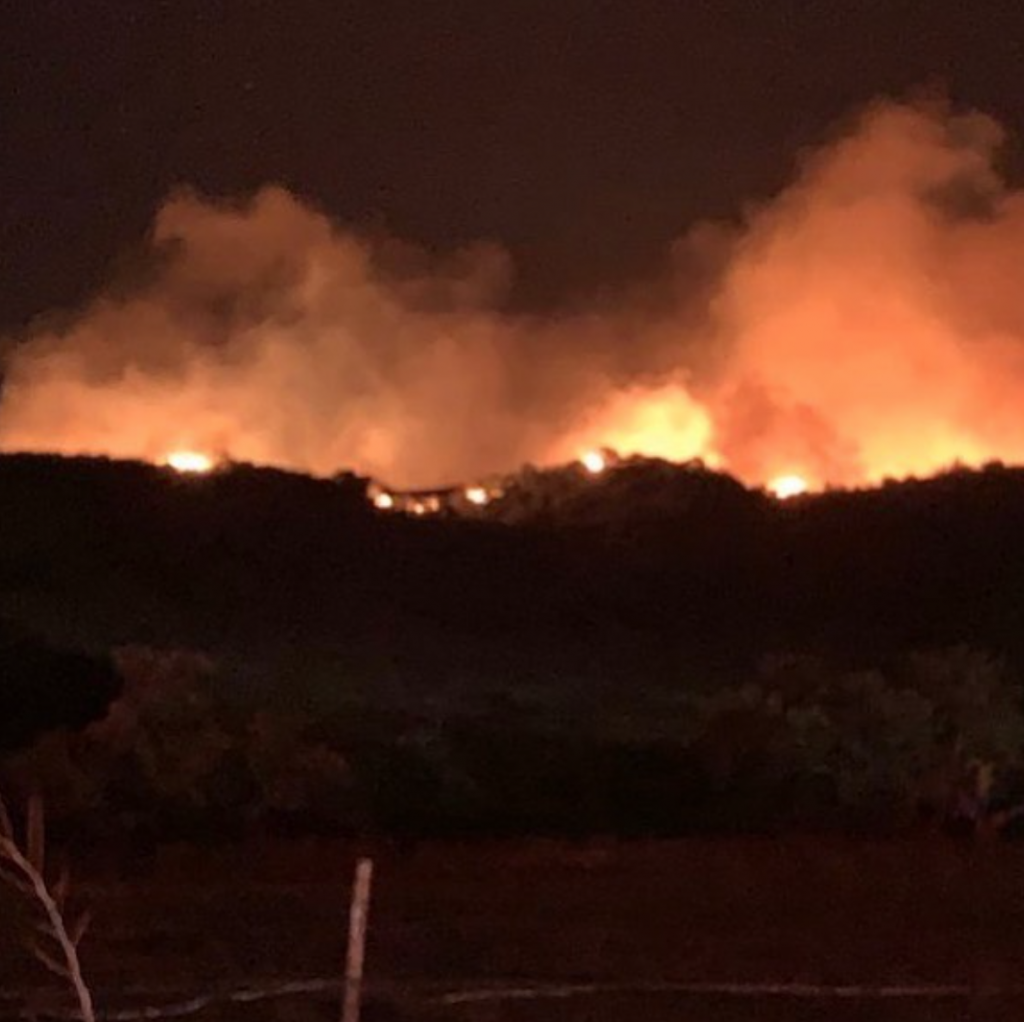
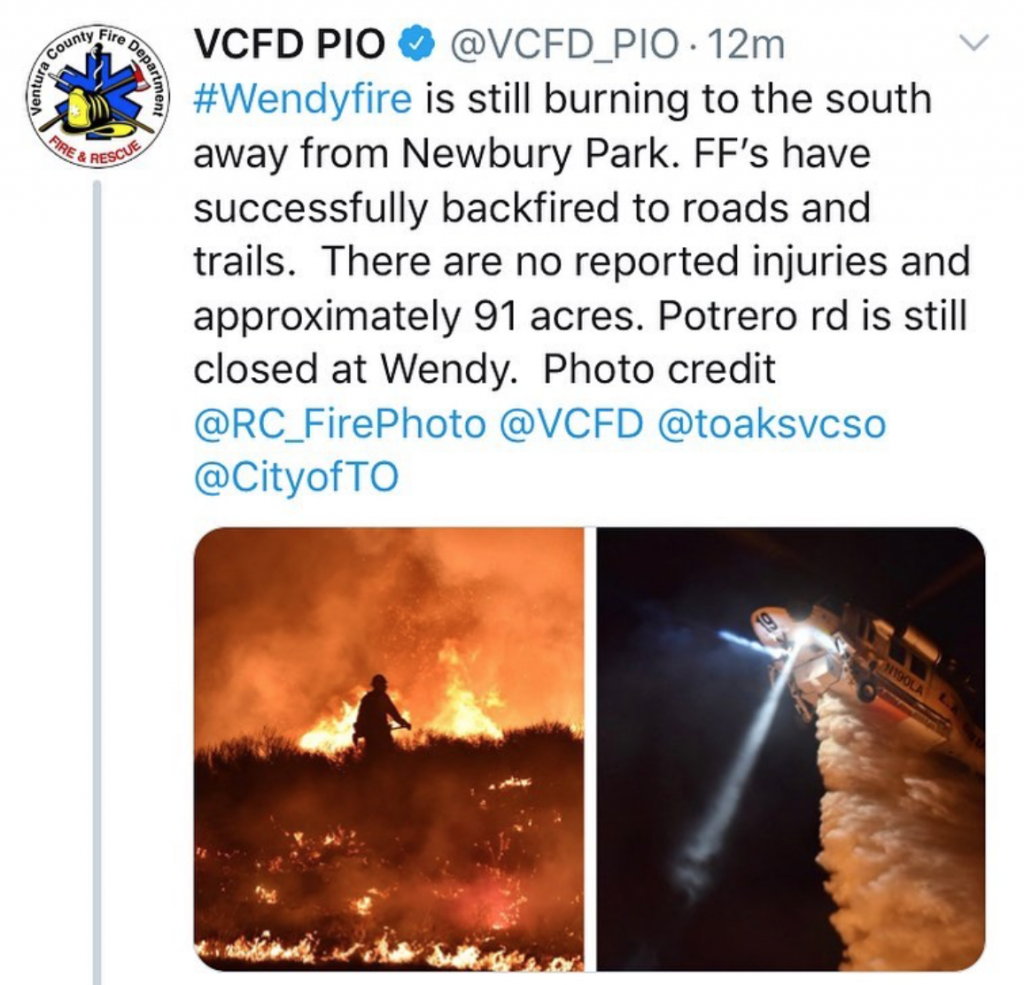
    Shortly after 7 pm. on Thursday, October 10th, the Wendy Fire, named for its ignition point on Wendy Dr. in Newbury Park, was reported on social media.

    The fire started at 7:11 p.m. near the Wendy trailhead at Wendy Drive and Potrero Road in Newbury Park. The fire burned in a southerly direction, away from homes on national parkland, with firefighters initiating a strong attack on flames. The same area was  previously hit hard by the Woolsey Fire last November.

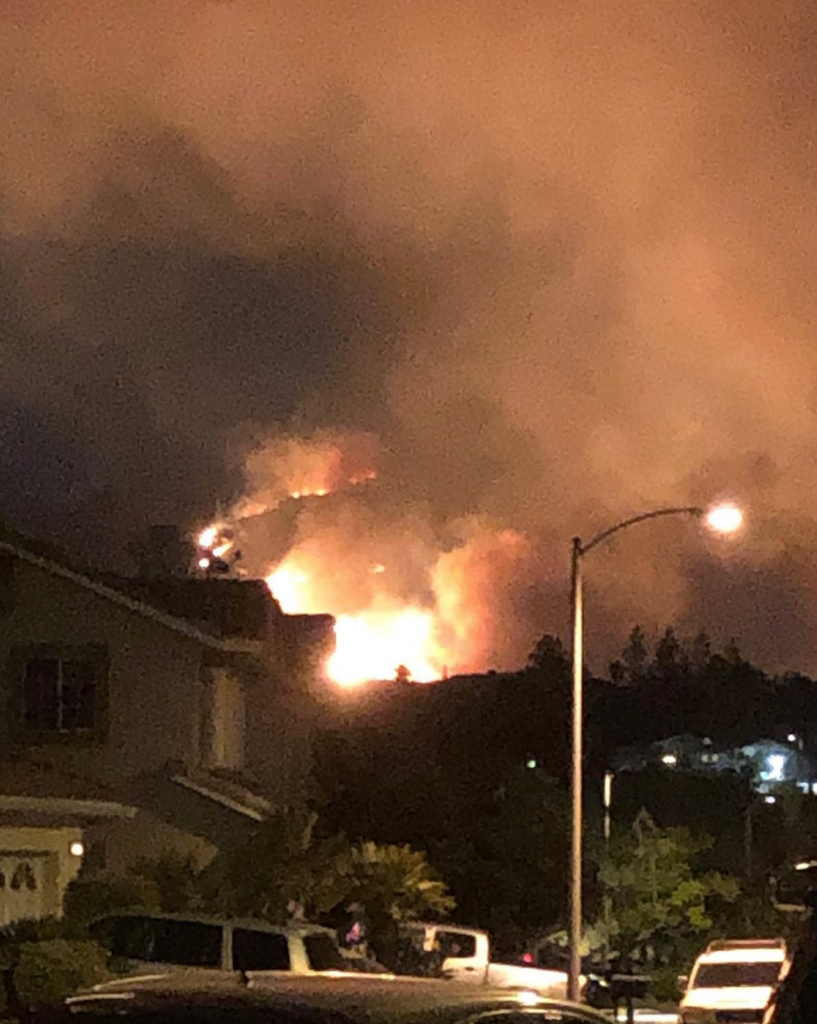
    Unbeknownst to locals, the efforts to stop the blaze were successful upon its approach to Point Mugu State Park. However, with flames visible in the distance by Decker Canyon residents before 10 p.m., and no guidance from authorities, or the City of Malibu as to wind direction and preparation for residents, those living in the canyon with large animals were not taking any chances and making plans to voluntary evacuate on their own.

    The Wendy Fire was getting dangerously close to Malibu for residents still raw from Woolsey.

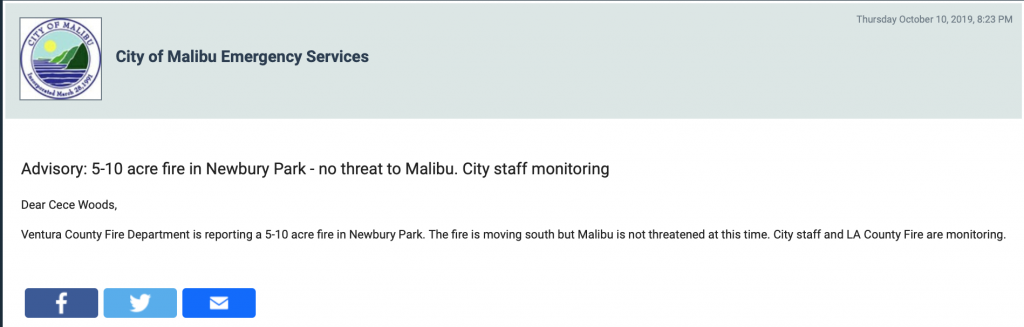
    Anxiety reached a fever pitch with residents posting on social media their concerns over the flames visible from the Wendy Fire, and smoke filling the canyons from different directions. The City of Malibu sent out only one alert at 8:23 p.m., and no further updates as flames became more visible from canyons looking down the coastline.

    The City of Malibu’s only emergency notification was at 8:27 stating there was “no threat to Malibu”, however, an hour later flames were visible from the Wendy Fire in Decker Canyon forcing residents to make plans to evacuate large animals.

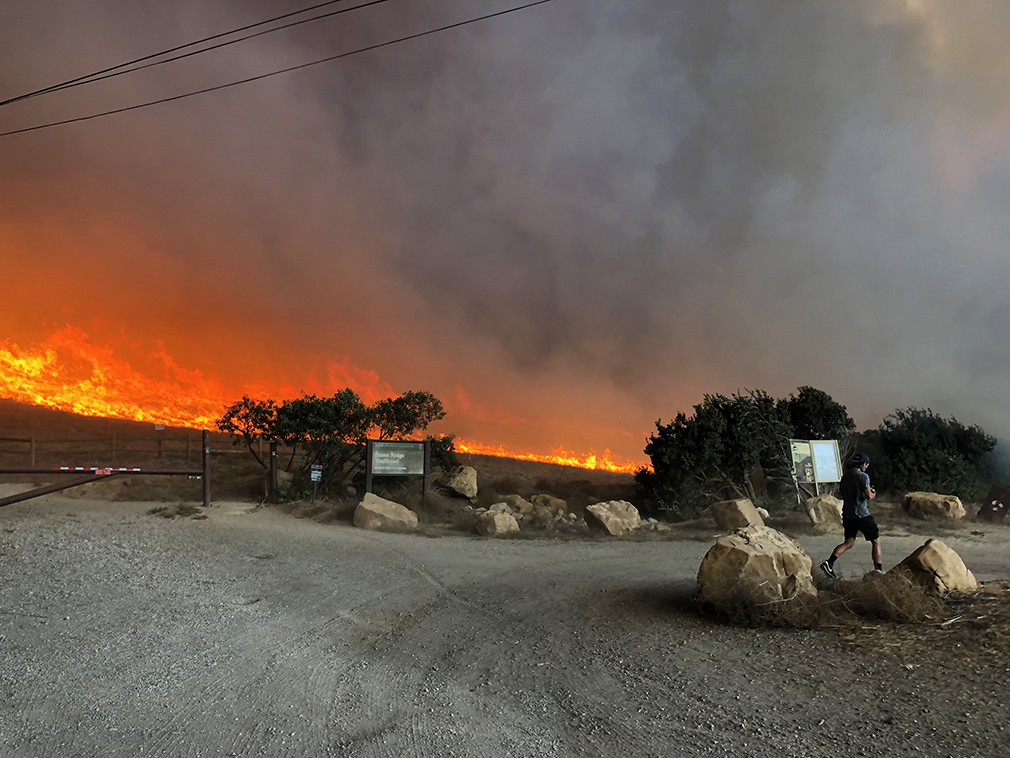
    The Saddleridge Fire was now raging out of control and fears of yet another fire headed toward Malibu, with similar patterns of the Woolsey Fire, spread through the community fast.

    After a sleepless night with no real updates on the Wendy Fire other than official response on social media that lacked detail, discrepancies over Wendy’s containment sent the community spinning once again. Reports varied between 25% and 90% with local authorities sending out an incorrect emergency notification at 90% when the fire was in fact only contained to 25%. Reports of winds gathering strength once again made residents extremely uneasy.

    The City managed to eek out one tweet mentioning the Wendy Fire, and completely ignored the Saddleridge Fire growing in size exponentially overnight.

    By Friday, more than 1,000 firefighters from multiple agencies were battling the Saddleridge Fire. Eight helicopters made repeated water drops as crews on the ground attack the flames, and two super scoopers and one Erickson air crane join the fight from the air as the fire headed west toward the Ventura County. A slight wind shift could have impacted Malibu similarly to what we experienced 11 months ago

    The Saddleridge Fire raging out of control.

    Too Lazy To Use Fire Liaison?

    In May, the city added a third person to the Malibu Public Safety Department. The new Fire Safety Liasion position was created and filled with Jerry Vandermuelen, a 35 year veteran of fire service experience with the Kern County and Ventura County Fire Departments.

    The Wendy Fire event would have been the perfect opportunity for the City of Malibu to flex this new fire expert’s muscle. Alas, that would not come to pass. It is unknown why the city did not utilize the newly hired Fire Liaison’s knowledge and connections in Ventura, the lead agency in the Wendy Fire, to gather information and properly guide residents during the first fire event breaking out so close to Malibu.

    The combined experience and relationships with Ventura officials that Malibu City Public Safety Director Susan Duenas supposedly brought to the table before the Thomas Fire (but did not benefit locals whatsoever in terms of communication and preparedness), and the added experience of the new Fire Liasion, it would seem the City would be prepared, and communication would be detailed and at the highest level.

    Unfortunately it was deja-vu-in-the-bu, as yet again, City of Malibu officials were embarrassingly unprepared, even after a report ordered by Council last February was submitted with over 50  recommendations regarding Malibu City staff’s failures during the Woolsey Fire that needed to be addressed before the next disaster (Paul Taublieb’s assessment of the whitewashed report on the City’s response to Woolsey).

    Our first taste of fire season was a bitter re-opening raw wounds from Woolsey much too soon.

    Yo Malibu…

    You’re On Your Own.


  • Woolsey Fire: City Council Accepts Whitewash Report of Malibu’s Darkest Days.

    Woolsey Fire: City Council Accepts Whitewash Report of Malibu’s Darkest Days.

    By Paul Taublieb

    Back in May, I wrote an article for the The Local titled, “I Hope I am Wrong,” expressing grave reservations about the process of selecting Management Partners, and then the decision to hire them, as well.  (It was a follow up to my original article “Woolsey: A Story of What Did and Didn’t Happen”).

    Well, I was right.  It is a debacle, whitewash, embarrassment and disservice to the community.

    It’s filled with outright falsehoods, and more insidiously, it concludes with a mind-boggling 50+ suggestions for “improvement,” which are all, essentially, preventable failures of preparation and execution by the city and its management.  While Management Partners, as I feared, tried to cloak the shortcomings in “government speak”, the framing of this document should have been how the city failed its citizens.

    And I say this acknowledging, as the report is quick to point out, the city of Malibu is not a firefighting or policing organization.  But that is not a justification for the egregious shortcomings in both the City’s preparation and actual performance.

    I can say this.  The City got what it paid for, if not what the citizens expected or deserved.

    Due to manipulation and CYA machinations by the council, most notably Rick Mullen and Skylar Peak, Management Partners (MP), who came into this highly-conflicted as previously reported, was specifically charged as NOT to do an investigation, but a very specifically a “review.” AND  I was personally told by a representative of  MP told they only were planning on making suggestions to do things better, not assign any personal responsibility for any individual’s shortcoming.  There was not to be, by design from the City Council, and then by MP, not to be any accountability or criticism of any specific individual.  I was told by MP, “We are analyzing the performance of the city” – as if it wasn’t made up of humans  – “not of any specific individuals.”

    Or as Mayor Karen Farrer told me, “We are not doing an investigation, we are doing a review. If you want an investigation, go hire your own investigator.”

    The report states that the City takes fire preparation, “quite seriously.”  And it says that in their analysis, the City needs to “improve performance and effectiveness.”  To draw a perhaps effective analysis, imagine if the same came from your doctor – he takes his preparation “seriously” but also needs to improve his “performance.” Would you go back?

    No.

    First, taking something “seriously” speaks not to competence.  It’s how MP likes to frame things rather than calling them for what they are in their report: shortcoming, failings and botched execution.

    This is how the entire report is constructed  – a mild chide, no responsibility assigned for the blatant gap of competency, followed by a cheery recommendation of what actually should be done.

    It is as if, for the most part, the city is a monolithic, computerized, un-human entity where failings are somehow intrinsically systemic, with no actual person responsible for anything.

    In other words, thanks to the gutless charge that MP was given by the City Council, the whitewash we received was inevitable.

    Moreover, a giant failure of the report is their stated, self-imposed guardrail to their inquiry of not analyzing the actions or performance of the LA Fire Department. One would think the actions of a fire deparment in a fire would be germaine. But no, thanks to our City Council, and perhaps at the behest or guidance of city officials. As MP writes in their report, “Many in the community want to understand why firefighting personnel were not able to actively fight structure fires during the event despite fire resources being in the area.” Uh, yeah.  But, “MP was not engaged to evaluate the response or tactics used by the LA County Fire Department, which serves Malibu.”

    In other words, the essential question faced people looking at burned out lots with all those ramifications, they may have looked to our city, the spending of $50,000 to do a “report” to fnd out why did your home burn down with firefighters hanging around? Heh, not our problem!

    As we know, there were other substantial issues around the fire and its aftermath, including “decision making” and “evacuation and repopulation of Malibu’s neighborhoods.” Clearly things the citizens wanted to understand?  That’s there, right?  Nope. “We are unable to evaluate other public safety or first responder agencies who were in the lead and carried out evacuation and repopulation.”

    So in other words, our city council gave the company doing the “review” guard rails that kept them from understanding why houses burned while fire trucks idled, why the police shut down Malibu like a diseased quarantined area, and why the repopulation effort was a fiasco.  Heh, might have been your problem, but not our problem, as far as your city council, and the professionals at city hall, are concerned.

    Complete exoneration wasn’t possible however, regardless of how the City Council kept the report within strict parameters.

    MP writes, for example, there was “(The) lack of pre-planned, mutually-agreed upon coordinated evacuation plan (across all first responders and the City), and agreed upon repopulation efforts…(which) resulted in…. considerable dissatisfaction by the community.”

    Ya think?

    But at the heart of what is missing is simply this:  who is responsible?  Who didn’t have an evacuation plan in place?  Who, specifically and personally, failed and should be held accountable? Does the proverbial buck stop at the City Manager’s desk?  Well, see MP didn’t have to worry about that – by policy, they don’t name names of people who fell woefully, and professionally, short in their duties. See, they were charged with doing a “review”, not an “investigation.”  They never set out to name names because the City wanted it that way.

    Still, despite the safeguards inherently built into this effort, the egregious failings were just too numerous, systemic and important – even for MP to avoid, and they laid out 53 specific recommendations.

    The obvious, however, is not stated:  essentially all of them could have been, and should have been, anticipated and addressed before the fire.  (Whether they are being so now is another question entirely – important no doubt, but subject to future scrutiny.)

    So the first round (of many!) recommendations MP makes – which should all really serve as indictments for not being in place prior, given that fire is by no means a stranger to Malibu, the size and scope of Woolsey, which a factor, is certainly not outside of something that should have been considered.  What are some of these groundbreaking assessments?

    Well, they proposed things like the City needs to be able to communicate better with outside agencies and first responders.  Really.

    And in one of the few pointed notes, they write about better time management by the City Manager, and how she was so busy with elected officials she needs to better use her time for “response issues and organizational management.”  One might also call this being a “chicken with her head cut off” or “overwhelmed” or “incapable of dealing with the crisis,” but those are not the words MP chose.

    The report goes on to make a slew of other recommendations about planning and preparation – implicitly acknowledging none of these things were done prior and should have been. AND no one is held accountable by name or department for not having done so.

    I could go on and on and on. It talks about how CERT kits (the city-managed, but volunteer run existing emergency responding group of Malibu, “contained food that was expired and much of the supplies not useful in a wildfire event.”  Well, who thought of that?  Did MP find out who was responsible at City Hall?  Nope.

    But MP does almost comically suggest, “more tools and support could have improved their effectiveness.”  Oh really, an entirely useless emergency system for a community in a known fire zone could have been prepared?  Who is responsible for this not happening?  No one is named.

    There is, however, some comedy in the report.

    Like “City staff left behind critical information and equipment when the EOC was forced to relocate.” You know, hard to manage and carry, or anticipate the need for, things like “laptops” or “personal contact information.”  So they couldn’t get online and couldn’t communicate with each other, you know, do their jobs.  (Of course, no mention of the fact it would have been easy and safe for someone to run up to city hall and grab the stuff.)

    But one thing the report somehow (I guess not surpassingly)  gets entirely wrong – and should chap the butts of everyone — is this sentence about our city manager:  “(She) remained in Malibu on a daily basis, resolving a number of issues that arose during the event as well as” now get this! “orchestrating the delivery of supplies to Zuma for those who did not evacuate.”

    See, I interviewed Reva shortly after the fire.  And that description is an attempt to post-event rewriting of history.  Or to put it more colloquially, utter bullshit. By her own account to me in my post-event reporting,  she stated on the Saturday of fire weekend, she and the city delivered some supplies to animals and people at Zuma, her own words to me in no uncertain terms was her responsibility was entirely focused on the repopulation, and “anyone who choose to stay behind should have been prepared, they are not the responsibility of the city.”

    Now, I was here for most of the post-fire lockdown, and like other people I’ve asked, not a single person ever saw Reva.   She was never at the Pt. Dume relief center where all supplies were distributed from, and for damn sure she wasn’t at Paradise Cove or Zumirez beach helping to ferry in supplies.

    By her own account, doing anything for the people behind the draconian blockade were not her problem. “Look, there are 12,000 people in the city of Malibu,” she said in our interview, “and helping the one thousand or so who stayed beyond and spending City resources on them would not be fair to those people who left.”

    Now Mikke Pierson, who along with Karen Farrer picked Management Partners, and both were fine with the idea of a “review” and not investigation, says he saw Reva up in Malibu a couple of times.  Well, I believe him I guess, but to say she in any way whatsoever “orchestrated the delivery of supplies” as the report stated, apparently from her account is pretty much like saying when I hum along to some classical music I’m orchestrating the LA Philharmonic.

    In summary, the reports has 53 very specific, mostly very good, virtually doable recommendations. But as I feared, and by design, no one’s feet are held to the fire for e 53 shortcomings. 53 items which could have been, and should have, been anticipated.  53 things which the person in charge, that the City Manager, as she’s where the buck stops, should be held fully and entirely accountable for.

    I hoped I was wrong, but I was right.  The city got what it wanted.  The citizens did not. Time for change.

  • The Local Malibu Exposes Judicial Misconduct and Potential Corruption in Woolsey Fire Litigation

    The Local Malibu Exposes Judicial Misconduct and Potential Corruption in Woolsey Fire Litigation

    by Erik Cooper

    When Los Angeles County Superior Court Judge William F. Highberger disqualified law firm Quinn Emanuel Urquhart & Sullivan, LLP from representation of any victims of the Woolsey Fire, The Local Malibu asked why Quinn Emanuel’s affiliated partner, Engstrom Lipscomb & Lack, were not equally disqualified after drinking from the same poisoned well.

    The well was the affiliation of Quinn Emanuel with Engstrom Lipscomb & Lack, a professional association of the two law firms which developed after the Woolsey Fire devastated much of Malibu last November.  Dozens of lawyers and their firms raced to gather as many Woolsey Fire victims as possible.  Their goal? Strength in numbers.  The more clients a law firm represents in the disaster, the more likely the law firm will be appointed by the court to the coveted position of  lead counsel in the inevitable mass civil action those victims would ultimately pursue in court. And appointment as lead counsel equals a percentage of not just the firm’s own clients, but also a percentage of all plaintiff’s proceeds received in the mass action for services provided as lead counsel.  Lead counsel equals big money.

    The poison was the “material confidential information” SoCal Ed alleged it shared with Quinn Emanuel during a December 2017 meeting in which Quinn Emanuel was vying to be appointed as SoCal Ed’s defense counsel for lawsuits the company faced from the 2017 Thomas Fire.

    Since most relationships are based upon honesty and trust, one could perceive that Quinn Emanuel would have shared the material confidential information it learned in those meetings with SoCal Ed (the poison) with its Woolsey Fire partner, Engstrom, Lipscomb & Lack.  Both law firms played together in the same well.

    We may never know. Judge Highberger apparently did not consider the potential relationship between Engstrom and Quinn Emanuel, and never conducted any evidentiary hearing to ascertain if, like Quinn Emanuel, Engstrom had also been poisoned, whether by actual evidence or the appearance of such evidence of access to that material confidential information, a relevant disqualifier.

    To the dismay of certain advocates, including a Facebook Group and its moderators who hosted a dog-and-pony show of specially-invited lawyers and their law firms to vie for their member’s business in exchange for a substantially reduced attorney’s fee, on June 20th, The Local Malibu attempted to explore the disqualifications of Engstrom, Lipscomb & Lack by submitting questions to the court for our readers.

    In response, Mary Eckhardt Hearn, public information officer for the Los Angeles County Superior Court, fenced our questions by citing Canon 3(B)(9) of the Code of Judicial Ethics, citing, “A judge shall not make any public comment about a pending or impending proceeding in any court, and shall not make any nonpublic comment that might substantially interfere [emphasis added] with a fair trial or hearing.”

    It appears the only substantial interference is the Court’s own efforts to avoid rebuke and dodge the obvious:  How can Engstrom, Lipscomb & Lack be permitted to represent Woolsey Fire plaintiffs when the court disqualified its partner, Quinn Emanuel Urquhart & Sullivan?  Both firms played in the same well, but only one was poisoned by exposure from SoCal Ed to material confidential information?

    Nonsense.

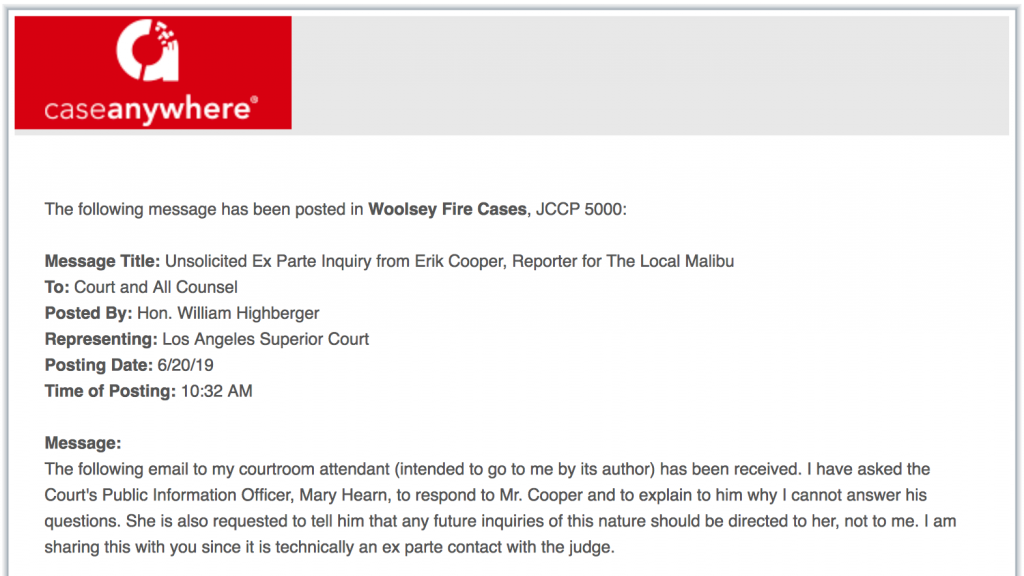
    Shortly after the court coordinated all Woolsey Fire cases into one oversight case — assigned case number JCCP 5000 — Judge Highberger authorized use of a private, exclusive, and proprietary internet platform — CaseAnywhere.com — “to facilitated electronic serving of litigation documents, calendaring of events and communication.” “Communication,” indeed.

    When The Local Malibu contacted the court for its comment on the poisoned well issue, the court used CaseAnywhere and sent its own message to all attorneys in the Woolsey Fire Litigation case.  That is, a private message.  Not a notice sent to counsel for all parties and filed with the clerk of court in the public record.  Not a comment made by Judge Highberger in open court and recorded by a court reporter.  Not a morsel of a recordable document accessible by the media.  Only a private message accessible by attorneys granted special access to CaseAnywhere.

    Judge Highberger’s private message was kept secret for well over two months, likely by your own attorney if you are a Woolsey Fire plaintiff.

    Only after The Local Malibu demanded disclosure of Judge Highberger’s private message did the message itself surface.  Only after The Local Malibu demanded the court file the private message in the public record with the clerk of court did the court do so on August 22nd more than two months after Judge Highberger sent his private message to the lawyers, not to you, and not to us.

    Judge Highberger’s private message suggested The Local Malibu’s efforts to research our story demanding transparency of the court and the legal process constituted “ex parte contact.”  The Local Malibu and its writers are not parties to the Woolsey Fire Litigation case, and if the court were truly transparent, our questions for the court should have been filed in the public record for disclosure not just to the attorneys who subscribe to CaseAnywhere, but to the plaintiffs, to the public, and to the media.

    According to Hearn, “Although a copy of the communication in question was provided to The Local Malibu upon request, it appears the document had not been placed in the court file.”  Surprise!  Hearn continued, “That has been corrected [as The Local Malibu demanded], and staff have been reminded of their obligations in this regard.” Caught.

    Judge Highberger’s oversight of filing his private message with the clerk of court was no error.  It appears the court and lawyers in the Woolsey Fire Litigation have been using CaseAnywhere to communicate privately for quite some time now, since the court approved its use, and continue to use the private CaseAnywhere message board as its communication platform today.

    The Local Malibu has requested all communications either sent or received by the court and all attorneys on the proprietary CaseAnywhere platform. We anticipate sharing with our readers more private messages communicated between the lawyers and the court, but not Woolsey Fire victims themselves, whose best interests remain compromised today.

    In the interim, The Local Malibu intends to report our concerns for judicial misconduct and, quite possibly, for corruption involving Judge Highberger to the State of California Commission on Judicial Performance.  We will cover the Commission’s response to our concerns in our future reporting.

    It seems Woolsey Fire victims face new challenges, caught in the cogs of those wheels of justice.  The court, in all of its actions, must always convey an open, honest, and transparent relationship with the parties, and with the public, for our justice system to work properly as intended.  Otherwise, misconduct, like Judge Highberger’s choice of communication platforms and his omission of disclosure of those private communications with others, creates the appearance of impropriety and secrecy, of backroom deals at the expense of victims, while the wheels of justice continue to crush the Rules of Civil Procedure governing the court’s conduct on the rails ahead.

    Haven’t Woolsey Fire victims already been victimized enough?

    Continue to follow our FireWire coverage of up to the minute news and information to help Woolsey Fire victims recover from this tragic event.

    For more FireWire stories and information, click here.

  • Rush to Justice? Woolsey Fire Victims Rushed Through Judicial System

    Rush to Justice? Woolsey Fire Victims Rushed Through Judicial System

    By Erik Cooper

    No one who has ever suffered a loss wishes to extend their suffering from that loss any longer than absolutely necessary.  While the wheels of justice sometimes turn painfully slow, for victims of the Woolsey Fire, the wheels of justice may actually come off.

    On November 9th, 2018, Malibu suffered one of the worst wildfires in our community’s history.  Millions of dollars of destroyed properties were left in its wake, and countless lives have been affected by the federally-declared disaster.

    Shortly after the smoke cleared, Woolsey victims assessed damages and hired lawyers to pursue recovery from their losses.  Lawsuits flooded the courthouse with more to follow. The court coordinated all of the cases into one action.

    for determination of liability against the defendants, in this case, Southern California Edison Company (SoCal Edison).  Judge William F. Highberger was assigned to the coordinated case.

    Since coordination, our wheels of justice have been turning at an expedient rate.  Attorneys have been disqualified , attorneys have bargained for positions to drive the train (as lead counsel), a trial date is set for February 2020, and now, victims face a deadline to submit their claims for damages — AUGUST 25th!

    The ashes are barely collected.  Our recovery from this catastrophe has barely begun.  And even though our damages are not yet fully calculated, we are placed on a track to dispose of our claims hardly before the ink has dried on our legal complaints.

    What’s the rush?  Sure, Malibu and its residents would like to move on.  But the extraordinary rush to force claims through the judicial system and resolve them, yesterday, seems outrageous.  Expediency has replaced efficiency.  It seems Woolsey Fire victims may soon be railroaded into rushed judgments and forced settlements to move this thing along for…what good reason?

    No after-action reports have been prepared. Investigations are not yet complete. The facts remain undetermined. But here we go!  So hold on.

    Continue to follow our FireWire coverage of up to the minute news and information to help Woolsey Fire victims recover from this tragic event.

  • Disqualified: Law Firm Prohibited From Representing Woolsey Fire Victims

    Disqualified: Law Firm Prohibited From Representing Woolsey Fire Victims

    By Erik Cooper

    Victims of the Woolsey Fire can no longer rely upon the law firm of Quinn Emanuel Urquhart & Sullivan, LLP for legal representation of damages suffered from the Woolsey Fire.  The November 8th blaze devastated millions of dollars in properties and impacted every Malibu resident.  Origination of the fire was sourced to the Santa Susana Field Research Laboratory in Simi Valley and, though official reports have still not yet confirmed, the cause is believed to be due the negligence of SoCal Edison’s electric service equipment.

    Shortly after the smoke cleared, victims of the Woolsey Fire filed their insurance claims and began looking for legal representation to help them recover from their staggering losses.  Malibu resident Kenneth R. Chiate, whose home reportedly survived the catastrophe, attended informational meetings hosted by a local newspaper and its recovery team, shared legal advice with attendees and suggested that he and his law firm, Quinn Emanuel, were not planning to represent any victims of the Woolsey Fire since Chiate and his firm had defended utility companies in lawsuits stemming from earlier wildfire events.

    In a motion to disqualify Quinn Emanuel filed in early May, SoCal Edison argued Chiate had participated in a December 2017 meeting and learned material confidential information about SoCal Edison and their strategy to defend claims filed by victims of the 2017 Thomas Fire.  SoCal’s motion implicated Chiate as a participant in strategy discussions and defense arguments during post-meeting follow-up calls, and though SoCal Edison did not hire Chiate or Quinn Emanuel as defense counsel, the confidential information disclosed to Chiate and his firm created substantial concerns for SoCal Edison’s defense of Woolsey Fire claims.

    Los Angeles Superior Court Judge William F. Highberger agreed, issuing an order Thursday disqualifying Quinn Emanuel from representing Woolsey Fire victims after finding SoCal Edision had made a “persuasive showing” of concern.

    Shortly after lawsuits began filling the clerk’s desk at the courthouse, the court sought to coordinate all lawsuits to avoid clogging the court system with numerous lawsuits heard and tried in various courtrooms before various judges at various times and with various outcomes.  The coordination of all related Woolsey Fire lawsuits reduced the logjam through the court system and the varying possibilities of win-some / lose-some outcomes in the trials of numerous cases.  Once coordinated, attorneys representing Woolsey Fire victims have appeared before Judge Highberger in numerous pretrial matters — the most significant, the matter of Chiate’s and Quinn Emanuel’s conflicts of interest representing Woolsey Fire victims after having “abruptly switched sides,” as alleged by SoCal Edison.  Judge Highberger agreed.

    In objection to SoCal Edison’s motion, Quinn Emanuel argued the firm should not be disqualified because its meeting with the utility lasted less than one hour and nothing confidential was disclosed. Quinn Emanuel also claimed SoCal Edison waited too long to seek disqualification, and that the firm had already partnered with Engstrom Lipscomb & Lack and had worked on the Woolsey Fire case for five months.  In his order, Judge Highberger found Quinn Emanuel’s witnesses opposing disqualification of the firm to be unpersuasive.

    Following disqualification of Quinn Emanuel from representation of Woolsey Fire victims, the question now remains whether the firm’s partner, Engstrom Lipscomb & Lack, will also be disqualified.  If confidential information may have been shared, as the court suspected, from SoCal Edison to Ken Chiate and staff at Quinn Emanuel, such confidential information was also likely shared from Chiate and his Quinn Emanuel team to key lawyers and staff at Engstrom Lipscomb & Lack.  The likelihood of SoCal Edison pursuing such disqualification seems inevitable.

    Continue to follow our FireWire coverage of up to the minute news and information to help Woolsey Fire victims recover from this tragic event.

    For more FireWire stories and information, click here, and follow us by subscribing here


  • In the Wake of the Woolsey Fire: What’s In Your Backyard?

    In the Wake of the Woolsey Fire: What’s In Your Backyard?

    By Cece Woods, Editor in Chief

    Nove 9th, 2018. Photo by Addison Altendorf.

    Since the Woolsey Fire devastated parts of Malibu and surrounding communities more than six months ago, questions remain today concerning the risk of nuclear contaminants and other toxins affecting our schools, our neighborhoods and our beaches.  Government officials conducted an initial assessment and issued public reports suggesting everything is fine.  But new evidence and a new look at those reports contradict those official findings, warranting independent studies and a deeper examination to help determine what’s really in our back yard.

    By now, most have learned that ground zero of the Woolsey Fire was sourced to the Santa Susana Field Research Laboratory (SSFL) located in Simi Valley. The site is comprised of 2,850 acres near the Ventura / Los Angeles county border and was once home to a nuclear facility and rocket engine test site before suffering a partial meltdown in 1959.  Radioactive and other chemicals have reportedly been released from the site over the years. Our state Department of Toxic Substances Control (DTSC) and California Environmental Protection Agency (CalEPA) published a carefully-worded joint report several weeks after the Woolsey Fire, confirming fire had burned through a portion of the SSFL and claiming, in part, that air sample testing results indicated “all the measurements and analyses indicate that no radiation or hazardous materials associated with contamination of SSFL were released by the fire.”  That report, initially published on the DTSC website, is no longer published on the website.

    Victim and first responder accounts of the Woolsey Fire reported thick black clouds of smoke blanketing the canyons, hills and beaches west of the SSFL. Many evacuees choked on smoke while fleeing our community.  Satellites recorded billowing smoke blowing westward from Simi Valley toward Malibu, Channel Islands National Park and beyond.

    Wildfire smoke alone has been determined to be toxic to our health.  Contaminants from structure fires, those structures being our homes and commercial buildings, include toxic chemicals and materials such as pesticides, mercury, asbestos and other pollutants.  But of equal or greater concern to the health of our own and future generations are the risks we face from nuclear contaminants polluting our air, our soil, and our water.

    In January, an investigator we worked with for this story, collected samples to help determine what, if anything, remains in our soils after the Woolsey Fire. Expected results included char, soot and ash, all common elements of wildland fires.  Char alone is known to be carcinogenic and therefore toxic to our health.  But what else would be found within our beach sands and sediment throughout the greater Malibu area?

    Three dozen mason jars, a box of powder-free latex gloves, a large bottle of hand sanitizer and a black Sharpie were used to collect samples.  A map of the greater Malibu region was obtained and various points of interests — popular beaches, local schools, public parks — were selected for sampling collection.

    For each collection, a new and previously unopened mason jar would be used with hands protected by a dab of hand sanitizer and latex gloves.  To avoid cross-contamination of any samples, repeated hand sanitization and a new pair of gloves were used at each collection point.

    Photographs and videos of each collection were produced to help identify the whereabouts of any concerns identified.  Each jar was assigned a number, then placed in a box in the trunk of the investigator’s car before being shipped across the country to a secure location for examination.

    After all, who would want this stuff in their house?  A private laboratory was identified where each of the samples could be tested for any hazardous or toxic contaminants, including, among others, nuclear particulate matter.

    The results?  Each jar confirmed the presence of char, soot, ash, and… nuclear particulate matter. The samples will now be shipped to a new laboratory for an official study to be performed and results released to the public.

    Questions involving the results of this study have been submitted to California’s DTSC and EPA for further reporting.  The Local Malibu will continue to cover this story and share the responses we receive from state and federal officials in future reports.

    Should your property be tested? Absolutely. Especially if your property was in the devastation zone or close to it.

    The level of contamination has not truly been determined yet, but it does brig up a very important issue that needs to be addressed by property owners in the area. Testing and remediation of the soil must be a part of the plan post Woolsey, whether you are a burn-out victim or not.

    After the smoke cleared. Photo by Paul Taublieb.

    For more FireWire stories and information, click here, and follow us by subscribing here.