Yesterday was a busy day at Malibu’s world renowned First Point.
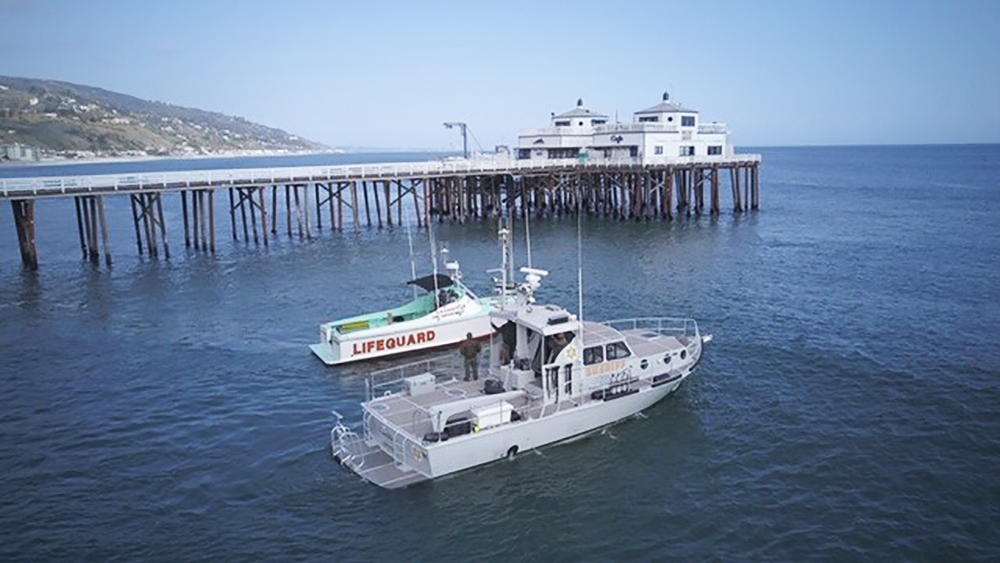
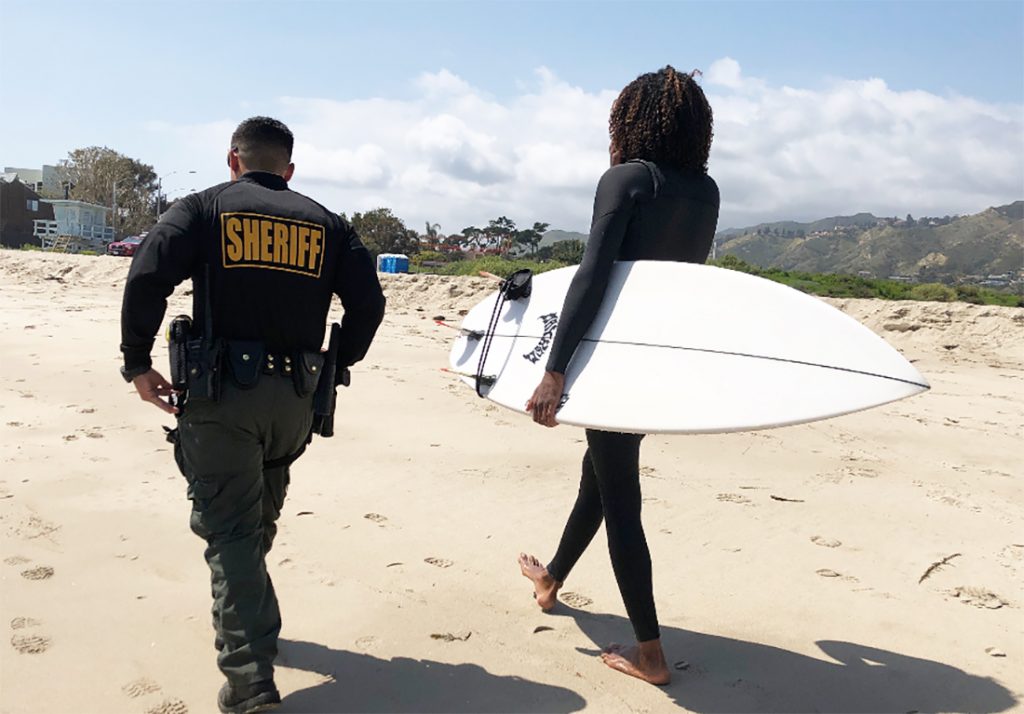
Deputies patrolled the popular surf break citing multiple offenders which includes arresting on paddle boarder. Lost Hills Station confirmed that all complied when asked to leave the beach.
The paddle boarder, from Pacific Palisades, ignored L.A. County Lifeguards demands to exit the ocean and remained in the water for approximately 30-40 minutes. An LASD boat was brought in from Marina Del Rey Station to assist, and once the Sheriff’s boat arrived on scene, the suspect then complied and swam to shore. The suspect was arrested for Disobeying a Lifeguard 17.12.115 LACC and Violation of Government Code 8665. He was booked at the Lost Hills station and subsequently released with a promise to appear in court. According to our sources, the suspect told officers his actions would now earn him”street cred” and was allegedly unfazed by his actions that carry stiff legal penalties resulting from the Stay at Home order on March 19th by Governor Newsome in response to the rapidly growing Covid-19 virus.
L.A. County Lifeguards and LASD coordinate in the water to bring a rogue paddle boarder disobeying orders to exit the ocean at First Point.
“To protect public health, I as state public health officer and director of the California Department of Public Health, order all individuals living in the state of California to stay home or at their place of residence except as needed to maintain continuity of operations of the federal critical infrastructure sectors,” stated Newsom in his order.
The order is enforceable by law, and the Office of Emergency Services has been given the authority to take necessary steps to ensure its compliance. This order utilizes California Government Code section 8665, which mandates that any person who violates or willfully neglects to obey the shelter in place order can be found guilty of a misdemeanor. Failure to adhere is punishable by a fine up to $1,000, a maximum sentence of six months jail time, or both.
A surfer escorted off the beach yesterday was cited for violating government code 8665.
Aside from the legal consequences, there is a growing health concern among scientists including Kim Prather, a leading atmospheric chemist at the Scripps Institution of Oceanography who was interviewed by the L.A. Times.
“I wouldn’t go in the water if you paid me $1 million right now,” she said.
In her research, Prather has found that the ocean churns up all kinds of particulate and microscopic pathogens, and every time the ocean sneezes with a big wave or two, it sprays these particles into the air. She believes that this new coronavirus is light enough to float through the air much farther than we think. The six-feet physical distancing rule, she said, doesn’t apply at the beach, where coastal winds can get quite strong and send viral particles soaring.
Many beachgoers know they can suffer skin rashes, stomach illness and serious ear and respiratory infections if they go into the water within three days of a heavy rain, because of bacteria and pathogens washing off roads and into the ocean. Raw or poorly treated sewage entering the ocean also poses major health risks.
During the Malibu Lagoon Restoration Project biologists and scientists weighed in on the faulty septic systems in the Colony that contributed to contributing to a toxic surf break at First Point.
The excavation during the project discovered some of the adjacent Colony houses to the lagoon had covert illegal discharge pipes that led into the back of the lagoon. Several eye witnesses claim that at least one particular home owner would sump pump untreated human waste of his submerged flooded septic through his illegal discharge pipe directly into the lagoon. The EPA deemed that area of the lagoon a “Dysfunctional Death Zone” and surfers referred to it as the “Polio Pond.”
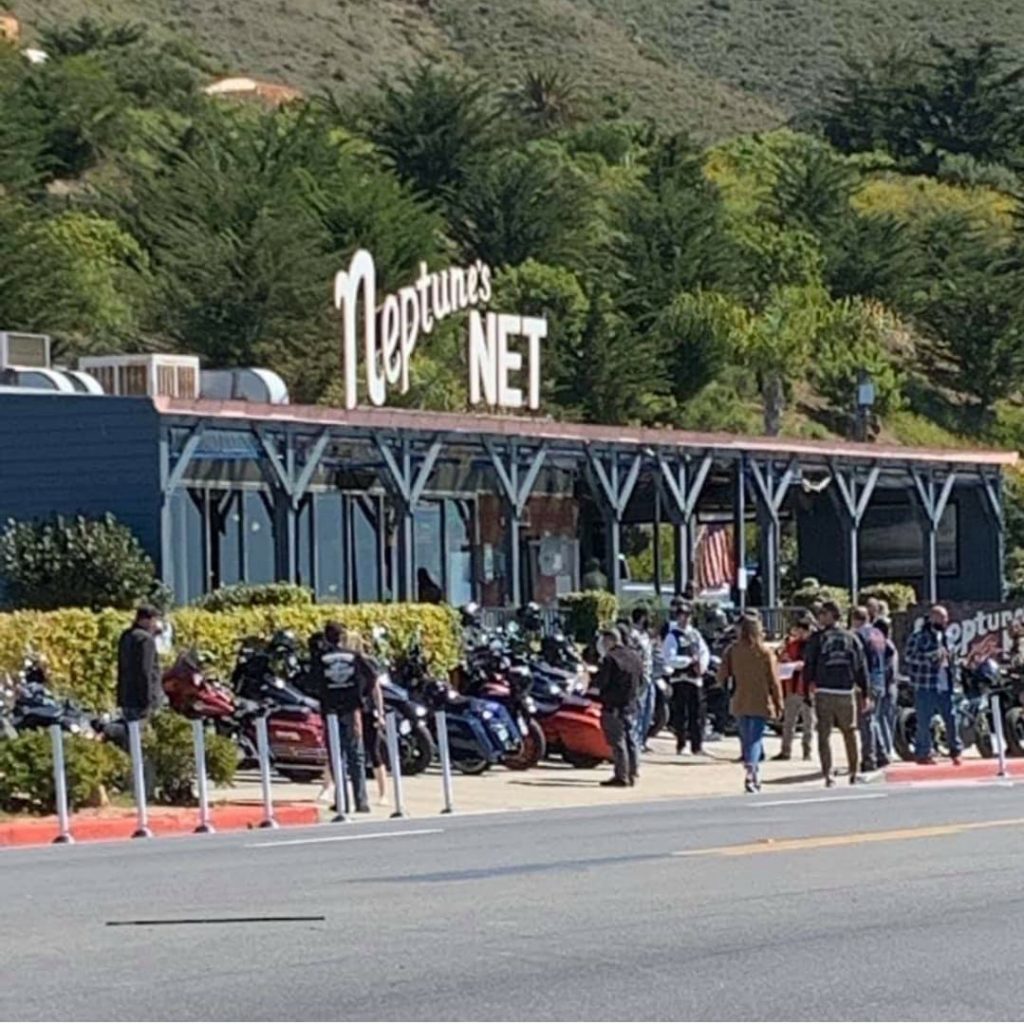
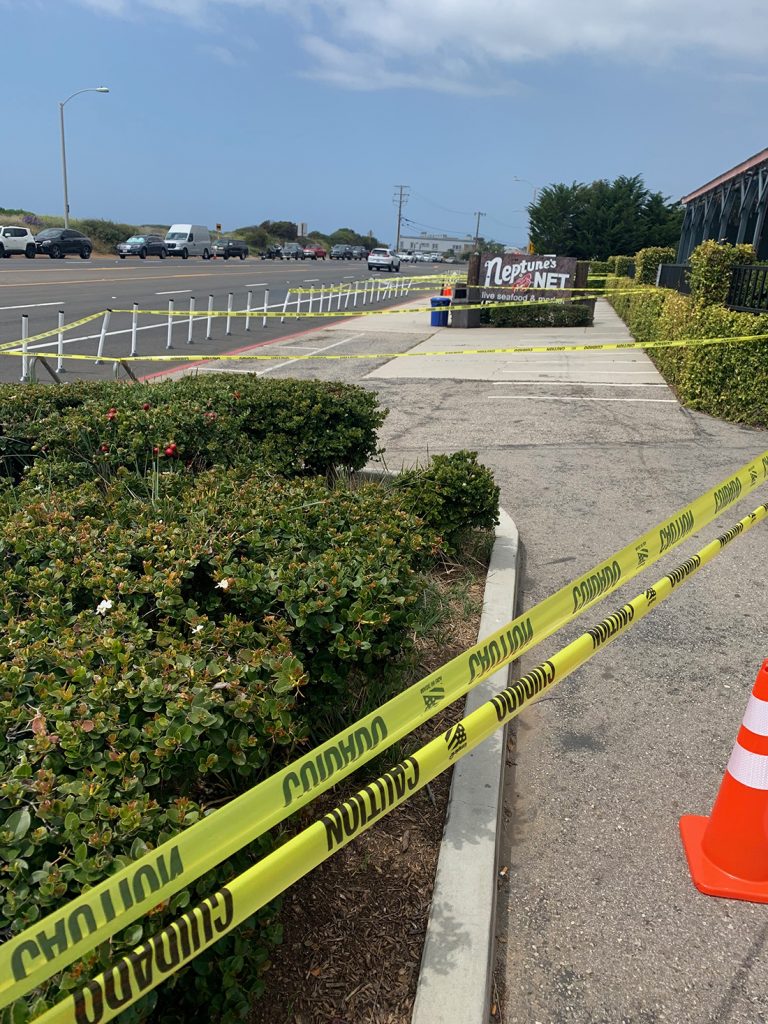
Regardless of known health risks regarding close contact during the Covid-19 health crisis, State Parks and Ventura County have been less than motivated to enforce state mandates based on the crowds that continue to congregate at Ventura County Line, and Neptune’s Net, a tourist destination who has been overwhelmed trying to implement social distancing according to public health guidelines. The first weekend of the Stay at Home Order, owner Margaret Cho told The Local Malibu they “didn’t expect anyone because of the Stay at Home order and was completely unprepared for the crowds”. They have since constructed barriers to limit crowds from gathering.
Crowds gathered at Neptune’s Net the first weekend of the Stay at Home order resulting in additional protection measures set up by the owners.
Repeated efforts have been made by community members putting pressure on lawmakers to enforce the government codes at County Line are expected to result in closing off of access to the County Line surf spot any day now requiring law enforcement to fine or arrest violators going forward.
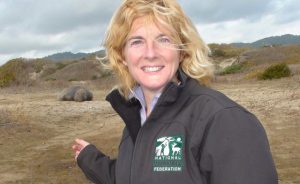
By Beth Pratt, Regional Executive Director, California, National Wildlife Federation, Leader, #SaveLACougars Campaign
Those of us who work to save the threatened mountain lion population in the Santa Monica Mountains and Los Angeles area are devastated with the senseless and preventable recent death of P-56.
We grow attached to these animals, and avidly follow their adventures, sometimes from kittenhood to adulthood. They are individuals with individual personalities. So let me introduce you to P-56.
P-56 roamed in the western edge of the Santa Monica Mountains. In videos he comes across as playful, and in a photo of him peacefully napping, he looks like he is living his best mountain lion life. His mother, P-23, was killed by a car—another senseless and preventable death. P-56 managed to survive to age five in this challenging urban environment–living in one of the most densely populated areas in the country—where most of his male relatives don’t live past age two. He likely sired at least one litter of kittens with P-19, who is also his grandmother, demonstrating yet another threat these cats face in the area—inbreeding.
Beyond our love for these mountain lions, however, we are devastated over P-56’s death because of the significant consequences. This is not about just one individual cat. For these threatened cougars, P-56’s death is another nail on the coffin for the entire population.
The National Park Service’s research has demonstrated that mountain lions in the Santa Monica Mountains are facing extinction because of genetic collapse from inbreeding. The 101 Freeway has effectively cut them off from the rest of the world, causing them to mate with their daughters, granddaughters (like P-56), great-great granddaughters etc.,. Cougars from the north bringing new genetic material can’t get past the ten-lane 101, and cats south of the freeway trying to find new territory usually die trying.
At best, the modeling by the National Park Service gives this population an estimated 50 years before inbreeding causes their demise. What this timeframe doesn’t include is other sources of mortality such as from automobiles, rat poison, and yes, being killed for preying on livestock.
Killing P-56 is tragic not just because of the loss of a remarkable cat, but because killing him has put an entire population of mountain lions at risk. He was one of just two known males in the area.
Indeed killing P-56 solved nothing (another mountain lion will just take advantage of the situation) and risked everything for these cats. Are twelve sheep worth driving a mountain lion population to extinction?
And I am also left asking why? Why was this necessary?
Those of us who work to save this population of mountain lions are happy to help people protect their livestock and pets. When a depredation permit in 2016 was issued for P-45—again, an important breeding male in the Santa Monica Mountains—the community rallied to his defense and offered solutions. My organization, the National Wildlife Federation, donated funds to build a predator proof enclosure, and groups like the National Park Service and Mountain Lion Foundation worked with the livestock owner to educate them on how to better protect their animals. Through these efforts, P-45 was spared.
I am saddened we were not given the chance in this situation to work on a nonlethal solution for P-56. Although the press release outlined some measures that had been taken, many of those have been proven to be ineffective in preventing mountain lions from attacking livestock. For example, penning livestock just makes them easier prey, and an electric fence, unless it is over 15 feet high (mountain lions can jump that height from a standstill) would not do any good.
In my role as the leader of the #SaveLACougars campaign, I work with a dedicated group of partners to build a wildlife crossing over the 101 Freeway to ensure these magnificent cats have a future. This crossing will allow for cats to move freely across the region and bring new genetic material to the threatened Santa Monica Mountain population. In layman terms, it will provide them with dates outside of their family.
Equally vital to the future of this population is solving this issue of inadequately protected livestock and issuing a death sentence to mountain lions for just being mountain lions. We humans have resources and capabilities a mountain lion doesn’t, and if we want to coexist with wildlife, we do need to take more responsibility for our actions than wildlife can for theirs, as they don’t have a lot of choice on where to live or what to eat like we do. As an owner of five beloved dogs and two cats, I would be devastated if a mountain lion attacked them. But I would not fault the lion. It is my responsibility to keep them protected.
At this point the situation for our cougars is dire. Native wildlife should take prominence in these decisions. I applaud recent calls to place more restrictions or ban depredation permits in the Santa Monica Mountains and Los Angeles area. This is an imperiled population. Most of us like living among mountain lions, recognize the specialness of having big cats on the landscape. But they will disappear if we don’t take the responsibility to coexist with them, and do what we can to avoid conflict.
I hope amidst the tragic killing of P-56, his legacy will be one of positive change that ensures a future for his kind.
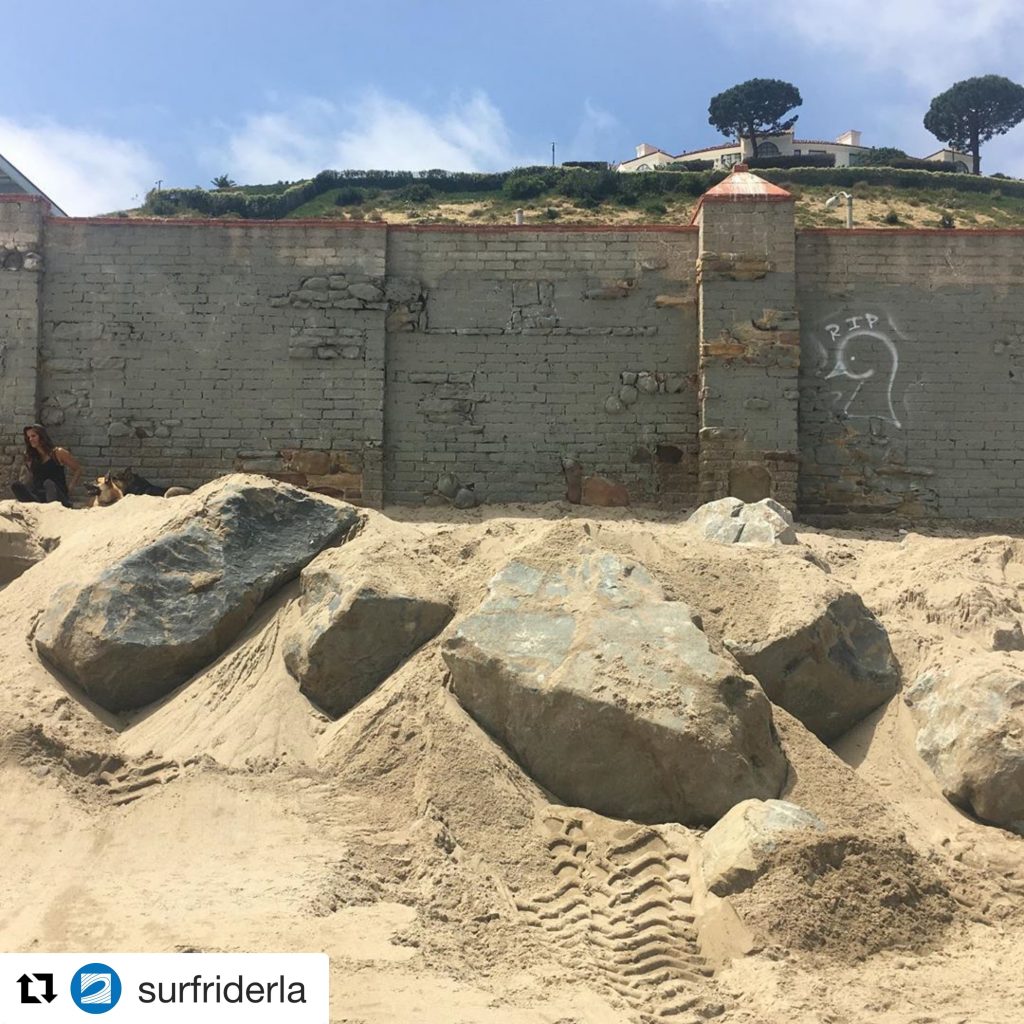
Historical landmarks The Adamson House and Surfrider Beach are eroding into the sea because of poor planning by City and County officials.
The Surfrider Foundation put out this announcement yesterday:
“The Surfrider Foundation is dismayed that City and County officials have chosen to drop boulders on the beach at Malibu in order to protect a historic landmark from erosion at First Point. Emergency seawalls are inevitable without proactive planning to accommodate ongoing erosion and the impacts of sea level rise. Surfrider continues to advocate for soft beach nourishment solutions at the Adamson Estate and a seasonal management program to encourage flows to exit Malibu Lagoonto the west at Third Point. We are calling on all stakeholders to come to the table and develop short- and long-term sustainable solutions that protect the beach at Malibu.“
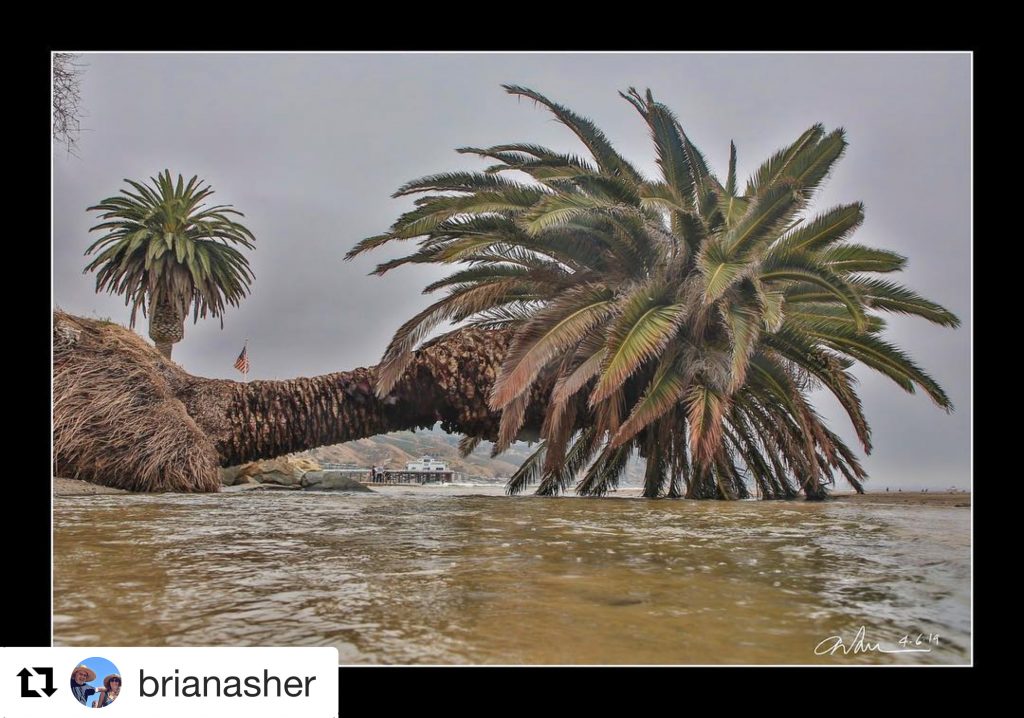
Local photographer Brian Asher posted this photo on Instagram of The Adamason House date palm tree that has fallen into this ocean.
As many of you know, we have a serious problem with rodenticides. These dangerous chemicals, are harmful to our environment and our pets, and are killing wildlife in the Santa Monica Mountains.
Local activist, Kian Schulman of Poison Free Malibu has been leading the ban for close to a decade.
We need the community’s participation by Monday, whether in person, or taking a few moments to write an email to Council regarding the Earth Friendly Management Policy:
“The Malibu city clerk that Poison Free Malibu’s Earth Friendly Management policy will be considered at a meeting of the Environmental Sustainability Subcommittee this coming Monday, May 13 at 2 pm in the Council Chambers at City Hall.
I hope you will have time to be there on such late notice.
Please come to the meeting to support it with a short comment, 3 minutes at most. Please request that Poison Free Malibu’s Earth Friendly Management policy be adopted, not the city staff’s version which encourages the return of synthetic pesticides. Organic pesticides should be the only ones considered under emergency conditions.
The city policy is still not finalized!
Poison Free Malibu’s policy is in the pdf file attached, PFM_EFM Policy.pdf.
The city’s October 8, 2018 revision is in pdf file Staff Proposed EFM Policy.pdf.
On May 4, 2018 after a two year CEQA study at the cost of $38,400, the PFM Earth Friendly Management policy was reviewed by
Michael Baker International declaring that the PFM Earth Friendly Management policy would result in less than significant adverse environmental effects and a mitigated negative declaration was made.
Ignoring this conclusion, on October 8, 2018 the city presented a ANOTHER, Pesticide Use Policy, including the return of the synthetic chemical pesticides, eliminating several essential building blocks of a green policy, and requesting bringing back killing squirrels in the park!
This meeting will determine the policy going forward.
Thank you!
I. Earth Friendly Management Review
The first integrated pest management (IPM) policy for the city of Malibu was initiated in October 2013 at the request of PFM.
Previous to this there was no transparent policy to guide the Parks and Rec. Dept. They used whatever pesticide they wanted with no public accountability.
This first IPM policy HAD the skeleton of what IPM is about. However, this basic skeleton was ignored. A public records request in 2016 was submitted and reply received for the previous 4 years. We totaled the amount of pesticides that were used on public areas. It was determined that the city was using MORE pesticides since the IPM policy was initiated, not less.
An uproar from the local citizens requested that the harmful pesticides be stopped.
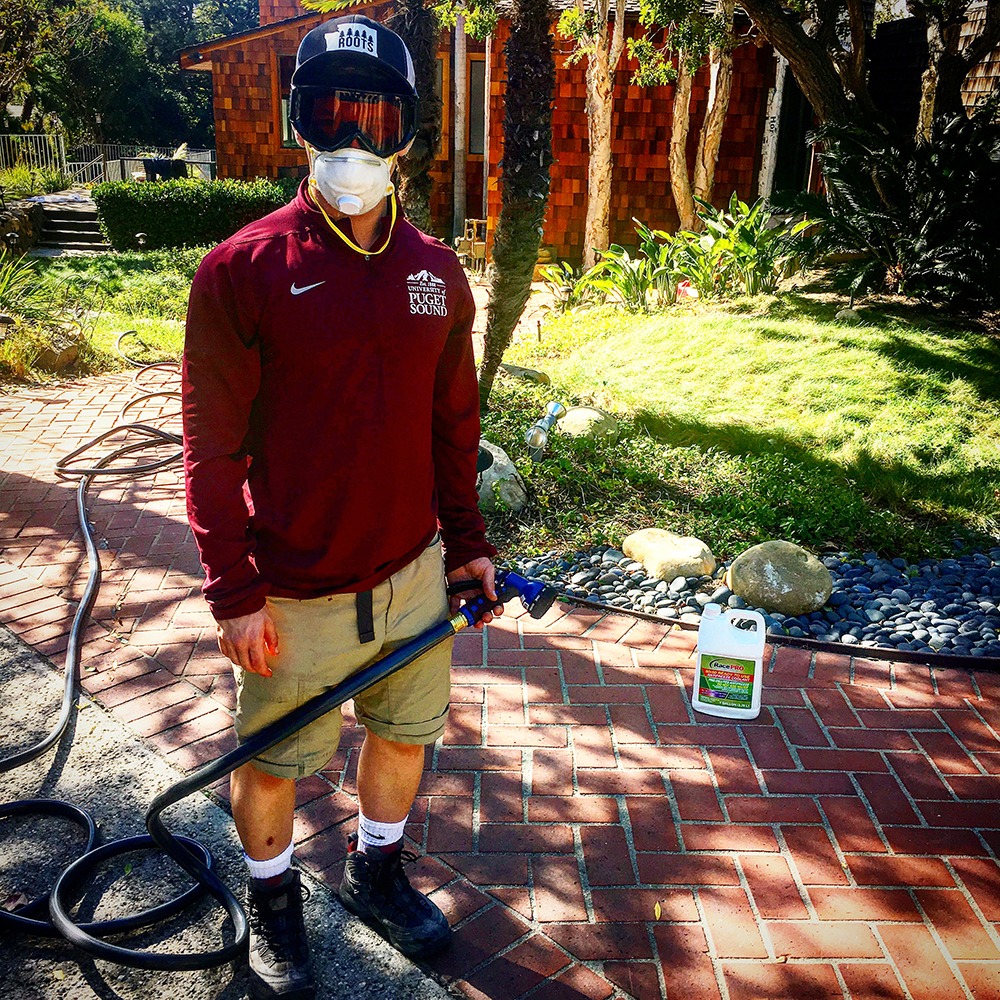
For example, here is a photo of a girl on a bike in Legacy Park next to a man with a hazmat outfit on spraying herbicides.
II. EFM Policy History at City Meetings
• May 17, 2016
The Parks and Recreation Commission reviewed the October 2013 IPM Policy.
Poison Free Malibu gave detailed input. Reported recent pesticide use.
• June 27, 2016
City Council Meeting.
Councilmember Peak moved a motion to direct staff to: 1) immediately discontinue the use of pesticides on all City-owned parks, roads, and property, and remove traps at Bluffs Park; and 2) bring back an Earth Friendly Management Policy. The motion passed unanimously.
The large utility boxes that were part of the trapping system and scattered around Bluffs Park were never removed.
• December 1, 2016
Craig George Earth Friendly Management Policy (Pesticide Use Policy) finished.
It included synthetic pesticides!
• April 24, 2017
City Council meeting.
Mayor Peak moved a motion to:
1) authorize the City Manager to execute an Agreement with Michael Baker International, Inc. for the preparation of an initial study the of PFM Earth Friendly Management Policy banning all use of pesticides; and
2) appropriate $38,400 from the General Fund Undesignated Reserve.
The motion passed unanimously.
• January 22, 2018
Environmental Sustainability Subcommittee meeting. Recommended to the City Council concerning the adoption of an ordinance amending Chapter 8.32 of Title 8 of the Malibu Municipal Code (MMC) addressing the requirements of locking lids on rubbish and garbage, market waste, and rendering containers.
We are still waiting for this new ordinance.
• May 4, 2018
The CEQA review was completed by Michael Baker International declaring PFM Earth Friendly Management policy would result in less than significant adverse environmental effects and a mitigated negative declaration was declared.
In the CEQA Review section 8 Hazards and Hazardous Materials, it states
c) No Impact. The proposed EFMP specifically prohibits the use of dangerous toxic chemical products, as listed in the project description on page 8. The proposed EFMP would not authorize use of hazardous materials or wastes within one-quarter mile of a school. If the Council decided to allow application of organic pesticides under special circumstances, such as when there are compelling issues involving public health or safety or substantial economic detriment as contemplated by Poison Free Malibu, this would still be a more restrictive approach than the IPM. No impact would occur.
• October 8, 2018
City staff proposed another “Pesticide Use Policy “ with clauses that require going back to the banned pesticides, dropping the Oversight Committee, the Precautionary Principle, any reference to using organic products and many other important clauses.
City Council meeting. Mayor Mullen moved and Councilmember La Monte seconded a motion to refer review of the staff proposed Earth Friendly Management Policy (EFMP), suggested changes by Poison Free Malibu, and the draft EFMP originally submitted by Poison Free Malibu to the Environmental Sustainability Subcommittee.
• January 14, 2019
Item 7A of the agenda was on Commission appointments.
Kian proposed a new Environmental Commission. All agreed.
Environmental Sustainability Subcommittee meeting to consider PFM Earth Friendly Management policy and comments on Jesse Bobbett’s Pesticide Use Policy version canceled.
III. Summary
In the Malibu city staff report for the October 8, 2018 city council, comments received are discussed including an inquiry concerning what input was received from other government stakeholders. The staff response reveals that three cities, Pebble Beach Resorts, a Palos Verdes Conservancy, a public botanical garden and two counties replied to the city’s request for input.
Poison Free Malibu reviewed documents from MANY more, including 43 pesticide free policies from across the nation and even international policies.
Also reviewed were recommendations from Beyond pesticides, PAN Pesticide Action Network, NCAP North West Center for Alternatives to Pesticides, The Rodale Institute, the California Department of Pesticide Regulation, NRDC Natural Resources Defense Council, Californians for Pesticide Reform, California Public Interest Research Group, Pesticide Watch, California Department of Public Health, the California Healthy Schools Act and many other preservation groups.
We also consulted with Dr. Stephen Frantz, research pathobiologist, and IPM consultant. His recommendation letter is reproduced below.
The PFM EFM policy that was presented to the city council on April 24, 2017 and that received a negative declaration from CEQA review was ultimately ignored.
Councilmember Peak specifically directed that an organic program be established at the June 27, 2016 city council meeting.
There is not one word mentioned in the proposed policy in the October 8, 2018 Staff Report that considers organic selections.
In fact in section III. B. 5 the Policy states that emergency circumstances could have occurred that “required the use of synthetic fertilizers, chemical pesticides, herbicides, insecticides or rodenticides.”
The PFM EFM Policy specifies organic only to be used only under emergencies.
In particular how could there possibly be a public emergency to use a synthetic fertilizer?
The staff proposed version ignored many other critical guidelines and strategies.
See the following email, Comments on the staff proposed Pesticide Use Policy, for more detail.
The PFM submitted EFM policy mandates an Environmental Commission and an Oversight Committee to be in control, to implement and to review the policy. The City Council by unanimous vote agreed to establish an Environmental Commission.
I would like to express my support for the original Earth Friendly Management (EFM) policy that went through the Environmental Impact Report review process. The new staff proposed version eliminates essential requirements and allows unnecessary synthetic pesticides. The proposals for EFM state that the City was using IPM prior to the City Council decision to stop using synthetic pesticides. That “IPM” program was a sham, basically a system of how to integrate pesticides regardless of what they were or the unintended impact on biology; in essence, it was “IPM” as designed by the pest control industry. In fact, they were using glyphosate (Roundup)! I commented on this in a letter to the editor of the Malibu Times. Remember, to a very large degree, the pest control industry makes its profit on repeat business and the use of mostly synthetic pesticides; actually solving pest problems is not their primary focus.
The EFM program that I’ve worked on with Kian Schulman is designed to solve pest problems, that is, to eliminate the problem with little need to return to a site except for occasional monitoring that would have increasingly long periods between visits as a problem is eliminated; in the long run this also saves money. The various interventions proposed by EFM result in permanent changes in the factors that support pest population growth. Human behavioral change is a key class of interventions, that is, people need to behave in ways that do not provide food, water, or shelter for pest species. The emphasis on exclusion and general sanitation are important to suppress many pest species, indoors and outdoors. For example with rats and mice, dumpsters and other garbage containers must never be overflowing and must have tight-fitting lids that are kept closed. Dumpsters must also have the drain plug in place (except when cleaning the containers and the need to drain water), otherwise it’s an entry point for various pest species. Clearly, this is not rocket science, it is logical (aka — “bio-logical”); if pest species are denied access to the resources that would sustain their population growth, they move away and/or die off by attrition.
The EFM program has it right on the selection of low-toxic pesticides (remember any substance created to repel, negatively affect or kill a pest species is a pesticide by definition), but the situation that might call for more toxic synthetic pesticides is not likely to occur in Malibu. And should some event or situation occur that raises concern, it should be decided by an expert panel of 5 – 7 individuals (I forget the exact number Kian and I discussed, but 3 is not adequate). Adherence to the EFM low toxic solutions should apply across the board to ALL City-owned and operated property regardless of who manages it. Otherwise the risks of accidental intoxication of children, animals and the environment are not eliminated. Remember, it’s not just acute poisoning we must worry about, it’s also chronic poisoning, and toxicants such as endocrine disruptors that do not follow a linear toxicity curve (that is, damage can occur at very very low doses), and also those toxicants that bioaccumulate with increasing damage over time (glyphosate is an example of both). In fact, glyphosate is a good example that fully supports the EFM as originally conceived (NOT the altered version by the City).
Let’s look at this example: Glyphosate (Roundup) was in use by the City, the Unified School District, fully approved by the CA agencies and the EPA — no one was doing due diligence in investigating what the chemical does, or they were ignoring the independent science, or they were being financially rewarded for doing nothing. This has all changed in the last five years, and we know of considerable morbidity and mortality that can be attributed to glyphosate, including cancer. Exceedingly small amounts of a pesticide can have a significant biological impact. And our very recent court success in San Francisco ($289 million awarded to the plaintiff dying from non-Hodgkin’s lymphoma attributed to glyphosate) supported all of our independent scientific efforts on at least one of the toxicological consequences of glyphosate.
Importantly, the use of a pesticide that is later shown to cause significant harm not only impacts the health of those individuals affected, but exposes companies and government bodies to litigation that could bankrupt such organizations. Is a city such as Malibu willing to risk the health of its people, animals and environment to unintended intoxication, as well as face future litigation of unknown proportions?I think the EFM as originally proposed offers the scientifically best solutions to pest problems and should prevent adverse health or other negative consequences in the future.
If you have additional questions or concerns, please feel free to contact me at your earliest convenience (T: 413.233.6407; M: 413.233.6407).
If you cannot attend the Monday 2 pm meeting, could you please send an email in support to the two subcommittee members, Mayor Jefferson Wagner and Councilmember Skylar Peak:
“Please support Poison Free Malibu’s Earth Friendly Management Policy. It is the best way to ensure that there will be no toxic chemical pesticides used on Malibu city property, including and parks and ballfields, that endangers our children, pets, and wildlife.“
In my look into what happened and what didn’t around the Woosley Fire, one of the more interesting and insightful conversations I had was with Fire Chief and Public Information Officer Tony Imbrenda.
(I’ve heard, btw, that he and some other firemen are unhappy with what I wrote and have claimed I misquoted Imbrenda. I have an extended an invitation to Imbrenda to respond and correct the record if he feels I was not accurate, but he has not responded. I stand by my reporting, but welcome anything he would like to add or clarify. I extend the same for anyone else included in my story. I’ve also made inquiries about getting transcripts that I’m told exist of all radio communication from the fire department during the event, but I am getting no response.)
But I want to discuss the moral dilemma that emerged from my original discussion. Imbrenda made the point that the only way to insure your safety and the safety of a fireman is to evacuate. It’s 100% effective when it comes to saving lives. (When we spoke he extended this to include Pepperdine, btw, but that’s another story.)
So for people like myself, my neighbors and many brave folks who stayed behind during the fire (and I have to state that I came and went a couple of times during the event thanks to a press pass from Cece Woods, editor in chief of The Local, so others deserve far more credit than I).
Clearly staying behind many saved homes, and my neighbors undoubtedly saved mine and many, many more on Zumirez, as others did quite effectively and dramatically throughout Malibu. (I would also add that apparently that includes our then Mayor, Rick Mullen, who endorsed the idea of “mandatory evacuation, but had his son stay, defy that order, and save his home or that of his family.)
We were, I realize in hindsight, very, very lucky. Frankly, we had no clue what we were doing. I wore a painter’s mask, which I later learned would did little to nothing to protect my lungs from fine ashes. The only goggles I could find were my wife’s pink, bedazzled, dark-lens ones, leaving me with the choice of taking ashes in the eyes or wandering around in a self-inflicted darkness (not to mention cruelly unstylish). My clothes were not fireproof. Half the time I was in sneakers with melt-able soles. I even once, so foolishly, left my house at 4 am for a possible mission to attack hot spots in flip flops, I sheepishly admit. And so on.
When you say we were ad-hoc, we were totally ad-hoc.
No, we learned out of necessity over the ensuing nights. But as we charged into the deep gullies on either side of Zumirez did we follow basic safety protocols, as Imbrenda pointed out? Did we leave a lookout on the street to alert us fire got behind us? Did we pre-plan multiple exist routes? Did we have backup hoses? Did we have a plan if someone twisted their ankle or worse? Heh, I had one plan if the fire came to my house – I’d jump in the pool! But as Imbrenda explained, was I aware that a full-on conflagration can reach 2,000 degrees and if I had come up for a single breath, the air would have been so superheated it would have sealed my throat shut and I would have suffocated to death? No, I didn’t. No, no and no across the board, no.
And did we address a deeper fundamental question: imagine a fireman, say with a wife and kids, had to come and rescue us. No, we were never close to this, but that’s just luck, not planning or strategy. But let’s say he had, and let’s say he was successful in saving me and my neighbors, but in the effort, he died. As Imbrenda pointed in making the case for evacuation, anyone staying automatically endangers firefighters lives, and moreover the need to rescue people who could have left, can impact the overall coordination of a firefighting effort. (Assume ‘ol Rick is ok with this, which he should share with his fellow firefighters.)
That firefighter would be dead, a wife would be without a husband, children without a father, and all because I wanted to save my house and my stuff, and pretty much had no idea what I was doing.
I’m not sure that’s fair or moral. I’m also fairly sure I’m going to stay again next time, as no doubt will even more people will, as there is no confidence – based on the reality of Woolsey – that fire department will be, even as they had in the past. They may do what it takes to protect Pepperdine, but our experience shows that won’t protect Malibu, either not as a priority or due to limited resources.
Now, there is also the powerful argument that the firemen know exactly what they signed up for. Risk to their life is part of the job and they (and their familes) know this going in. And they can get paid pretty good for it – a salary I’m told can be in the $150,000 range, and in the case of fire chief Mullen, eventually go over $400,000, with overtime. It was a choice, and a conscious choice included the knowledge that the job requirement included running into a burning building, and maybe rescuing a well-intentioned, but totally boneheaded homeowner like myself, who thought he could fight a fire on his own, and who had defied a “mandatory” evacuation. As our former mayor, and an experienced fireman, can tell you, given his own personal experience, it is not really mandatory.
I think this is something for each person to think about. Given what we know, it certainly makes sense to be better prepared fight a fire, and I know at least personally and on Zumirez, we will be. I think it makes sense to personally have food stocks and other supplies on hand, and I know at least personally, I will. I think it makes sense for neighborhoods to be more organized and have the ability to coordinate efforts, and thanks to things like Cece is setting up with the new community website Malibu 90265, and efforts by people like Dane Skophammer and the Point Dume Bombers, there will be cells of like-minded people ready to come to each other’s aid in better coordinated fashion.
I also think back to Friday night, November 9, 2018. My family had long left, but finally, at their frantic urging, that evening I left, too. Thanks to Cece granting me a press pass, I was able to shortly return. But I remember that night, a deep, primal, powerful longing to get back to my home and defend it, to join my neighbors who hadn’t left. I had even arranged for a friend to drive me up on a rented jet ski and I would swim to shore to get back up and in, when Cece came to rescue.
Editor in chief Cece Woods with me in front of Pepperdine making reports back to the community during mandatory evacuations.
So the reality is this. I will stay and fight again, should it come to that. And I will do it better, smarter and more effectively, and in concert with my neighbors. And more people will also stay. And the reality is, firefighters lives will be put at risk as I defend my home and material goods. I can’t say I feel good about that, but I know that is what will happen. I will justify this by saying that risk is something that comes along with the job. But I will not be ignoring, and I want everyone to understand, that what goes along with it is the possibility of being at a funeral, perhaps with a young family, mourning over a loss which will never in their lives stop hurting, to save my house and material goods. And also, it might be your family at your funeral, too.
I thank Fire Chief Imbrenda for raising the question.
I will stay, but will do so with an understanding of what’s at stake.
I just wanted to find out what happened. My confusion started Friday, Nov. 9th, the day fire came to Malibu and Point Dume. I walked to the firehouse on the corner of Zumirez and PCH, the one we always felt would be there for us when the day came we needed them. The guys who would run up and down the street and came to be part of the neighborhood. The guys who said they would be there for us – and who once told my wife we shouldn’t buy a pump and hose since they would come and do a much better job. And we didn’t.
At first the firehouse appeared empty and dark, even though there was a fire truck inside. The hill above upper Zumirez was now ablaze as the fire crested the ridge, and a massive, special effects-like fire cloud loomed ominously above. The situation was looking very serious, PCH was locked with evacuees, and the word was it was 4-5 hours to Santa Monica.
I knocked to no avail, but then saw a man hurrying through the shadows. He saw I spotted him and he reluctantly came to the door, opening it just a crack.
I asked what should we do given PCH was a parking lot and the fire was approaching. “It’s a mandatory evacuation, you should go,” he said. I asked about what would happen if the fire came down to the highway and we were in our car. “Don’t worry, it should go right over you,” he said. I looked at the trees lining the highway and imagined them on fire and falling down on the parked cars, so it didn’t seem like a good idea. I asked, “Should we go to Zuma?” He said, “Yeah, that’s a good idea, too.” What about going to the beach lot at the end of Zumirez? “Yeah, that is a good idea, also,” he said. “Can we count on help coming?” I asked. “I wouldn’t count on it,” he said.
Then he closed the barely-open door and disappeared back inside.
So when it was over – the days and nights of fighting fire — ill prepared and ill equipped, but my house saved, along with most on the street thanks to the adhoc Zumirez Drive (Fighting Alta Cocker Brigade) fire department (Mike Lansbury, James Respondek, Frank Kerze, John and Robbie Mazza, Mace and Mary Stanley and Randy Holland) — and after the days of lockdown, and finally repopulation — I felt compelled to brush off my old journalistic skills (I had written over the years from publications from The Washington Post to the Village Voice to Surfer, and now work as a two-time Emmy-winning documentary producer) I’d call the key players and ask: what happened? What went right and what went wrong with the agencies and politicians and city officials we pay to protect us?
The Zumirez Drive Fire Brigade, a.k.a. “The Fighting Alta Cockers” Photo: Paul Taublieb
The first thing I learned, which in retrospect seemed obvious, is that ‘our’ fireman who lived on our corner were not ‘ours’ at all. They were LOS ANGELES Fire Department fireman. And the sheriffs were not ‘ours’, they were LOS ANGELES sheriff department. But I would also learn that the City of Malibu contracts with those entities for services and they are legally obligated to deliver those services, or so I thought. Because like so many others on Zumirez, the cavalry never came, not during the fire and not after the fire. Something went wrong.
And it seemed the best way was to start with the two people who would be in the best position to know: Rick Mullen, not only our mayor but currently an LA fire chief, and Reva Feldman, who as city manager is the defacto CEO of the city. With Reva, my first email directed me to Rick and no response for a face-to-face, though I remained hopeful.
So with 600 or so homes burned, and virtually no fire trucks seen in Malibu and around Pt. Dume at the height of the incident, I naively thought that Rick would be able to provide candid, expert analysis.
So what went wrong, I asked. Where were the fire trucks, I asked?
Rick, as many would do after him, wanted to focus on the size and speed of the fire, pointing out how it was the biggest and fastest in recent history, if not of all time. His opinion of how the fire was handled? “People did a great job, given the circumstances.” he said. He would, as other would do, also say, paradoxically despite the ‘great job’ that was done, “We learned a lot about how to do things better and different in the future.” So you can do a great job, I guess, but that apparently includes doing things ‘greatly better’ in the future.
But what about the lack of response in Malibu and around Point Dume?
“I can’t speak for the fire department. If you’re interested in their performance, speak to them,” and wouldn’t comment further. Any insights into how the fire was fought? “No,” he said, “and no further comment as you need to talk to them,” he added.
What about the lack of support to the people who stayed behind and ignored the mandatory evacuation? “Direct those questions to the fire chief and sheriff. I have no other comment except a mandatory evacuation is designed to provide ease of movement and operation of emergency forces, and anyone not evacuating impacts that. If the fire department calls for evacuation, they know what they’re doing – evacuate.” Apparently mandatory evacuation is good for the goose, but not for the gander(though I’m not sure what a ‘gander’ is, I must confess). Rick’s son chose to stay behind and fight the fire.
When I did talk to an LA fire chief about this, he commented, “I can’t speak to an individual case, but the fact is anyone who stays behind is putting the life of a fire fighter at risk. It doesn’t matter how prepared you are, you can get in trouble. Firefighters die in fires, so anyone who chooses to remain behind is putting their own life at risk, as well as that of someone who might have to come to rescue him.”
So according to Rick, as best I can figure, mandatory evacuation is mandatory and should be followed, unless it’s someone in your family defending your own home.
After first saying hearing from the community and communicating his priorities, Rick was clearly anxious to get off the phone. But I had few more questions.
Were resources diverting en masse to Pepperdine, as I would later learn they were? Our fire chief cum mayor would only say, “They have a long-standing policy of sheltering in place, but I have no other comment.”
I also asked our mayor about the CERT program. “I’m very familiar with the program, and am an enthusiastic supporter,” he answered enthusiastically, finding ground to talk about with confidence. “It’s a great program.” But when I told him that I was heard from the head of Malibu CERT, Richard Greaves, that much of the contents of the containers were expired, and a lot of the non-expired contents were not what was actually needed by those behind the blockade, he said, “Was CERT used effectively? I don’t know. Don’t expect me to know what’s in every nook-and-cranny in what the city has. I don’t get into that kind of minutia. Okay, maybe it’s less than perfect, I don’t know.”
At this point, he was accusing me of trying to ‘spin’ the story – “I know what you’re doing, you’re going to write whatever you want” – but I told I was just trying to get some answers, and had a couple more questions. He reluctantly stayed on the line.
What about the massive traffic jam on PCH during the evacuation: “Great question – but if you want an answer contact someone from the sheriff department. I don’t know the answer for gridlock.” But then he added, “But yes, it’s something we need to look at in the future.” He wouldn’t elaborate.
Photo: Paul Taublieb
Lastly, I asked him why, at the time of our interview, city hall was still closed for safety reasons, but without any caveats the roadblocks had been taken down and people could freely return to their homes. How could it be too dangerous to open city hall – which wasn’t directly impacted by the fire — yet it was okay for residents to return to their homes? “No one is working at city hall until it’s deemed to be safe. In terms of repopulation, we’re just saying it’s okay to return to your homes, not that it’s safe.If you have any concerns, contact your insurance company.”
Then he was gone.
I really wanted to talk to Reva, and sent her another email. No response. But I did get through to Susan Duenas, Public Safety Manager for the City, who was quite willing to chat. One question I had was why wasn’t someone from the city on-site, in Malibu, during the crisis and the aftermath? Many people felt that you can’t really manage something like this from afar, let alone know what was happening and be able to share up-to-the minute info.
She said they had no choice as city staff. A mandatory evacuation order had been given, and as far as she knew it was a legal order that came from the city attorney, Christi Hogin. But what about all the people who stayed, without repercussions? Clearly, as the mayor was well aware, ‘mandatory’ is not ‘mandatory’. And wouldn’t it have been great to have someone on-site, particularly given city hall had electricity, water and internet and never was threatened?
“If the city says go, then we have to go,” she responded. “If anyone got sick, then they would look to the city.”
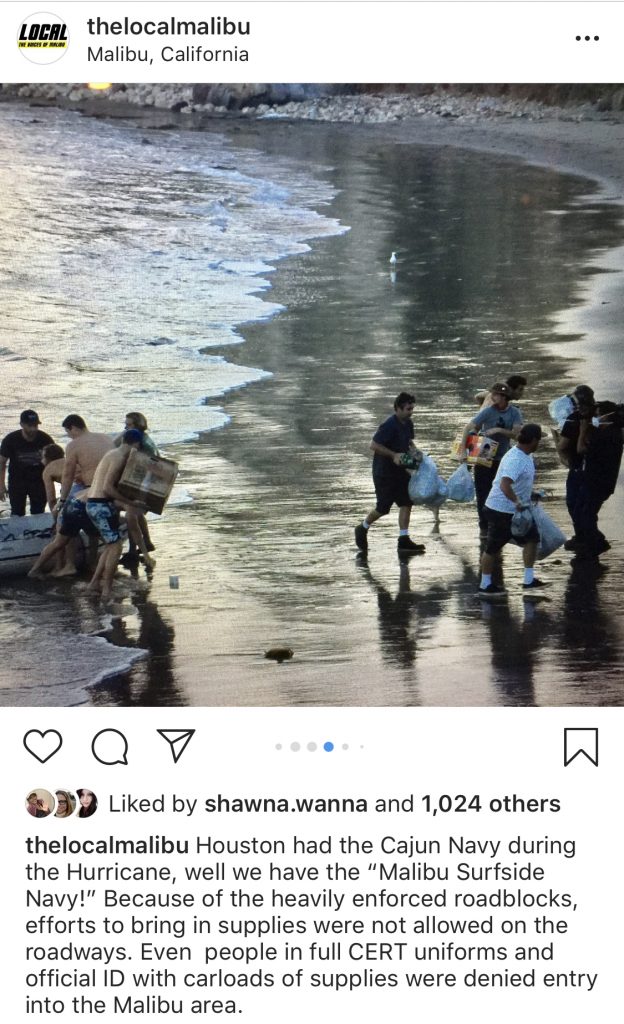
What about getting food, water and other relief goods past the blockade to the residents who stayed behind? Didn’t the city have an obligation of some kind – maybe making the dramatic relief-by-sea and paddle-through-surf unnecessary? A city council member would later rail against the sea-relief efforts. Lifeguard boats actually tried to stop it. And yet a couple of U-Hauls escorted in and out would have solved this?
The morning after Woolsey’s wrath wreaked havoc over Malibu. Photo: Paul Taublieb
“We were forbidden because we would technically be breaking the law, and we have to abide with the sheriff’s department since it was a mandatory evacuation,” she said, even when the purpose was to help people who didn’t ‘mandatorily’ evacuate? Also, she said, “FEMA and the state look for reasons to deny money. If they can show you are not doing things by the book, they will deny relief dollars, and have very strict procedures. If we had broken the rules we might not get relief dollars.”
This seemed logical until I later learned that over in Thousand Oaks and other areas impacted by the fire, FEMA itself was “disobeying” the ‘mandatory’ orders in those areas and providing assistance, and when I spoke to a high-ranking official of a neighboring city who has dealt extensively with FEMA, he said, “That’s ridiculous. You’re not going to be penalized for helping citizens in a safe and responsible manner – it’s exactly what FEMA is supposed to do, and they would support a city that did this. And we know it was safe to drive up PCH from Santa Monica to Pt. Dume Marine Science or even to Zuma – they just would have had to take on the sheriffs to make it happen, and they clearly didn’t want to. It’s just the way Malibu operates – a failed bureaucracy, from the top down.” More from him later.
Total devastation on Point Dume. Photo: Paul Taublieb
Susan did explain, “You have to understand, it was a challenge from our side. We were working 24/7, remotely, at home with no makeup and in our pajamas.”
I also asked her about the parking-lot-on-PCH evacuation fiasco. “Oh, I’m really glad you asked that question. It was something we spent a lot of time discussing, but the way things happened just wasn’t something we anticipated in our planning. You would think opening one or both northbound lanes heading south would be possible, but there were many agencies involved and it’s really complex, and it’s something we need to think much more about beforehand if there’s a next time.”
Not a bad idea, I thought. Think about evacuation from an area with a history of fires more beforehand.
But still, I could tell Susan really did care and had tried her best. I needed to hear from Reva, who actually runs the city under the direction of the city council. I reached out to Matt Meyerhoff, the Public Information Officer for Malibu. He wanted to be helpful, but said, “It’s up to her if she wants to talk to the media. She’s under no obligation to do so. I’ll ask her again.”
One city official who would talk was city attorney, Christi Hogin. I asked her if Reva had an obligation to talk to the press. “All government is about communicating to constituents, and I don’t see how that happens without the press,” said Hogin. “But I don’t think Reva, or anyone else, has a legal obligation to speak to the press.”
And legally, I also wondered, what does ‘mandatory evacuation’ actually mean? “That’s an interesting question, and I’m not sure,” she opined. “I can tell you this – no one is going to arrest you for not evacuating.” (Note: later research revealed that it is a rarely, if ever, enforced misdemeanor, for not abiding by a mandatory evacuation order, but Is at most a small fine).
Regarding what was happening the days after the fire, Christi had some interesting insights as she was working out of the temporary offices set up in Santa Monica. “Priority for the city wasn’t to get relief to the people who stayed behind but reorganizing population. Hey, we saw on the internet they were actually doing pretty good, so we weren’t putting in any effort to try and create a supply line.”
“Our focus was to end the blockade, for repopulation, not relief. People were anxious to get back in, and our efforts were focused on ending the evacuation,” she added. “We wanted to get it open for everyone, that was the focus of our skeletal staff – not worrying about relief. ”
At the Point Dume Marine Science School Relief Center Photo: Ari Taublieb
She also added one intriguing concept, and conundrum. “The city is responsible for providing fire and police protection, that is an obligation we have and we contract for that with the county.” So if the city is responsible, where were the fire trucks that the citizens paid for, even if somewhat indirectly?“All I can say is Cal Fire took command, and they have their own criteria for dealing with the situation, particularly with a fast-moving fire like we had. Once an evacuation is declared and it’s an emergency situation, the city really has no role in that decision making, even if we’ve contracted with them.”
“There were plans, and I can’t understand why the right people who had the right equipment refused to provide aid,” she added, referencing the many accounts of fire trucks sitting idle. “In the future we have to figure out a way to have faith in each other, need to understand the thinking. We shouldn’t be defensive about it, we need to learn from it.”
But when I asked where were the fire trucks, and what about the problems with the Sheriff Department, her only answer was, “Cal fire took over command, and we followed the direction from them, the LA fire department and the Sheriff Department. We may hire the fire department and have an obligation to provide those services to the community, but once there’s a fire we have no control of the decisions the fire department makes.”
Kind of a curious conundrum. The city is legally obligated to provide fire services to the citizens, but once there’s a fire or other major event, the city has no ability to direct how they execute their services.
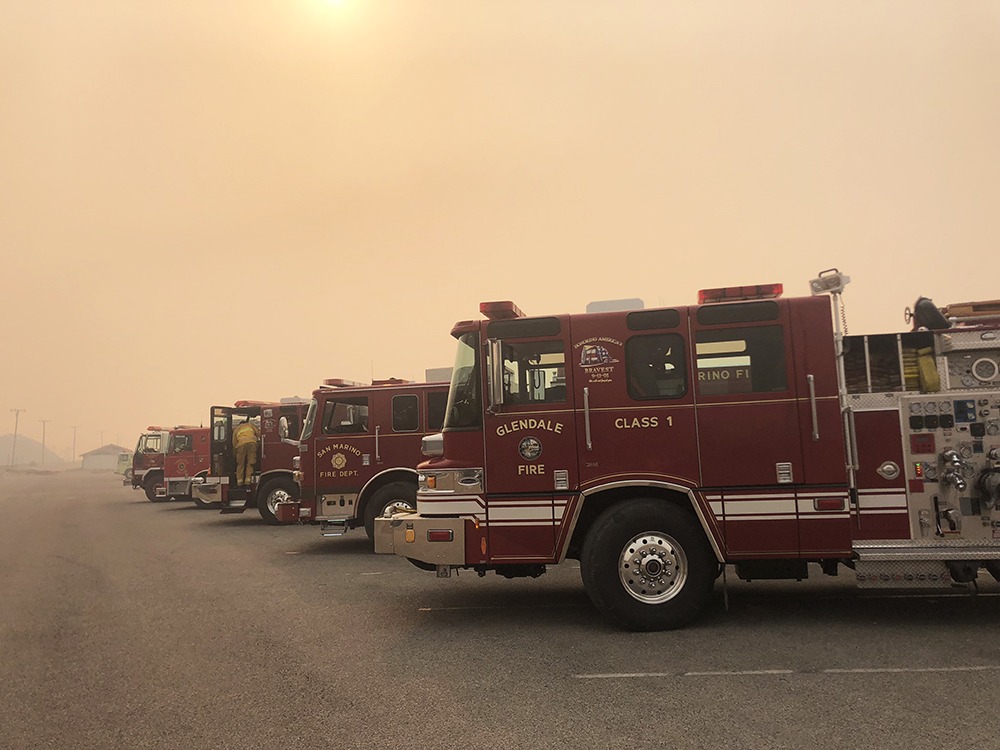
Fire trucks from all over LA County were sitting stationary at Zuma Beach in the early morning hours of November 10th. Photo: Cece Woods
With still no word back from Reva, my editor – the indefatigable Cece Woods, to whom I am indebted for putting me under the auspices of The Local for this crisis – did connect me to someone I confirmed was a high ranking official at a neighboring city which has suffered similarly to Malibu from the Woolsey fire.” He had quite a bit to say, even though he had to do it anonymously.
“In terms of the city of Malibu, speaking as someone who is a professional in city management, it was a total fail. Perhaps even negligent,”was his opinion.
“Now I have big love for the city of Malibu and have many friends there, and being in my position in my city government, a lot of people called me to find out what was going on, because they weren’t hearing anything from the city. And that’s inexcusable mismanagement. And if you’re asking my opinion, you have to question the job Reva did, because she’s in charge, and any problems are her responsibility,” he began.
“Where do I start? If city hall is not being used, why not open it up and use it as a shelter? People need a roof over their heads, and there was full electricity and internet. My city was open the whole time, and we had flames a block away, which never happened near Malibu city hall.
“Let me tell you about the evacuation – it was damn lucky only three deaths, not 300. It’s ridiculous they hadn’t anticipated the need to open all lanes south – that’s the responsibility of the city manager to do disaster planning – and this wasn’t hard at all to have gamed-out as a possibility.Our city manager has actual hands-on experience during a disaster, and that’s what is needed, and what Malibu didn’t have,” he explained.
“What Malibu also needs,” he continued, “is a public works department that can be onsite during a crisis and assist with knowledge of the area – which people from the outside can never do. And what Malibu needs is what we had –a city manager who is on-site, or at least coming every day to see what’s going on and manage a crisis with first-hand knowledge, not working remotely, because that’s the only way to really know what’s going on, and be responsive to the needs of the citizens,” he concluded.
Still trying to get in touch with Reva, I did hear back from Matt Meyerhoff, the Public Information Officer for the city, with no update on her speaking to me. But he reiterated Duenas’s position.
“We were told it was illegal to bring relief supplies, so we focused on repopulation, not resupply,” he explained. “We have to abide by what the sheriff was telling us, and advice of council,” even though city attorney, Christi Hogin wouldn’t confirm she had given that specific advice, Meyerhoff wouldn’t exactly confirm who directed things overall, either, as if maybe there was someone’s name he didn’t want to mention who might be culpable.
Meyerhoff also was both oddly proud, and also a little contrite, about the effectiveness of communication with the citizens, during and after the fire. “We put out constant updates and I really felt we were doing our jobs,” he said, “but I have heard people felt there wasn’t enough info. But hey, it was really hard since we weren’t on-site because the sheriffs said we couldn’t be there. Something to do better next time!”
“Matt Meyerhoff? Never heard of him,” began LA County Fire Chief Tony Imbrenda,when we began what was a long and disturbing conversation. “The city is supposed to send a PIO (Public Information Officer) to our command post and embed with our team to roll out the same message across all media to keep a unified message and have accurate information. The problem is people have egos and did their own reports that weren’t vetted. And there was no one from Malibu at our command.”
“I was at our command center the whole time, gathering information and sending information out,” continued Imbrenda. “Look, the first thing you have to understand is the size of this fire, over 14 miles wide, maybe up to 20 miles wide, with winds blowing as high as 85 miles per hour.
“And many of the strike teams were not from the region as we had to backfill after sending resources north,” Imbrenda explained. “So you had guys not knowing what to do is because without cell service –down because electricity was cut off – they had to try and go by Thomas Guides, and given the terrain there’s a big chance of entrapment and there not being an egress route, especially given the geography,” Imbrenda said, explaining why the response on-site seemed so scattered and hesitant to respond to requests from locals during the event.
“In the case of this fire, fire fighters were driving over downed power lines, had to do it constantly to try everything, which we never are supposed to do because we were trying. But I have to admit some guys were from out of the area and if they were asked to fight a fire or come to someone’s aid and didn’t, which I understood did take place, it’s probably because they were from out-of-town, were going by a Thomas Guide, and simply didn’t know how to respond properly. The fire department functions in a military fashion, and without coordination and proper orders they can’t, and won’t, just go on their own.”
“So yes, there was a breakdown somewhere, and it’s something we want to get to the bottom of,” he admitted.
He wanted to stress one point: “We will go out and risk our lives, but if you want to be safe and you want fire fighters to be safe, the one way you can guarantee you will survive is simple. Evacuate.”
When I mentioned there was, um, a bit of a problem with the evacuation, he acknowledged it. “I personally ordered evacuation over Twitter, and told all the residents to leave the area, and said this on all local media as well. But in retrospect, what you had was paralysis by analysis given what happened with the traffic.”
“I would have immediately opened all four lanes to get people out of there. There’s no excuse for people sitting there for that long,” he added.
I mentioned my experience of being told to get in line and evacuate, with the advice from a firefighter that if the fire came down to the road it would go over us. “Well, we have some people who are not very bright, and some of the people manning fire stations might not have been actual fire fighters. But I’m horrified that traffic situation took place – it could have been a disaster, a highway of death, and if anyone tells you differently, they don’t know what they’re talking about.
“The bottom line is we got lucky, very lucky, that hundreds of people didn’t die waiting to get out of Malibu,” he stated matter-of-factly.
He did add that “Part of the problem would have been eased if people left earlier when the word first went out. But everyone is conditioned that Malibu and Pt. Dume never burns, so they waited and then all left at once. But that’s no excuse for how it was handled – and the tragedy of what almost happened.”
I backed up and asked him when he said the whole ‘area’ was under mandatory evacuation, did that in his mind include Pepperdine?
“They should have evacuated, as far as I’m concerned because the only way to insure survival and safety is to leave. For people and firefighters. But the decision was made to shelter in place. I even asked another fire chief about this, as I couldn’t understand why they stayed. It meant lives were at risk, it’s as simple as that.
“I was told that a high level politician had made a call, that the school said they didn’t have resources to get everyone out, and the fire department was told to send resources.” Imbrenda explained.
“That meant five battalions, with each battalion being five fire-fighting trucks, plus a command vehicle” and some level of air resources, as anecdotally myself and others observed numerous helicopter runs over the campus dropping liquid (not just refueling or picking up water)”.
(Note: This was confirmed by Point Dume Bomber, Keegan Gibbs, who said, “I heard it over and over on the LA fire radio, which I was monitoring, for over two hours on Friday – send resources to Pepperdine. Life over property. Go now.”)
“Why those evacuations didn’t occur? All I can say is I agree it’s not fair, and I would like to know the discussion between the university president and our command and how that decision was arrived at. It’s a valid question – why that evacuation was not done. It’s a legitimate question that needs to be answered,” he said. “Why there was a lack of ground transportation, I find that unacceptable because it put lives at risk. The potential to move those students with vans or buses wasn’t there, but should have been.
“With students sheltering in place, there was no way we were going to let them die, but it’s a hard question to answer – why were so many resources directed to the university and what do we tell a resident who lost their single family dwelling because of it, what do we tell them?” he asked in conclusion.
I did some other research into the Pepperdine situation. Of course, I tried to reach Pepperdine for comment, but except for one short email, was denied any opportunity to talk to anyone, including the president’s office, where I left a number of messages. For an institution that claims to want to be part of the local community, it was sadly ironic they wouldn’t talk to The Local.
But this is what I did learn from eyewitnesses and other sources. On Friday afternoon of the fire, students were advised to “leave if possible,” which many, if not most, did. Then sometime late on Friday, the remaining students were told they couldn’t leave and should “shelter in place.” According to the university this was for their own safety, that they had no means of getting these remaining students out, that they had nowhere for these students to go.
According to a cynic, they were guarantees that, as fire chief Imbrenda said, “by them remaining, we were going to defend the University, even at the expense of single family homes.” Or to put it crassly, you might take some liberties and say they were human shields for the University property. One might.
A key question is how many students were remaining. According to a written statement by the University, it was between 1200 and 1500. However, according to the school’s own newspaper, the number was likely closer to 500. And of particular note, by Saturday morning – while homes in Malibu and Point Dume continued to light up and burn, and the 5 battalions remained at Pepperdine – the number of students on campus dwindled to as few as 100, according to eyewitness reports. So all day Saturday and all day Sunday, the university and a handful of students were protected, but Malibu burned. You can argue, as the university does, that there was nowhere to put these students, that they couldn’t just throw them to the wind on their own, and they say there was no way to get buses or vans to evacuate them even though, as I experienced on both these days with my press pass, it was clear and open sailing from Pepperdine down PCH to Santa Monica, with neither obstruction or threat.
Regarding the repopulation, Imbrenda said, “The check points should have been open faster and the whole situation handled better. There was a communication problem between so many entities, compounded by having guys at the checkpoints not being from the area. They always say it’s the fire department that keeps people out, but it’s not true. You have Edison, you have police, you have other entities. They all want it closed as long as possible. But I acknowledge the process was slow and cumbersome. I tried to relieve that, which would have alleviated a lot of suffering, but I didn’t have that power. “
Imprenda promised to learn, do a true post mortem, and do things better in the future, and at the very least, I believe he is sincere in his desire and intent, though whether things actually change remains to be seen.
I also found a sheriff with long standing experience in Malibu who asked to remain anonymous, and he put it this way, “It was an old fashioned cluster fuck. First when the fire started, besides how big it was, it crossed jurisdictions, so you had all kinds of brass trying to run things. Then what we call the ‘mother ship’ came in with the top guys and it became a bureaucratic mess. By the time the order came to evacuate, it was inaction by committee – too much talking and not enough action.”
With still no word from Reva, I reached out to Skylar Peak, who I’ve shared a few peaks with in the water at Dume. He was happy to talk about his role, which some found controversial, and said he would also try to get Reva to get on the phone or have a meeting.
“Look,” he began, “this was the biggest, fastest moving fire in history. And I think the city did a fantastic job given the circumstances.” During the period when the lockdown was on, Skylar drew attention for seemingly not supporting the influx of food, gas and survival supplies, though in our conversation he downplayed reports of being involved in trying to stop the relief effort. “I wasn’t against it, I was just very concerned about the gas being brought in as my main issue,” he said, not really addressing the other claims, with numerous accounts of him supporting the abbreviated effort by the lifeguards to block the effort to circumvent the blockade. But specifically, it was the gas, he said, was his concern: “It wasn’t being stored or managed properly, and imagine if the gas had spilled into the ocean!” he explained.
As someone who came in and out during the blockade, why, I asked, didn’t he organize a truck of relief supplies so the water mission wouldn’t have been necessary. “If you choose to stay behind, you need to be prepared to take care of yourself, and it’s not the city’s responsibility to help people who didn’t properly prepare, as I did.”
I asked him for help in sitting down with Reva, and soon afterwards, I received an email from her. I should send her a list of questions, and then she would respond in writing, she asked.I told her “No, I don’t do journalism that way. It’s not a take-home test”.
Skylar said he would see what he could do about a face-to-face.
While waiting, I spoke to a local volunteer sheriff, who stayed behind the whole time on patrol, and volunteered to talk as long as no name was used. This person had some interesting observations.
“I’m on the radio the whole time, hearing everything,” the volunteer began. “And I can tell you it was chaos, a catastrophic breakdown of communication. Firemen were asking for orders and not getting them. There was no information as to where to go, what houses needed help and where fire engines were supposed to go. I believe these out-of-town firemen wanted to help, but they weren’t getting orders or directions and they weren’t just going to freelance – particularly when they didn’t know the terrain.
(We on Zumirez, btw, experienced this first hand during the fires. An fire truck cruised down our street as we attacked hot spots in the ravine behind houses on one side of the street using garden hoses, often with a weak stream of water. Here was deliverance, we thought. But when we asked them to come down in the gully, whatever little enthusiasm this out-of-town truck had immediately evaporated. Nope, they explained they don’t go down into gullies or ravines they don’t know as a matter of policy, and no amount of explaining it was really just people’s backyards and you couldn’t get trapped, was effective. They simply got back in their truck and drove away, leaving us slack jawed, disappointed, feeling left on our own and more resolved than ever to keep fighting fires and saving each other’s homes on Zumirez; 28 houses were saved, only two were lost.)
Ari Taublieb putting out spot fires on Point Dume. Photo: Paul Taublieb
“There were all these agencies not talking to each other” the sheriff’s volunteer continued, “and not getting anywhere.
“I’m a Malibu resident, and for days people were asking which houses were standing and which were not. As I drove around on patrol, I tried to answer as many people as I could, but the city itself did nothing in this regard,” the volunteer explained.
“But I’ll tell you what bothered me the most,” the volunteer stated. “During the entire event we had an office at Malibu City Hall. There was never a time city hall didn’t have electricity, internet, water and bathrooms. Land lines were working – why weren’t those doors flung open? Where was our mayor? Where was Sheila Kuehl? Where was our city manager? I don’t care what they say but there is no substitute for being fully onsite. There was a news trucks and media on every corner. But no city mayor, no head of emergency services, no city manager. It was complete radio silence from the city– and there should have been news hourly from the city – like what the community got from Cece and The Local,” the volunteer added.
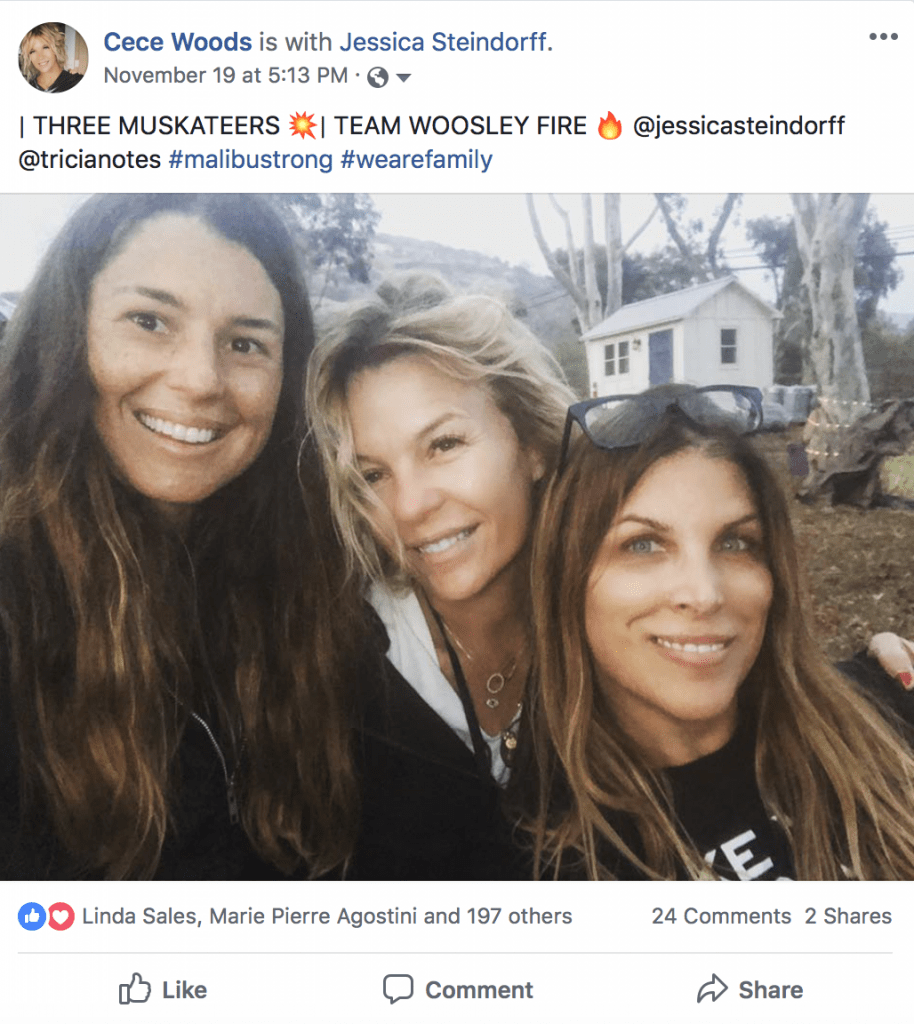
Team Woolsey Fire Community Communication Center was manned by Editor in Chief Cece Woods (center), Tricia Small (far right) and Jessica Steindorff (left).
”It was safe enough for us, if our leaders really cared, they would have been there,” the volunteer concluded. “No excuses.”
Then came the call from Skylar. Reva would meet at City Hall.
Skylar walked me down the hall to the meetings, and suddenly I saw the appeal of being a council member. In the modern, sleek offices, being a councilman was very much a role where as you walked past the various desks, there were murmurs of quiet respect.
We entered a conference room, myself, Skylar, Reva and an assistant.
“We were in the middle of a perfect disaster storm, beginning on Monday of that week,”Reva began, seeming as if she had prepared the statement and narrative, but leaving me a bit confused. Monday, I thought, the fire was pretty much over by then? Huh? As she continued, I got more confused, “There was a sheriff captain with a medical emergency and we were dealing with a new guy on Monday,” she continued, and now I was baffled.
“The next day we had an election, which was very demanding on our whole staff. And there was the shooting where a Pepperdine student was lost along with others and we and Lost Hills Sheriff Department were responding to that. So we were very stressed and had been working long days.”
What, I thought?
“Then I got the call about 5 am from Skylar about the fire,” she continued.
In other words, her narrative was that the week leading up to the fire was demanding and stressful, and the initially tepid response by the city was due to the busy, difficult week before, though candidly I failed to see how a new sheriff, a shooting outside of Malibu and doing the normal job of a city of holding an election, as done annually, could be used as an excuse for the city’s response. But that was her case, seconded by Skylar.
Next, came the description of the size, speed and scope of the fire, and how it was unprecedented and this was the real root cause of whatever shortcomings that ensued. I had heard this before.
Followed by praise. Of themselves.
“Hey, there were 60,000 houses in the fire zone,” Reva stated, expanding her prevue well outside of Malibu, “and only 1600 were lost, so people should be praised for that.”
In terms of the evacuation snafu, neither she nor Skylar saw it that way. “The evacuation worked,” said Peak. “Look, nobody died on the highway.”
“I will continually say that not one person died,” added Reva. “That’s a very good success, especially considering what happened at the Paradise fire.”
When asked about how close a disaster came, as the fire chief had said it was “potentially a highway of death,” both countered that it didn’t’ happen so what was the issue?
Now, both Reva and Skylar emphasized that the City of Malibu “Doesn’t have prevue over the sheriff department, fire department, Cal Fire or any other first responder.”
As to why they evacuated and didn’t manage the fire onsite, as a nearby city did, Reva explained, “We were given evacuation orders and we followed them, which is our protocol and the proper thing to do. We don’t question the fire department and police department when they issue orders.”
She refuted comments that the city didn’t do much to open all lanes going south. “CHP is responsible, they direct traffic. We were actively trying to get lanes open.” She did add, “OK, decisions were not made quickly enough, even though we had planned for something like this, if not this exactly”
“We sit and do these exercises and plan for scenarios like this,” she added, “and not one person died in the city,” she repeated.
Regarding the issue of Pepperdine, and the allocation of resources over Malibu, her only comment was “That’s not a city conversation. Talk to the fire department, I don’t know about taking a stand in that particular location.” Technically correct, if not legally, but sure seems like a dodge given Pepperdine’s proximity essentially within Malibu, and her previous concern over the tragic shooting event that took place there and the fact that the diversion to Pepperdine over Malibu residences may have cost many families – her actual constituency – their homes. Neither she or Sklyar would comment further or address any other question in this regard.
We had a limited window for this conversation, so I asked about why the city didn’t come more to the aid of the citizens who had stayed behind. Both she and Skylar were clear on this.
“Look at it this way,” she began. “We have 13,000 people in Malibu, all paying taxes and many who left were now paying for their hotels and other expenses. The 1,000 or so who decided to stay behind, they now want the city to come take care of them? That’s simply not fair.”
Skylar added, “It’s ridiculous to think that if there’s not going to be electricity or water you should stay in your home unless you’re prepared to survive on your own. If you can’t handle your own survival, you could consider leaving.”
“We did provide food and water to animals at Zuma for the first two days,” Reva added. “But after that people were on their own. After that, we did not feel it was our obligation to bring in further supplies after that. People were on their own as far as we were concerned. People who chose to remain need to take responsibility for their safety, and our focus after that was repopulation, which is actually more complex than many people understand as we’re talking about leasing land and making many other arrangements.”
“Yes there were some issues,” she concluded, “We have to change things in our plans to do things better, that’s my takeaway, but overall I think the city did a great job.”
And with that, she hurried off to another meeting.
Photo: Steve Woods
Here’s my conclusion. The city actually had a fairly low-bar to hit to handle this successfully.They are not the fire department or the sheriff’s department. During a crisis they actually have very little to do — just let people know what’s going on — and given that somewhere around 1,000+ people stayed behind, bringing a little relief in some trucks would not have been that difficult or expensive, even if meant bending some rules a tad.
But under pressure, a city manager who has a conservative bureaucratic, by-the-book orientation, a mayor who not only had a conflict of interest but was a hypocrite over evacuation, and city council members who didn’t know how to react, it was all just bungled. With a huge swath of your population staying behind, city hall could have easily been manned, and the much needed communication, which totally broke down, could have been addressed.
Cece Woods is a force of nature, but her efforts of letting people know what was going on could have easily been handled by the city if someone had simply driven up to Malibu on a regular basis and done basic reporting. And maybe the intervention of the city government on behalf of its constituency might have led to a different outcome at Pepperdine, or least the dignity of having tried.
Yes, the fire department and sheriff department might have objected to a relief effort, to manning city hall during an evacuation, to confronting them on access and repopulation, but no one would have gone to jail.
The shortcoming was not criminal malfeasance. It was insensitivity and ineptitude. Poor planning along with being overwhelmed by the magnitude of the event.
But, simply, if the city had responded in some kind of supporting, understanding way to the citizens, some quite brave, who stayed behind and not only saved their homes but the homes of neighbors who surrounded them, addressed the need for information that wasn’t provided, acknowledged the desire for people to return to their homes, our Malibu city government today might still have what is needed to effectively govern: the good faith that comes from credibility and respect.
Malibu’s lush green hillsides are a welcome site after the devastating Woolsey Fire. However, to achieve those neon hues that are brightening up our local landscape, we have had to endure a powerful El Niño weather pattern that will persist at least through February and could conceivably last through even June experts predict.
According to the United Nations’ World Meteorological Organization (WMO), there is a 75-80 percent chance of an El Niño developing by February, and judging by the deluge of water we were hit with this month, El Niño is not only here, he’s planning on sticking around too.
Local meteorologist Jason Daniel Farhang has been watching weather models that suggest that a new pattern is just around the corner
“Latest solutions continues end dry weather by Superbowl 53! Southern CA needs to pay close attention for February 2019. Trending SuperBowl Of Storms in development.” wrote Farhang on his FB page … “… aggressive February storm continues to trend. Late next weekend atmospheric conditions will come into sync with return of rains for our region. Timing: February 3 – 8, 2019
Farhang explains the El Niño pattern weaver re currently experiencing more in-depth;
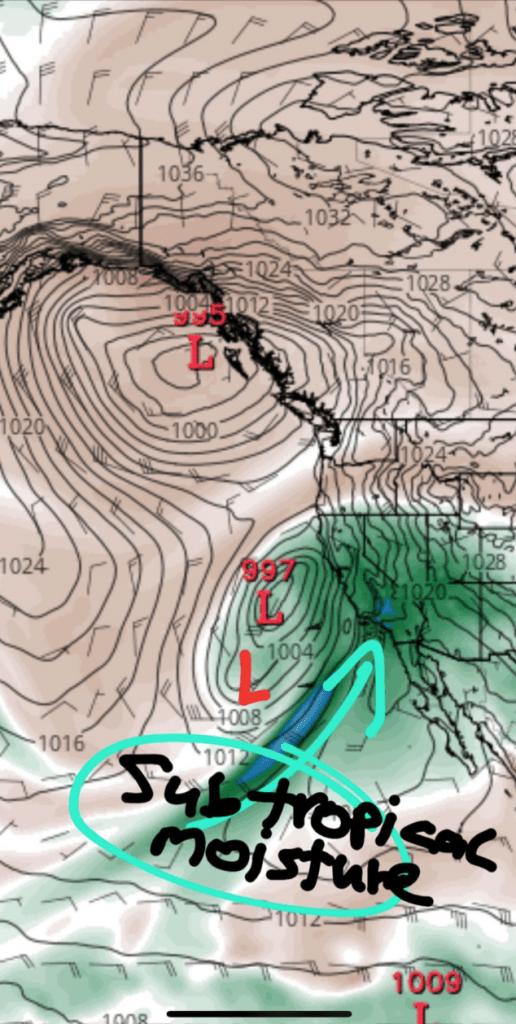
“We are in a classic El Niño weather pattern, the warming of Equatorial Pacific off coast of Peru and our coast. Warming off our coast 5 – 10 degrees warmer. Solutions since last week have been trending very wet and possibly above normal. The moisture is possibly coming from Hawaii origin. However this El Niño pattern is acting different. Most of the storms have been coming from the polar jetstream not the subtropical jetstream. That’s why we have a colder air-masses driving into U.S and Alaska. Placement of our high pressure has been acting erratic.”
Farhang weighed in on weather systems ready to strike our coastline; “Big PACIFIC Storms are waiting for February. Current Atmospheric conditions ready showing impressive system lurking waiting to strike Southern CA.”
In other words, get ready to be hit with another wave of wet weather. Also keep in mind that El Niño patterns typically start around Thanksgiving and can last all the way until June.
Woolsey fire burn areas are particularly at rick for extensive damage from these storm as we saw when the area was soaked by multiples systems passing through this month.
Many neighborhoods in Malibu are at significant risk for mudslides and in the path of debris flow. Be prepared for the possibility of more evacuations if you are in those high risk areas.
We’ll have more updates on these weather patterns as we get closer to Super Bowl weekend.
Our resident pitbull with building and planning (even more so after the Woolsey Fire!), Architect Lester Tobias, goes deep on the subject of debris.
Debris Removal: A Burnout’s Analysis
I have been so deep in the debris on this debris removal thing that it’s pathetic. But it’s justified.
I do not trust the government as far as I can throw them. The whole notion that Cal OES will take care of everything and either not charge the homeowner a dime seemed, at first blush, a nice offer. We kept being told how successful the program has been in the past, how there have historically been 90% participation rates, etc. Then the people of Malibu read the “opt-in” document and forms, and started asking questions.
So I have been reading and calling and getting quotes on all sorts of scenarios. I have filled out the entire “Opt-out” form and generated all the plans and photo documentation. I have also filled out the “Opt-in” forms so that I may submit them immediately if the situation ultimately warrants this action. I have met with the County representatives at both Malibu and Calabasas. And I still haven’t decided what to do. I don’t have the answers, but I think I have all the right questions.
Which is why fortune smiled on me this morning and put me at the building department just as Tim Smith, the Cal OES guy in charge of the whole deal, showed up to answer questions.
So I had questions and he definitely had answers. Here is the gist of our conversation:
Q: How is this thing structured?
A: Cal OES is in charge of the whole thing. They are hiring two “Prime” Contractors who will be subcontracting all of the work to licensed demo and hauling outfits. Each Prime Contractor will start out with three to five subcontractors and will ramp up to 20 each, for an estimated total of 40 demo crews working in Malibu at the apex of the effort.
Q: What about the “Sweetheart Deal” aspect of this no bid work?
A: Cal OES is assuring homeowners that each property will be monitored for actual costs (I had heard that each property would be bid, but he did not say that, nor does the structure of the process seem to involve individual bids), hauling loads will be recorded, crew size and days per project will be monitored and ultimately managed by the Cal OES people. It is important to remember that, ultimately the only people on the hook for the cost of this work are the American Taxpayers, so I do think that there will be that perfunctory governmental assurance that they realize that the taxpayers deserve an efficient and effective process, so, you know, there’s that….
Q: What parts of the site are being cleared by this program?
A: The testing and debris removal are limited to structures. They are NOT clearing your site, vegetation, removing vehicles, site retaining walls, etc. They are not removing swimming pools.
They will not remove a structure’s retaining walls if it looks like their removal will cause slopes to fail.
Q: How much work can be done on those excluded items before the Cal OES contractors come in?
A: As long as the areas of the structures are undisturbed, there is nothing that is specifically excluding the removal of those items that Cal OES is not having removed. HOWEVER, if the crews determine that the areas under their purview have been disturbed, they might not perform their services, so it’s a little dicey if you want to get in ahead of the process.
Q: How will the parcel debris removal be prioritized?
A: At this time it is undetermined. Historically, schools and other public sites go first, then parcels that pose the most hazard to neighbors (like, if you are the only house on your street that burned down, I think…). However they may just set up a start and finish line and run an orderly sweep from one end of the west side to the other. It is all up to the number and location of the “opt-ins” and how fast they can ramp up operations. Basically, nobody knows.
Local architect Lester Tobias has given our readers a first hand account of the frustration residents are experiencing with the debris removal process (no thanks to the City and the County’s communication on the subject).
The Local reached out to experienced Fire Attorney Bill Robins of Robins Cloud LLP to formulate an easy to understand checklist for Woolsey burn out victims.
Before signing up for the Los Angeles County Debris Removal program get an estimate from a licensed debris removal contractor
The Los Angeles County debris removal program is not free as is often stated. If you opt-in to this program (deadline extended to January 28, 2019) you must assign the County “any and all” proceeds from your debris removal insurance coverage to the County. Most insurance policies provide a benefit for debris removal in addition to the face value of the policy which may also be available to reclaim your property or for other costs of construction. If debris removal can be provided by a licensed contractor at a cost less than what the County would take from your insurance coverage, you may have more money for rebuilding. Whether participating in the program is right for you is a decision that should be made only after that comparison is done.
Document all damage to trees and other landscaping before any debris removal takes place
Evidence of trees and other landscaping destroyed by the fire may be lost after debris removal occurs. Most insurance policies will not cover the full value of lost trees and other landscaping, and these underinsured losses may be recoverable from SoCal Edison or other third parties found responsible for starting the Woolsey Fire. California law also allows for recovery of up to two times the value of lost trees from the responsible party.Documenting damage to the trees and other landscaping is an important part of supporting these claims. Take photos of all damage or have an arborist assess the damage before removing destroyed trees and other landscaping.
Create a fully itemized list of your contents and their value
People may be discouraged from fully itemizing their contents once they get to the policy limit, or may be tempted to accept a waiver of the itemization requirement by the insurance carrier in exchange for acceptance of less than the full policy limit. These may seem like easier approaches, but, aside from not receiving every dime you are entitled to under your insurance policy, there is another hidden danger. If you choose to pursue a third party claim, a list of contents will be a valuable tool to ensure you receive full and fair compensation for everything that was lost. Every toothbrush, every spoon, every table coaster has value. Trying to create a list of everything that was lost six or twelve months from now will be frustrating and difficult as those items will fade from memory.
Be patient in making your decision whether to rebuild or replace your home
As the shock and disbelief wears off, people may find the task of rebuilding or finding another comparable home overwhelming, and may be tempted to just cash out their insurance for the face value of their coverage for loss of their structures on the property. However, many insurance policies have provisions that will pay money above the policy limit for the purpose of rebuilding or replacing their burned structures. People who inform their insurance company they do not have an intent to rebuild or replace their property may lose these proceeds, without being told there may be money available beyond the face value of the policy limits that can be used for rebuilding or replacing their home.
Our resident pitbull with building and planning (even more so after the Woolsey Fire!), Architect Lester Tobias, guides us through the very confusing site clearing process to date.
December 11th, 2018
The confusion surrounding the hazardous Waste Removal, Demolition, and Debris Hauling associated with the Woolsey Fire homes. It’s amazing how confused the people who apparently should be in charge of this portion of the rebuild process continue to be, nearly five weeks after the fire. My understanding is based on numerous, face-to-face discussions with city officials. Admittedly, I have not spoken to state or county agencies, but I think I should be able to rely on the City for valid, up to the minute information (did I really just say that?).
Okay first off, about this Hazardous Waste Removal. I have been associating that scary term with toxins and radioactivity and cancer causing leaky sludge (thank you, Robert Kennedy Jr.) As it turns out, it’s basically paint cans and propane tank removal. So we are being held hostage by paint cans and propane tanks.
After those items have been removed by people who apparently posses special training in moving paint cans and propane tanks, we reach a fork in the road. The state has made each fork undesirable, yet we each most choose a path.
Path #1 is the path of Big Brother. It is the so called “Free” option. You basically sign on the dotted line and the government comes and clears your site. Sounds great until you ask a few questions or read the fine print. The first thing is that they will remove your foundation whether you like it or not. So if you need to see, inspect, measure or otherwise engage with your foundation, cleared of debris, then this is an untenable offer. The second item of note is that if you are insured, this service is not free, as you will have to sign over all or part of the demolition line item in your policy to the state agency clearing your site “for free”. To a government agency, the only thing better than “other people’s money” is other people’s money from even other people. I’d love to see the lobbying efforts that went into that clause…
Path #2 is the so called “private” option, where you basically act like a logical human in the marketplace who hires a private sector company that performs debris removal and/or hauling (these two acts are typically performed by separate companies, working in tandem, to get the shit off your site and get it to the dump). If you choose this option you need to be aware that a special license is required by the state for fire debris removal. In a similar vein, the hauler must be also approved for fire debris removal. Now, I am assuming that companies that are licensed for this type of demo and hauling know the ropes, can fill out the paperwork, and get the job done. But I am just assuming at this point, so it’s still buyer beware….but it is free market pricing with this option, and the competition will be fierce, so the odds are that you will keep more of your insurance money with the private option.
I’m sorry that I have no definitive advice or recommendations on this matter, especially since it is such an obvious bottleneck and roadblock to getting our lives put back together. But this is the information on which I am basing my decision today, but since I may wait a month for that one paint can that didn’t incinerate at my house to be removed, I guess I am not in any hurry….sigh….