Month: November 2025

  • Exposing the Shadows: Eric Swalwell’s Tangled Web of Spies, Scandals, and Sedition

    Exposing the Shadows: Eric Swalwell’s Tangled Web of Spies, Scandals, and Sedition

    Eric Swalwell has mastered the art of political theatrics, positioning himself as the self-appointed moral compass of California’s progressive aristocracy while leaving behind a trail of scandals that would have ended any other public career years ago. His downfall has been slow, loud, and messy, but today, on November 26, 2025, his reckless rhetoric finally collided with the consequences he’s been outrunning for a decade. And when the dust settles, he may go down not as a fearless resister, but as one of the most compromised and dangerously impulsive officials California has produced in a generation.

    Long before he was calling for military disobedience on national television, Swalwell was tangled in the notorious Christine Fang affair, a counterintelligence nightmare that he pretended to shrug off, even as it exposed a stunning lapse in judgment. Fang, better known as “Fang Fang”, wasn’t merely a friendly face on the Bay Area fundraising circuit; she was a Chinese intelligence operative with a carefully crafted public persona and a laser-focused strategy for embedding herself in the orbits of rising American politicians. Swalwell didn’t just cross paths with her. He let her inside his circle, his campaign, and according to former staffers, into the kind of late-night meetings that would make any intelligence analyst cringe. While he claims he was simply “targeted,” and insists he cooperated with the FBI once briefed, the truth is that the damage was done. Money moved. Access was granted. A Chinese spy positioned herself as a close confidant of a sitting U.S. Congressman. When the story finally broke in 2020, Swalwell played the victim card as if the country had collectively misunderstood what a compromise looks like. But the shadow of that relationship has followed him ever since, resurfacing every time he steps in front of a camera to lecture the rest of us about patriotism and accountability.
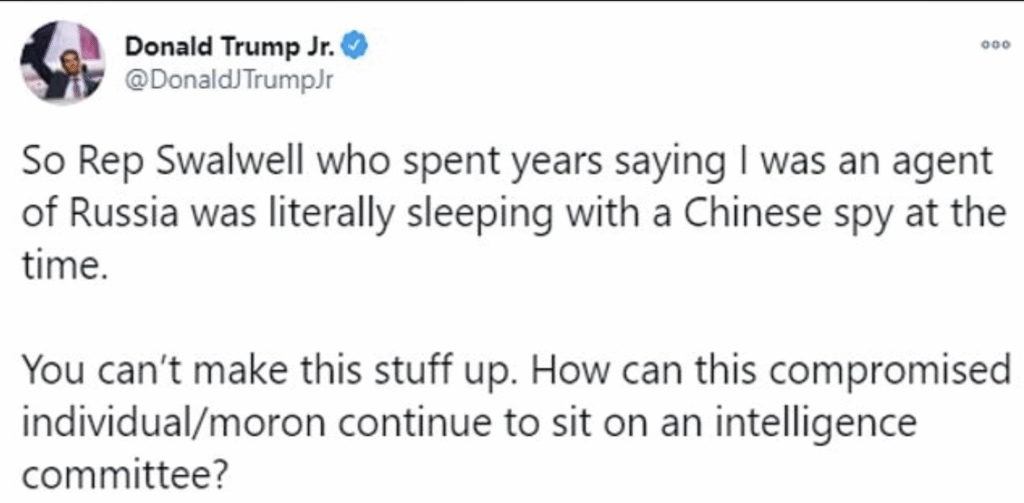
    By 2025, as Trump returned to the Oval Office and reestablished control over the federal agencies Swalwell once weaponized rhetorically, the congressman’s past was no longer a punchline. It became the backdrop to a much larger unraveling. While positioning himself as California’s next governor, Swalwell was hit with an investigation that landed harder than any Fox News segment ever could.

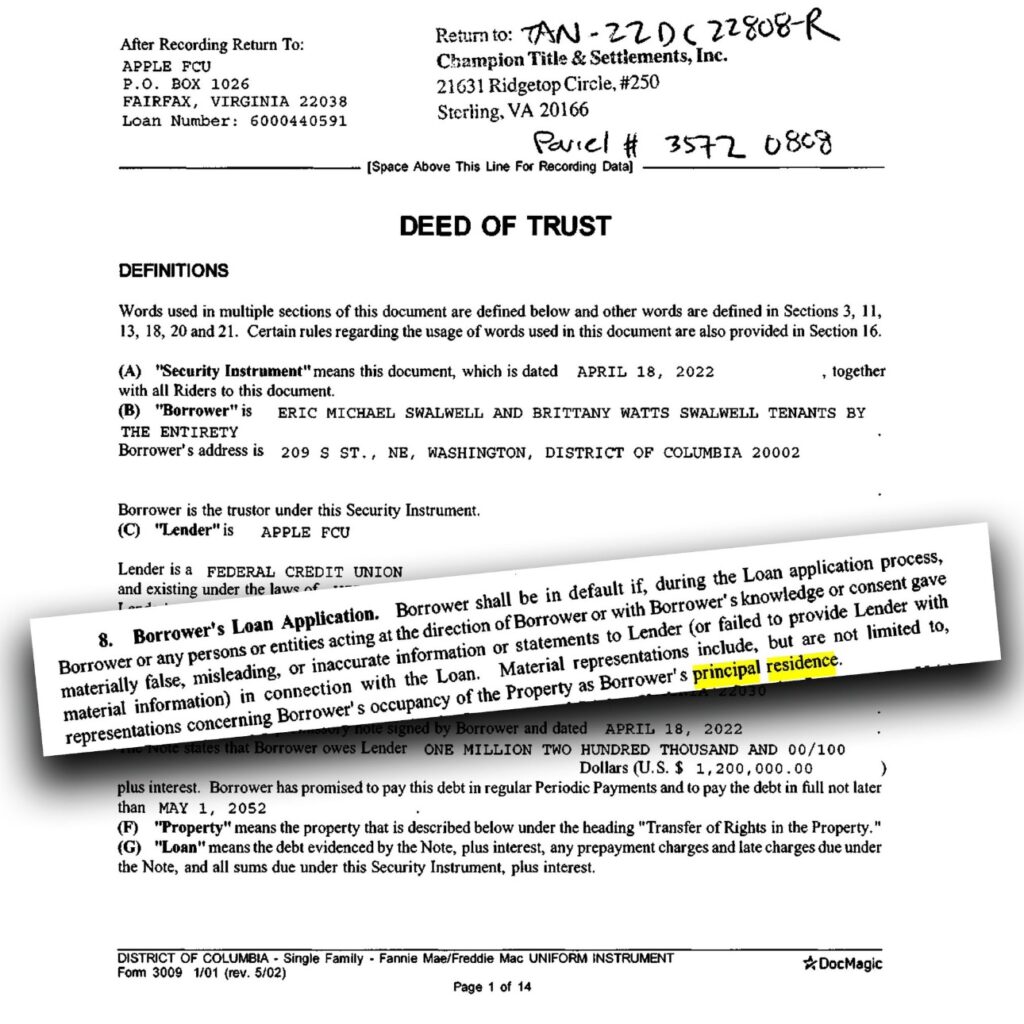
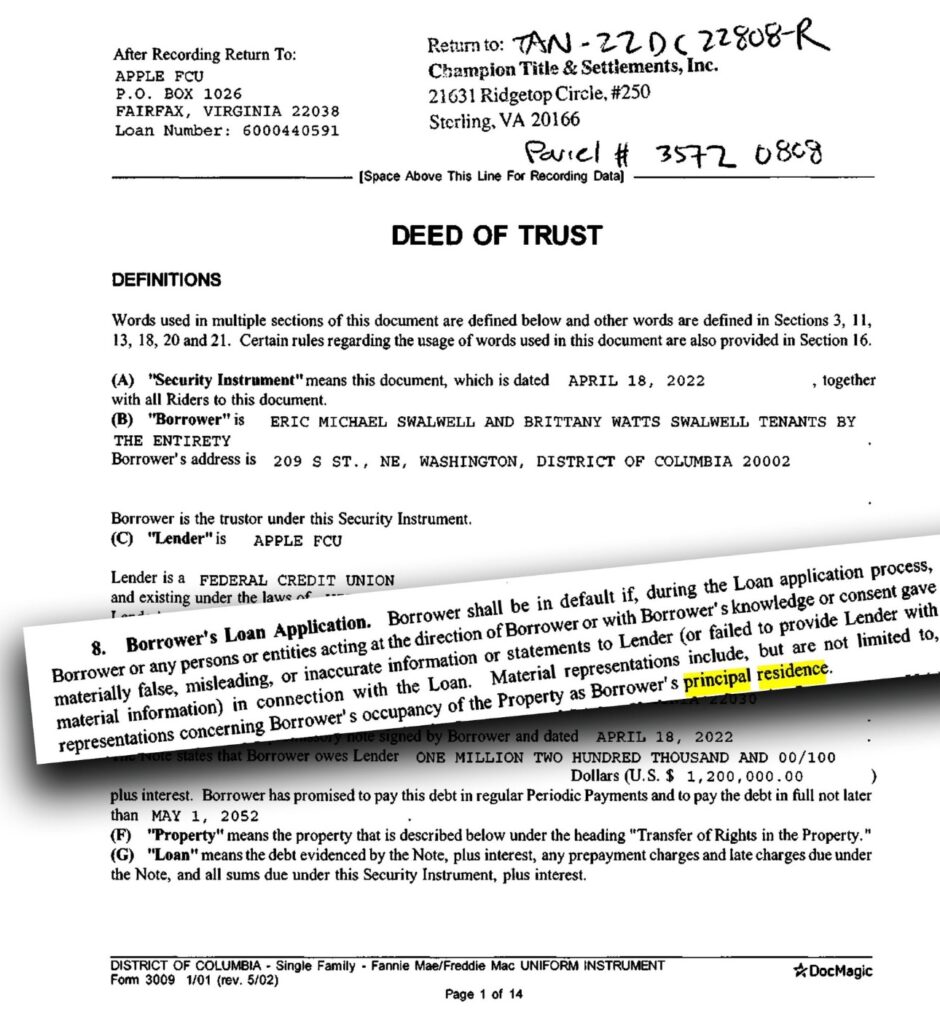
    Bill Pulte, Trump’s newly appointed Federal Housing Finance Agency chief, uncovered what appears to be a textbook case of mortgage fraud in Swalwell’s 2012 Dublin home purchase. This wasn’t a minor clerical error or a disputed appraisal. Pulte flagged a maze of suspiciously structured loans, inflated valuations that pointed to potential kickbacks, and tax maneuvering through entities with no legitimate purpose other than shielding assets. He sent a blistering letter to the Department of Justice, calling for immediate prosecution. And the timing was brutal: it landed just days after Swalwell launched his gubernatorial run, complete with glossy campaign vans and rally speeches recycled from the impeachment era.
    The moment the letter went public, Swalwell unraveled. He filed a 19-page lawsuit attacking Pulte, accusing him of orchestrating a “mortgage McCarthyism” campaign designed to “silence dissent.” He held an indignant press conference in Sacramento, barking at reporters about political witch hunts while his own donors quietly backed away. Privately, campaign insiders whispered that the DOJ had already assigned Special Counsel Ed Martin to fast-track charges that could land before year’s end. And while Swalwell dismissed everything as political smears, it became clear that his gubernatorial campaign was bleeding out before it ever left the driveway.

    Then came the moment that pushed everything into a different category, a moment so reckless that even his allies struggled to defend it. Today, during a heated MSNBC segment criticizing President Trump’s executive orders on defense, Swalwell declared that members of the U.S. military should disobey Trump’s orders if they deem them “unlawful,” admonishing them to “heed your oath to the Constitution, not any one man.” The clip detonated across social media. Analyst Ian Jaeger posted it with a simple but devastating assessment: “BREAKING: Democratic Rep. Eric Swalwell calls on the military to disobey President Trump’s orders if they are ‘unlawful.’ This is sedition.” Within minutes, the post was everywhere. Veterans’ groups lambasted him. Constitutional scholars questioned his intent. Conservatives labeled it open incitement. Even centrists recoiled at the sheer irresponsibility of a sitting congressman encouraging military personnel to override the Commander-in-Chief. One viral reply tied the moment right back to his most embarrassing scandal: “If sleeping with a spy isn’t unlawful, what is?”

    Instead of recalibrating, Swalwell doubled down. In a follow-up interview with Don Lemon, he claimed, without irony, that active-duty service members privately confide in him, telling him they will serve as a “check” on Trump. He described himself as a conduit for military “whistle warriors” who reassure him that they “won’t betray their oath because this guy tells them to.” It was a bizarre moment of political fantasy, the kind of thing you’d expect from an influencer chasing engagement, not a member of Congress under federal investigation.

    By dawn, the shape of Swalwell’s future had become unmistakable. His polls were collapsing. His governor campaign was effectively dead. Donors were fleeing. The mortgage investigation was tightening. The Fang Fang ghost was back in full force. And now he had walked himself face-first into a potential sedition inquiry, all while operating under the illusion that he is the lone moral safeguard against a duly elected President.

    Eric Swalwell’s story is no longer about partisan noise or political rivalry. It is about a pattern of recklessness, compromised judgment, and a stunning inability to grasp the consequences of his own actions. He tried to reinvent himself as the hero of the resistance, the man willing to “take down bullies,” the crusader for democracy who saw threats everywhere except in his own reflection. But power has a way of exposing the cracks. And tonight, as the fallout from his MSNBC tirade rips across the country, the illusion has shattered entirely.

    What remains is a politician drowning in his own self-created chaos: the spy scandal he never outran, the mortgage mess he can’t litigate away, the sedition controversy he ignited on live television, and a gubernatorial dream collapsing under the weight of its own hypocrisy. Eric Swalwell isn’t the savior he sells himself as. He’s the liability. And California, for once, seems ready to move on.

  • BREAKING: Newsom’s Inner Circle Quietly Bankrolls Dana Williamson’s Defense – And the Money Trail Leads Straight Back to the Governor’s Desk

    BREAKING: Newsom’s Inner Circle Quietly Bankrolls Dana Williamson’s Defense – And the Money Trail Leads Straight Back to the Governor’s Desk

    When federal prosecutors dropped a scorching 20-count indictment on Dana Williamson last week, accusing Gavin Newsom’s former Chief of Staff of siphoning off Xavier Becerra’s old campaign account for luxury hotels, designer wardrobes, and family getaways—most Californians assumed Newsom would sprint in the opposite direction. This is, after all, the same governor who never misses a chance to moralize about “accountability” and “public trust” when the cameras are rolling.
    Wrong.

    Not even two days after the indictment went public, a freshly minted SpotFund quietly appeared: “Dana Williamson Legal Defense Fund.” Goal: $100,000. Tone: dripping with Sacramento self-pity about “protracted battles” and “extremely expensive lawyers.” And the organizer? Steven Maviglio – Newsom’s longtime fixer, spin doctor, French-Laundry-tier insider, and the guy who’s been orbiting Newsom’s political universe since his Lieutenant Governor days.

    But the real tell wasn’t the organizer. It was the very first donor – the moment the page went live.

    A clean $1,000 from Mark Krausse.

    Most voters couldn’t pick Krausse out of a crowd. Gavin Newsom, however, knows him very well. Because on June 21, 2024, while Dana Williamson was still sitting ten feet from Newsom’s desk running the Governor’s office, Newsom personally appointed Krausse to the powerful Public Employment Relations Board, a plush six-year gig with a $168,000 salary. The Senate rubber-stamped it instantly. No hearings. No sunlight. Just the sound of the Sacramento conveyor belt doing what it does best.

    And Krausse wasn’t some neutral technocrat. He spent 17 years as PG&E’s top lobbyist, yes, that PG&E, the utility that received billion-dollar lifelines courtesy of Newsom’s pen. He overlapped with Williamson during her own PG&E stint before Jerry Brown elevated her to Cabinet Secretary. Same corporate orbit. Same power network. Same governor who later installed both of them in positions of enormous influence.

    So the picture becomes painfully clear.

    Dana Williamson gets indicted for allegedly treating a campaign account like her personal Neiman Marcus card. Within hours, Newsom’s old communications chief launches a legal defense fund. And the first big check comes from a man Newsom handpicked for a cushy state appointment while Williamson was still managing the building.

    This isn’t “friends standing by a friend.” This is the Governor’s political clan circling the wagons, laundering reputational support through GoFundMe while pretending this is some grassroots act of compassion.

    If a junior staffer were caught boosting a few bucks from an office petty-cash drawer, Newsom would be on the Capitol steps demanding their badge, their resignation, and probably their firstborn. But when the accused thief is his former right hand – the woman who has had a front-row seat to six years of backroom deals, campaign mechanics, and buried political bodies – suddenly it’s all “sending love” and “staying strong” while his appointees quietly toss money into the defense pot.

    Californians can barely afford groceries, gas, or housing under Newsom’s tax-and-spin regime. But the Sacramento aristocracy has no issue crowd-sourcing six figures to protect one of their own from an indictment that would have ended any regular person’s career before lunchtime.

    The message from the Governor’s mansion is unmistakable: rules are for the public, protection is for the insiders. When someone in the machine gets caught, the response is swift, disciplined, and impeccably choreographed, complete with a Venmo link.

    And here’s the part they should worry about: if federal prosecutors start tugging on the Krausse thread, they’re not just going to find a $1,000 donation. They’re going to find the fingerprints of a Governor who keeps insisting he’s “cleaning up Sacramento,” while quietly coordinating the cleanup crew behind the scenes.

    Stay tuned. The Krausse connection is the beginning – not the end – of this story.

  • EXCLUSIVE: Evidence Buried, Due Process Denied – How a Private Referee Helped Shield a Judge From His Own Rulings and Destroyed Lives

    EXCLUSIVE: Evidence Buried, Due Process Denied – How a Private Referee Helped Shield a Judge From His Own Rulings and Destroyed Lives

    For three years, inside a quiet California courthouse where the promise of justice was supposed to hold steady, one man with no immunity, no oversight, and no constitutional authority shaped the fate of an entire case. His name was Leon Bennett, a private discovery referee who, on paper, was merely assigned to referee disputes. In practice, he became the single most powerful figure in the courtroom, the gatekeeper who controlled every document, every delay, every piece of evidence, and every outcome. His decisions didn’t just affect the litigation. They protected the judge who appointed him and derailed the lives of two families.

    A thorough review of the case file reveals a disturbing reality: Bennett was not a neutral arbiter. He became the bottleneck, the filter, and ultimately the wall between truth and the judge who needed to see it. What transpired was not an accident. It was a structure — a system designed to ensure that the most critical evidence would never reach the bench.

    The case was built on a mountain of corroboration. From the start, Amir Rahnavardi documented everything: a full year of video evidence, daily journals, timestamped photos, audio recordings, transcripts, even digital forensics proving someone had accessed his accounts without authorization. His evidentiary record formed one of the most comprehensive paper trails any judge could hope for. It should have been impossible to ignore.

    But Bennett made sure the court never had to reckon with it. The videos stayed sealed off. The journals never reached judicial review. The audio recordings were sidelined. The photos and digital logs never made it into the hands of the judge who ultimately ruled against him. Every accusation of non-compliance leveled at Rahnavardi by the opposition, and there were many, was built on a foundation of fiction. The delays were manufactured. The disputes were staged. And every funnel led to the same destination: through Bennett, and then nowhere.

    This structure existed for one reason. Judge Michael Lief had already issued sweeping rulings against Amir early in the case. Once the video evidence and corroborating material were seen, those rulings would have collapsed under their own weight. So the evidence had to be kept out. The referee’s role became the perfect shield, a private lawyer acting as an unaccountable barrier between the truth and the judge whose decisions would have been disproven by it. It was not neutrality. It was self-preservation disguised as procedure.

    The consequences were staggering. A temporary restraining order that should have been reviewed within days remained unresolved for two and a half years. Instead of receiving timely judicial oversight, the TRO was buried beneath an avalanche of procedural accusations and evidence bottlenecks. When the case finally moved from Judge Lief to Judge Joann Johnson, the most critical evidence, especially the videos, still had never been placed in the record. Not because Amir failed to provide it. Because Bennett made sure the judge never saw it.

    One piece of evidence, however, broke through the blockade: the Becky Odum letter. The document, typed but covered in Rebekah’s handwritten notes and initials, revealed real-time manipulation, with Rebekah shifting between speaking as herself and attempting to write as if she were Amir. Attorney Richard Masson spotted a rare procedural opening and forced the letter into the record. Overnight, opposing counsel’s panic made it obvious that this single document threatened to unravel their entire narrative.

    Judge Johnson allowed the letter late on a Wednesday afternoon. When court reconvened Thursday, she recessed for lunch before issuing her ruling, and announced, on the record, that she had just spoken with Judge Lief. Minutes later, she delivered a ruling that neutralized the very letter she had allowed into evidence the day before. Whatever confusion she may have had earlier in the process, that communication with Lief sealed her position. As the supervising judge stepping in after Walsh and Lief, she had a clear opportunity to clean up the mess. Instead, she aligned herself with the suppression structure and validated an incomplete record.

    The targeting didn’t stop with Rahnavardi. It expanded to encompass Becky Odum, a Board Certified Behavioral Analyst and collateral damage in the court’s effort to isolate and pressure him. Judge Lief, operating within the same machinery Bennett helped maintain, ordered Becky to turn over confidential HIPAA-protected patient records for anyone named Ashley, Thomas, or Kenny. Becky refused on ethical grounds and was sanctioned more than $20,000 for protecting her patients’ privacy. When she moved to Arizona for safety and family support, the harassment followed. They even deposed her niece, who had just given birth. To protect her family, Becky moved again, this time to North Carolina, and still the attorneys pursuing her flew across the country with Rebekah in tow for yet another deposition. None of it ever produced meaningful evidence against Amir. The purpose was pressure, not truth. And the message was unmistakable: anyone who stood near him would be targeted.

    After examining every part of the record, one conclusion becomes unavoidable. This case was never decided on evidence. It was decided on evidence that the structure ensured no judge would ever see. A private discovery referee without judicial immunity became the choke point for the entire case file. His decisions shielded Judge Lief from the consequences of his own rulings, and when Judge Johnson inherited the case, she embraced the same structure instead of dismantling it. The outcome rendered by three judges and one private referee does not match the actual evidentiary record Amir had compiled, because the record they relied on was deliberately engineered to be incomplete.

    This case is not over. It is finally coming into focus. This is larger than a discovery referee, a single judge, or a set of rulings. It is a story of what happens when courts outsource their most fundamental responsibilities and allow private actors to hold unchecked power inside the judicial system. When evidence is filtered, obstructed, or buried, and when those in authority choose protection over transparency, justice becomes a narrative controlled by those who benefit from the darkness.

    The contradictions, the extraordinary 2½-year TRO delay, the targeting of a behavioral analyst for protected patient records, the buried videos, the inter-judge communications, and a final ruling that cannot be reconciled with the full evidence all point in the same direction.

    This was not justice. It was a controlled outcome crafted from an incomplete record. And now, for the first time, the truth is emerging into the light.

    Table of Contents: Attachments

    Master Conspiracy & Cover-Up Map – Full two-page visual showing the web of actors (Lief, Bennett, Herring, Walsh, Barrella) and cover-ups. (From Conspiracy_CoverUp_Map.pdf)

    Police Reports & Early Incidents (2013-2014) – 9-page bundle of early reports showing no injuries or arrests. (From Police Reports & Early Incidents (2013-2014).pdf)

    The Robing Room Lief screenshot – Full scroll with 2.3 rating and comments on Lief’s bias against victims. (From The Robing Room.pdf)

    Appellate Brief cover page (B340171, June 6, 2025) – The ongoing challenge to the suppression. (From 250606_CL_Opening Brief 2.pdf)

    Becky Odum Letter – Handwritten Edits, the 7-page document with Rebekah’s notes. (From letter written to Becky Odum.pdf and Exhibit B – Becky Odum Letter.pdf)

    Appellate Brief – Odum Sanctions Page from B340171, detailing $60k fees, 4 depositions, $10k+ sanctions. (From 250606_CL_Opening Brief 2.pdf)

    CJP Admonishment for Walsh – Full 3-page 2016 public admonishment for undisclosed contributions. (From Walsh_02-10-16 admonishment.pdf)

    Robing Room Walsh Screenshot – Full scroll with 2.2 rating and 34 comments criticizing Walsh’s bias. (From The Robing Room 2.pdf)

    Bamieh Letter Analysis – Yellow-highlighted callouts on Ron Bamieh’s 2021 email admitting extreme DV finding and no-win setup. (From bamieh_letter_exhibit.pdf)

    Evidence Bundle Part2 – 20-page texts on ex parte ruling without hearing, denying due process. (From Evidence_Bundle_Part2.pdf)

    Scott Barrella Evidence Packet – Summary and text screenshots proving post-class contact he denied under oath. (From SCOTT_BARELLA_EVIDENCE.pdf)


  • Bonta’s House of Cards: How Casino Cash Flooded Mia’s Coffers, Whispering Sweet Nothings to the AG’s Gaming Gambit

    Bonta’s House of Cards: How Casino Cash Flooded Mia’s Coffers, Whispering Sweet Nothings to the AG’s Gaming Gambit

    Sacramento’s marble corridors have seen their share of power couples, but none embody California’s one-party entitlement culture quite like Rob and Mia Bonta, the state’s polished, progressive poster family whose political brand has quietly doubled as a two-person cash-handling operation. What began as a seamless dynastic handoff in 2021, Gavin Newsom elevating Rob from a safe Assembly seat to Attorney General, only for Mia to slide effortlessly into the vacancy, has since morphed into a sprawling family enterprise built on recycled campaign cash, insider perks, donor-funded personal defenses, and conflicts of interest so obvious they’d scandalize anyone not shielded by a Democratic supermajority.

    This isn’t casual nepotism.
    It’s a blueprint, engineered, reinforced, and repeatedly rewarded, where public office lubricates private gain, federal probes trigger six-figure legal cavalry funded by political donors, and California’s gaming giants place strategic bets on leniency from the state’s top cop. The house of cards they’ve built stands tall, but the winds of scrutiny are rising.

    The cracks were visible from the beginning, starting with those infamous 2021 receipts from Mia’s special-election committee. A war chest that should have tripped every ethics alarm instead became textbook evidence of the Bontas’ pay-to-play playbook. Donor dollars didn’t just fuel the campaign, they underwrote cocktails and appetizers for the Attorney General, subsidized “staff appreciation dinners” that looked suspiciously like family outings, and padded nebulous “office expenses” that traced directly back to Rob.

    California law is explicit: campaign funds cannot provide personal benefit.
    The Bontas treated this as optional fine print.

    Mia’s campaign manager, conveniently a Bonta insider, raked in more than $17,000, plus reimbursements for flowers, events, food, and favors. Shared last names appeared across payment logs like a family reunion roll call, no bids, no transparency, just Sacramento’s insider buffet at its purest.

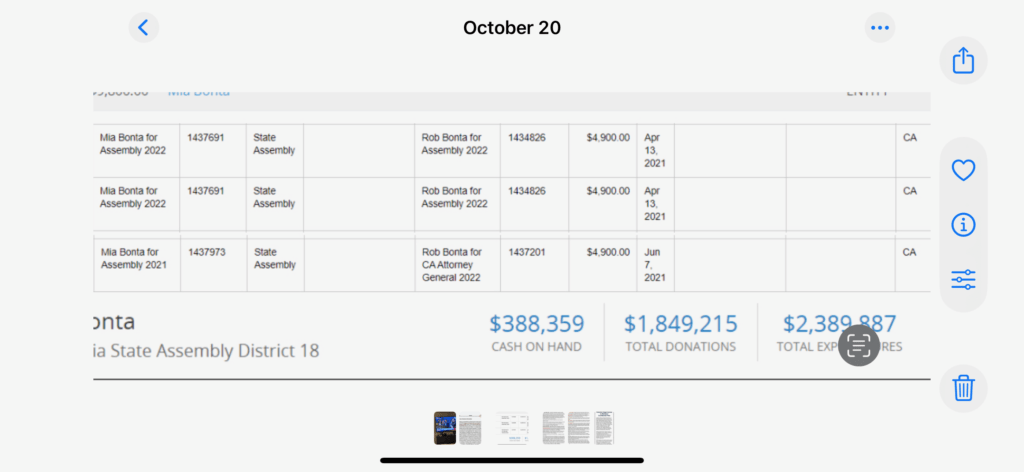
    Rob kept the faucet running, pumping money from his old Assembly account into Mia’s newly christened operation, then back again as Attorney General, exploiting a legal loophole with the precision of a family accountant. By 2025, Mia’s machine had metastasized: $1.84 million raised, $2.38 million incinerated on consultants and cronies, nearly $400,000 cash on hand, and a donor slate that read like a who’s-who of entities with business before her husband.

    Then came the Duong debacle, a scandal so brazen it dragged every Bonta-friendly shadow figure into the light.

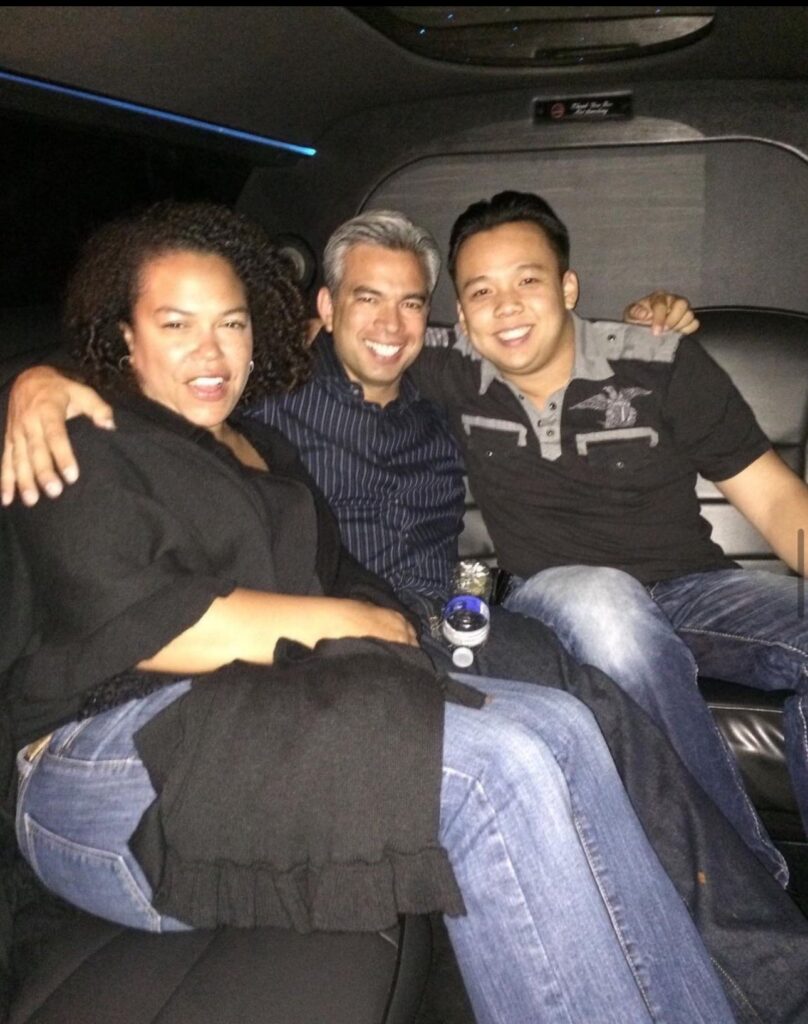
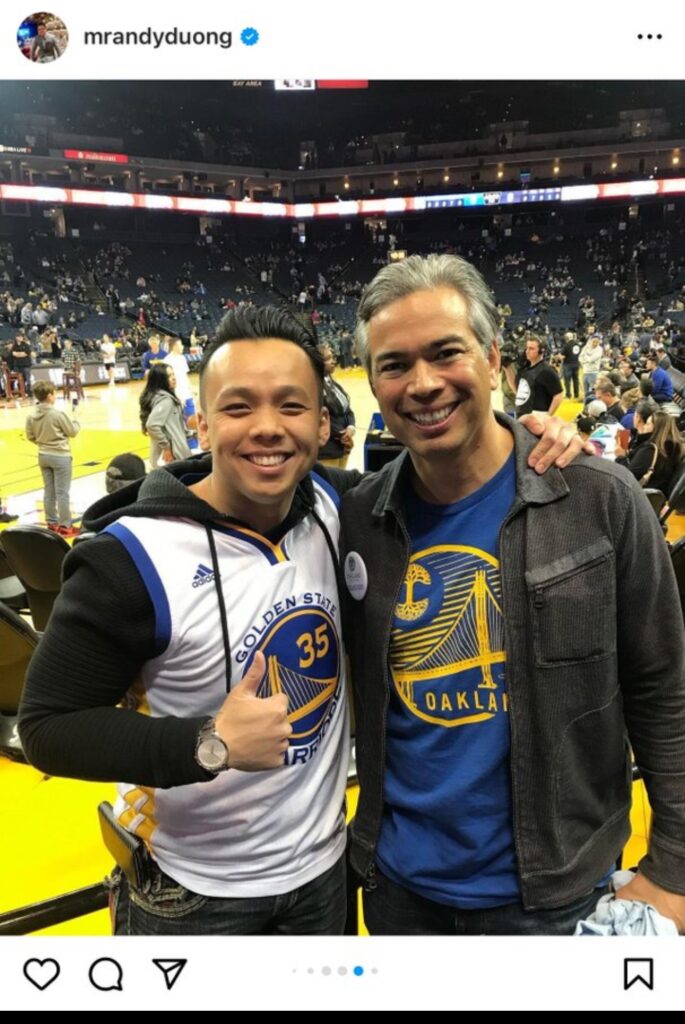
    Andy Duong, Rob’s longtime hanger-on and self-described “brother,” didn’t just appear in Warriors courtside photos and limo rides — he and his network funneled $155,000 into Bonta-aligned committees. Rob only returned the cash after FBI raids landed in June 2024, and even then, the damage was already done.

    The real tell wasn’t the money in, it was the money out.
    Rob spent nearly $500,000 on Silicon Valley powerhouse Wilson Sonsini for “personal protection” during federal interviews, a staggering figure that ethics watchdogs labeled “historically large.” Five oversized payments. Two processed right before Rob suddenly abandoned his gubernatorial ambitions to cling to the AG seat.

    Spokesman Dan Newman’s spin-shift, from claiming Rob was “advancing law enforcement” to “protecting himself due to the nature of charges facing others”, only confirmed suspicions: non-targets don’t burn half a million in donor dollars on Big Law cavalry.

    And then there was Mario Juarez, another Bonta confidant turned FBI co-conspirator. Rob once secured him a $3.4 million state energy grant for their joint venture, complete with shared offices and mutual political endorsements. Mia was no bystander either: Rob funneled $21,000 in campaign money into a nonprofit where she served as CEO, then behested $500,000 more from Silicon Valley players, a maneuver so ethically radioactive it forced FPPC rule revisions.

    Her so-called “recusal” from overseeing the DOJ budget, Rob’s domain, was nothing more than a paper shield in a forest of conflicts. Every move felt like a family IOU paid with someone else’s checkbook.

    But if the Duong dinners and benefit swaps exposed the Bontas’ personal grift, their gaming ledger showcases the industrial scale of the operation, a high-stakes extension of the same dynasty, where tribal war chests and card-room kingpins have poured more than $350,000 into the family orbit since 2021 to grease the Attorney General’s regulatory roulette while Mia positions herself as the velvet-gloved collector.

    Which brings us to November 20, 2025, just days after federal indictments rattled Oakland like loose change in a busted slot machine. As the Duong fallout refuses to dissipate, a new spotlight snaps open, illuminating the Bontas’ gambling-cash pipeline with the clarity of a casino surveillance camera.

    Suddenly, Mia’s first-year haul, nearly $107,000 from gambling interests, doesn’t resemble routine fundraising. It looks like the opening move in a deliberate spousal detour designed to skirt the AG’s contribution caps while tilting state policy toward tribal gaming powerhouses.

    Back in 2021, East Bay challenger Janani Ramachandran saw the architecture clearly and labeled it what Sacramento insiders whispered:
    “Legalized corruption.”

    She demanded Mia return the money and urged Rob to recuse himself from all gaming decisions.
    The Bontas kept every penny, offered no apology, and marched straight through the ethics fog as both ballot measures, Prop 26 (tribal-backed) and Prop 27 (card-room-backed), imploded. Tribes celebrated. Card rooms seethed. And the Bontas walked away with reinforced donor alliances.

    The filings lay it out with mathematical precision. Mia’s 2021 special-election kitty hit $460,244, with gaming interests chipping in $92,000 — a clean 20% of the pot. Tribal contributors like the Mission Indians followed with nearly $14,000 in 2022. Even after the ballot battles ended, Pechanga and CNIGA affiliates kept her machine fueled – drip by drip – until her operation ballooned into a multimillion-dollar influence hub.

    Mia constructed the soft-power runway.
    Rob executed the hard-power landing.

    While her committees collected the checks, his office swung, or consciously declined to swing, the enforcement hammer.

    The sharpest example? The Bicycle Casino scandal.
    Barely a month into his AG tenure, Rob’s reelection committee pocketed the maximum $16,200 from the Bell Gardens powerhouse at the precise moment his Bureau of Gambling Control was probing more than $100 million in suspicious cash flows linked to laundering.

    The feds acted in 2022.
    They levied a $500,000 penalty.

    Bonta’s office?
    Not a single charge.
    Not a single fine.
    Not a single explanation.

    Card-room advocates now battling his proposed statewide blackjack restrictions have a simpler term for this timing:
    “A well-placed gratuity.”

    But the tribal side of the ledger reveals an even clearer pattern. Since taking office, Rob has banked over $232,000 from tribal gaming interests, including a tidal wave of $101,500 from Pechanga and allies between late 2023 and mid-2024, perfectly aligned with the tribes’ campaign to crush daily fantasy sports.

    Leo Chu, Owner of Bicycle Casino

    Then came July 2025, when Rob issued the opinion declaring daily fantasy sports illegal, a wholesale tribal victory and a death sentence for card rooms already bracing for new restrictions. Card rooms, for their part, had only contributed $12,100 by 2024, enough to be acknowledged, not enough to be protected.

    Meanwhile, Mia chaired the Assembly budget subcommittee overseeing the Department of Justice, her husband’s shop. Her “recusal” was cosmetic at best, meaningless at worst.

    Ramachandran’s words echo louder than ever:
    “The money isn’t for her seat, it’s for his decisions.”

    FPPC oversight? Missing in action, buried under California’s thick fog of ethical ambiguity.

    X (Twitter) now brims with satire: Bonta-as-croupier memes, Duong donors rehashed in every thread, and card-room workers marching on the Capitol chanting that the entire deck is rigged. Former FPPC chair Bob Stern’s resigned shrug speaks volumes, when corruption becomes normalized, ethics becomes nostalgia.

    Because the truth is simple:
    The Bontas aren’t bending the rules.
    They’re weaponizing them.

    From Duong’s dirty-money dinners to casino contributions masquerading as democratic participation, their dynasty thrives on a ruthless formula:
    personal benefit upfront, regulatory payoffs in the back.

    With the 2026 primaries closing in, Rob quietly circling a Senate run, Mia’s $400,000 war chest humming on tribal fuel, and California’s gaming titans prepping for another multimillion-dollar ballot brawl, the real question isn’t whether the Bontas will play the game again, it’s whether voters will finally call their bluff, or whether Sacramento’s one-party casino will let the house favorites keep raking the pot.

  • Former LAPD Deputy Chief Al Labrada Blows the Whistle on a Protected Captain, a Suppressed Racial Slur Investigation, and a Culture of Fear Moore Built and the LA Times Refused to Touch

    Former LAPD Deputy Chief Al Labrada Blows the Whistle on a Protected Captain, a Suppressed Racial Slur Investigation, and a Culture of Fear Moore Built and the LA Times Refused to Touch

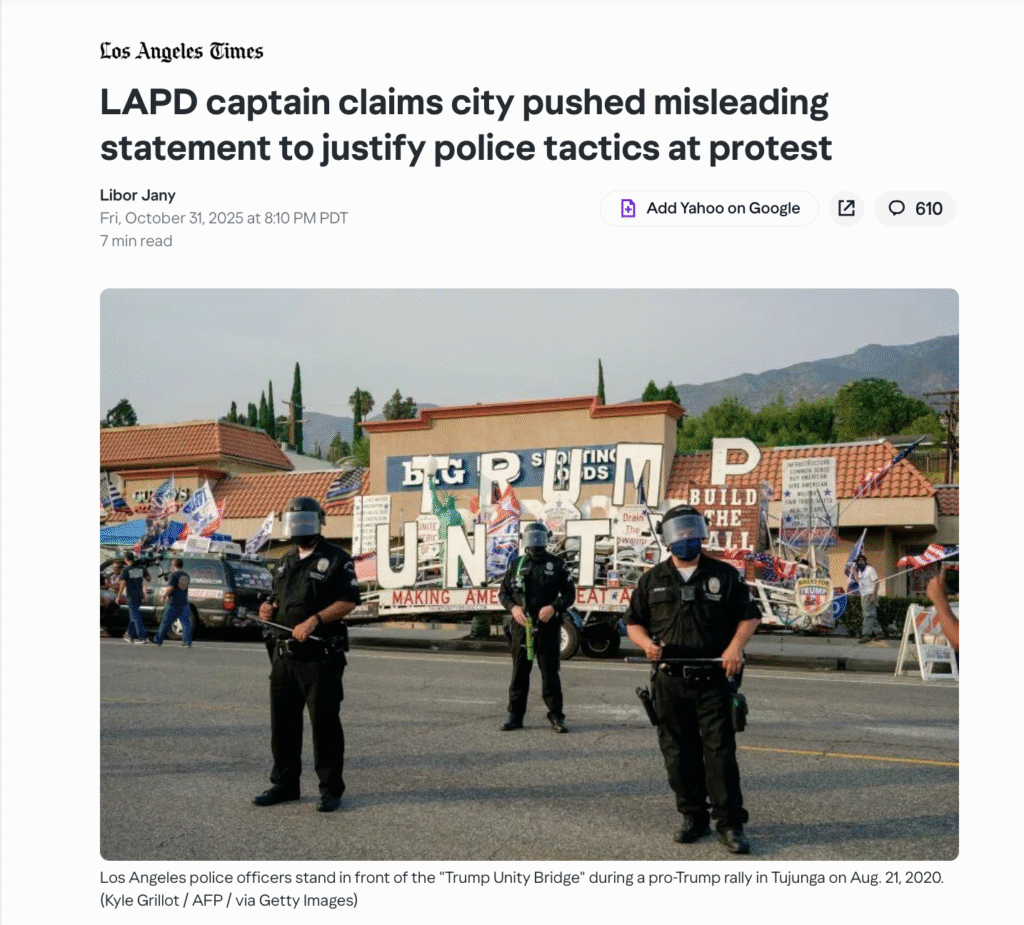
    To the surprise of absolutely no one who has watched the LA Times bend over backward to serve the political class since Patrick Soon‑Shiong purchased it in 2018, the publication recently delivered a sanitized, PR-burnished rendition of LAPD dysfunction – a narrative clearly designed to prop up Mayor Karen Bass, who has been staggering under one political hit after another, most notably the cover-ups and corruption tied to the Palisades Fire.

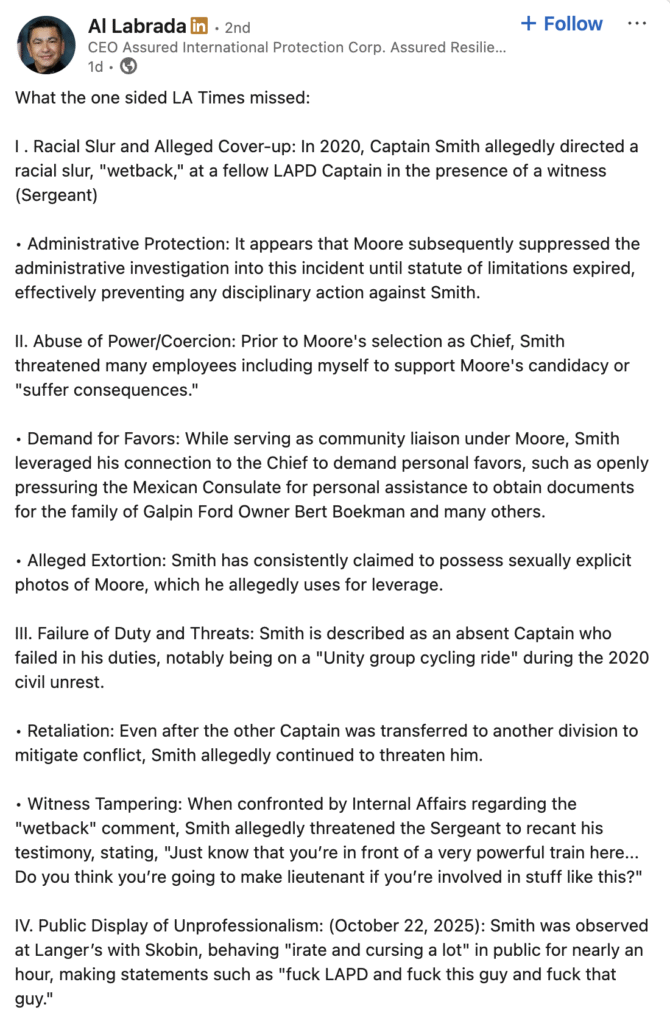
    The story neatly, and conveniently, sidestepped the people who actually lived the chaos – and now former LAPD Assistant Chief Al Labrada is now calling out them directly, taking to his social media to publish the true facts in the case: a years-long pattern of retaliation, buried investigations, and top-down protection surrounding a single LAPD Captain who wielded so much unchecked power that even the department’s own command staff privately admitted he had become “an uncontrollable monster.”

    It starts with a slur, one the department buried.

    In 2020, Captain Johnny Smith allegedly directed a racial epithet,  “wetback”, at a fellow LAPD Captain. A sergeant witnessed it. A complaint was initiated. In any just system, that moment would have triggered immediate removal and a sustained investigation. Instead, according to Labrada, then Chief Michel Moore suppressed the administrative case long enough for the statute of limitations to expire, a bureaucratic sleight of hand that wiped out any chance of discipline and shielded Smith entirely from consequences.

    Labrada also exposes what happened behind the scenes of Moore’s rise: before Moore was selected as Chief, Smith allegedly threatened multiple employees, including Labrada, telling them to support Moore “or suffer consequences.” Once Moore was installed, Smith leaned into the connection like a personal power supply.

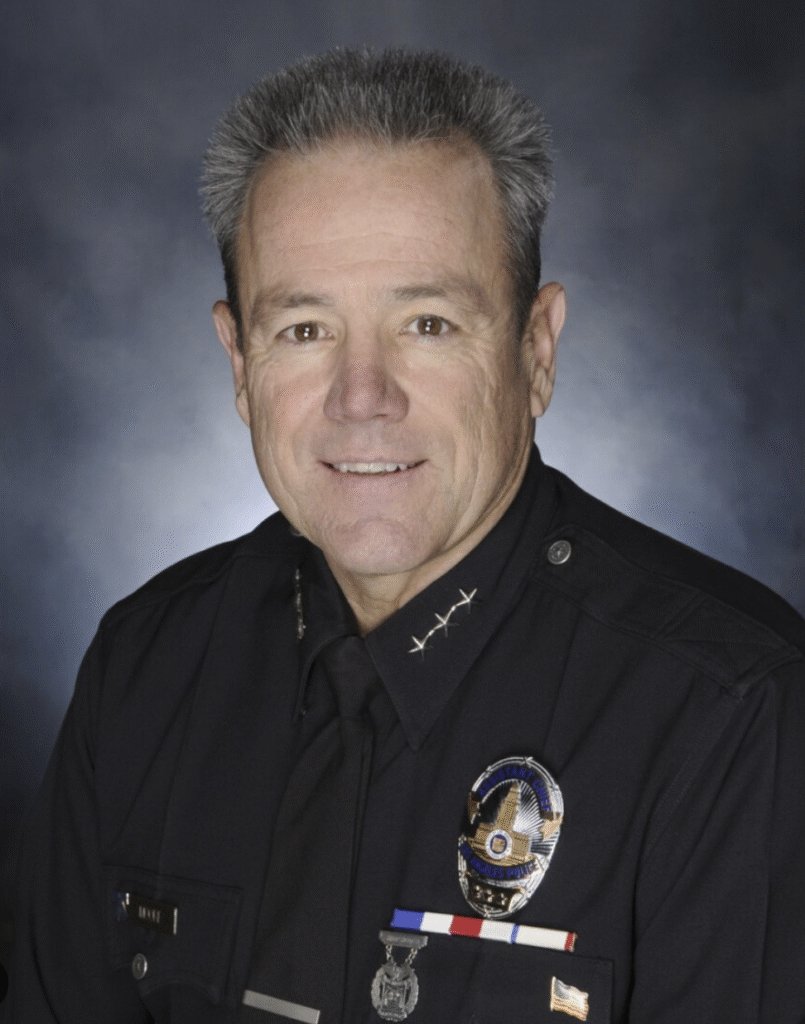
    Former LAPD Chief Michel Moore.

    Labrada says Smith abused his position as community liaison to demand personal favors far outside the bounds of his role, including pressuring the Mexican Consulate for help securing paperwork for Galpin Ford owner Bert Boeckmann’s family and others. And in the darkest allegation of all, Smith repeatedly claimed to possess sexually explicit photos of Moore, which he allegedly used as personal leverage.

    Moore’s inability, or unwillingness, to check this behavior came to a head during the 2020 civil unrest. While Los Angeles burned, Smith was absent from his command responsibilities, reportedly out on a Unity cycling ride. Yet he still wielded enough influence to retaliate against anyone who challenged him. Even transferring the Captain he targeted to another division didn’t stop the harassment. According to Labrada, when Internal Affairs questioned Smith about the “wetback” slur, he threatened the sergeant witness, telling him, “Just know that you’re in front of a very powerful train here. Do you think you’re going to make lieutenant if you’re involved in stuff like this?”

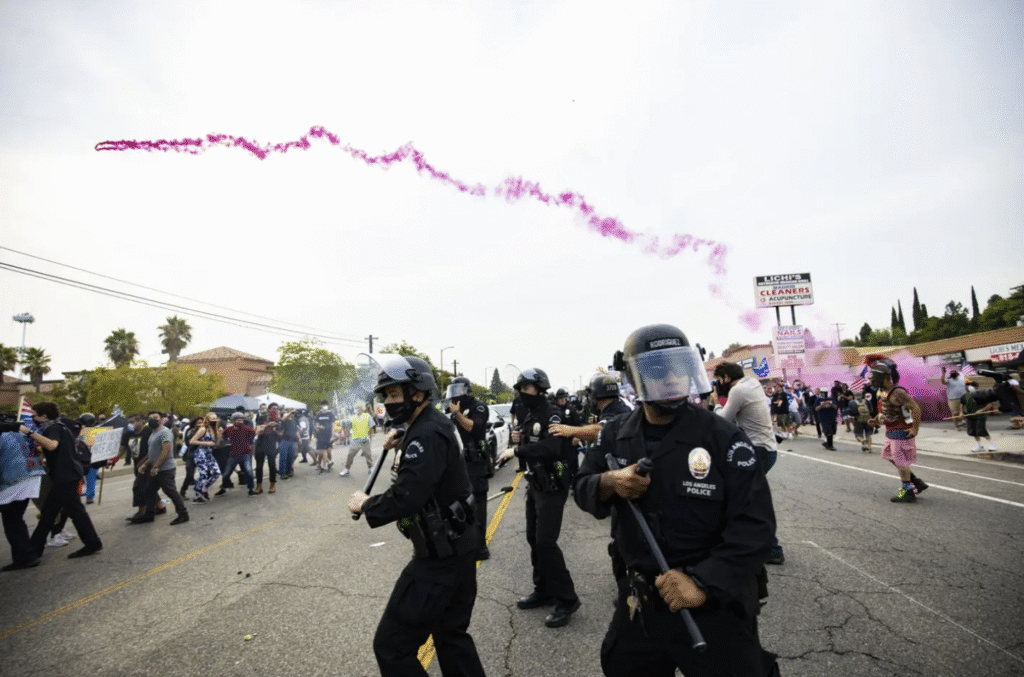
    LAPD officers attempt to hold a scrimmage line as supporters of Black Lives Matter and supports of President Trump face off. (Brian Feinzimer)
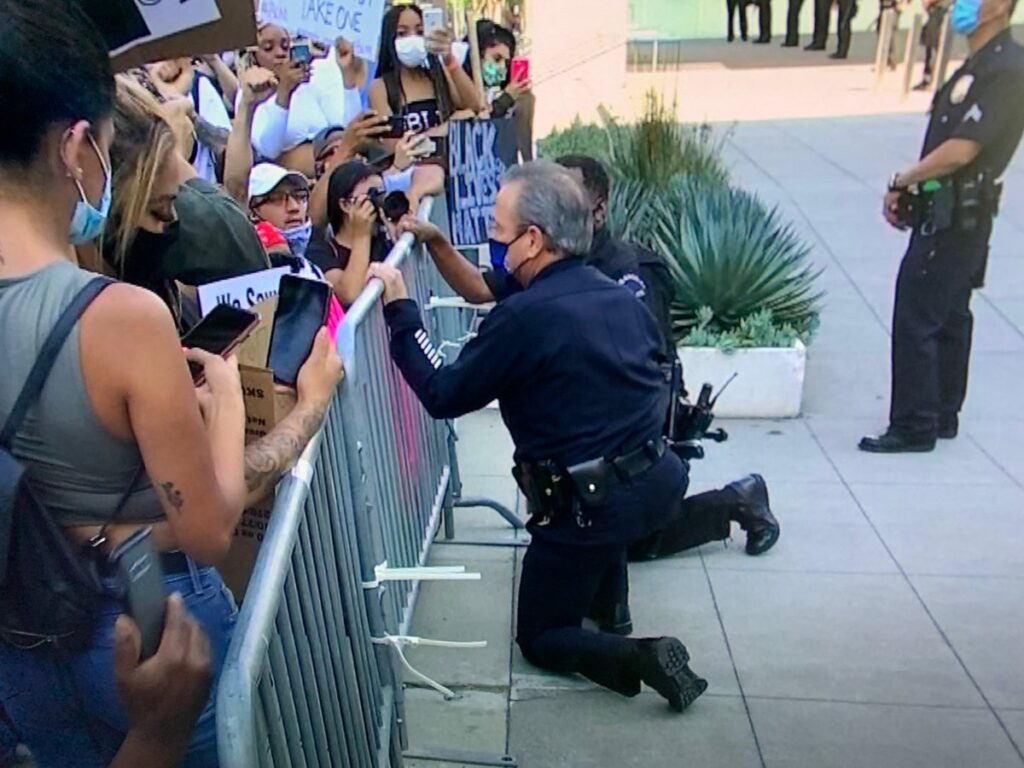
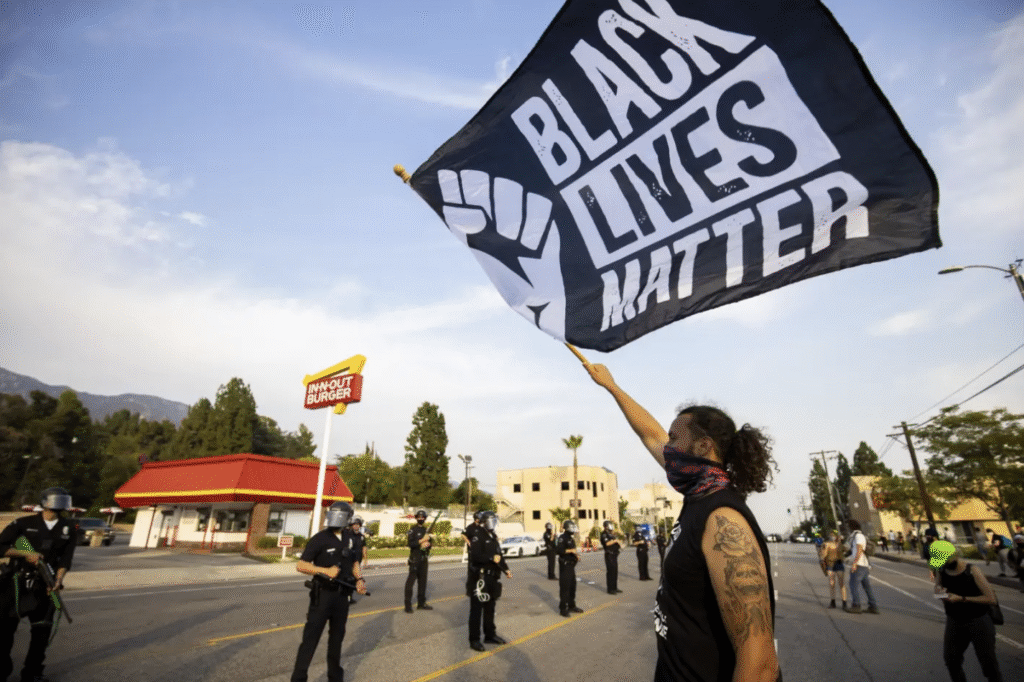
    A supporter for Black Lives Matter waves a flag while facing a line of LAPD officers block the two sides of demonstrators from interacting. (Brian Feinzimer)

    That is not leadership. That is coercion. And the Times printed none of it.

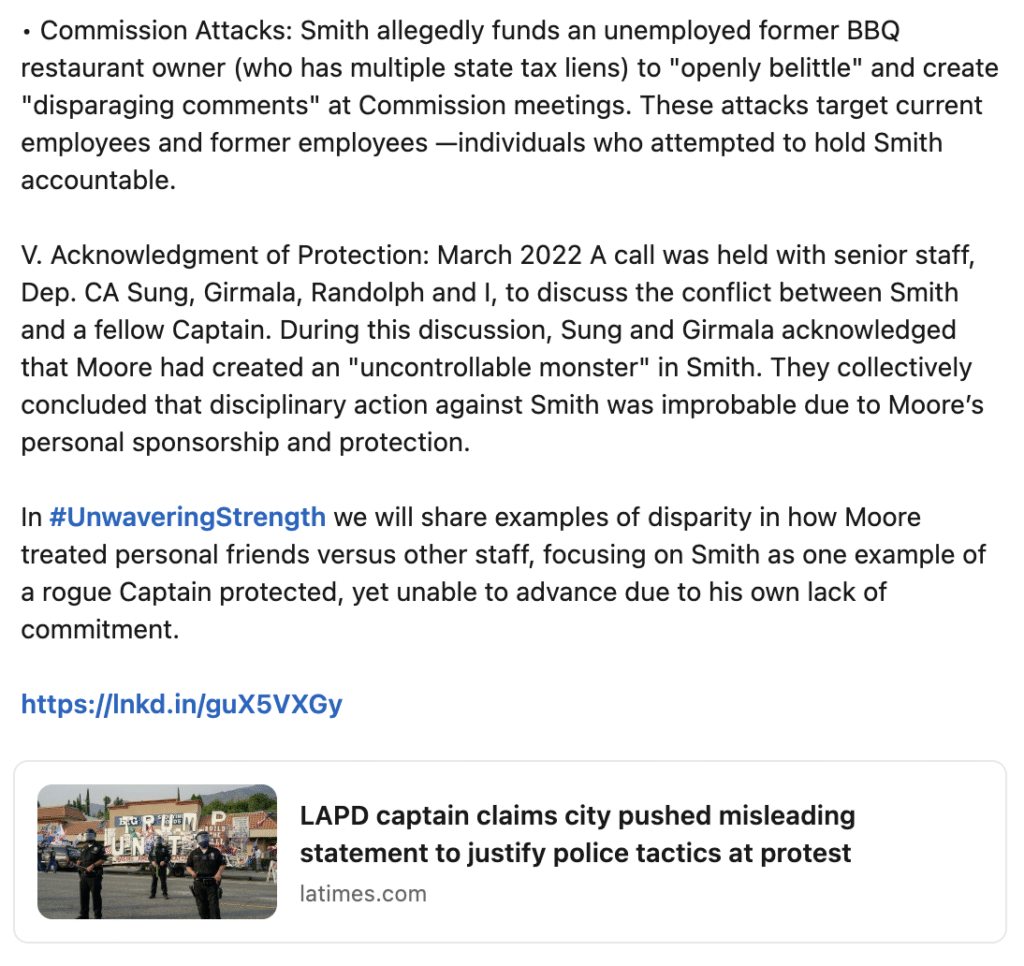
    Labrada also details an incident on October 22, 2025, when Smith was at Langer’s with Skobin, behaving erratically, loudly cursing LAPD for nearly an hour, yelling “fuck LAPD and fuck this guy and fuck that guy.” This wasn’t a private meltdown. It was a public spectacle by a senior LAPD Captain confident he was untouchable, because for years, he was.

    Smith’s protection even extended to orchestrated harassment at Police Commission meetings. According to Labrada, Smith financially supported an unemployed former BBQ restaurant owner with multiple state tax liens to show up and launch vulgar, targeted attacks at both active and former LAPD employees, specifically those who tried to hold Smith accountable. These weren’t organic criticisms. They were proxy assaults sponsored from within the department’s own command staff.

    And then comes the moment that underscores everything Labrada is now putting on the record. In March 2022, a conference call with Deputy City Attorney Sung, Assistant Chief Girmala, Commander Randolph, and Labrada took place to address ongoing conflict between Smith and another Captain. On that call, Sung and Girmala openly acknowledged that Moore had “created an uncontrollable monster” in Smith. They further admitted that disciplinary action was “improbable” because Smith was Moore’s protected confidant.

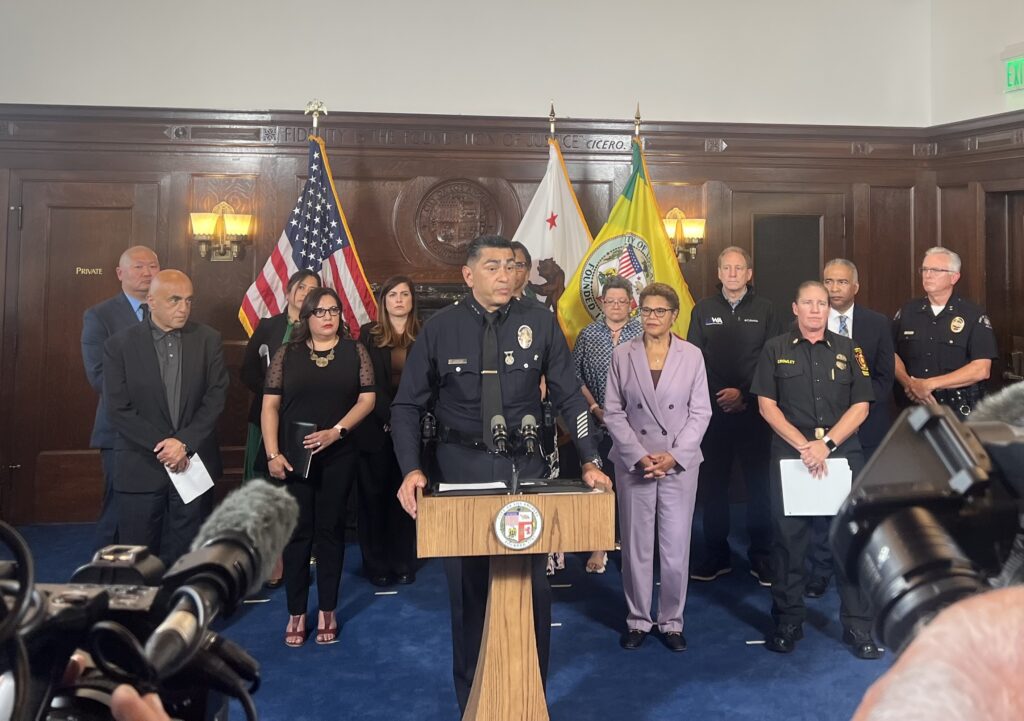
    Former LAPD Assistant Chief Al Labrada at a press conference.

    This is the truth the LA Times omitted, a truth that exposes LAPD’s deeply-rooted culture of protectionism, retaliation, and selective discipline that rewards loyalty to the Chief over integrity to the badge.

    As Labrada launches #UnwaveringStrength, he is putting daylight on the disparity between how Moore protected his inner-circle allies versus how he treated everyone else. Smith is only one example, but he is the clearest: a rogue Captain shielded from accountability, feared inside the ranks, and ironically stalled in his own career because protection can’t replace competence.

    The LA Times framed the story as bureaucratic friction and messaging disputes. What they left out is the heart of the crisis: a command structure corrupted by personal alliances, political threats, and a Chief whose loyalty to one Captain compromised the safety, integrity, and morale of an entire department.

    Labrada’s account isn’t a footnote the LA Times forgot to include. It IS the story.

  • LACERA’S SHADOW SYSTEM: Document Tampering, Attorney Pressure, and the Quiet Machinery Built to Deny Injured Deputies Their Rights

    LACERA’S SHADOW SYSTEM: Document Tampering, Attorney Pressure, and the Quiet Machinery Built to Deny Injured Deputies Their Rights

    In the underbelly of Los Angeles County’s most powerful retirement agency, a disturbing pattern is emerging, one that suggests LACERA has quietly built a system where records shift, timelines morph, medical opinions are massaged, and attorneys tasked with protecting injured workers suddenly go silent. In the case of former Sheriff’s Deputy Robert Renko, the evidence now coming to light paints a picture of systemic interference so deep it threatens the very credibility of the disability retirement process.

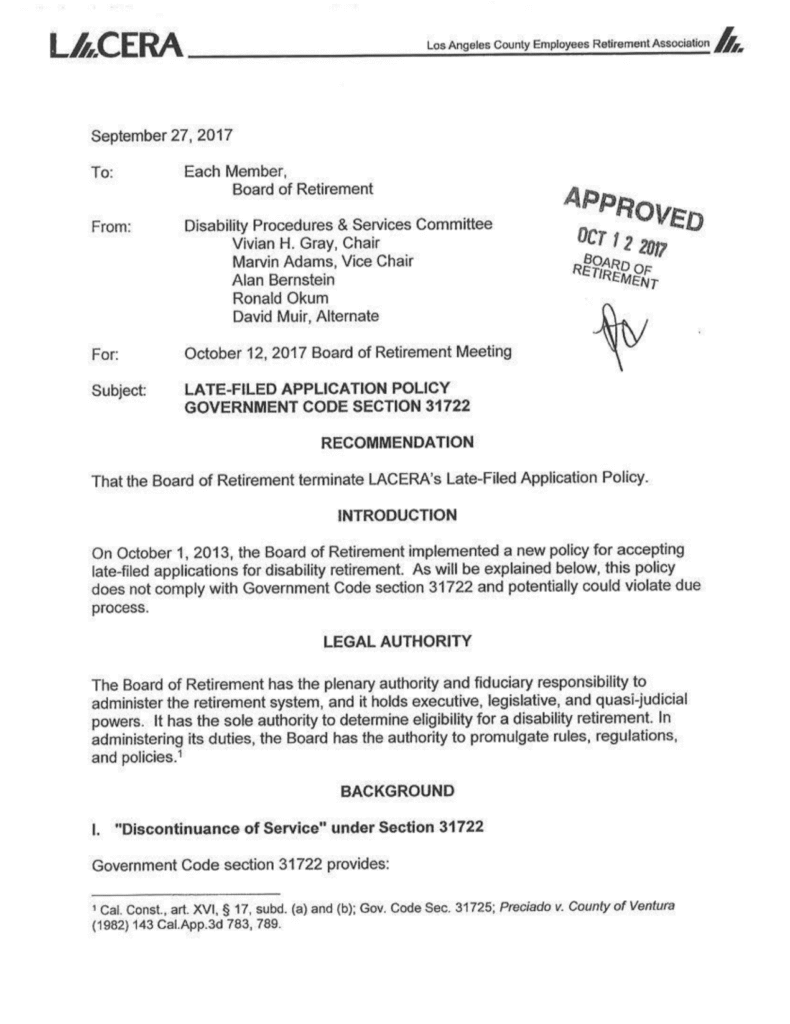
    From the outset, Renko’s file reveals an agency that cannot, or will not, abide by its own rules. LACERA’s Electronic Signature Policy demands verifiable signatures. Its Conflict of Interest Code requires neutrality. Its procedures call for precise documentation and factual accuracy. Yet Renko’s administrative file reads like a patchwork of manufactured reality, altered filing dates, computer-generated signatures, and unexplained inconsistencies that directly violate LACERA’s internal standards. Even more damning, a 2017 LACERA legal memo openly admitted the agency had been misapplying Government Code § 31722 for years. The statute is clear that a disability application hinges on the last day of compensation. Renko’s was November 25, 2016. LACERA ignored that and processed the application as if it occurred months later, warping the legal threshold required to approve his claim.

    Read the entire file here.

    The legal representation surrounding Renko’s case is equally disturbing. Attorneys who should have been his shield instead became casualties of LACERA’s influence. Renko’s first attorney, Thomas Wicke, produced no written arguments, filed no objections, and mounted no defense whatsoever despite two denials. His silence was not advocacy, it was surrender. What happened next underscores the reach LACERA appears to have over the lawyers who rely on the agency for business. Attorney Michael Treger accepted the case, communicated with LACERA Senior Staff Counsel Jason Waller and hearing referee Stephen Biersmith, and was acknowledged on record as Renko’s representative. Then, after conversations with LACERA personnel, Treger abruptly withdrew without explanation, abandoning Renko at a critical stage. When attorneys start walking away after internal conversations, it raises the specter of pressure far beyond routine administrative friction.

    Referee Stephen Biersmith’s handling of the record only deepens the concern. In his administrative summary, Biersmith claimed Renko’s later attorney, Kala Schmidt, ended her representation on December 6, 2023. But documented records show Schmidt continued representing Renko well into January. The December 6 date has nothing to do with Schmidt’s involvement. It does, however, coincide with a major internal shift: Senior Staff Counsel Francis Boyd issued a “NEW REVISED” confidentiality-control policy for all LACERA clients that same day. Renko’s second denial followed six days later. Biersmith’s use of that date looks less like an error and more like an attempt to scrub Schmidt’s ongoing advocacy from the timeline before the fallout from Boyd’s sudden policy revision landed.

    Perhaps the most explosive element is the allegation that LACERA legal counsel instructed orthopedic surgeon Dr. Haronian to generate three different versions of the same medical-legal report following a single examination. If true, this is not just a procedural failure, it is medical tampering. A med-legal report is a legally binding document, and altering such an opinion at the direction of agency counsel crosses into territory that threatens a physician’s licensure. Three versions of one exam is not a miscommunication. It is a manipulation of the medical evidence that forms the backbone of disability-retirement determinations.

    Taken together, these elements form a chilling portrait of an insular system that protects itself above all else. When documents can be altered, attorneys pressured into silence or withdrawal, medical reports revised on command, and timelines rewritten to shield internal policy changes, the retirement system ceases to function as a safeguard for injured workers and instead becomes a fortress of unchecked power. Experts reviewing Renko’s records warn that the abnormalities are not isolated but indicative of a widespread culture where internal influence overrides due process.

    Renko’s case is now headed to Superior Court, where a judge will decide whether these cumulative failures and alleged acts of misconduct invalidate LACERA’s denials. The stakes extend far beyond one deputy. If the court finds the process so contaminated that a fair determination was impossible, it could force a reckoning inside an agency that has operated with near-total autonomy for decades. How many disability cases have been quietly compromised? How many workers have been denied earned benefits because LACERA’s internal machinery was more focused on protecting its own authority than honoring the law?

    This is a developing investigation, and as more evidence emerges, and more LACERA insiders step forward—the true scale of this broken system may finally come into view. More updates to follow.

  • How Sacramento Bought LA: The Bonta Machine, Billionaire PACs, and the Coordinated Takedown of Sheriff Alex Villanueva

    How Sacramento Bought LA: The Bonta Machine, Billionaire PACs, and the Coordinated Takedown of Sheriff Alex Villanueva

    In California’s most guarded political cul-de-sac, where glossy progressive branding conceals backroom power trades, the Bonta empire has evolved from a cozy family consultancy into a full-scale influence machine. And like every machine built to consolidate power, it requires fuel. In this case: Sacramento-engineered cash pipelines, billionaire-backed nonprofits, and a donor ecosystem that reads less like civic participation and more like a criminal enterprise searching for a statute.

    Our previous investigation unmasked the Bontas’ cozy husband-and-wife operation, campaign accounts ping-ponging funds, perks dressed up as “staff appreciation,” and a façade of social justice used as camouflage for old-school dynastic power. But the deeper we dig, the more it becomes clear: this isn’t a story about two elected officials. It’s a story about a syndicate. A syndicate that bankrolls the “right” candidates, buries the “wrong” investigations, and rewards loyalty with protection, all while laundering its influence through a maze of nonprofits and PACs headquartered neatly in Sacramento.

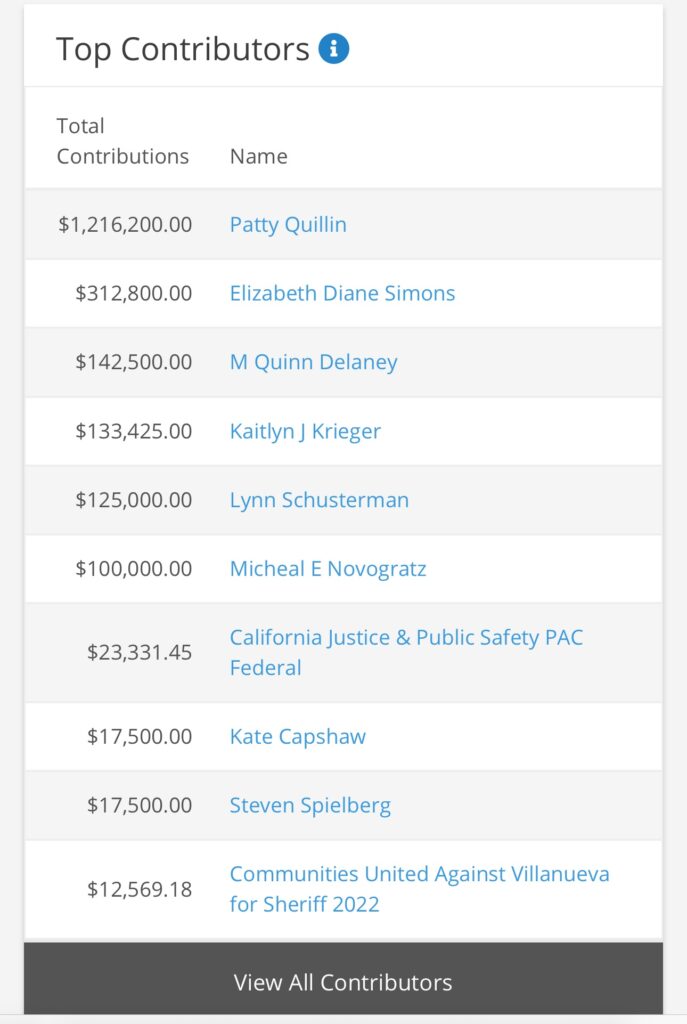
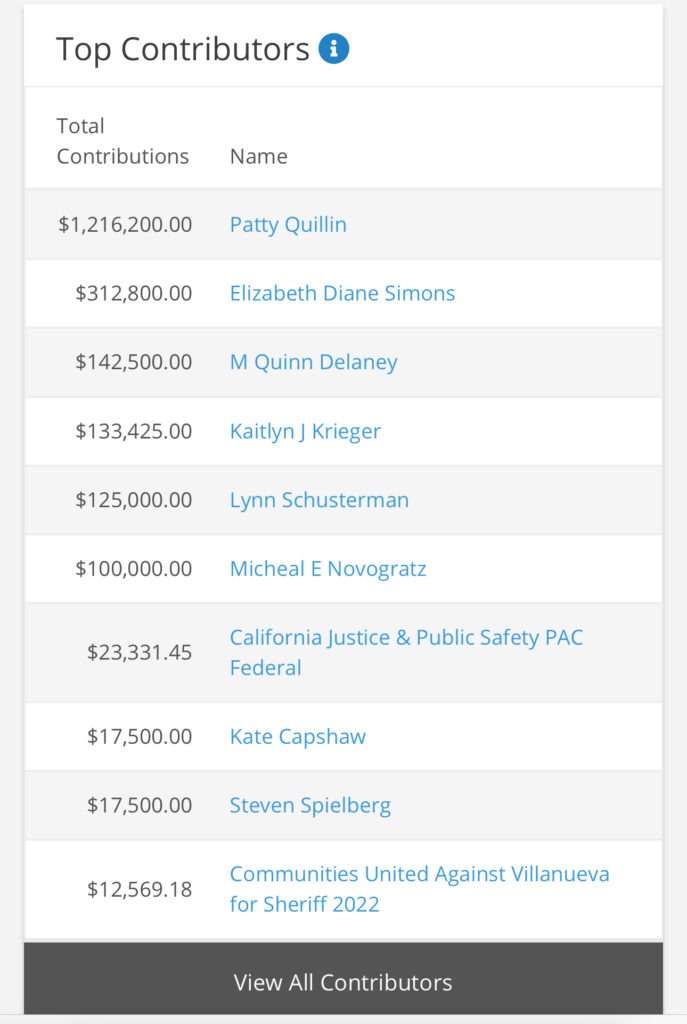
    And the clearest proof of that racket? A modest, easily overlooked $12,569.18 donation from an outfit named Communities United Against Villanueva for Sheriff 2022, a political action committee whose sole mission was simple: remove LA County Sheriff Alex Villanueva at any cost. That dollar figure isn’t random. It is a breadcrumb in a much larger trail linking Sacramento’s progressive donor class to LA County’s most explosive corruption scandal in a decade.

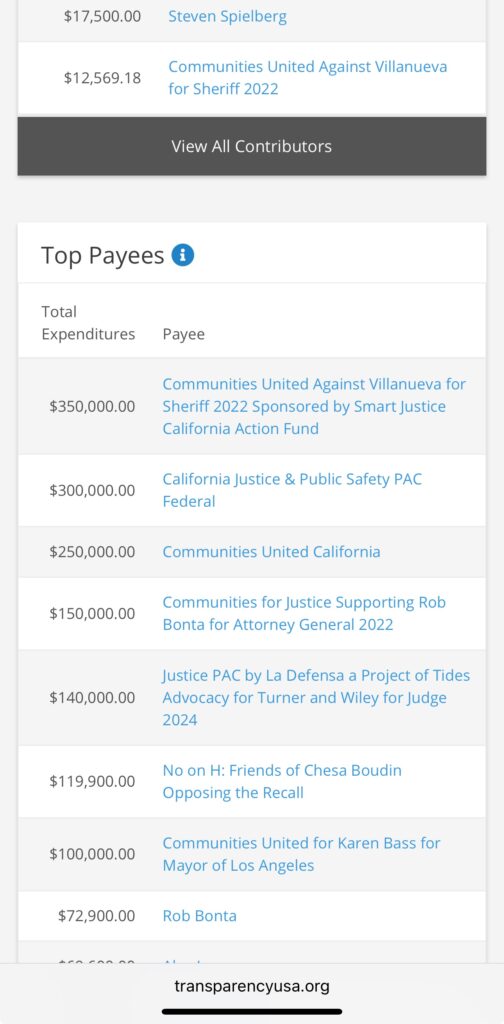
    Zoom out and the players come into focus. Patty Quillin’s seven-figure checks. Liz Simons’ six-figure wiring. M. Quinn Delaney. Kaitlyn Krieger. Lynn Schusterman. Michael Novogratz. Spielberg and Capshaw. Nearly $2 million in maxed-out contributions,$9,000 a head, flowed into Rob Bonta’s campaign for attorney general, while his wife Mia’s Assembly war chest swelled with the same Sacramento return address labels. Smart Justice California Action Fund dumps in $250,000, then another $100,000. SEIU drops $100,000. Philanthropist-activists in Sacramento slip in their $50,000, $35,000, $20,000 offerings. A steady drip of reform-branded money that, when traced, lands squarely at the feet of the Bontas, and directly into the political kill shot aimed at Villanueva.

    This is the part where the establishment wants you to tune out, so listen up.

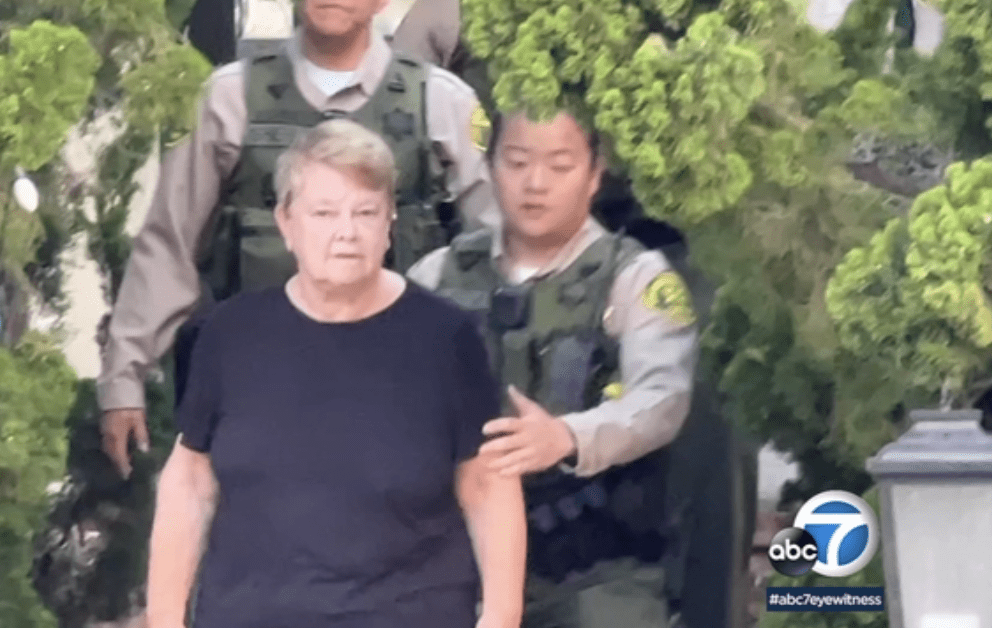
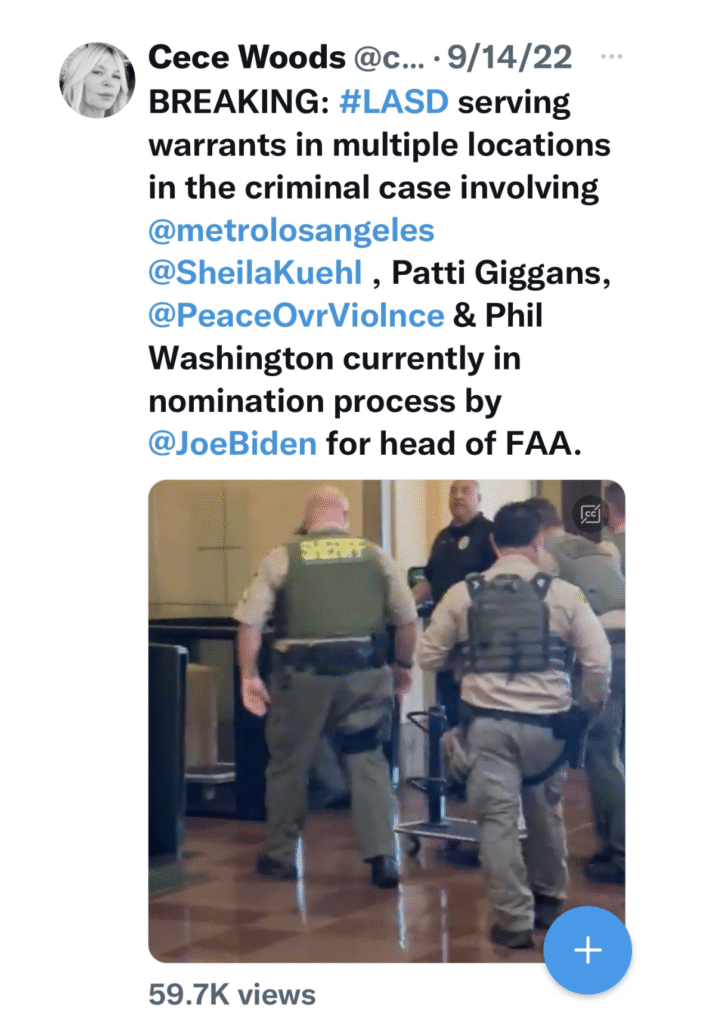
    Because when Villanueva’s deputies executed search warrants on September 14, 2022, at Metro, Peace Over Violence, the Office of Inspector General, and the private homes of Supervisor Sheila Kuehl and her longtime ally Patricia Giggans, the entire progressive fundraising ecosystem went into cardiac arrest. Here was the sheriff no one controlled digging into a multi-year no-bid contract scheme, millions in questionable Metro payments, and a nonprofit run by Kuehl’s best friend. And then came the moment that should have sent federal investigators sprinting: during a live broadcast, Kuehl brazenly admitted she’d been tipped off about the warrant by County Counsel Dawyn Harrison, who himself got the information from Inspector General Max Huntsman.

    A pre-raid leak. A tainted warrant. A group chat of insiders scrambling to protect one of their own. In any functioning democracy, this becomes the investigative equivalent of a five-alarm fire.

    But, California in 2022 was not functioning.

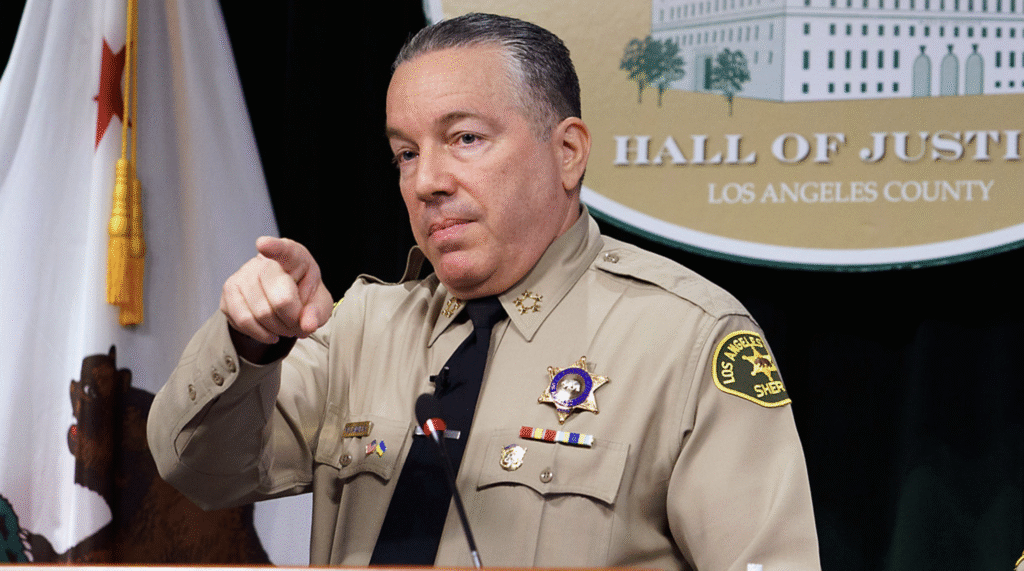
    Los Angeles County Sheriff Alex Villanueva takes questions during a news conference in Los Angeles, 2022. (AP Photo/Damian Dovarganes)

    Within a day, LASD had evidence, texts and voicemails, directly implicating Harrison, Huntsman, and Kuehl’s chief of staff Lisa Mandel in the unlawful warning. Within a week, the entire operation was yanked out of LASD’s hands. Rob Bonta, whose campaign was fueled by the very network of donors protecting Kuehl and Giggans, declared the investigation too “questionable” to continue and commandeered it under the Department of Justice.

    Think about the timing.

    Smart Justice and SEIU are sending Sacramento cash south to tank Villanueva’s re-election. Mia Bonta is cashing dual $4,900 checks from Senator Sydney Kamlager-Dove, whose husband, attorney Austin Dove, represents Giggans in the criminal probe. Kamlager-Dove’s $9,800 rides alongside her endorsement of Mia’s Assembly run. The San Francisco Chronicle sounds the alarm in June 2021, calling the arrangement “legalized corruption.” The warnings go ignored.

    Congresswoman Sydney Kamlager-Dove and her husband attorney Austin Dove

    Then, in September 2022, right as the Communities United PAC detonated its war chest, unleashing more than half a million dollars against Villanueva and billionaire power brokers Jeff Katzenberg and George Soros piled on with a combined $1.5 million to ensure that a sheriff willing to hold corrupt politicians accountable would never be re-elected—Rob Bonta appears on cue. With the elite donor class financing the takedown, Bonta swoops in, seizes the Kuehl investigation, and neutralizes the only law-enforcement official actually probing LA County’s entrenched corruption ecosystem.

    By August 2024, Bonta quietly closes the probe. No charges. No accountability. No explanation.

    State investigators confessed to LASD investigators that they were blocked from viewing the truckload of evidence seized during the search warrants. Bonta publicly claimed there was “insufficient evidence” – THAT WAS A LIE.

    A perfect political hit job wrapped in the language of “oversight.”

    The East Bay scandal followed the same trajectory as the Kuehl probe: serious allegations, powerful donors, overlapping political interests, and an Attorney General who always seemed to land on the side of the people writing the checks.

    The through line is painfully obvious. The same Sacramento donors backing the Bontas were bankrolling the PACs that drowned Villanueva’s re-election bid. The same nonprofit networks writing checks for “justice reform” were funneling money into Oakland’s political apparatus. The same political families donating to Mia’s campaign were tied to Giggans’ defense. The same insiders hosting fundraisers for the Bontas were at the center of a federal bribery and blackmail case.

    This wasn’t governance. It was orchestration.

    And the public is the mark.

    Villanueva was replaced. Kuehl was shielded. The Duong machine was allowed to thrive until the feds stepped in. And the Bontas, flush with PAC cash, billionaire backing, and carefully cultivated alliances, kept climbing.

    The marble-hall mafia won another round.

    When all the lines converge in the same Sacramento office suites and the same LA County power circles, that’s not politics. That’s a racket.

    But the Bontas’ talent for slipping past real scrutiny doesn’t stop at the LA battlegrounds, they’ve been running the same playbook up north, deep in the East Bay’s corruption underbelly, where indictments, blackmail threats, and political favors swirl in the same smoky backrooms.

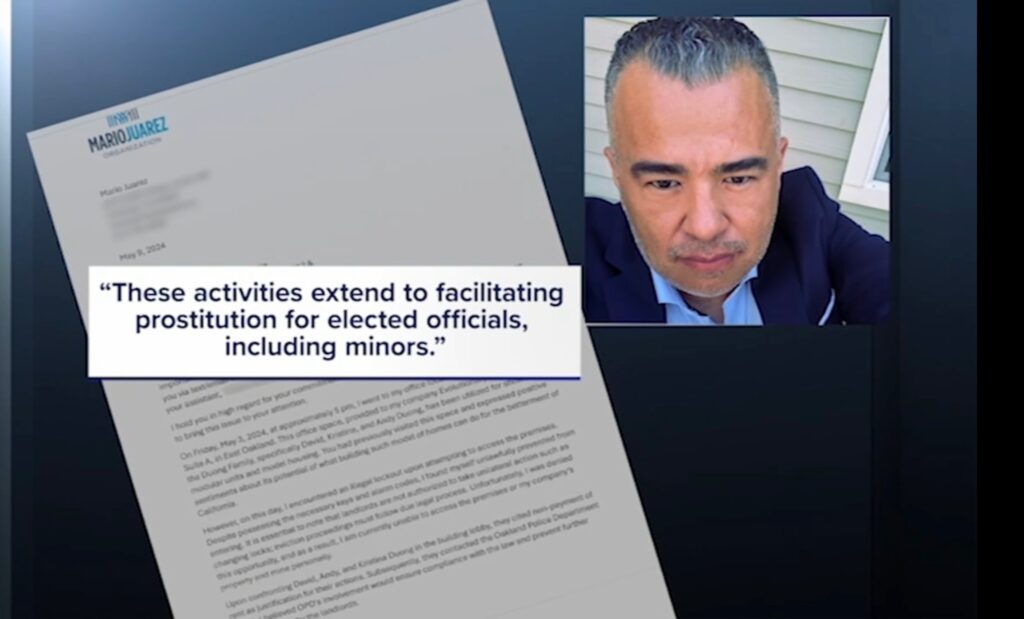
    By May 2024, the federal probe detonated in Oakland: former Mayor Sheng Thao, her partner Andre Jones, and the Duong brothers, David and Andy, the power behind the modular housing firm Evolutionary Homes, slapped with charges for bribery, straw-donor laundering, and an entire ecosystem of illegal campaign cash. And sitting at the center of that explosion was a letter, dated May 9, from Evolutionary Homes founder Mario Juarez, alleged “Co-Conspirator #1”, hand-delivered straight to Attorney General Rob Bonta.

    Screenshot

    Juarez wasn’t just any insider. He had hosted Bonta family fundraisers out of his Oakland office. He knew the terrain, the players, and the whispers. And his message was a gut punch: Andy Duong had “surveillance footage” of Bonta in a compromising situation, footage allegedly captured during the Duongs’ notorious “entertainments,” where officials were secretly recorded for future leverage. Juarez didn’t mince words. The footage, he warned, could trigger “public embarrassment at the least” or expose “illicit activities, including the use of drugs.”

    The letter read like a prophecy. Juarez laid out the Duongs’ entire operation, money laundering, fake contracts, a straw-donor factory, prostitution arranged for elected officials, “including minors.” He detailed fabricated payouts to Andre Jones, $80,000 during Thao’s 2022 mayoral run, later updated to $95,000 in the federal indictment. And then came the most harrowing revelation: Juarez described being assaulted just six days earlier, beaten, robbed, forced to record a coerced apology video by Andy and his sister Kristina outside California Waste Solutions headquarters. He told Bonta he believed his life was in danger: “I do feel at this point that I am subject to possible murder attempts.”

    This wasn’t a theoretical complaint. This was a man begging the state’s top law-enforcement officer for protection, praising Bonta’s supposed integrity, pleading for action.

    And what did Bonta do?

    Nothing that protected the public. Nothing that stopped the Duong machine. Nothing that acknowledged the whistleblower who risked his life to expose corruption in Bonta’s own backyard.

    But the receipts are surfacing. The connections are tightening. And the public is finally paying attention.

    Follow the filings. Follow the PACs. Follow the spouses. Follow the nonprofits. Follow the Oakland donors and the LA power players. When all the lines converge in the same Sacramento office suites and the same Los Angeles backrooms, that’s not politics.

  • The Bontas: California’s First Family of Corruption – A Marble Hall Marriage of Power, Perk and Blatant Self-Dealing

    The Bontas: California’s First Family of Corruption – A Marble Hall Marriage of Power, Perk and Blatant Self-Dealing

    Sacramento’s marble corridors have seen their share of power couples, but none embody California’s one-party entitlement culture quite like Rob and Mia Bonta, the state’s polished, progressive poster family whose political brand has quietly doubled as a two-person cash-handling operation.

    The story begins in 2021 when Gavin Newsom elevated Rob from a safe Assembly seat into the Attorney General’s office. And in true Sacramento dynastic tradition, the now-vacant seat didn’t go to the next qualified public servant. It went to his wife. A seamless handoff. A political heirloom. And the opening act of a years-long family enrichment scheme hiding in plain sight.

    The receipts – literal receipts – from Mia Bonta’s 2021 special-election committee should have detonated a statewide ethics review. Instead, they landed with the dull thud of corruption so normalized it barely raises an eyebrow. Donor dollars reimbursing the Attorney General of California for cocktails and appetizers. Donor dollars subsidizing a family dinner labeled as “staff appreciation.” Donor dollars covering vague “office expenses” and “travel” attributed to Rob himself. California law explicitly bars campaign funds from personal use, including payments benefiting family members. The Bonta operation didn’t just flirt with the line – they leapt over it and made themselves at home.

    And it wasn’t just the Bonta household helping themselves. Mia’s inner circle treated the campaign like a private petty-cash buffet, with her campaign manager raking in more than $17,000 plus a steady stream of reimbursements for everything from flowers to food. Families sharing last names surfacing on the same payment dates. No competitive process. No transparency. Just the familiar scent of Sacramento’s favorite pastime: insider patronage.

    While Mia’s committee burned donor money on snacks and friends, Rob kept the family pipeline humming. His old Assembly committee funneled money into Mia’s new operation. His new AG committee did the same. Transfers stacked one after the next – technically legal under California’s deliberately toothless campaign-finance framework, yet unmistakably brazen in intent. A political baton pass orchestrated behind closed doors while the public was told it was all above board.

    By 2025, Mia’s operation had ballooned into a multimillion-dollar fundraising and spending machine – $1.84 million raised, $2.38 million spent – with nearly $400,000 cash on hand and an all-too-familiar roster of consultants and insiders feeding at the trough. The family business model wasn’t slowing down. It was scaling.

    Then the ground shifted.

    As federal investigators began tightening their net around the East Bay bribery scandal, the notorious Duong crime ring operating behind its recycling front, the Bonta name resurfaced again and again. Rob Bonta, the state’s top law enforcement officer, suddenly dropped nearly half a million dollars in campaign funds on Wilson Sonsini, one of Silicon Valley’s most elite legal fortresses. Feds were asking questions. Rob was giving interviews. And his spokesperson, Dan Newman, spun two contradictory explanations within days, first claiming the legal costs helped advance law enforcement, then admitting they were for Rob’s own protection during federal interviews because of the “nature of the charges facing others.”

    He insisted Rob wasn’t a target. But no “non-target” drops close to half a million dollars on Big-Law cavalry, paid out in five massive checks, two of which cleared days before Rob abandoned his long-teased gubernatorial run to hold onto the safety of the Attorney General’s office.

    Experts aren’t fooled. Ethics scholars have called the legal bills “historically large,” a glaring signal that something far more serious was unfolding behind the scenes. FPPC officials, bound by California’s labyrinth of intentionally murky rules, can only repeat what everyone watching already knows: campaign funds are supposed to be used for political activity, not personal lifelines.

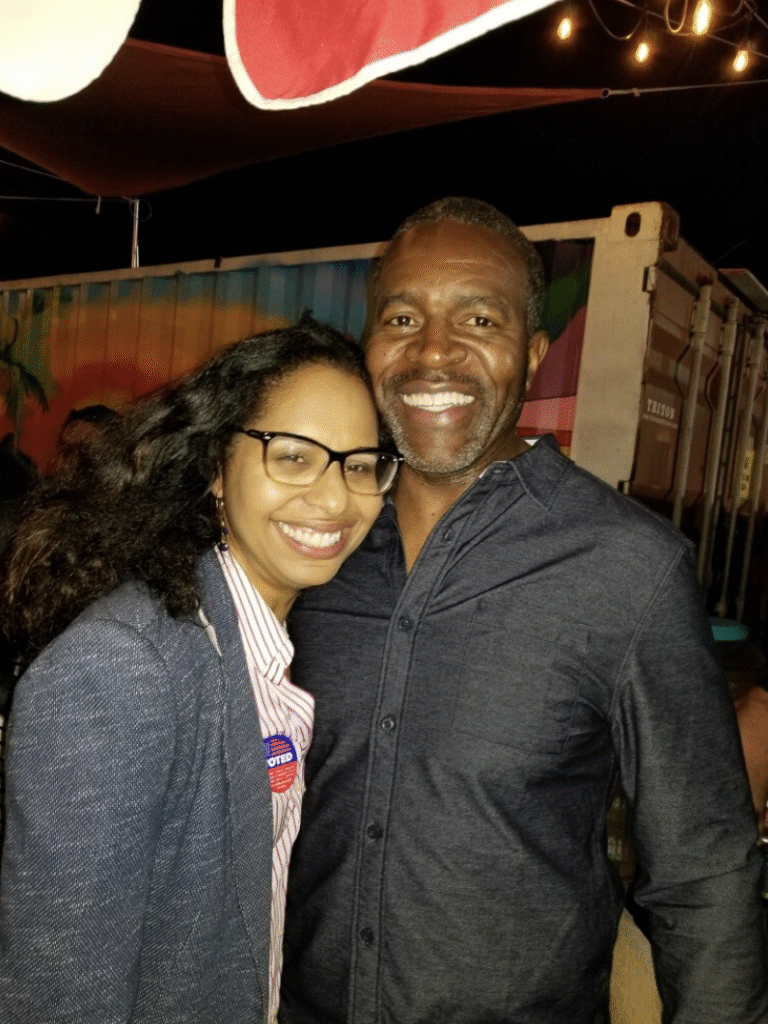
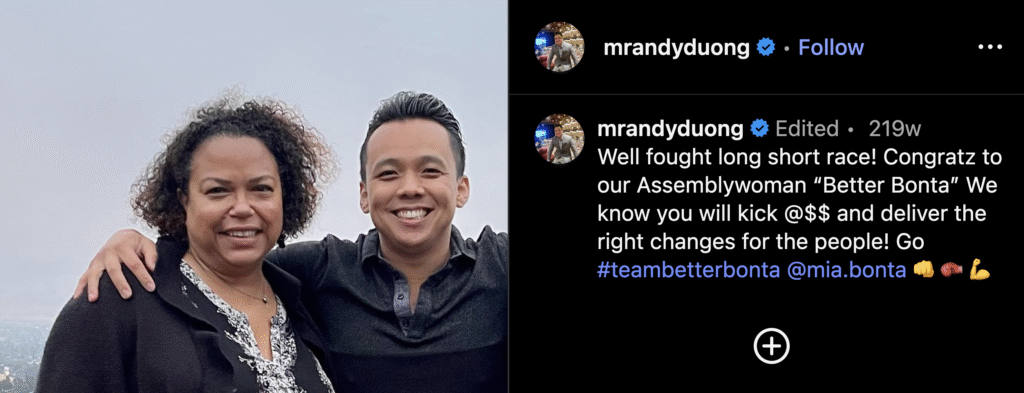
    This is where the Duong scandal becomes impossible to ignore. The indicted recycling moguls, accused of bribing Oakland’s mayor with cushy no-show jobs, weren’t strangers to the Bontas. They were friends. Photographs show Rob and Mia court side at Warriors games with Andy Duong. Smiling in limos. Arm-in-arm at events. Duong referred to Rob as “brother,” celebrating his rise from city council to Attorney General. When the feds raided the Duong empire in June 2024, Rob hurriedly returned $155,000 in contributions, but only after federal agents kicked down doors.

    There’s also the Mario Juarez entanglement, another close Bonta ally named as a co-conspirator in the FBI filings. Rob once secured Juarez a $3.4 million energy grant for a company they ran together. Shared offices. Mutual endorsements. A long-documented history of financially intertwined dealings that directly contradict Rob’s carefully curated image as an ethics-first attorney general.

    The pattern stretches back years. Rob steered $21,000 in campaign cash to a nonprofit where Mia was the CEO drawing a six-figure salary. Then he behested half a million dollars from Silicon Valley giants to the same organization, triggering rule changes at the FPPC because the arrangement was so obviously improper.

    Yet somehow, the hammer never fell.

    Today, the family continues operating as if ethics are suggestions rather than rules. Mia chairs the budget subcommittee that oversees Rob’s Department of Justice. She recuses herself, a hollow gesture when the entire structure is built on shared political and financial fortunes. They trade donor dollars like family assets. They leverage the state’s lax laws to fortify their own power. And when federal heat moves in, campaign contributors quietly foot the bill.

    This is California’s ruling class at its most unvarnished: the Bontas hosting Warriors nights with indicted donors, converting campaign committees into personal expense accounts, laundering influence through insider networks, and ducking accountability under the protection of a political supermajority too loyal, or too complicit, to intervene.

    Mia will keep talking about “justice” and “equity.” Rob will keep positioning himself as the legal warrior against Trump. But the truth is simpler: the Bonta Family Business runs 24/7, and until voters or regulators decide they’ve had enough, California donors will continue picking up every tab, from appetizers to attorney fees.

  • LASD Class 464’s Silent Mass Casualty – And the LA County Justice System Poised to Let the Driver Walk

    LASD Class 464’s Silent Mass Casualty – And the LA County Justice System Poised to Let the Driver Walk

    Los Angeles County has a special talent for turning the most catastrophic failures of its institutions into quiet, procedural footnotes. The November 16th, 2023 crash that nearly wiped out an entire academy class of LASD recruits, Class 464, should have been a defining moment of accountability. Forty individuals hit. Dozens hospitalized. Five in critical condition. One, 19-year-old Recruit Alejandro Martinez, later died from his injuries. And yet here we are, two years later, watching prosecutors float plea deals that would allow the accused driver to avoid a single day of meaningful jail time.

    Jeff Gritchen/The Orange County Register via AP

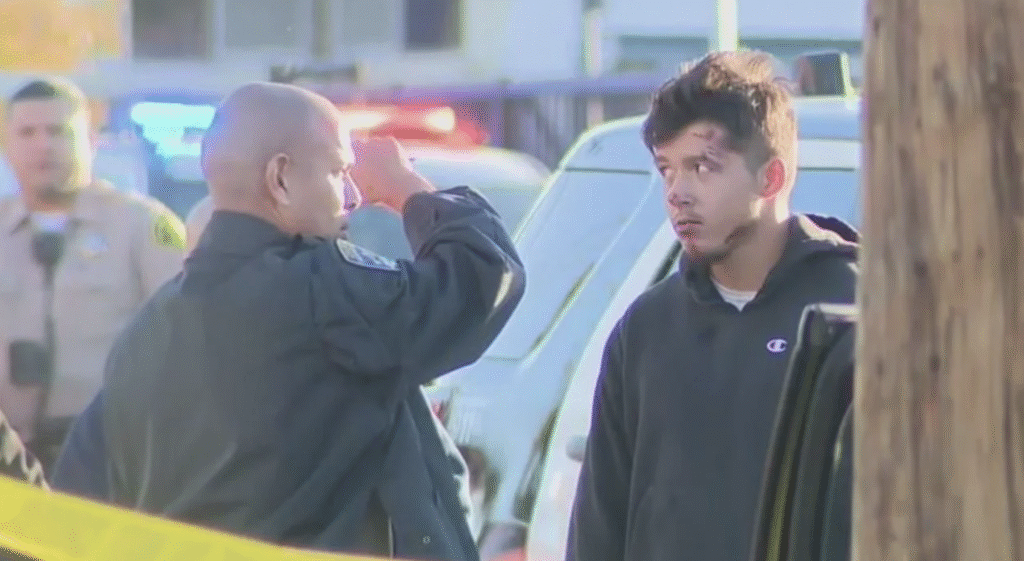
    According to sources, the victims appeared in court on November 19th only to learn that the defendant, Nicholas Joseph Gutierrez, who plowed into the formation during a morning training run in Whittier, may walk away with nothing more than probation or a 30-day “tap-and-go” jail stint.

    Nicholas Joseph Gutierrez at the crash scene on November 16th, 2022

    Meanwhile, the families of Class 464 continue to bury the trauma of the most preventable mass-casualty event in recent LASD history.

    Originally charged under DA George Gascon, this case continues to drag on with stunning leniency, and the families have been pushed into the background, unheard, unseen, and deliberately sidelined.

    The November 19th update represents the clearest signal yet that LA County is preparing to quietly dispose of a case by shrinking it down until it’s barely recognizable.

    Families say the court laid out the defense’s three options.

    Option one: a DA-offered deal with zero jail time, just probation and the threat of eight years if Gutierrez violates the law in the future.

    Option two: a weak court-offered deal of 30 days in jail, a sentence that doesn’t come close to matching the shattered bodies, the months of rehabilitation, or the loss of Recruit Martinez.

    Option three: go to trial, an outcome no one believes the county will risk because a courtroom would force inconvenient truths into the public record.

    The next hearing is set for January 29. But victims and their families already fear the writing is on the wall: LA County wants this gone.

    At the time of the crash, recruits reported the SUV actually accelerated before impact. Multiple witnesses said Gutierrez never even tapped the brakes. LASD leadership initially declared the crash “deliberate,” only to reverse course abruptly. Behind the scenes, sources say Gutierrez’s family connections helped smother the investigation, steering it toward a conveniently vague “medical episode”, a diagnosis never fully explained but quickly embraced because it was the least politically explosive story to sell.

    Yet none of that explains how the largest sheriff’s department in the country allowed a training run on a route so dangerously exposed that one wrong move could wipe out half a graduating class.

    And none of it explains why, two years later, the families are being forced to accept plea offers that cheapen the life of a dead recruit and the suffering of dozens more.

    Class 464 deserves justice, not the silent, bureaucratic grave the County dug to keep this scandal buried forever.

  • The Cartel Exposed: How LA County’s Power Brokers Weaponized Straw Donors, Bought Supervisors, and Took Aim at the Only Sheriff Who Wouldn’t Bow to Them

    The Cartel Exposed: How LA County’s Power Brokers Weaponized Straw Donors, Bought Supervisors, and Took Aim at the Only Sheriff Who Wouldn’t Bow to Them

    The façade finally cracks under the weight of its own lies. New Ethics Commission filings confirm what insiders have known for years: Los Angeles County is not governed by its elected Supervisors. It is governed by an unelected legal syndicate operating from polished Century City conference rooms, attorneys who litigate the county’s scandals by day, launder political influence by night, and move millions in taxpayer dollars like their own personal bankroll. Their most valuable asset isn’t expertise. It’s impunity.

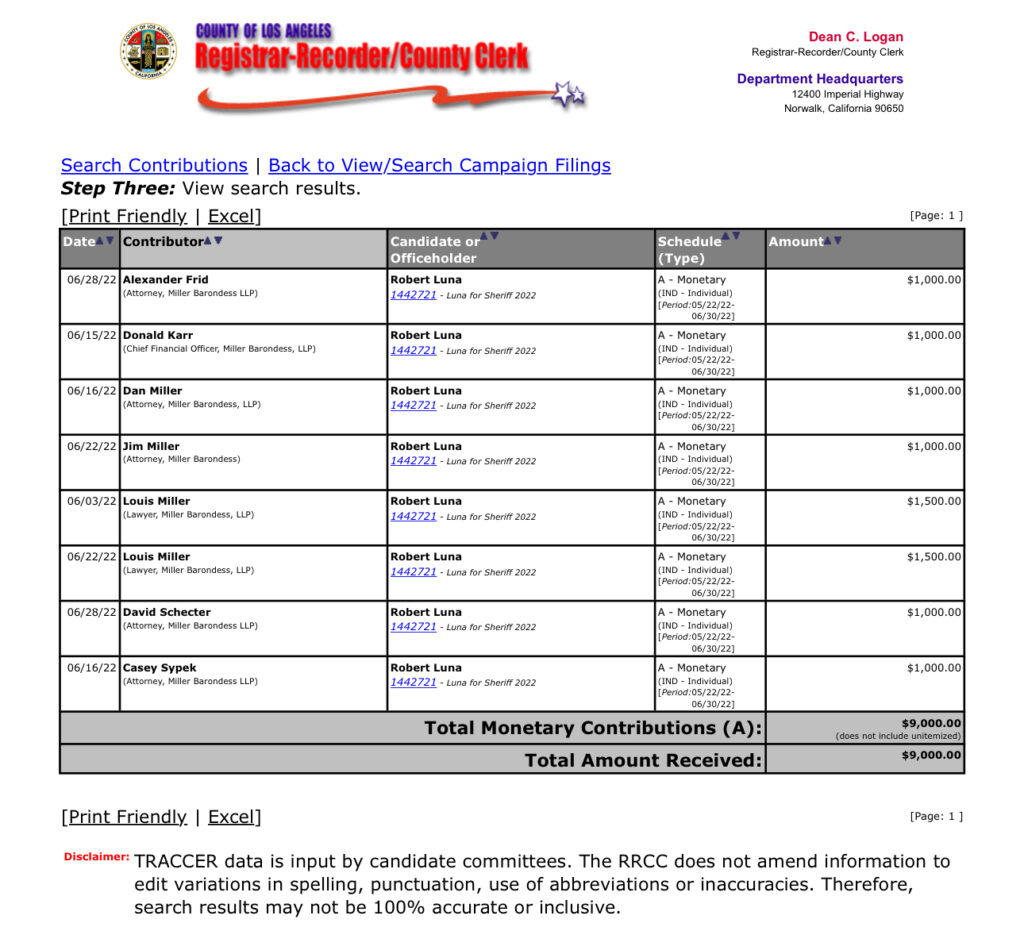
    At the center of this orbit stands Louis “Skip” Miller, the Miller Barondess power broker whose firm has consumed tens of millions in taxpayer dollars since 2020. The latest filings don’t reveal clerical errors or sloppy disclosures. They potentially expose a fully engineered straw-donor pipeline, a corporate-shell conveyor belt meticulously fashioned to fortify the most compromised political actors in LA County and suffocate anyone who threatens the machine’s ability to self-preserve.

    And sitting at the top of that enemies list is former Sheriff Alex Villanueva, the one official who refused to be managed, bought, or intimidated.

    What these filings make crystal clear is that the real power in LA County has never lived under the dome of the Hall of Administration. It lives in the briefcases of the attorneys who quietly decide which scandals receive sunlight, which political careers receive oxygen, and which inconvenient watchdogs are crushed.

    Miller Barondess perfected a model that merges public litigation with private political engineering. They defend the county’s elite from their own mismanagement, then pour disguised contributions into campaigns to ensure the same politicians keep signing their contracts. They represent feuding bureaucrats, shield the Board from internal accountability probes, and, when necessary, undermine law enforcement leaders who get too close to the truth. It is not governance. It is the county’s most lucrative protection racket.

    The “Skip” donor universe,  an explosion of seemingly phantom entities with identical addresses and suspiciously identical timing, is the clearest evidence of potential “political engineering” yet. What appears to be fabricated facades dumped more than $25,000 into the campaigns of Holly Mitchell, Lindsey Horvath, and Chris Holden. On the surface, none behave like real corporate PACs, or show transparent authorization. All trace back to Miller Barondess. What appears on paper to be simple “support”, with the “Skip” donor acting as an intermediary, could be a potential violation mill: undisclosed true-source money, conduit donations masked as corporate contributions, and potential felony laundering hidden behind corporate names that may never have approved a single check. If even one corporation disavows a contribution, the entire operation collapses into criminal impersonation and money laundering.


    Nowhere is the scheme more brazen than in the finances surrounding Chris Holden. According to our sources in late 2023, Holden’s old Assembly committee quietly paid Miller Barondess for vague “consulting”, a payment that conveniently aligned with a sudden surge of “Skip” donations flowing straight into Holden’s Supervisor campaign. Money leaves Holden’s account through the side door, reappears moments later disguised as fresh support from corporate shells, and all of it circulates through the same law firm responsible for defending the county against scrutiny. This is not consulting. This is a round-trip wash designed to evade disclosure requirements, contribution limits, and surplus-fund restrictions. If the FPPC subpoenas the invoices, and that is now non-negotiable, the financial choreography becomes impossible to explain away.

    But the most staggering element of this machine is not the money. It is the audacity.

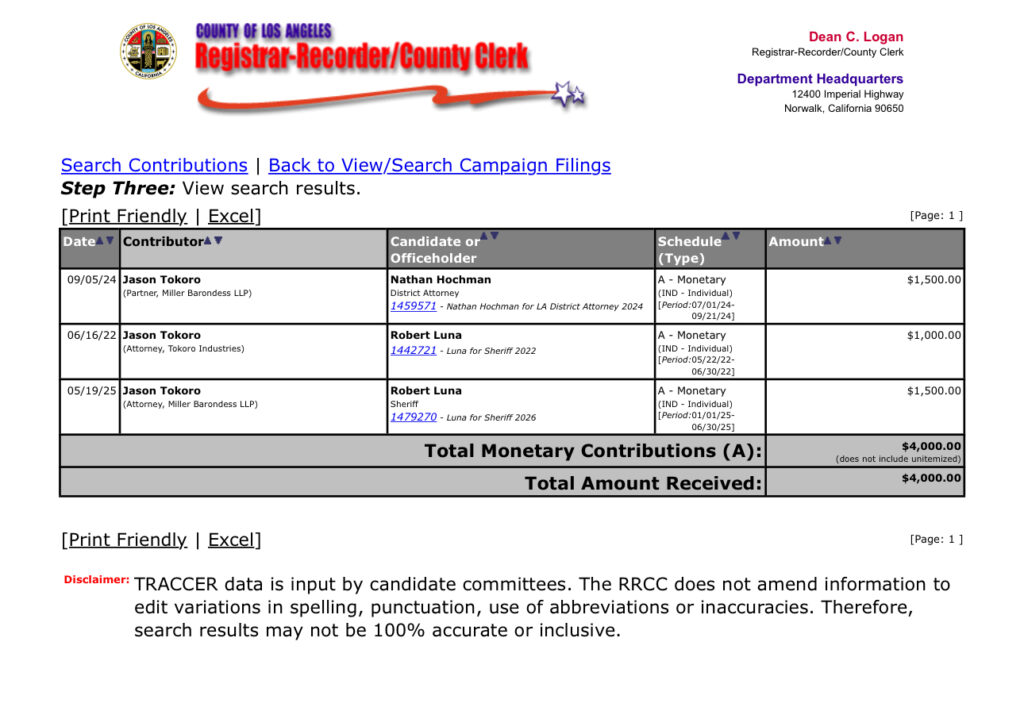
    While Miller Barondess was billing taxpayers to defend the Sheriff’s Department in the Vanessa Bryant wrongful-death case, a defense that ballooned into almost $50 million in settlements and fees, the firm was simultaneously bankrolling Sheriff Robert Luna’s campaign to unseat Alex Villanueva. Miller Barondess litigated on behalf of Villanueva’s department during business hours, then quietly funded his political removal after dark.

    And while the “Skip” donor operation exposes the financial machinery propping up Los Angeles County’s political elite, Sheriff Luna’s own orbit reveals an equally troubling overlap. His daughter is employed by Miller Barondess, the very firm orchestrating legal and political cover for her father while simultaneously holding multimillion-dollar contracts with the County. That dual allegiance isn’t just uncomfortable optics; it’s a built-in conflict of interest that blurs the line between personal loyalty and public accountability.


    The same pattern emerges in the Maya Lau lawsuit. Villanueva did not target a journalist for her reporting. He followed evidence that sensitive personnel files had been obtained through improper channels and referred the matter, appropriately, to the Attorney General. The AG declined prosecution. That should have been the end of it. But the syndicate saw an opportunity. Miller Barondess swooped in, not just to defend the county, but to wield the case as a political tool against the sheriff who dared investigate their donors and clients. This is textbook conflict of interest: a law firm that donates to the Supervisors who approve its contracts, defends the county against lawsuits involving its political allies, and undermines the law enforcement leader who threatens its revenue stream. The fox isn’t guarding the henhouse. The fox is billing the hens.

    When Villanueva’s Public Corruption Unit began cracking open the Board’s ethical vulnerabilities, the retaliation was swift and carried out through checkbooks, not subpoenas. Sachi Hamai walked away with a $1.5 million golden parachute and lifetime security. Fesia Davenport exited with a $2 million “reputational harm” package. Both payouts engineered quietly. Both shepherded through the same political channels Miller’s influence protects. Both insulated from voter outrage by a Board that long ago learned there is no price too high for silence.

    All of this, the phantom donors, the money laundering, the golden parachutes, the political sabotage funded by taxpayer defense contracts, leads back to one undeniable truth:Alex Villanueva wasn’t removed because he was corrupt. He was removed because he refused to be corruptible. He exposed the revolving-door ecosystem that keeps the same insiders paid, protected, and immune. The syndicate responded the only way it knows how, by buying an outcome, installing a compliant replacement, and burying the evidence under layers of legal invoices.

    What happens next is not a matter of politics. It is a matter of forensic accounting and prosecutorial will. Every “Skip” donor must be audited. Every invoice between Holden and Miller Barondess must be subpoenaed. Every corporate PAC allegedly represented by these shells must be contacted. And every golden parachute must be re-examined for impropriety.

    Villanueva followed the evidence. The Board buried it. Now the evidence is resurfacing on its own, and the machine can no longer control the narrative.