Month: October 2025

  • Murderers in Malibu: L.A. County Turns Camp Kilpatrick into a Prison for Violent Offenders

    Murderers in Malibu: L.A. County Turns Camp Kilpatrick into a Prison for Violent Offenders

    Los Angeles County is quietly advancing a plan that could turn Malibu’s once-celebrated Campus Kilpatrick, built as a sports-based rehabilitation camp for at-risk youth, into a Secure Youth Treatment Facility intended to house the county’s most violent juvenile offenders – and by violent, I mean stone cold murderers.

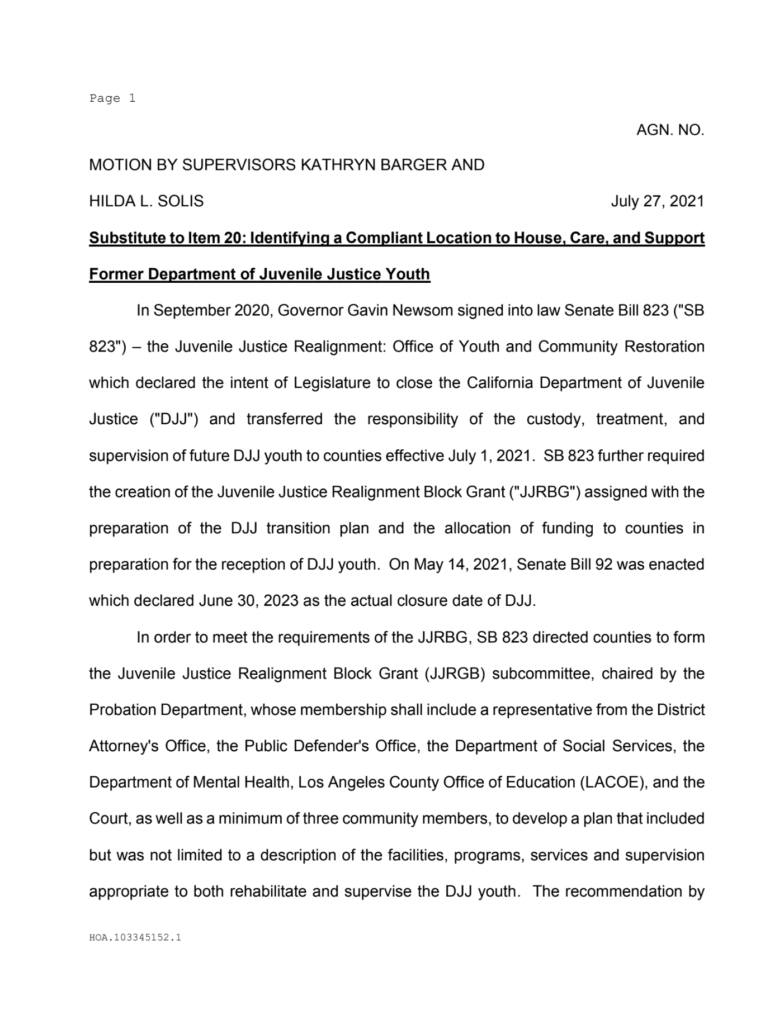
    This shift traces directly back to a 2021 Board of Supervisors motion authored by Kathryn Barger and Hilda Solis. The motion, titled “Identifying a Compliant Location to House, Care, and Support Former Department of Juvenile Justice Youth,” was introduced on July 27, 2021, as part of the county’s compliance with Senate Bill 823, Governor Gavin Newsom’s so-called “Juvenile Justice Realignment” plan. SB 823 was meant to close the state’s Department of Juvenile Justice and transfer the responsibility of housing and supervising serious youth offenders to local counties. On paper, the law promised reform, rehabilitation, and community-based reintegration. In reality, it opened the door for counties to quietly reclassify facilities and sidestep the very accountability measures the law was designed to enforce.

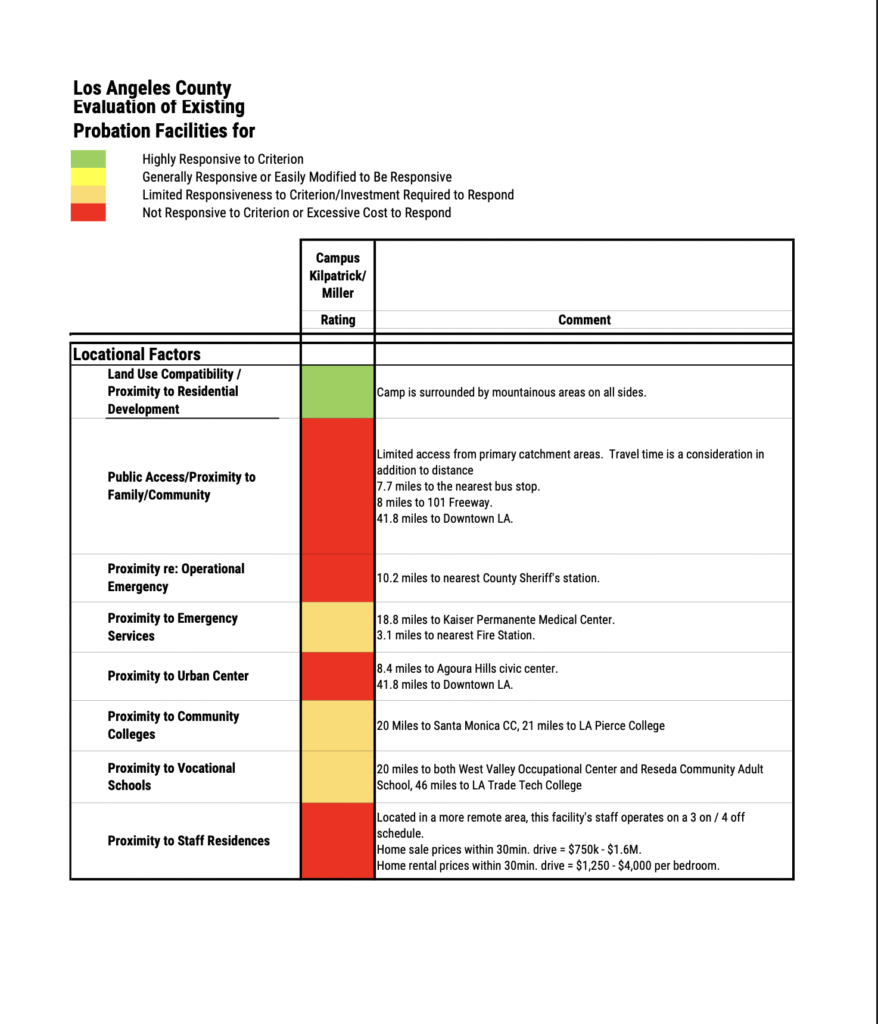
    In Los Angeles County, that translated into the Probation Department’s unilateral power to transform Malibu’s open-air sports camp into a locked compound for high-risk offenders. But internal county documents reveal that Kilpatrick fails nearly every suitability test for this purpose. Page D49 of the Probation Department’s evaluation is littered with red flags – literally – marking the site unsafe, impractical, and prohibitively expensive to retrofit. The report cites serious deficiencies in emergency response, staffing, and access.
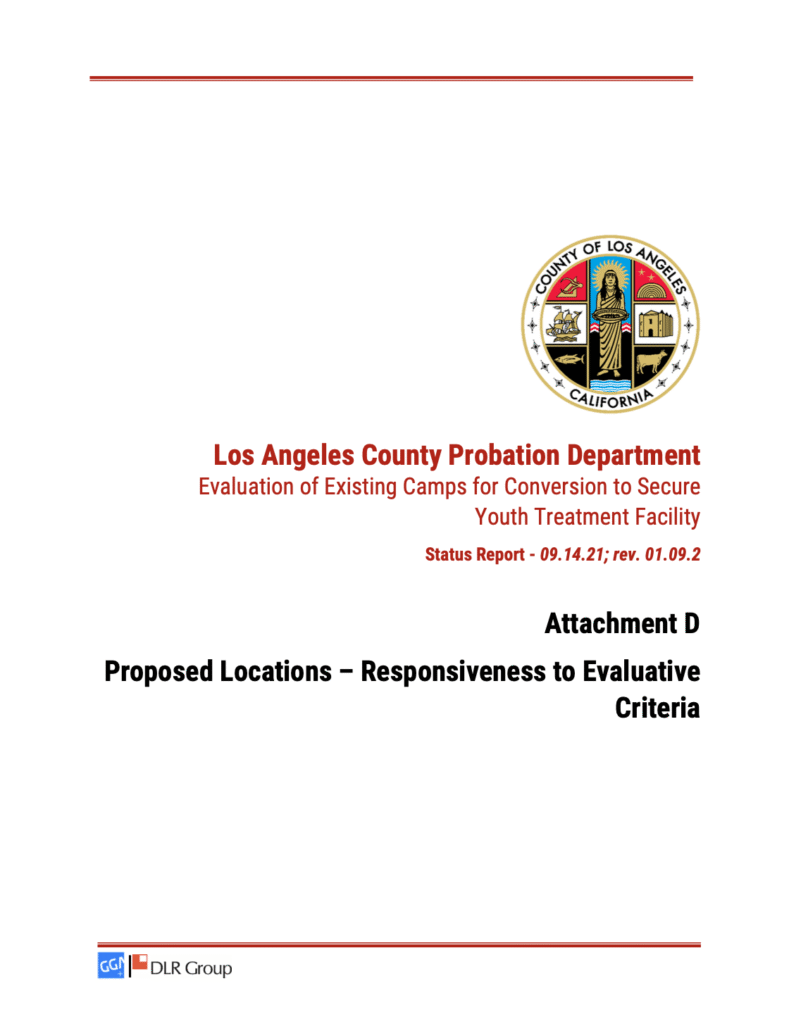
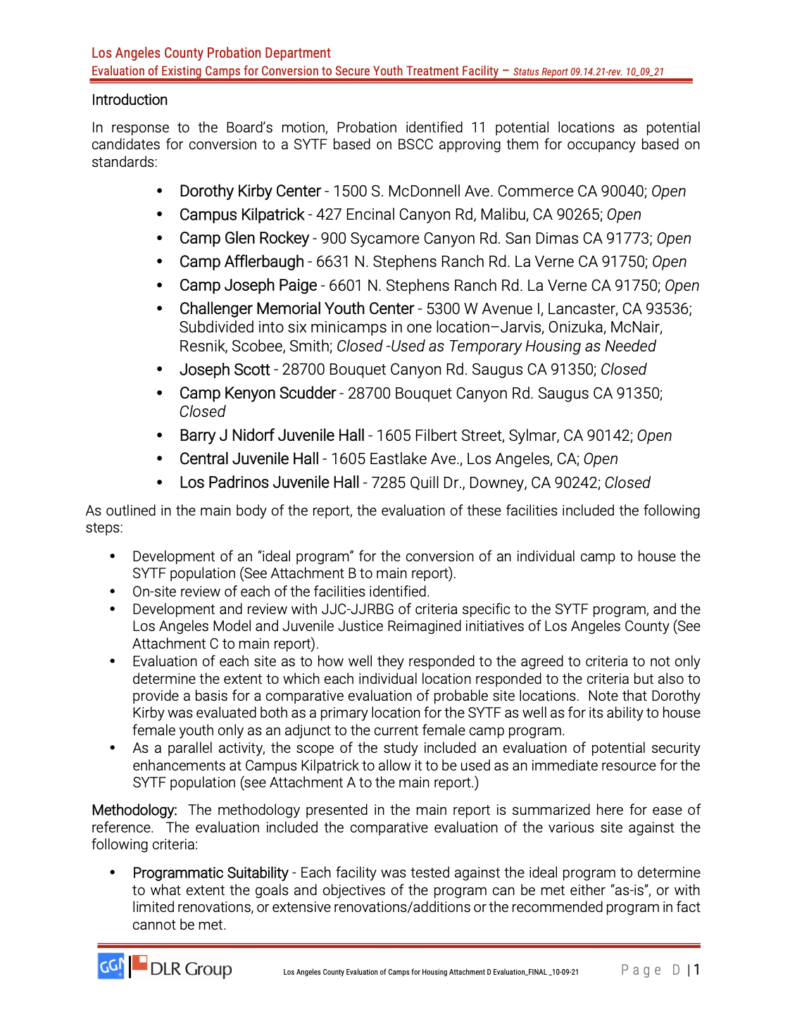
     

    The County’s own report even states that emergency help is too far away from Kilpatrick to ensure safety. That risk isn’t theoretical, it’s been proven. When incarcerated youth were transferred to Los Padrinos, chaos erupted almost immediately. Youth escaped, fights broke out, and the Probation Department was forced to call in Downey and South Gate police, along with Lakewood Sheriff’s deputies, to regain control. Malibu offers no such backup. The area is geographically isolated, with the nearest Sheriff’s station ten miles away and no city police department to assist. The Malibu/Lost Hills Sheriff’s Station is already chronically understaffed and simply not equipped to mount a large-scale emergency response in a violent disturbance or mass escape scenario.

    The camp’s location compounds the danger. The nearest bus stop is nearly eight miles away. The closest freeway is another eight. The nearest hospital is nineteen miles out, and Downtown Los Angeles is more than forty miles from the facility. In an emergency, whether fire, medical, or security, help won’t arrive quickly, if at all. That isolation also creates chronic staffing problems. The County’s own analysis acknowledges that the distance from affordable housing makes recruitment nearly impossible, forcing staff into an unsustainable “three on, four off” rotation.

    And while the Board of Supervisors constantly preaches about keeping detained youth close to their families to maintain community ties, the Kilpatrick plan makes a mockery of that ideal. None of the youth slated for Kilpatrick live in or anywhere near Malibu. This is pure virtue signaling, political optics over practical reform. The Supervisors can tout family access and rehabilitation in press conferences, but sending these youth to a remote canyon in the Santa Monica Mountains ensures the opposite.

    Kilpatrick’s design flaws only make matters worse. The facility lacks sufficient staff quarters to maintain safe staffing ratios after hours. In a scramble to compensate, the Department is now exploring the purchase of temporary trailers to place on the grounds of the former Camp Miller, allowing staff to sleep nearby. Even so, those trailers are miles from Kilpatrick, leaving staff unable to respond quickly in a crisis. The entire arrangement underscores just how ill-conceived and dangerous this plan really is.

    Kilpatrick was built as a model for youth rehabilitation, a sports-focused, therapeutic environment designed to heal, not harden. The campus features open fields, classrooms, and shared spaces meant to promote teamwork and emotional growth. Turning that environment into a high-security detention center is like trying to convert a Little League park into a maximum-security prison. There is no indication that the Sheriff’s Department has conducted a comprehensive security audit, nor any evidence of updated fire evacuation or escape protocols. In a region repeatedly devastated by wildfires, that omission borders on criminal negligence.

    The July 27, 2021 motion by Barger and Solis framed the realignment as an opportunity for “community-based transformation,” yet it effectively authorized the creation of a remote, underprepared lockdown facility in one of the most fire-prone, inaccessible areas of Los Angeles County. It was bureaucratic sleight of hand — a political maneuver cloaked in reformist language that now endangers staff, youth, and the Malibu community.
    This is not rehabilitation. It’s negligence wrapped in bureaucracy. Kilpatrick was designed to inspire change, not to contain chaos. Converting it into a secure treatment facility for violent offenders isn’t progress, it’s a catastrophic misstep that ignores every warning from experts, staff, and common sense.

    A Pattern of Concealment

    The Kilpatrick conversion is not an isolated failure. It’s part of a larger, deeply entrenched pattern within the Los Angeles County Probation Department, a department long plagued by scandal, cover-ups, and federal scrutiny. Similar reclassification efforts have occurred quietly at Central Juvenile Hall and Barry J. Nidorf, where the county continued to warehouse high-risk youth in facilities repeatedly cited for inhumane conditions, staff abuse, and safety violations.

    In 2023, the California Board of State and Community Corrections deemed both facilities “unsuitable for confinement,” forcing the County to temporarily relocate youth populations while publicly downplaying the crisis. Behind closed doors, however, the same officials were already planning to rebrand Kilpatrick as a “model secure facility”, despite internal reports warning it could never safely serve that purpose.

    Each move follows the same playbook: rebrand, rename, and repackage existing failures under the banner of “reform.” From the Department’s misleading compliance reports to the Board of Supervisors’ rubber-stamp approvals, transparency has been replaced with political theater. Public input is nonexistent, safety audits are buried, and the county continues to gamble with human lives, both the youth in its custody and the surrounding communities.

    Kilpatrick’s conversion isn’t a step forward in juvenile justice. It’s the latest chapter in Los Angeles County’s long-running cover-up of systemic dysfunction inside its probation system. Unless the Board halts the reclassification and orders a full public investigation, this will end the same way so many of L.A. County’s “reforms” have, with another tragedy no one claims to have seen coming.


  • The PREA Charade: How Los Angeles County’s “Reform” Town Hall Masks a Decade of Corruption, Cronyism, and Cover-Ups

    The PREA Charade: How Los Angeles County’s “Reform” Town Hall Masks a Decade of Corruption, Cronyism, and Cover-Ups

    In a county still reeling from revelations of pay-to-play schemes disguised as jail reform, the Los Angeles County Sheriff’s Department (LASD) is preparing to host a virtual town hall on Tuesday, November 4, to discuss compliance with the federal Prison Rape Elimination Act (PREA). The event, promoted as a “community feedback forum” to create safer reporting environments for sexual assault survivors, will run from 1:00 p.m. to 3:00 p.m. via Webex and is co-sponsored by several advocacy organizations. But critics say the initiative looks less like genuine reform and more like another public-relations maneuver to protect the same insiders who have profited from “oversight” for years.

    At the center of the coalition sits Peace Over Violence (POV), the politically connected nonprofit run by Executive Director Patti Giggans, a longtime ally of former County Supervisor Sheila Kuehl. Appointed by Kuehl in 2016 to the Sheriff Civilian Oversight Commission (COC), Giggans has since helped shape many of the County’s so-called reform narratives while her nonprofit collected millions in County contracts for violence-prevention programs. Her inclusion as a PREA town-hall partner raises familiar red flags. Giggans’ organization was a focal point of corruption probes after Kuehl’s office allegedly funneled no-bid deals to friendly nonprofits under the guise of jail reform, among them a controversial $494,000 Los Angeles Metro contract in 2020 that fell just below the competitive-bidding threshold.

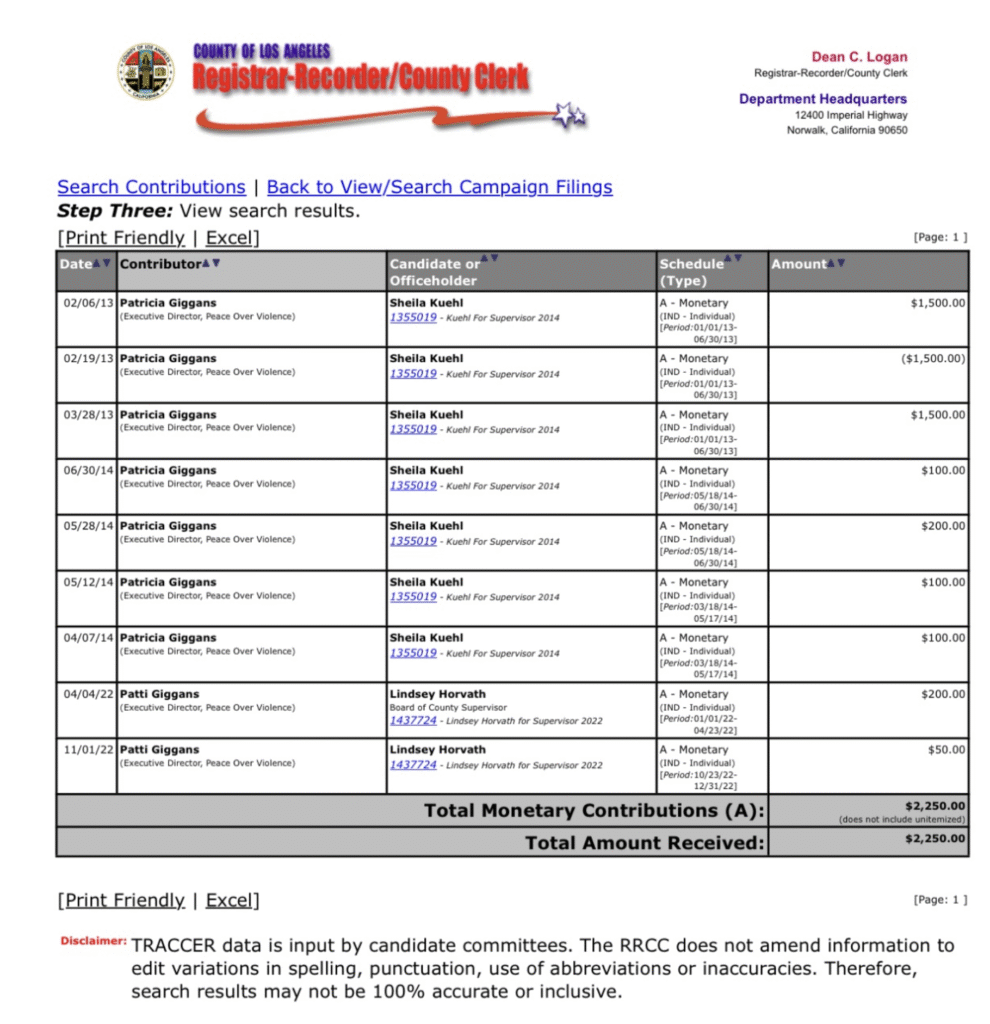
    Campaign finance records reviewed by The Current Report show a pattern of reciprocal donations between Kuehl and Giggans. Between 2013 and 2018, Giggans contributed over $2,500 to Kuehl’s campaigns, including $1,000 in 2014, during an active reform funding cycle. But notably, Giggans stopped donating to her “BFF forever,” Sheila Kuehl, after 2018, the year multiple contracts were locked in and approved, ensuring POV’s financial pipeline was secured. As one County insider put it, “She didn’t need to buy access anymore. The money was already flowing.”

    The parallels between the way Los Angeles County promoted the LA Metro sexual-harassment hotline and how it is now pushing the PREA “town hall” are striking, and deeply troubling. In both cases, officials and their nonprofit partners framed the initiatives as groundbreaking efforts to protect vulnerable populations, while quietly funneling taxpayer dollars and political capital into the same circle of insiders. Just as the Metro hotline was marketed as a lifeline for harassment victims — only for whistleblowers and Bill Melugin’s FOX 11 investigation to reveal it cost $8,000 per call and served mostly as a vehicle for no-bid contracts to Peace Over Violence, the PREA campaign is being sold as a reform milestone in creating “safe reporting environments” inside jails. Yet it features the exact same players: Patti Giggans, Sheila Kuehl’s longtime ally and beneficiary of County contracts, now re-emerging under the banner of “sexual assault prevention” with the Sheriff’s Department. Both programs lean heavily on virtue-signaling rhetoric and public-relations theater, using survivors’ stories as moral cover for a system that has repeatedly prioritized optics, funding, and political loyalty over measurable outcomes or accountability.

    Kuehl, in turn, supported allies inside law enforcement. Just months after being tipped off to a pending LASD search warrant related to her Metro dealings, a leak that allowed her to evade initial scrutiny, Kuehl donated $1,500 to then-candidate Robert Luna’s 2022 sheriff campaign. Luna defeated incumbent Alex Villanueva in what became one of the most politically charged sheriff races in County history. Since then, critics argue, Luna has shielded Kuehl’s network rather than investigated it.

    Upon taking office in December 2022, Luna’s first move was to disband the LASD Public Integrity Unit, the same unit that had been investigating the Kuehl-Giggans corruption case. Oversight commissioners denounced the move as “a puppet’s first priority,” warning it effectively dismantled internal safeguards against misconduct. Three years later, Luna’s department faces mounting accusations of PREA non-compliance and rising sexual-assault reports within jails. An April 2025 COC ad-hoc report cited chronic underreporting and failures to ensure long-term compliance. Meanwhile, statewide audits found that 37.5 percent of jail deaths between 2016 and 2025 stemmed from preventable causes, including unaddressed sexual violence.

    California Attorney General Rob Bonta’s September 2025 lawsuit against LASD for “inhumane” jail conditions underscores the department’s deepening crisis. Instead of cooperating, Luna sued the COC in March for issuing subpoenas into deputy misconduct. Behind the glossy language of “zero tolerance,” insiders describe a system where PREA violations persist because the same players responsible for systemic abuse are now rewriting the rules. Survivor advocates privately accuse Luna of “looking the other way”, not out of incompetence, but deliberate protection of what one whistleblower called “the reform-industrial complex” that enriched Kuehl, Giggans, and their allies.

    Adding to the intrigue, The Current Report recently revisited the 2022 Kuehl corruption probe, uncovering a key unresolved mystery: Why did the FBI’s Los Angeles field office, after pledging 40 agents to assist LASD’s Metro search warrants, suddenly withdraw one week before execution? Sources close to the investigation cite political interference from Sacramento, a theory bolstered by statements from agents familiar with the case. The Bureau has refused to explain its withdrawal.

    As the PREA town hall convenes next week, the public will hear speeches about compassion, safety, and transparency, many from the same voices who oversaw a decade of corruption, mismanagement, and performative reform. The real question remains: will this forum expose the rot, or polish it?

  • Betrayal Behind Bars: Sheila Kuehl’s Fall from “Reformer” to Insider in L.A. County’s Jail Corruption Scandal

    Betrayal Behind Bars: Sheila Kuehl’s Fall from “Reformer” to Insider in L.A. County’s Jail Corruption Scandal

    For years, Sheila Kuehl was celebrated as a “progressive reformer,” a feminist voice for justice and compassion in Los Angeles County government. But behind the carefully crafted image lies a darker truth – a calculated network of influence, deceit, and political payoffs that turned “reform” into a personal power play.

    Despite Kuehl’s public insistence – “I had nothing to do with the contracting process” – records tell a different story.

    Documents reveal how Kuehl’s longtime ally, Patti Giggans, and her nonprofit Peace Over Violence (POV) became a favored County partner through a no-bid contract arrangement that reeks of cronyism. What was marketed as a noble initiative under the Prison Rape Elimination Act (PREA) became, in reality, a taxpayer-funded pipeline for political favors.

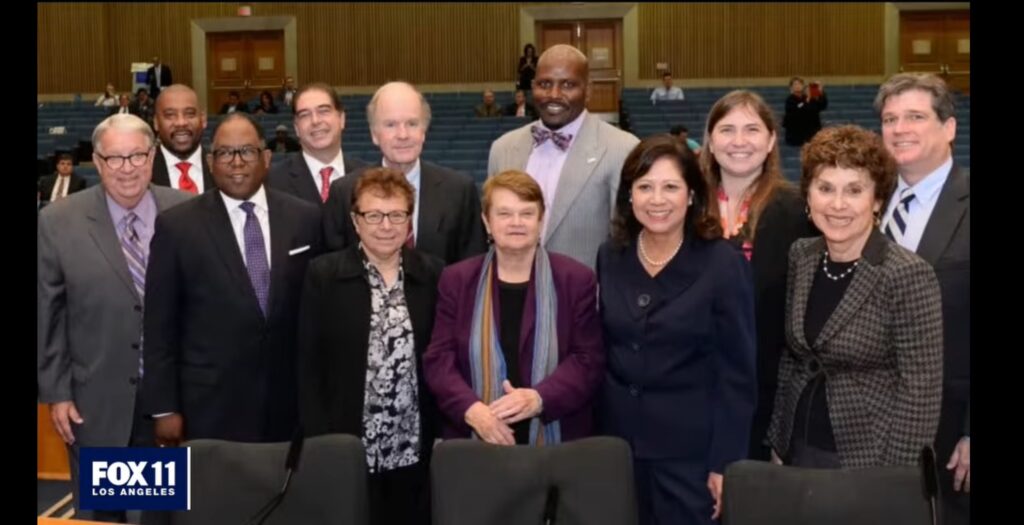
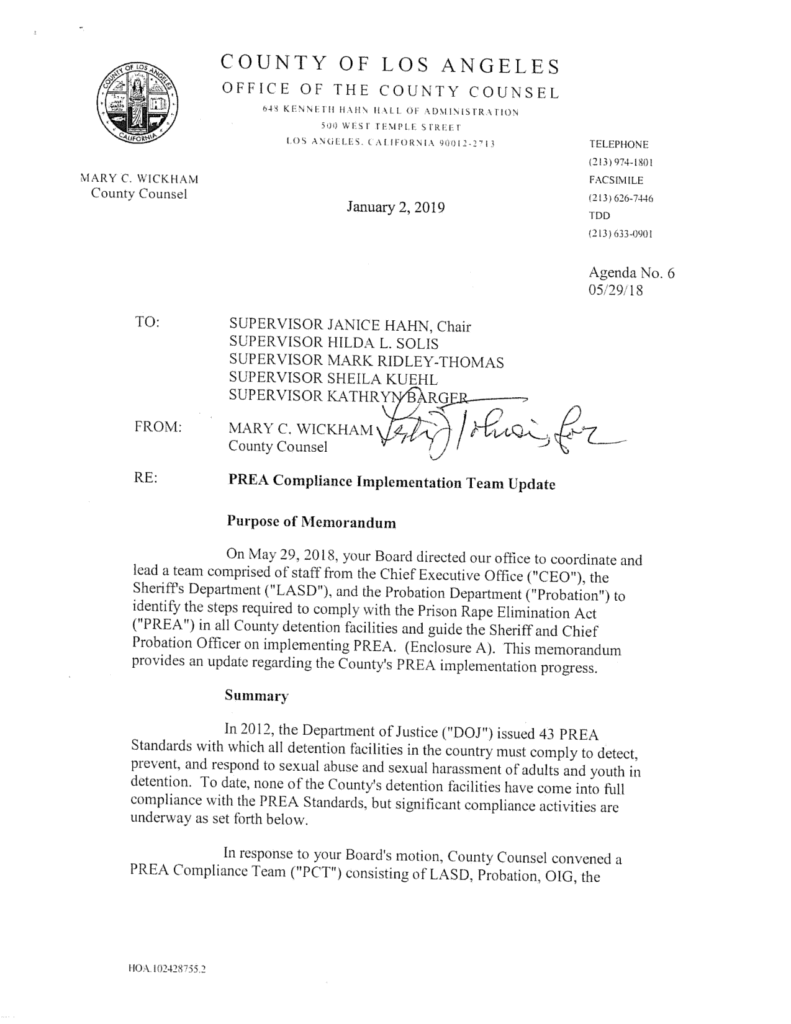
    It began quietly on May 29, 2018, inside the County’s Kenneth Hahn Hall of Administration. Under the guise of routine business, the Board of Supervisors – Kuehl, Hilda Solis, Mark Ridley-Thomas, Janice Hahn, and Kathryn Barger – approved the creation of a “PREA Compliance Implementation Team.” Framed as a safeguard for inmate welfare, the initiative evolved into a backroom operation that handed lucrative jail-reform contracts to Giggans’ organization.

    A January 2, 2019 memo from County Counsel Mary C. Wickham lays bare how Peace Over Violence was quietly inserted into the PREA framework without competitive bidding. Weekly meetings, bi-weekly briefings, and direct oversight by the Board occurred while Kuehl sat in plain view – publicly championing “women’s safety” as her close friend’s nonprofit reaped the financial rewards.

    Read the entire MOU here.

    Watch the Board of Supervisors meeting here: https://lacounty.granicus.com/player/clip/5219?view_id=&meta_id=264632&redirect=true

    The Real Victims

    While Kuehl and Giggans profited, inmates reporting rape went unanswered. Metro employees alleging harassment were routed to a voicemail black hole. Taxpayers footed the bill for a corruption racket disguised as compassion.
    This wasn’t reform. It was racketeering with a feminist face.

    Sheila Kuehl and Patti Giggans didn’t just betray public trust – they weaponized progressive ideals to build a private empire, shielded by political allies, buried reports, and a compliant media.

    In L.A. County, the only thing “behind bars” was accountability.

    A Political Web of Influence

    Follow the money and the pattern becomes unmistakable. Campaign finance records show an incestuous network of political patronage: Supervisor Holly Mitchell funnels thousands to Sydney Kamlager, just as the PREA initiative advances. Kamlager, married to Giggans’ attorney Austin Dove, rises through the political ranks with Kuehl and Mitchell’s unwavering support. The same trio later backs Attorney General Rob Bonta and his wife Mia Bonta, completing a self-reinforcing political circuit — contracts, campaigns, and favors flowing in a closed loop under the guise of “progressive reform.”

    Sydney Kamlager-Dove is the Leadership PAC sponsor approving these donations from this PAC to Supervisor Holly Mitchell.

    This insular machine didn’t just control County politics. It reached straight into Washington, D.C.

    The Washington Connection 

    As The Current Report’s investigation first revealed, the Kuehl-Giggans network extended directly to Phillip Washington, then CEO of L.A. Metro and later President Biden’s nominee to head the Federal Aviation Administration (FAA).

    Washington’s tenure at Metro was marred not only by the no-bid Peace Over Violence hotline contract, but also by a series of other serious allegations, including his role in the distribution of counterfeit N95 masks during the COVID-19 pandemic, a scheme that triggered two separate federal investigations. Sources close to those inquiries described the scandals as part of a broader pattern of mismanagement, political favoritism, and possible fraud under Washington’s leadership.

    Despite these red flags, Washington was elevated to national prominence through the same political network that shielded Kuehl and Giggans. When his FAA nomination reached the U.S. Senate, those controversies finally caught up with him.

    During the Senate confirmation hearings, Senator Ted Cruz directly confronted Washington about the criminal investigations stemming from his time at Metro, pressing him on both the Peace Over Violence contract and the fake N95 mask scandal. Washington appeared visibly unprepared to explain the mounting evidence of misconduct, and his evasive responses only deepened bipartisan concern about his fitness to lead a federal agency.

    Behind the scenes, The Current Report worked directly with D.C. watchdog organizations and Senate investigators, providing crucial documentation and evidence connecting Kuehl’s Los Angeles corruption network to Washington’s abuses at Metro. That collaboration helped inform key senators and oversight committees, ultimately contributing to Washington’s decision to withdraw his nomination before a confirmation vote could be held.

    His downfall marked a turning point, proof that what began as a local corruption scandal had metastasized into a federal accountability crisis, exposing how deeply entrenched the culture of protectionism had become inside Los Angeles County’s power structure.

    The Raids and the Tip-Off

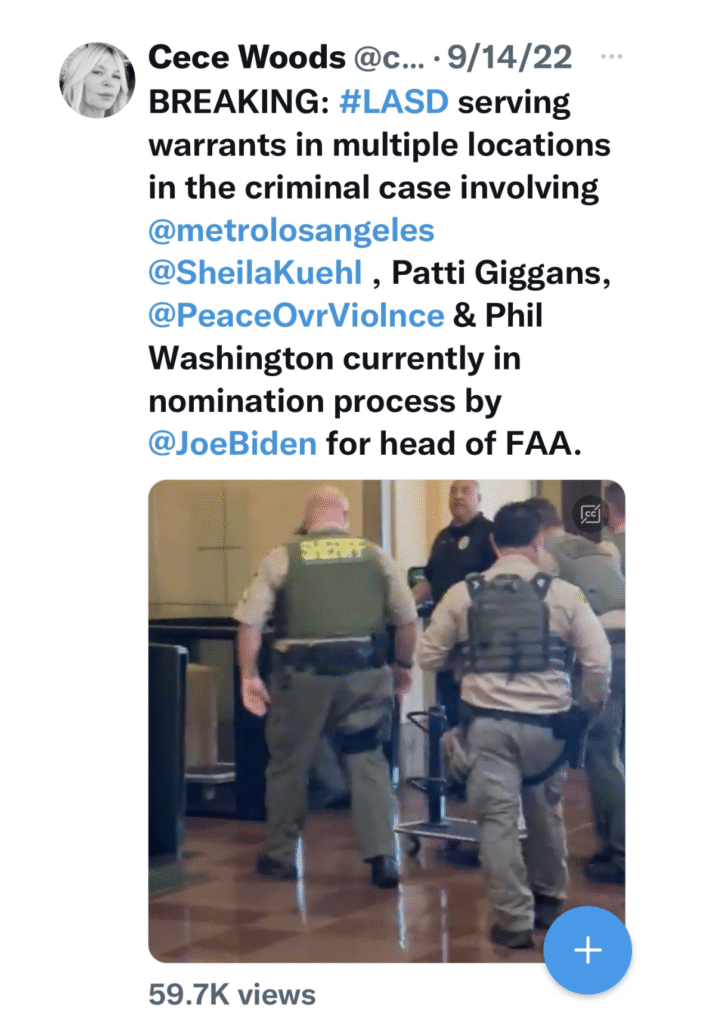
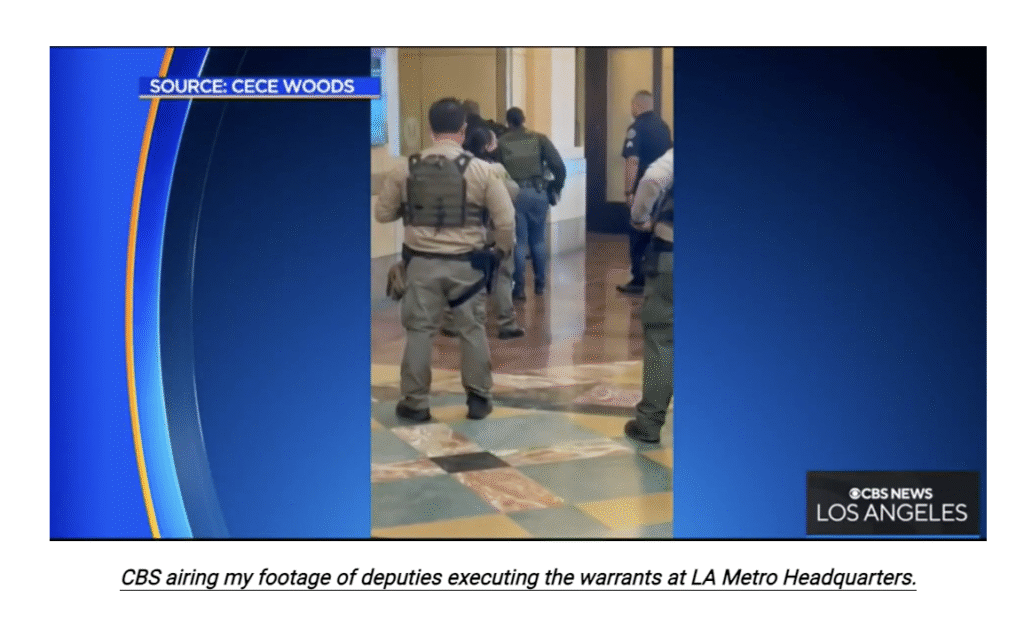
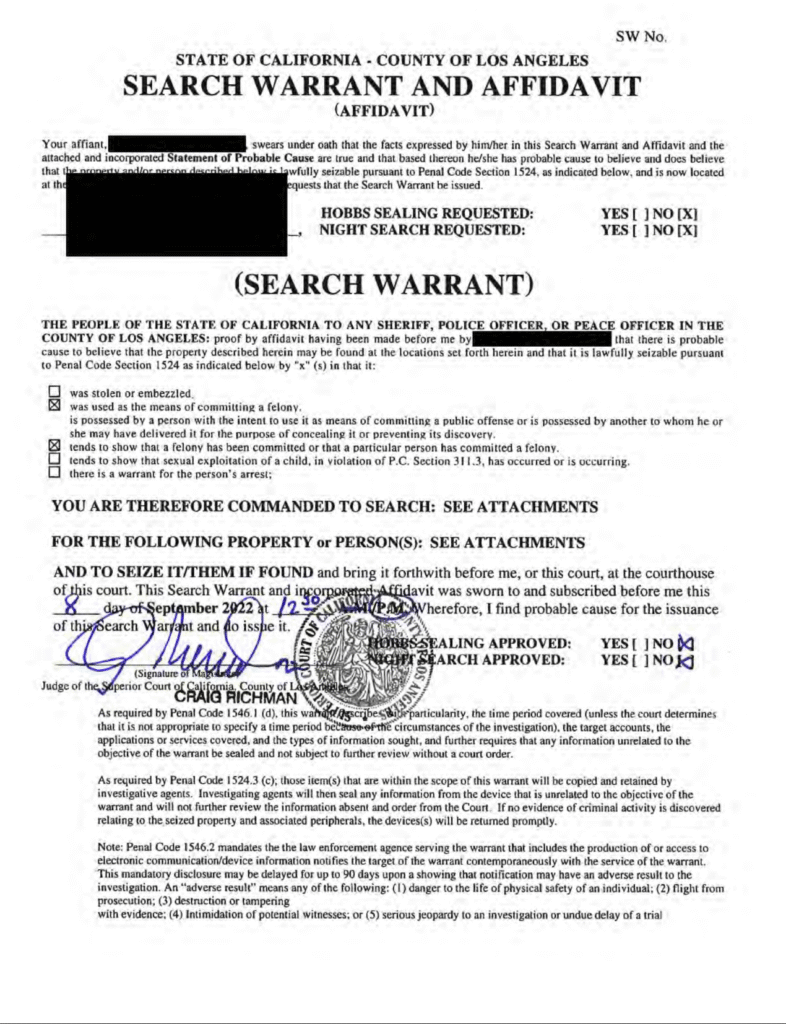
    On September 8, 2022, Judge Craig Richman authorized a series of search warrants targeting Metro headquarters, Peace Over Violence’s Wilshire Boulevard offices, and the County Inspector General’s division. Investigators cited probable cause for misappropriation of public funds, alleging that Kuehl had steered a no-bid Metro hotline contract to her friend Giggans.

    When deputies arrived at Kuehl’s home six days later, she stunned reporters by admitting that the Los Angeles Times had tipped her off ahead of the raid, an extraordinary breach suggesting collusion between political insiders and media allies.

    According to sources, federal involvement was derailed by political interference. The FBI had committed 40 agents to assist the Los Angeles County Sheriff’s Department with the Metro search warrants but abruptly withdrew a week before the operation. Investigators say the supervising agent admitted the decision was made “for political reasons.”

    Read the entire Search Warrant here.


    Among the items seized were the following:

    • 40,000+ pages of seized documents
    • Sworn affidavits from Metro whistleblowers
    • Bank records showing POV funds used for political galas, private travel, and Giggans’ home renovations
    Kuehl retired in 2022 with a $300,000+ pension. Giggans’ POV still holds $4.8 million in active county contracts.

    Despite mounting evidence, Peace Over Violence continued receiving County money under PREA contracts, providing “rape crisis counseling” services that bypassed normal oversight. The irony was brutal: a program meant to protect victims instead exploited them to advance a political agenda

    The DOJ’s Quiet Retreat

    New claims from law enforcement sources suggest the California Department of Justice possessed key information about a second no-bid contract that could have bolstered the public corruption probe, yet did nothing.

    Multiple veteran law enforcement officials familiar with the investigation say the DOJ’s handling of the case raised serious questions about procedural integrity. The Department allegedly convened a secret grand jury but failed to summon the lead investigator, whose testimony was described as crucial to securing an indictment. Instead, the grand jury reportedly heard only from individuals aligned with Kuehl and Giggans — a decision one insider called “a boondoggle” that led a judge to quash the LASD’s search warrants.

    The unprecedented move invalidated all evidence seized during the raids — including materials from Kuehl’s and Giggans’ homes and offices.

    In August 2024, the DOJ quietly closed the case without filing charges, citing “insufficient evidence,” and agreed to quash the warrants as part of a court-approved settlement. DOJ representatives declined to comment on the allegations, referring instead to their statement that the review was “thorough and independent.”

    Kuehl and Giggans continue to deny wrongdoing, dismissing the investigation as politically motivated.

    A System Protecting Itself

    Former Sheriff Alex Villanueva, now running for re-election, says what happened was no accident.

    “The lengths the Board of Supervisors went to in order to obstruct and discredit our legitimate investigation of public corruption reveals how hopelessly compromised they are with the shadowy world of non-profits,” Villanueva said. “AG Bonta buried the investigation at the behest of the Board, falsely claiming there was ‘insufficient’ evidence.”

    The pattern is unmistakable: insiders protect insiders, evidence disappears, and the justice system bends to shield those at the top.

    Three years later, no one has been held accountable. Kuehl remains defiant in retirement, Giggans continues to operate Peace Over Violence with County funding, and Phillip Washington has faded from public view. But the paper trail — of contracts, campaign donations, and insider favors — tells a damning story of power abused and justice denied.

    In Los Angeles County’s justice system, the inmates weren’t the only ones behind bars – integrity was, too.

    And Sheila Kuehl, far from the reformer she pretended to be, helped lock the door.

  • The Retaliation of Officer Devon Wenger: Inside Antioch PD’s Cross-Agency Cover-Up – The “Good Ole Boy Club” Part 2

    The Retaliation of Officer Devon Wenger: Inside Antioch PD’s Cross-Agency Cover-Up – The “Good Ole Boy Club” Part 2

    Editor’s note: Read Part 1 here.
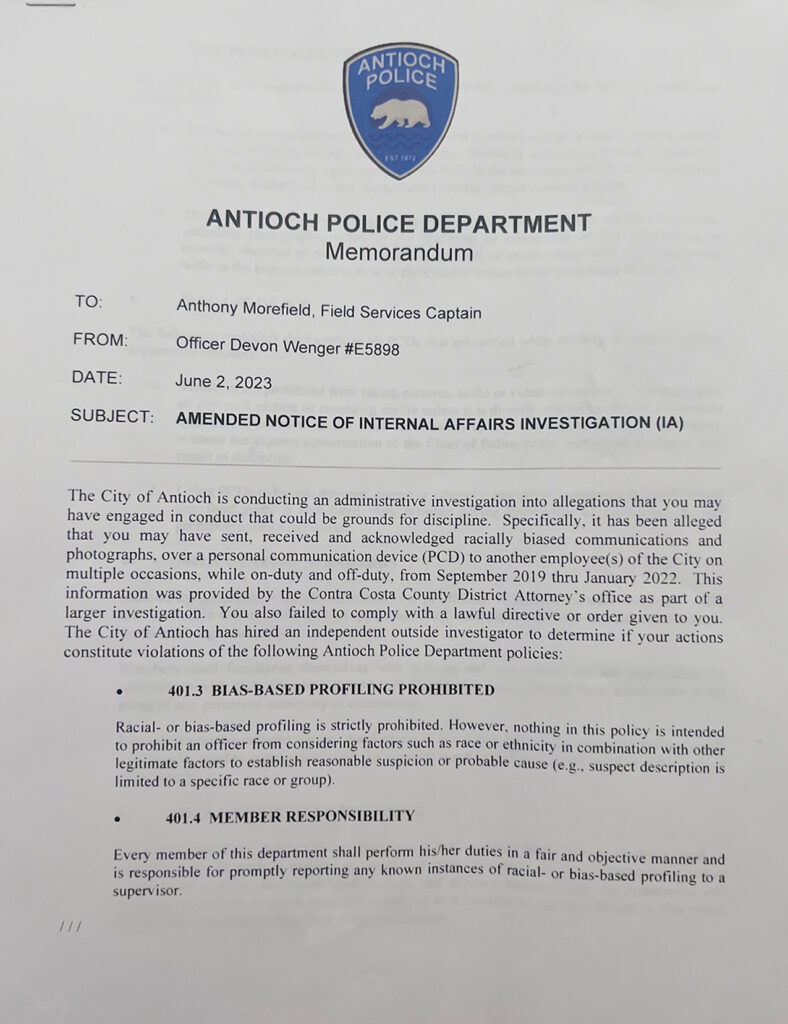
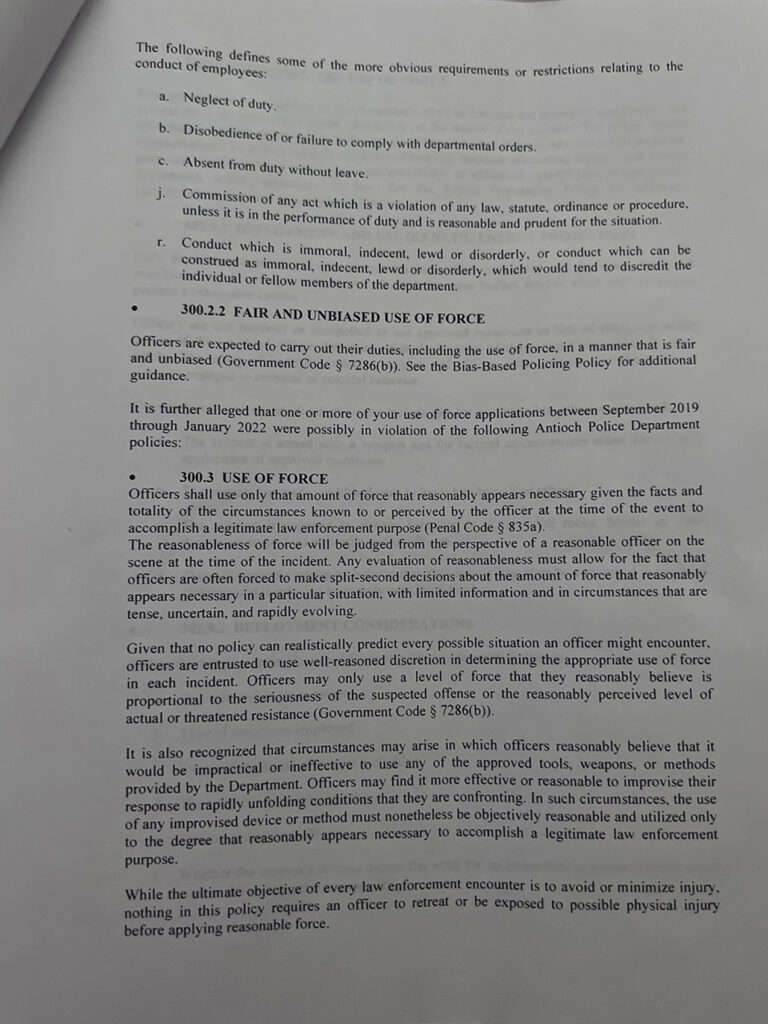
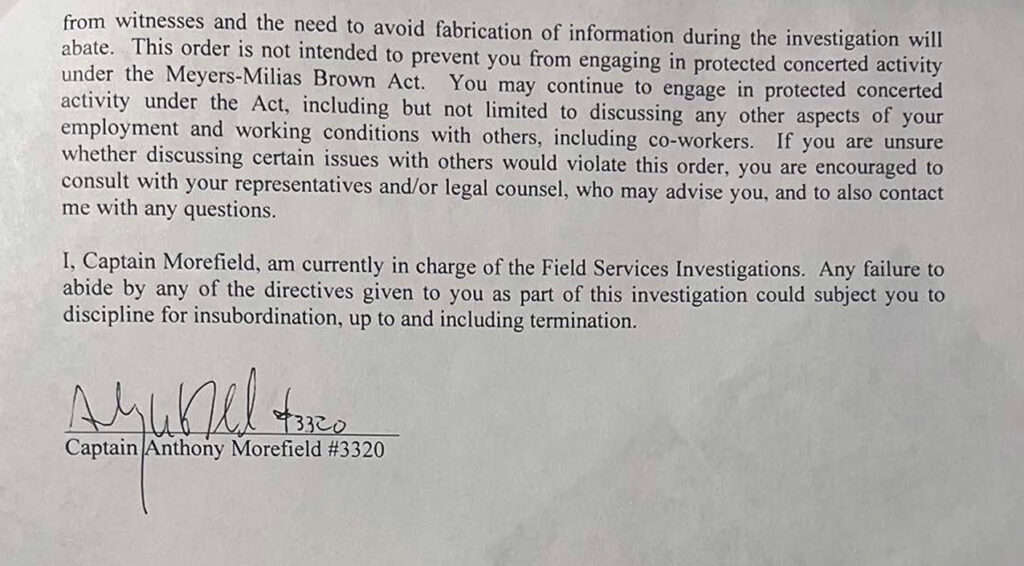
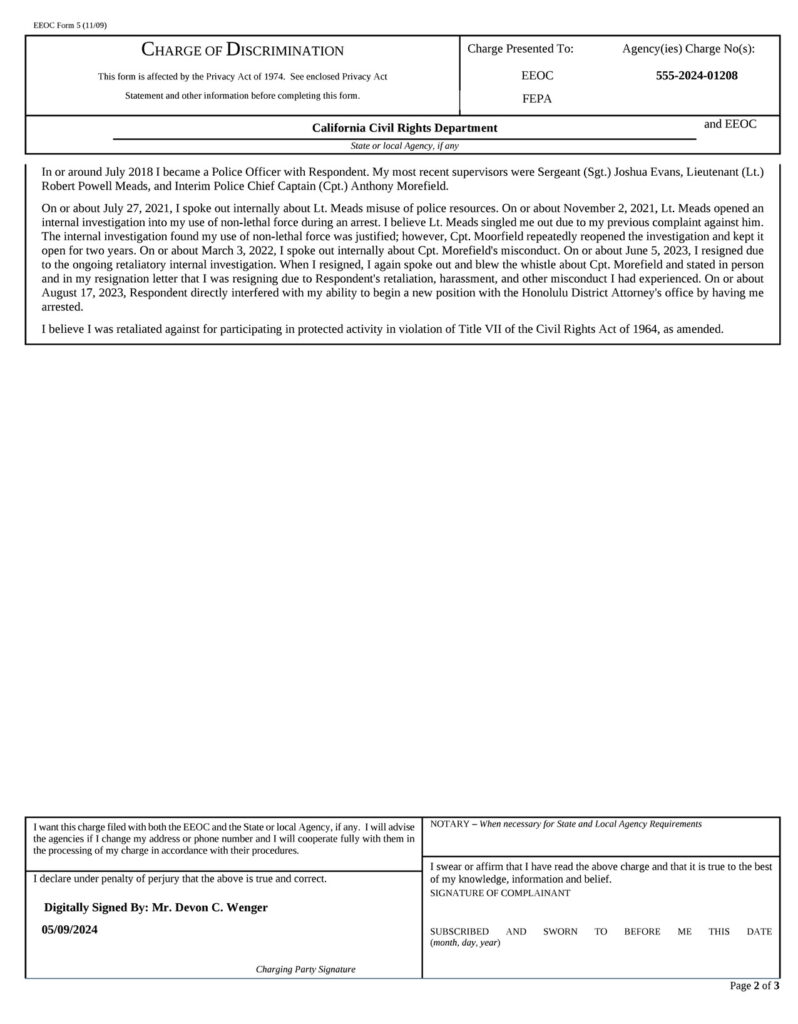
    On June 5, 2023, Antioch Police Captain Tony Morefield delivered the final blow in what had become a relentless campaign to silence Officer Devon Wenger. The pretext was familiar: a new Internal Affairs complaint accusing Wenger of “unnecessary use of force,” “racist texts,” and “insubordination”. No “Officer’s Rights and Obligations” Internal Affairs Investigation was ever issued to inform him that he was under investigation – a direct violation of California Government Code §§ 3300–3311 and the Peace Officers’ Bill of Rights (POBAR).

    The evidence? Illegally seized cellphone data, obtained without a warrant, consent, or judicial review, and funneled through the Contra Costa District Attorney’s Office in direct violation of the California Electronic Communications Privacy Act (CalECPA), the Peace Officers Bill of Rights (POBAR §3303), Labor Code §1102.5, and the Fourth Amendment. Captain Tony Morefield, desperate to discredit Officer Devon Wenger and protect Lt. Robert Meads from serious CLETS database misuse allegations that Wenger had originally exposed, weaponized this tainted evidence. The conflict of interest was glaring: Morefield not only led the investigation, he decided its outcome.

     “I have never sent racist texts or been part of those groups,” Wenger stated. “In fact, I reported Romobugh’s racist rants in 2021 and APD leadership did nothing until Wallace’s report.”

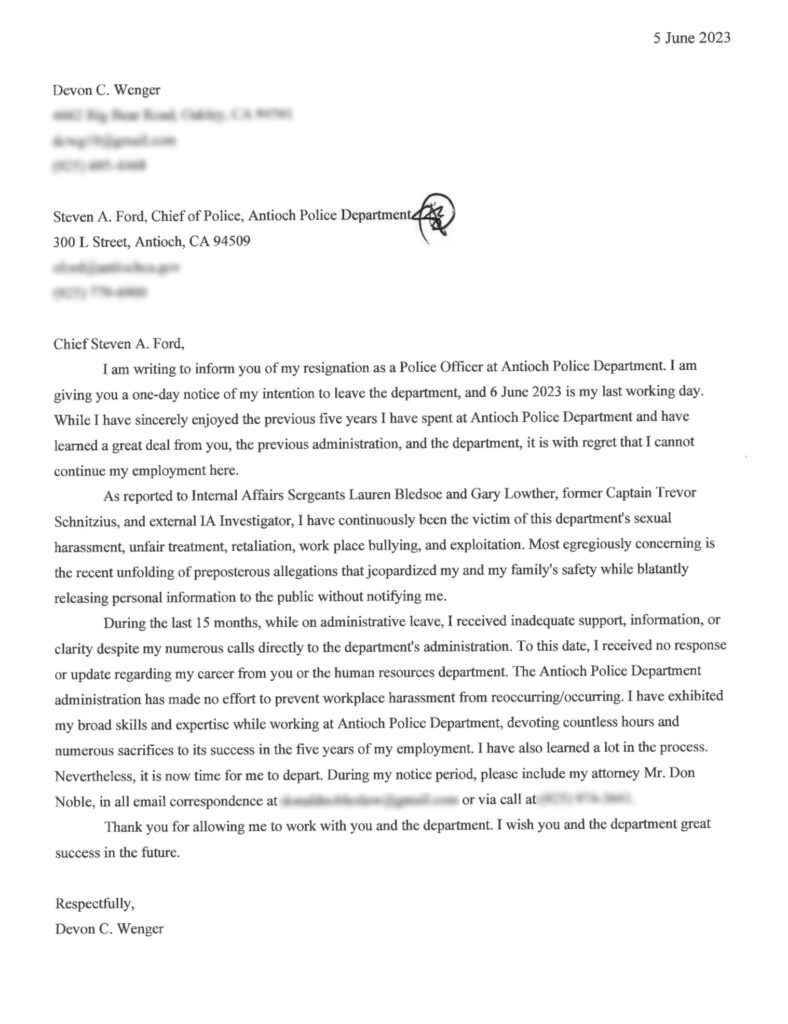
    Morefield’s ultimatum was clear: sign and admit a lie, or be fired for insubordination. Wenger refused. Facing an intolerable, retaliatory environment, he resigned, a textbook case of constructive discharge. His resignation letter, witnessed by HR Director Ana Cortez, Chief Steve Ford, and attorney Don Noble, documented months of harassment that city officials ignored. By forcing Officer Wenger into a coerced resignation amid sustained retaliation and by failing to initiate any internal or POST-mandated investigation, City of Antioch and APD officials committed actionable violations of state employment law, POBAR, federal civil-rights statutes, and constitutional due process. The omission to refer the matter to POST constitutes both a procedural breach and a concealment tactic that obstructed oversight, converting a hostile workplace into a federally cognizable act of retaliation under 42 U.S.C. § 1983 and Title VI funding conditions.

    Federal Coordination Before Any Case Existed

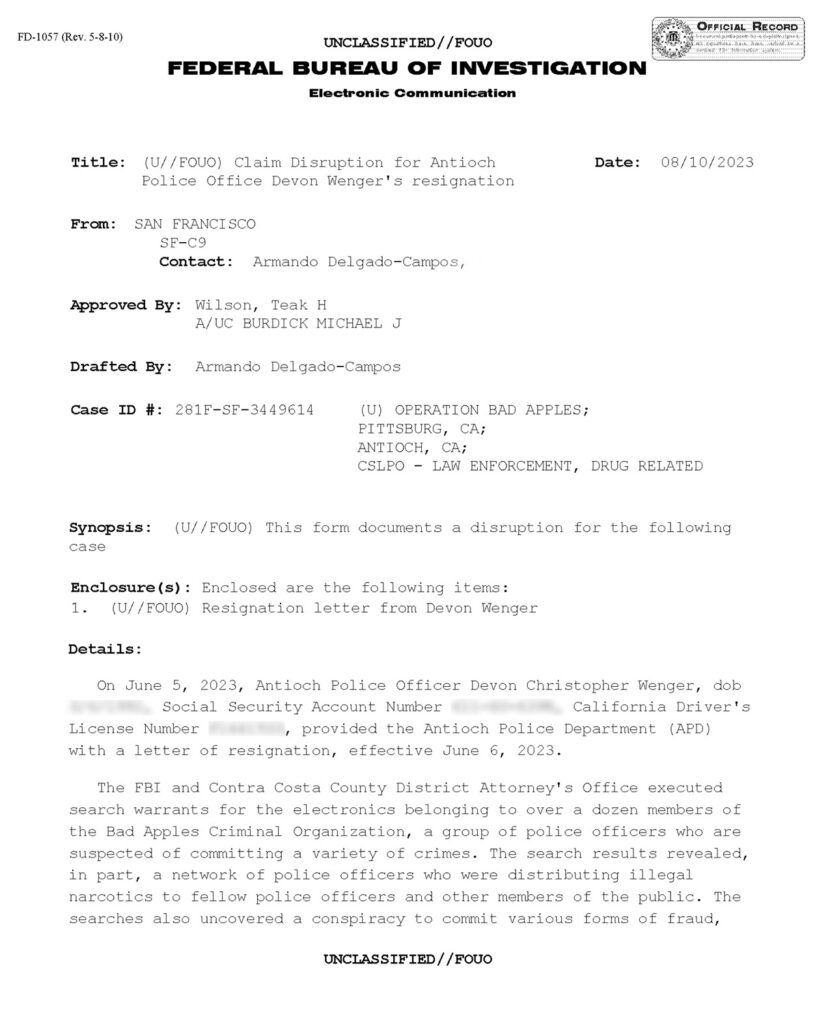
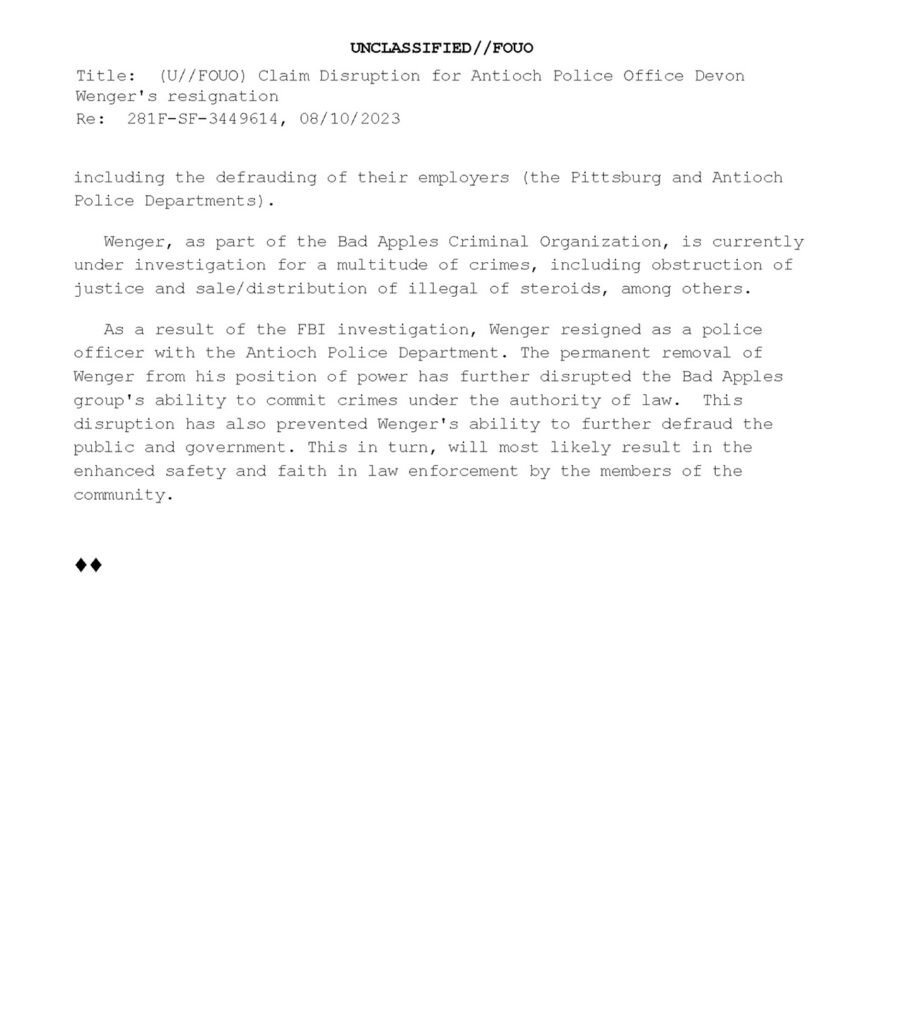
    Once federal agents took over, the retaliation only escalated. FBI Concord-RA Safe Streets Task Force Supervisory Special Agent Teak Wilson and Agent Armando Delgado-Campos authored a memo titled “Claim Disruption for Antioch Police Officer Devon Wenger’s Resignation.” Attached was Wenger’s resignation letter — where he cited harassment and retaliation, but the memo falsely reframed it as fallout from an FBI Concord-RA Safe Streets Task Force probe.
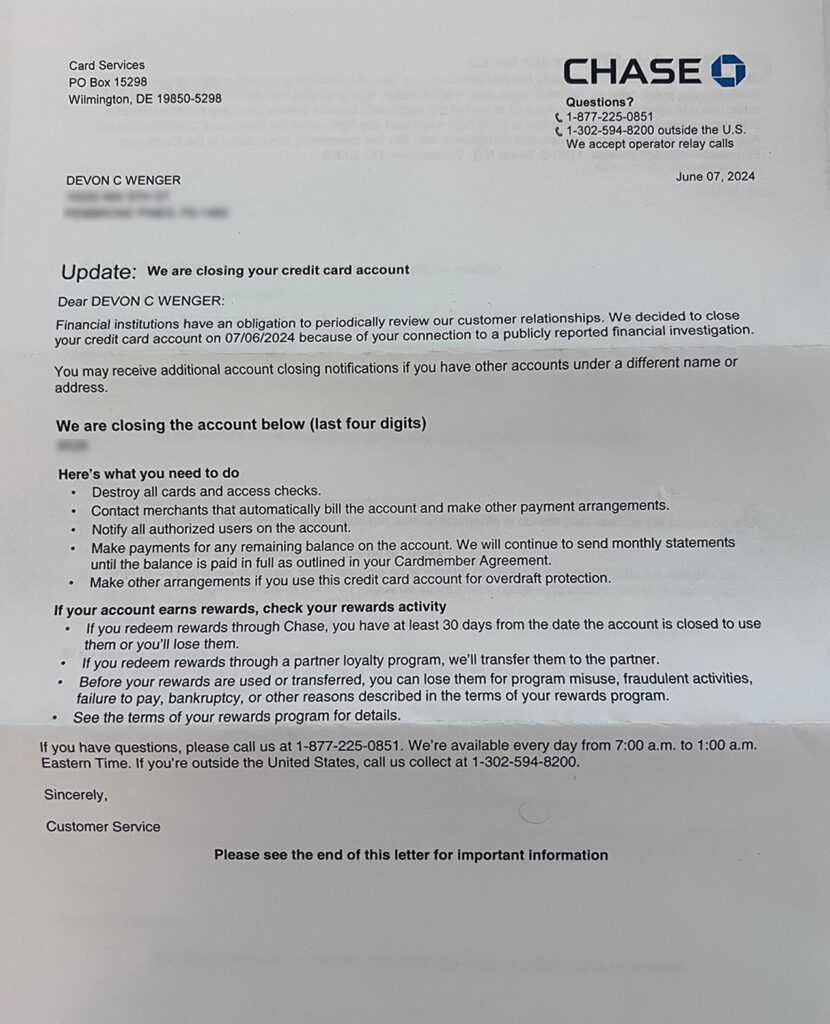
    The agents went further, writing: “This disruption has also prevented Wenger’s ability to further defraud the public and government.” No evidence supported that defamatory claim. Nonetheless, it was echoed in law-enforcement databases and soon seeped into the private sector. Chase Bank abruptly closed Wenger’s account, citing his “connection to a publicly reported financial investigation.” The pattern was unmistakable: coordinated, institutional retaliation — using federal resources to financially and professionally destroy a whistleblower. The “Claim Disruption” memorandum authored by SSA Teak Wilson and Agent Armando Delgado-Campos constitutes a direct violation of the Safe Streets Act’s civil-rights assurances, Title VI retaliation prohibitions, and DOJ Justice Manual § 8-2.130 oversight requirements.
    By weaponizing a federally funded law-enforcement program to circulate defamatory misinformation, these agents engaged in retaliation under color of federal authority, violating 18 U.S.C. §§ 241 and 242, the Privacy Act, and the Whistleblower Protection Act, while undermining the integrity conditions tied to DOJ grant funding.
    Discovery later revealed that Capt. Morefield had been quietly coordinating, calling in favors from his long time associates and close ties with FBI Concord-RA Safe Streets Task Force to establish federal cases against an officer that had reported misconduct against APD Management in his resignation letter. A supervisor of the FBI Concord-RA Safe Streets Task Force was previously an Antioch Police Officer, and good friends with Captain Morefield.
    Emails show Captain Morefield was sharing Wenger’s private data and internal affairs findings with FBI Concord-RA  Safe Streets Task Force Special Agents Krystal Templin and Thuy Zoback, a good ole boy gesture to help Antioch PD’s vendetta.


    The Pre-Dawn Raid

    Two months after his forced resignation, Wenger secured a position as an investigator with the Honolulu District Attorney’s Office. For the first time in years, he felt the dark chapter of retaliation was finally behind him. But that peace was short-lived.

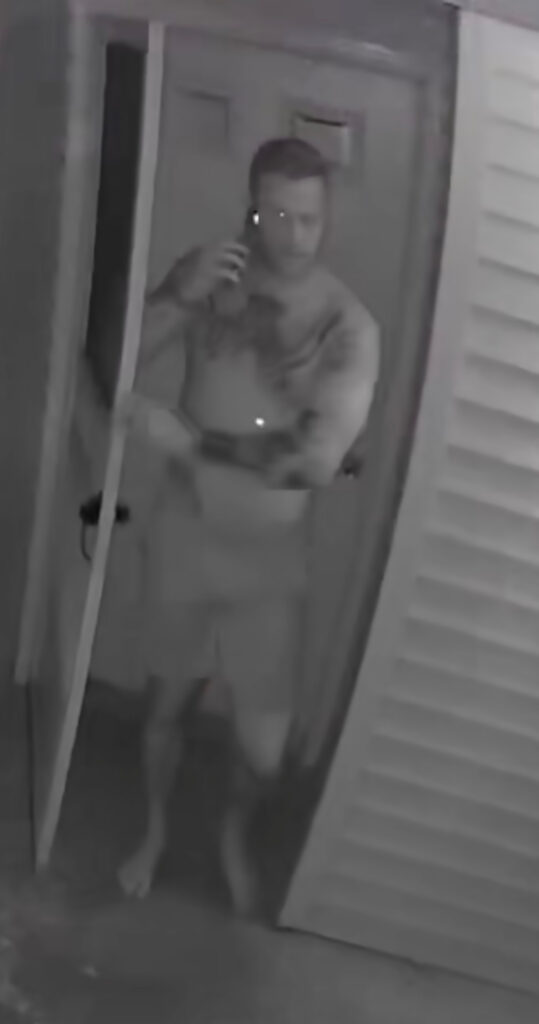
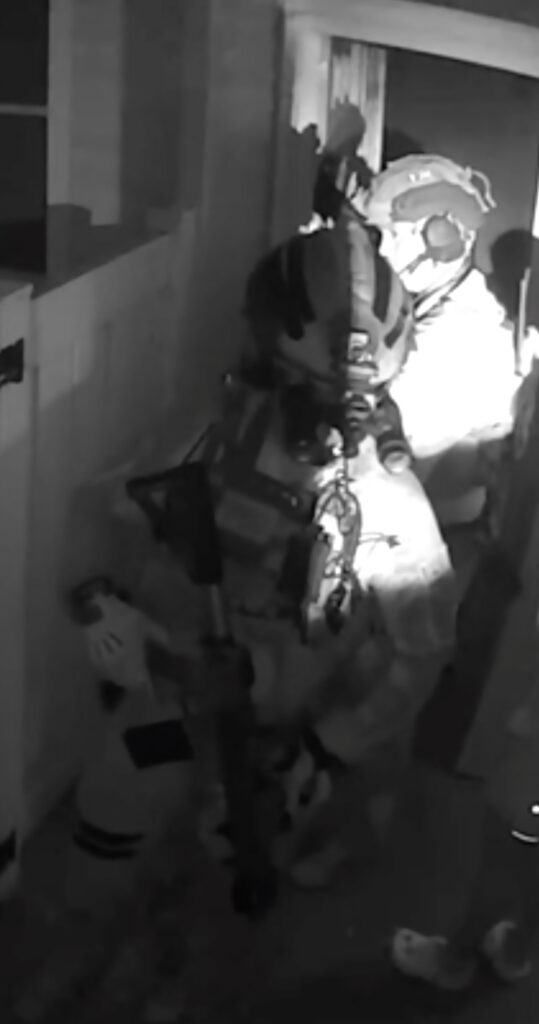
    At 5 a.m., the FBI’s Concord-RA Safe Streets Task Force launched a SWAT-style raid on his home, four vehicles, armored units, and even a drone surrounded the property to serve a sealed federal indictment. The charges mirrored Captain Morefield’s fabricated Internal Affairs complaint, which had accused Wenger of “unnecessary use of force,” relying on Meads’ tainted IA file and falsified text messages. The indictment also incorporated Detective Wallace’s bogus “steroid” affidavit, derived from an unlawful search of Wenger’s phone.

    The cumulative evidence reveals a deliberate and coordinated pattern of misconduct, where internal administrative tools were weaponized to construct a false criminal narrative against Wenger. The absence of a lawful “Officer’s Rights and Obligations” notice, the replication of a manufactured IA complaint in a sealed federal indictment, and the inclusion of a falsified “steroid” affidavit collectively amount to grave violations of state, federal, and constitutional law.

    Taken together, these acts demonstrate a conspiracy under 18 U.S.C. §§ 241, 242, and 1519 – executed in direct violation of California Government Code §§ 3300–3311 (POBAR) and the Department of Justice Civil Rights Division’s oversight mandates.

    FBI Concord-RA Safe Streets Task Force Agents labeled Wenger “armed and dangerous” – a baseless claim contradicted by his spotless record and the absence of firearms or contraband. The spectacle violated both DOJ and FBI arrest-protocol standards requiring minimal force for cooperative defendants. The TOC SWAT request made by Safe Streets Task Force FBI Concord-RA  and approved by SSA Teak Wilson, transformed a standard arrest into a potentially deadly operation. Since the indictment was sealed the TOC SWAT members only knew Devon was “Armed and Dangerous”.  The FBI Concord-RA Safe Streets Task Force’s TOC SWAT stunt for media attention recklessly endangered innocent lives and showed blatant disregard for public safety.

    Jailhouse Retaliation

    After arrest, Wenger was placed in general population at a federal detention facility with no protective custody and denied access to counsel for 48 hours – a clear violation of his Sixth Amendment right. For three days, he went without clean clothes, hygiene, or even a phone call to a lawyer or his wife. These deliberate conditions weren’t bureaucratic error; they were punitive measures meant to break a whistleblower before he could speak to a lawyer or appear before a judge. Such treatment flouted federal detention standards and the Eighth Amendment’s prohibition against cruel and unusual punishment.

    A Bond Meant to Intimidate

    At his first court appearance on August 29, 2023, prosecutors demanded, and a magistrate approved, a $100,000 secured bond. For a first-time, non-violent defendant with deep community ties, the amount was excessive. To justify it, prosecutors falsely labeled Wenger as “armed and dangerous,” a reckless mischaracterization designed not to ensure justice, but to destroy him. The tactic worked, branding a whistleblower as a threat guaranteed his public humiliation and financial collapse. The message was clear: speak out, and you’ll be silenced.

    Trials Fabricated and Perjured Oaths

    The Assistant U.S. Attorneys (AUSAs) handling the case; Eric Cheng, Alethea Sargent, Ajay Krishnamurthy, Alexandra Shepard Weaponized “motions in limine”, suppressed exculpatory evidence, and misled Judge White. Fought to keep out all discussion of retaliation, evidence tampering, or misconduct. AUSAs appeared all too eager to ride this runaway train of tainted evidence at trial. Come to find out Eric Cheng since early February 2022 had been working hand-in-glove with the FBI Concord-RA Safe Street Task Force and Contra Costa County DA Investigators holding weekly briefings as the investigation unfolded. By the time of indictment and trial, the AUSAs adopted and amplified the misleading evidence points.
    Case 23-CR-00268 which charged Devon Wenger with conspiracy to distribute anabolic steroids (and related evidence destruction), was marred by egregious misconduct. The trial resembled theater built on lies, with multiple government actors bending the truth to secure a conviction. Three officials in particular took the stand (or otherwise influenced proceedings) and effectively turned perjury into policy:
    FBI Concord-RA SSA Teak Wilson: Falsely told jurors that Wenger barricaded himself and frantically deleted phone data before arrest. Internal VCC logs proved Wilson knew Wenger was not home and Wilson coordinated a meeting spot with Wenger at the boat storage facility. In which Wenger surrendered his cell phone cooperatively. Exposing this claim as a deliberate lie.
    USPS Inspector Sukhdeep Singh: Swore under oath that no detailed USPS tracking data existed for a suspect package. A subsequent FOIA release revealed full tracking scans and showed the package’s weight inexplicably doubled while in custody – indicating evidence tampering that Singh’s testimony concealed.
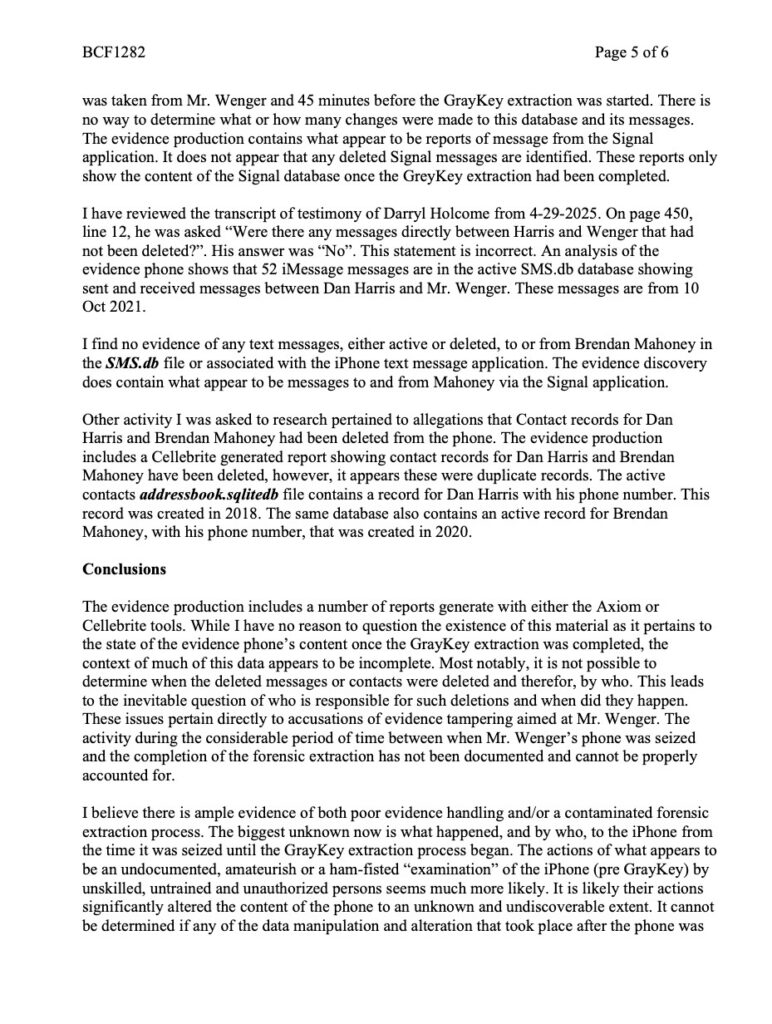
    Contra Costa DA Investigator Darryl Holcombe: Testified that Wenger deleted text messages to obstruct the investigation, yet failed to disclose that his own phone extraction log inexplicably omitted several hours during while in his & FBI Concord-RA custody. In truth, the data was manipulated by Holcombe & FBI Concord-RA Safe Streets Task Force to create a false impression of deletions.
    FBI Agent Krystal Templin: Presented incomplete phone data (cache fragments) as if they were real, incriminating messages when briefing the grand jury, while omitting deleted contacts and context that would have exonerated Wenger. This misled the grand jury and tainted the indictment process.
    AUSA’s: Reinforced all these false narratives in court, introducing cherry-picked, prosecution doctored exhibits and suppressing exculpatory evidence (a clear Brady violation). Cheng echoed the misleading points to the jury despite knowing the full context of the fabricated text message data.
    Each broken oath and twisted fact in this case protected a bigger agenda: a vendetta against Wenger. In effect, federally funded task force resources (through DOJ “Safe Streets”/TOC-West) were used to retaliate against a whistleblower by fabricating evidence and truth itself. Case 268 stands as a stark example of justice subverted by those entrusted to uphold it.
    Screenshot
    Case 23-CR-00269 charged Wenger (and other Antioch officers) with civil rights violations (conspire to violate rights). However, this prosecution appears driven more by retaliation against Wenger as a whistleblower than by justice. Federal prosecutors and task force agents shaped a narrative while concealing serious irregularities. Key violations in this case included:
    Suppression of Exculpatory Evidence: The prosecution team (AUSAs Alethea Sargent, and Alexandra Shepard) resisted disclosing evidence that might have aided Wenger’s defense. They withheld proof of data tampering, witness vendettas, and manipulated text messages (text messages purpose to prove conspiracy)  – clear Brady/Giglio violations. Misleading the Court: By framing the case as a righteous takedown of a “bad cop,” prosecutors misled the court and jury. When evidence later proved agents had fabricated communications, the prosecution either failed its duty to disclose or, worse, knowingly presented falsehoods. This breach of candor made them complicit in an apparent frame-up.
    AUSA’s Alethea Sargent, and Alexandra Shepard knew the truth – they just chose to bury it using “motions in limine”  Devon Wenger’s 2021 whistleblower complaint had ignited the very probe that later turned against him. The same officers he exposed – including Sergeant Eric Rombough – were repackaged as federal witnesses, and the DOJ’s own Safe Streets Task Force, funded to fight organized crime, was hijacked to settle personal scores.
    That’s not law enforcement – that’s sanctioned corruption. It violated the Justice Manual’s own mandates, including Title 8 §§ 8-2.130 and 8-3.120, which require Civil Rights Division oversight in any color-of-law case to prevent conflicts of interest and retaliation. No such oversight ever existed. DOJ ethics canons under 5 C.F.R. § 2635.101 and 28 C.F.R. § 45.2 were shredded in plain sight. The prosecution hid it from Judge Jeffrey S. White, concealing the paper trail that would have exposed the retaliatory origins of the indictment.
    This wasn’t a trial. It was a performance built on deceit – a weaponization of federal policy against a whistleblower who dared to tell the truth. The DOJ owes the public more than silence; it owes accountability. Case 269 isn’t just a miscarriage of justice – it’s a mirror reflecting a federal system that forgot its oath.

    Politics, Promotion, and the Price of Silence

    The FBI Concord Safe Streets Task Force, the Contra Costa District Attorney’s Office under Diana Becton, Antioch Police Department leadership, and the U.S. Attorney’s Office all had something to gain from taking down Officer Devon Wenger. Becton wanted the optics of being a reformer. Her investigator, Larry Wallace, needed a “dirty cop” trophy. Antioch city officials needed Wenger out of the way to bury their own internal scandals. And federal prosecutors wanted résumé-building headlines from a high-profile case.

    This coalition of agencies Antioch Police Dept, Contra Costa County DA & Investigators, FBI Concord-RA Safe Streets Task Force & assigned AUSA’s collectively, fabricated digital evidence, tampered with postal records, and manipulated testimony to frame Wenger.

    Their motives were as self-serving as they were corrupt: career advancement, political leverage, and public acclaim as supposed champions of “police reform.” In truth, they conspired to pervert justice, deceive the courts, and destroy a whistleblower for telling the truth. When fully exposed, this case will stand as a chilling example of how those sworn to uphold the law used it instead as a weapon of retaliation.

    The Civil Case – Redemption

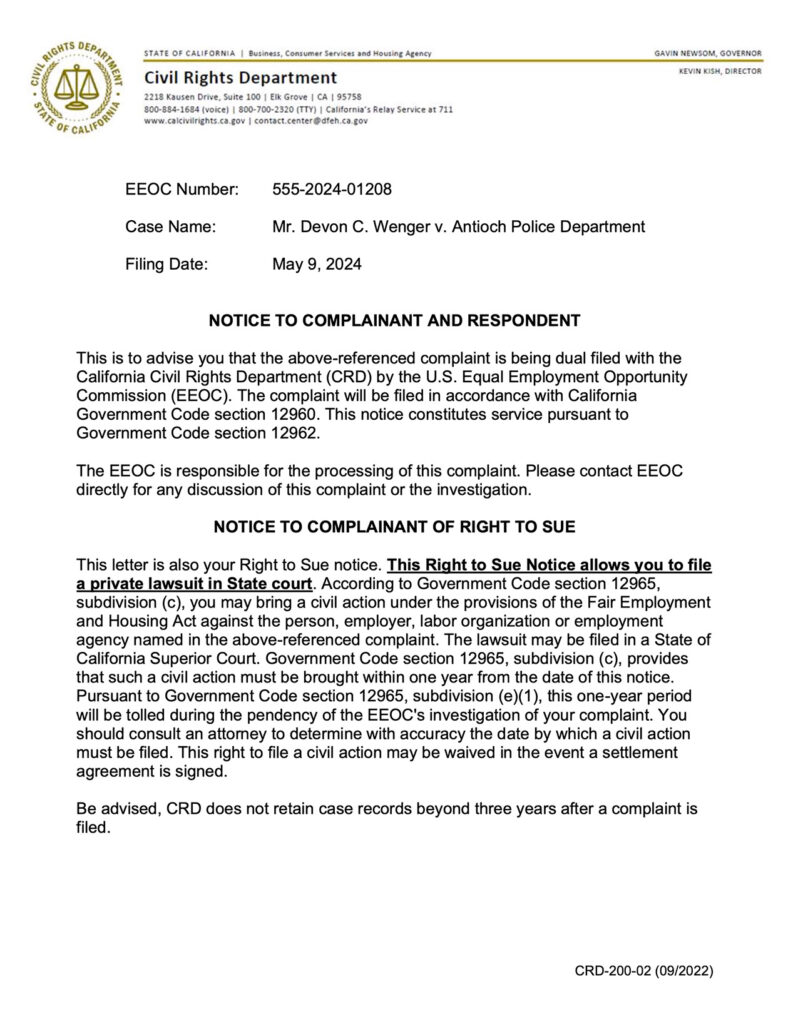
    Wenger’s fight for justice continues, he filed a formal EEOC complaint against the City of Antioch. Within hours, the EEOC issued a Right-to-Sue letter – confirming that a federal agency saw clear evidence of retaliation.  No matter how many times the City of Antioch or Northern District DOJ tries to bury the truth or smear Devon Wenger’s name, his civil case C25-00578 is far from over. With no more legal loopholes to hide behind, every thread of the cover-up can finally be pulled into the open—for the judge, the jury, and the public to see just how far those in power were willing to go to silence the one honest cop who tried to do the right thing.


    What Accountability Looks Like

    Devon Wenger is calling for the Department of Justice’s Office of Professional Responsibility (OPR) and Office of the Inspector General (OIG) to open internal investigations into the misconduct that defined his case. Under federal policy, the Department has full authority to vacate the charges, discipline prosecutors and agents, and sanction the offices involved. The Justice Manual is unambiguous: a prosecutor’s duty is not to win at any cost, but to ensure fairness. In U.S. v. Wenger, that duty was willfully abandoned.

    What happened to Officer Devon Wenger is not just another local corruption scandal, it is a textbook case of how the justice system can be weaponized by those willing to break the rules. Every major player in this saga — from Antioch PD brass to Contra Costa County DA investigators and forensic examiners, from the FBI’s Concord-RA Safe Streets Task Force to Assistant U.S. Attorneys – trampled federal law, DOJ policy, and basic ethical standards in a coordinated campaign to destroy a whistleblower. Their methods were chillingly familiar: perjury, evidence tampering, retaliation, and lying under oath – all to silence a truth-teller and advance their own careers under the false banner of “reform.”

    Every step of this frame job represents an abuse of power – precisely the kind of corruption the Department of Justice claims to fight. The question now is whether DOJ and FBI leadership have the courage to root out corruption within their own ranks, or whether the cover-up will continue behind closed doors.

    To prevent this kind of systemic retaliation, all law enforcement agencies must strengthen protections for whistleblowers. Policies mean nothing if, in practice, an officer can be isolated and ambushed for speaking the truth. Independent monitors or inspectors general should be required whenever an officer reports internal misconduct, ensuring local politics cannot taint investigations.

    The FBI and DOJ must also re-examine how joint task forces operate. When local agents – such as those in the FBI’s Concord-RA office, partner with local departments, there must be vigilance against manipulation by local vendettas. Requiring dual federal authorization for any case originating from internal police or county DA complaints could prevent abuses like Wenger’s. Likewise, DOJ must begin enforcing its own nondiscrimination and anti-retaliation grant conditions with real consequences, pulling funds from agencies that use federal money to target whistleblowers.

    At its core, this comes down to integrity. Every law enforcement officer must decide whether loyalty lies with a clique – or with the Constitution. For a time, Devon Wenger chose the latter. He was one of the good ones – a cop trying to expose bias and abuse within his own department. His reward was a nightmare of retaliation. That is not just an indictment of those who led Antioch PD, it is a warning for the entire justice system.

    But Wenger’s fight also embodies the cure to the “good ol’ boy” culture: courage, persistence, and truth. Through his legal battle, he forced evidence into the light that would have otherwise been buried. Every memo, every email, every document now telling the real story exists because one man refused to stay silent.

    Speak Up. Speak Out. Speak Truth.

  • Justice in Reverse: How the Racial Justice Act Became a Weapon of Bias in Los Angeles

    Justice in Reverse: How the Racial Justice Act Became a Weapon of Bias in Los Angeles

    In Los Angeles County, where District Attorney George Gascón rose to power on the post-George Floyd wave of “reform,” the promise of fairness has been twisted into a political weapon. The California Racial Justice Act, created to prevent bias and ensure equality in prosecution and sentencing, has been turned on its head. Instead of shielding defendants from discrimination, it now enables selective prosecution, a system where perception, politics, and identity determine who is punished and who is protected.

    Under Gascón’s pro-criminal, anti-“privilege” agenda, defendants perceived as affluent or “advantaged” have become easy targets in a justice system obsessed with optics. The same DA who publicly champions leniency for repeat violent offenders from “disadvantaged” communities has no hesitation in throwing the full weight of the state against defendants who appear to represent wealth, success, or privilege. What was sold to voters as reform has become retribution.

    In the years following 2020, justice in Los Angeles County shifted from the courtroom to the newsroom. The Racial Justice Act was passed to eliminate bias, but instead it institutionalized a new form of it. The law’s intent – to ensure that race, ethnicity, or background never factored into charging or sentencing – was quickly subverted under Gascón’s leadership, where social optics replaced evidence as the primary driver of prosecutorial discretion.

    While violent offenders and repeat criminals are released under “equity reform,” prosecutors now overcharge those perceived as symbols of privilege to prove ideological purity. The courtroom became the stage, and defendants like Rebecca Grossman and Fraser Bohm became headline sacrifices.

    In the midst of the politically charged atmosphere surrounding progressive “reform” during the pandemic of 2020, Rebecca Grossman, a philanthropist and mother of two, was involved in a horrific accident that killed two young brothers, Mark and Jacob Iskander. It was an unimaginable tragedy, and one that prosecutors under embattled DA George Gascón used as an opportunity for political and personal gain as a result of the racially charged atmosphere post George Floyd era.

    Grossman was following closely behind another vehicle traveling ahead of her on Triunfo Canyon Road. That driver, former MLB baseball player Scott Erickson, was approximately three seconds in front of her, and was captured on surveillance footage traveling at a faster speed. Despite his proximity to the crash scene, he was never questioned the night of the accident, and his vehicle was never examined. Evidence collected at the scene matched the description of his car, yet that evidence later went missing, even though it had been logged on the original evidence list.

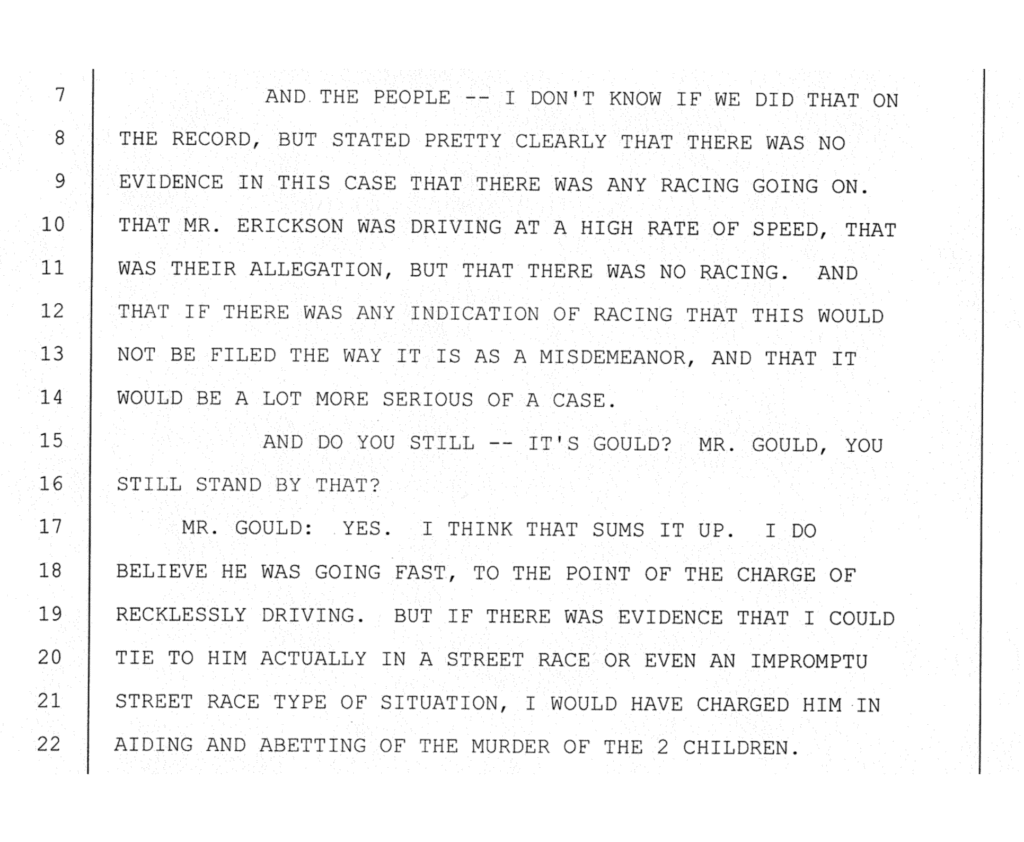
    Grossman has acknowledged her responsibility for the crash and expressed profound remorse for the deaths of the two children. She had no prior DUI history, her blood-alcohol content was below the legal limit, and prosecutors admitted there was no evidence of racing – as confirmed by Deputy District Attorney Ryan Gould during Erickson’s hearing. Yet, despite the absence of intent to harm, Grossman was charged with second-degree murder under the Watson doctrine – a law enacted in 1981 to target repeat drunk drivers who had previously been warned about the dangers of driving under the influence.

    The Watson charge was never meant for cases like this. Yet prosecutors argued that “speed alone” was enough to establish “implied malice,” effectively rewriting the doctrine in the process. Key witnesses were omitted, including investigators who first arrived on scene, and evidence that could have complicated the state’s narrative was left out.

    Crucially, audio and video evidence shows that Grossman did not flee the scene and demonstrates her visible concern for the children. Still, this was ignored in favor of a made-for-media narrative portraying her as callous and entitled. Her conviction was built on emotion, not law, and it now stands as one of the most extreme examples of prosecutorial overreach in modern California history.

    In October 2023, Fraser Michael Bohm, a 22-year-old Malibu resident, was involved in one of the deadliest collisions in local memory. Investigators alleged his BMW reached speeds up to 104 mph in a 45-mph zone before losing control and striking parked vehicles along Pacific Coast Highway. Those vehicles were pushed into four Pepperdine University students – Niamh Rolston (20), Peyton Stewart (21), Asha Weir (21), and Deslyn Williams (21) – who were walking nearby. All four died instantly.

    Prosecutors immediately charged Bohm with four counts of second-degree murder and four counts of vehicular manslaughter with gross negligence, arguing that his excessive speed demonstrated “implied malice.” However, Bohm was sober, had no prior record, and defense experts contend his speed was overstated, with black-box data suggesting closer to 70 mph. His attorney, Alan Jackson, also argued another vehicle cut him off in a road-rage encounter, forcing him into the crash. On Hot Mics with Billy Bush, Jackson maintains Bohm was “wildly overcharged” by Gascon, an embattled politician getting hammered daily for his soft on crime policies, who used the Bohm case to “right the ship” during his re-election campaign.

    Rather than allow the investigation to unfold, Gascón’s office quickly elevated the charges to murder, leveraging the tragedy for headlines. Once again, the same pattern appeared: when the defendant was white, and affluent, the system demanded blood.

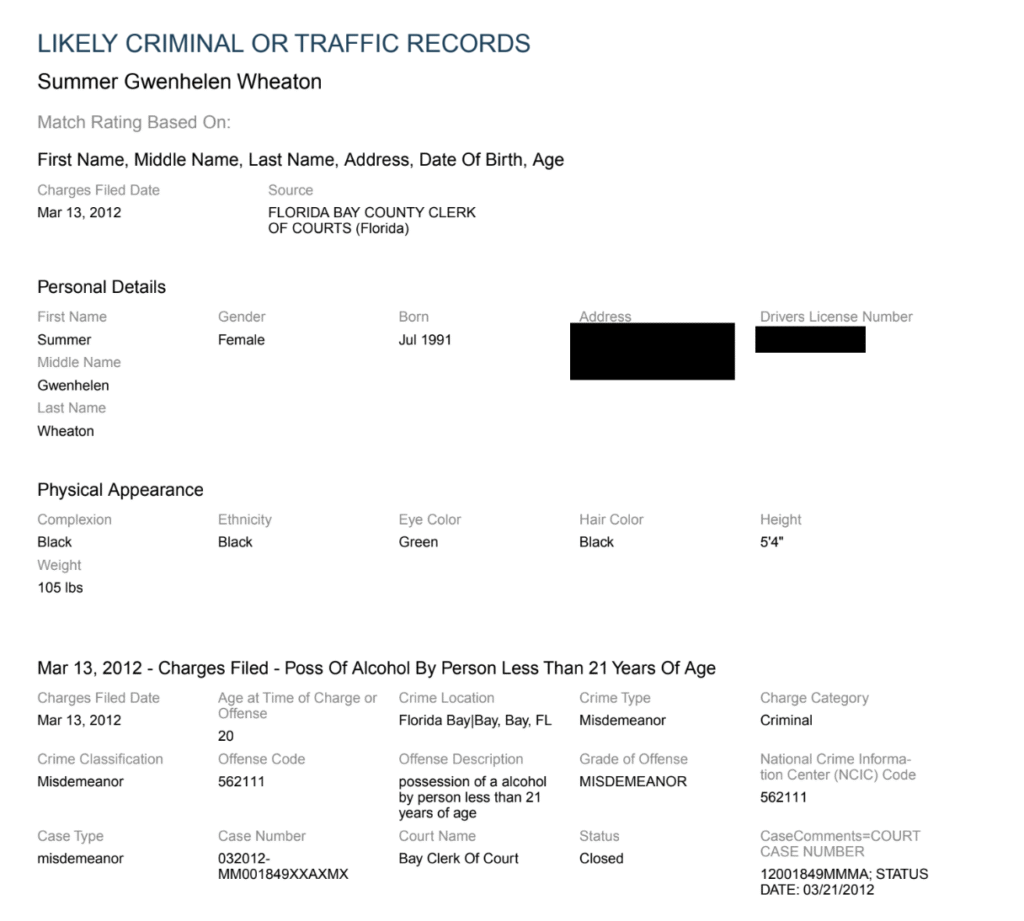
    In contrast to these two cases, in July 2024, social-media influencer Summer Wheaton killed 44-year-old Uber driver Martin Okeke while a minor passenger survived. According to Malibu Daily News, Wheaton was legally intoxicated, had a documented history of impaired driving, and a prior misdemeanor charge for possession of a controlled substance as a minor.

    By every metric, Wheaton’s case met- and arguably exceeded – the threshold for a Watson murder charge. She was under the influence, speeding, and had a record of prior impairment. Yet Gascón’s office handled her case quietly, allowing the announcing of charges to drag on for months, with no murder charge, no press conference, and no calls for accountability.

    Why? Because Wheaton’s profile fit the post-reform narrative – Black, young, female, and framed as “rehabilitatable.” Grossman and Bohm, on the other hand, were perfect villains: white, from affluent areas, and symbolic of “privilege.”

    Just this month, another fatal crash laid bare the hypocrisy of California’s so-called justice reform. An illegal Indian national driving an 18-wheeler on the 10 Freeway while allegedly impaired slammed into multiple vehicles, killing three people. Despite the egregious circumstances – unlicensed, intoxicated, and with multiple victims – he was not charged with murder.

    The contrast is staggering. When an undocumented or minority driver kills multiple people while impaired, the case is softened, spun, or buried. When a white woman from Westlake Village or a young man from Malibu is involved in an accident, it becomes a career-making headline for prosecutors eager to showcase “accountability.”

    This selective application of justice exposes a deep ideological rot, one where the legal system now punishes identity over intent.

    What the Racial Justice Act was meant to stop, prosecutions rooted in bias, is now happening in reverse. Privilege itself has become the new prejudice. Prosecutors once cautioned to avoid bias are now encouraged to weaponize it under the guise of social justice.

    Under Gascón, the scales of justice have been flipped: leniency for the repeat offender, condemnation for the citizen who represents stability or success. The same law written to ensure fairness now shields criminals and punishes the law-abiding. The result is a justice system divided not by evidence, but by identity.

    This is not justice. It’s selective prosecution masquerading as reform. It’s the deliberate inversion of accountability to serve a political agenda. The same DA who insisted on rehabilitation for violent offenders refused to extend the same humanity to those deemed “privileged.”

    In Los Angeles County, the law no longer punishes intent, it punishes image.

    The Grossman and Bohm cases should terrify every Californian. If the state can label an accident a murder based on who you are – not what you did – then justice no longer belongs to the people. When prosecutors choose defendants to fit a cultural script, when equality becomes revenge, and when reform turns into ideology, no one is safe.

    This is not progress – it’s persecution. And in Los Angeles County, it now wears the mask of justice.

    DISCLAIMER: Investigative reporting in high-profile litigation cases published by The Current Report is non-commercial, fact-based journalism; any project fees compensate research and reporting labor only, sources participate solely in accuracy verification, and final publication is approved exclusively by The Current Report after fact-checking is confirmed.

  • What Did and Didn’t Happen in the Rebecca Grossman Case: The Collapse of Investigative Integrity in the LA County Justice System

    What Did and Didn’t Happen in the Rebecca Grossman Case: The Collapse of Investigative Integrity in the LA County Justice System

    The murder conviction of Rebecca Grossman, once touted as proof that Los Angeles County could still deliver justice under embattled, soft-on-crime District Attorney George Gascón, is beginning to crumble under the weight of new evidence. What’s emerging is not a story of accountability, but of instability, negligence, and concealed misconduct by the very investigators who built the case.

    Depositions, coroner documents, and internal records obtained by The Current Report reveal that Sgt. Travis Kelly and Detective David Huelsen, the lead LASD investigators, were each battling personal crises and professional failures that tainted nearly every stage of the investigation, and may explain why prosecutors kept both men off the witness stand.

    According to multiple LASD sources, Kelly’s erratic behavior had been an open secret for quite some time. Supervisors were allegedly aware that he was struggling psychologically even as he led one of the county’s most politically charged crash cases. If command staff knew of his condition, it raises a damning question: why was a volatile, medicated sergeant entrusted with an investigation that depended entirely on credibility and precision?

    Video footage from the night of the crash shows Kelly shouting at Grossman, demanding answers rather than methodically gathering facts. His aggressive, accusatory tone revealed not an investigator searching for truth, but a man intent on confirming guilt, unwilling to consider any other suspects or alternate scenarios.

    Despite being the lead investigator, Sgt. Kelly was never called to testify by Deputy District Attorneys Ryan Gould and Jamie Castro at the preliminary hearing, and was not on their witness list for the trial. The omission is striking. Were the prosecutors aware that Kelly’s documented mental instability could devastate their case if exposed under oath?

    The truth of Kelly’s unraveling came to light less than a month before Grossman’s trial began. On December 2, 2024, his wife fled their home after he fired multiple rounds from his service weapon inside their bedroom. A friend performing a welfare check later found Kelly hanging from a tree in his backyard, a rope knotted around his neck. There was no suicide note,  and, inexplicably, no autopsy. Fifty-six photographs were taken at the scene.

    Toxicology results initially indicated a “presumptive positive” for benzodiazepines, but confirmatory testing later came back “not detected.” His medical records listed bipolar disorder, hypertension, pre-diabetes, and the recent abrupt discontinuation of the antidepressants Lexapro and Pristiq, medications that, when stopped suddenly, can trigger dangerous mood swings. The report also noted a history of suicidal thoughts.

    If the county knew that its lead investigator was mentally unstable and failed to disclose that fact, the consequences extend beyond this case. It would expose a systemic culture of concealment inside the sheriff’s department and the district attorney’s office, one that values convictions and optics over truth and transparency.

    Diana Teran, a longtime Los Angeles law-enforcement attorney who built her career around police oversight, first at the Sheriff’s Department, and later inside the District Attorney’s Office. Under former Sheriff Jim McDonnell, she served as the department’s first Constitutional Policing Advisor, a position created in 2016 to bring reform and accountability to the LASD after years of misconduct scandals. In that role, Teran had access to sensitive deputy personnel and disciplinary files and helped shape the county’s Brady and ORWITS tracking systems, which identify deputies with credibility or integrity issues. When Alex Villanueva replaced McDonnell in late 2018, he eliminated her position, and she was dismissed along with several other members of McDonnell’s reform team.

    After leaving LASD, Teran joined District Attorney George Gascón’s administration, where she rose to become the Assistant District Attorney for Ethics and Integrity Operations. In that post she advised prosecutors on discovery compliance and officer-credibility disclosures, ironically, the same type of records she once managed at the Sheriff’s Department. Teran directly supervised Deputy District Attorneys Ryan Gould and Jamie Castro, as well as their superior, Garrett Dameron.

    In April 2024, Teran herself was arrested and charged with 11 felony counts of unauthorized access to computer data. The California Attorney General alleged she had downloaded confidential LASD personnel files while working under McDonnell and later used those files after joining Gascón’s office. Teran pleaded not guilty, calling the case politically motivated, and in June 2025 a state appellate court effectively dismantled the prosecution, ruling that the material she accessed was not protected confidential data. Even so, the episode cast a long shadow over both agencies, leaving open questions about her handling of deputy-credibility records and how much she knew about investigators involved in cases such as Rebecca Grossman’s.

    Teran was deposed on August 27, 2025 in connection with the Grossman civil proceedings, her testimony added another layer of concern. Under oath, Teran was asked whether Sgt. Kelly, or any investigator connected to the Grossman case, was listed in the ORWITS or Brady databases, the systems used to track law-enforcement officers with credibility or misconduct issues. Her attorney immediately instructed her not to answer. She complied. When pressed further, Teran claimed she did not remember who the investigators were, nor did the names Travis Kelly or David Huelson “ring any bells.” The dissonance was striking. Teran had overseen discovery compliance for the district attorney’s office, precisely the department responsible for flagging officers like Kelly if mental instability or integrity concerns could affect a prosecution. Her evasive answers suggest a deliberate effort to conceal information that might have undermined the state’s case against Grossman.

    Even more troubling was the conduct of Detective Huelsen, who assumed control of the scene despite being outranked by Sergeant Travis Kelly. Witnesses say Huelsen trampled through evidence, barked conflicting orders, and oversaw what can only be described as a chaotic, disorganized investigation. At one point, caught on video surveying the debris field, he could be heard exclaiming in frustration, “How the fuck does it get here and then all the way over there?” – a telling snapshot of confusion from the man leading the inquiry.

    Multiple law enforcement sources describe Huelson as a “political appointee” of disgraced former Lost Hills Captain Tom Martin, a figure long shadowed by controversy. Martin gained infamy for his role in concealing jail security footage in the Mitrice Richardson case and was later the subject of serious internal allegations, including accusations that he raped multiple women he allegedly targeted after they left local rehabilitation facilities during his tenure at the station.

    According to sources familiar with the department’s internal dynamics, Martin handpicked Huelsen precisely because he was easy to control. Despite being assigned to high-profile and politically sensitive investigations, Huelson reportedly had little to no background in accident reconstruction and frequently relied on other deputies to navigate complex or fatal cases.

    “He had no business leading a case like this,” said one veteran investigator who worked alongside him. “We cleaned up some major messes he left behind. Everyone hoped he’d improve with experience, but it never happened. The Grossman investigation was chaos from the start. If someone competent hadn’t been quietly shadowing the case, there’s no way it was done right.”

    Huelsen’s own deposition, taken on June 18, 2025, exposed how deeply the investigative foundation had cracked. Huelsen, now 55 and living in Tennessee, testified that he joined LASD in 1994 and served 28 years, the last 14 with the Malibu/Lost Hills Station. He retired in March 2022. During his testimony, Huelsen appeared uneasy, and at times confused about key details. He admitted that he was not the lead investigator on the night of the crash and arrived at the scene roughly an hour after the accident, only after stopping at the station first. His partner, Sergeant Scott Shean, was not at the scene at all. Huelsen stated that Sgt. Kelly was already there when he arrived and that he – the only investigator present – took limited command of an already chaotic scene. He described the intersection as “chaos,” with officers, emergency personnel, and bystanders scattered everywhere, yet insisted that “everyone handled everything appropriately.” He recalled seeing a white Mercedes with damage and a “small area of blood spatter,” but offered no description of how evidence was preserved.

    From the start, Huelsen’s recollections wavered. He admitted he did not recall which deputies were present, did not remember who handled evidence collection, and never conducted a thorough forensic inspection of any other vehicles involved. Most damningly, he acknowledged that neither he nor anyone else examined or impounded Scott Erickson’s black Mercedes SUV, the car seen just ahead of Grossman’s seconds before the fatal impact. Despite acknowledging that officers “went to Rebecca’s home to look for Erickson’s vehicle,” Huelson said he never saw or inspected that car himself and could not recall if anyone ever did.

    He further testified that he made no attempt to contact Erickson the night of the accident and was unsure whether any other investigator did. He remembered trying to reach Erickson several days later “to get his statement,” Erickson was later charged with reckless driving, a misdemeanor later dismissed through diversion. Huelson admitted he was not a Dodger fan and had no personal knowledge of Erickson prior to the crash.

    When asked about scene documentation, Huelson conceded he had no recollection of preserving surveillance footage from nearby properties or businesses. He remembered accompanying Sgt. Shean to “look for videos” but could not say which locations they checked, how many times, or whether any videos were ever secured. He said he “does not recall any officers telling him they observed or obtained videos.” In effect, the detective responsible for confirming or disproving a second-driver theory admitted under oath that he failed to collect or even remember the existence of potential video evidence that could have determined the true sequence of impact.

    Huelsen’s handling of witness interviews was equally troubling. He testified that he began taking statements a week after the crash, by telephone rather than in person, and that he relied on those telephonic recollections to write supplemental reports. When asked why he hadn’t revisited the scene or interviewed witnesses face-to-face, Huelson explained that he was trying to be “expedient.” His supplemental reports later became the backbone of the prosecution’s narrative at trial.

    Throughout his testimony, Huelsen’s language suggested detachment and uncertainty. He described himself as “very aggressive” in interviews but “did not recall” several critical statements. Huelsen did remember interviewing Rebecca with Sgt. Kelly at the Lost Hills station and admitted he relied heavily on Kelly’s direction during questioning. The image that emerges is of an investigator operating more as an assistant than a lead detective, one taking cues from a superior already unraveling psychologically.

    The cumulative effect of Kelly’s instability, Teran’s obfuscation, and Huelsen’s incompetence has left a permanent stain on the Grossman investigation. With Kelly dead and his personnel and medical files locked away, the paper trail that could confirm how long his bipolar disorder and depression were known to the department remains hidden. Teran’s refusal to clarify whether he appeared in the ORWITS database now appears less like ignorance and more like strategic avoidance. And Huelsen’s deposition confirms what defense attorneys have long suspected: that critical evidence, particularly relating to Scott Erickson and potential alternate causation, was never properly examined or preserved.

    One might have hoped that when Detective Huelsen was replaced by Sgt. Shean as lead investigator, the case would have taken a more professional and methodical turn. Instead, the transition only underscored the widening gap in investigative standards at the troubled Lost Hills Station. In his later civil deposition, Shean admitted that he never examined Scott Erickson’s vehicles, despite clear early indicators of Erickson’s involvement. Within days of the crash, Shean had already decided that Rebecca Grossman was solely responsible. Whether out of ignorance or arrogance, Shean – and by extension, the Lost Hills Sheriff’s Department – failed to conduct a comprehensive investigation, fatally compromising the integrity of the entire case.

    What began in 2020 as a tragic accident on a suburban crosswalk has evolved into a moral indictment of Los Angeles County’s justice machinery. The record now shows that the Grossman case was not only mishandled – it was contaminated from within, steered by a detective who couldn’t remember, a sergeant who was losing his mind, and prosecutors who chose silence over disclosure. The result is a verdict built on the shifting ground of negligence, secrecy, and psychological collapse. Whether that structure can stand much longer is a question that may soon confront both the courts and the conscience of Los Angeles itself.

    DISCLAIMER: Investigative reporting in high-profile litigation cases published by The Current Report is non-commercial, fact-based journalism; any project fees compensate research and reporting labor only, sources participate solely in accuracy verification, and final publication is approved exclusively by The Current Report after fact-checking is confirmed.

  • Power, Payoffs, and the Disappearing Watchdogs: How Political Alliances Eroded LA County’s Fight Against Corruption

    Power, Payoffs, and the Disappearing Watchdogs: How Political Alliances Eroded LA County’s Fight Against Corruption

    The $25 million settlement paid by Los Angeles County to the family of Isaias Cervantes was billed as justice for a young man shot and paralyzed during a mental health crisis. Instead, it has become a symbol of how deeply political influence and insider relationships shape outcomes inside the county’s justice system.

    The payout, one of the largest of its kind in U.S. history, was approved by Supervisor Holly J. Mitchell, seconded without discussion, and funneled through the Sheriff’s Department Contract Cities Trust Fund. For attorney Austin Dove, who represented the Cervantes family, the deal was a financial windfall, yielding as much as $10 million in contingency fees. For taxpayers, it was another staggering reminder of how personal connections, not public accountability, drive county decisions.

    Supervisor Holly J. Mitchell and Congresswoman Sydney Kamlager-Dove.


    Congresswoman Sydney Kamlager-Dove and her husband attorney Austin Dove

    The Cervantes case didn’t occur in a vacuum. It directly intersects with another explosive investigation, the Sheila Kuehl “Pay-to-Play” corruption probe – exposing the same small circle of political operatives and family ties that have come to define Los Angeles County’s culture of power.

    As the threads of these overlapping scandals continue to unravel, new political and financial links are surfacing, tightening the circle around Supervisor Holly Mitchell, Congresswoman Sydney Kamlager-Dove, and attorney Austin Dove. What once appeared to be separate controversies, a record-breaking civil rights payout, a criminal corruption probe, and a network of campaign donations, including a staggering $62,705.82 from Kamlager-Dove to Mitchell, have now merged into a single web of influence stretching from the Board of Supervisors to the California Attorney General’s Office.

    According to publicly available federal campaign finance records, Securing a Kinder Democracy PAC is registered with the Federal Election Commission (FEC) as a Leadership PAC under committee ID C00822478. The FEC lists Congresswoman Sydney Kamlager-Dove as the Leadership PAC sponsor. Notably, a donation from this PAC to Supervisor Holly Mitchell was made approximately 43 days before the Los Angeles County Board of Supervisors approved the $25 million Cervantes settlement, a timeline that raises serious questions about political influence and ethical oversight in the decision-making process.


    In the L.A. Metro “Pay-to-Play” investigation targeting former Supervisor Sheila Kuehl and her close friend Patti Giggans, founder of Peace Over Violence, Austin Dove surfaced as a key player. Just four days after the first search warrants were served on February 18, 2021, Dove contacted the lead LASD investigator to declare he was representing Giggans – effectively inserting himself between detectives and the core of the Metro probe.

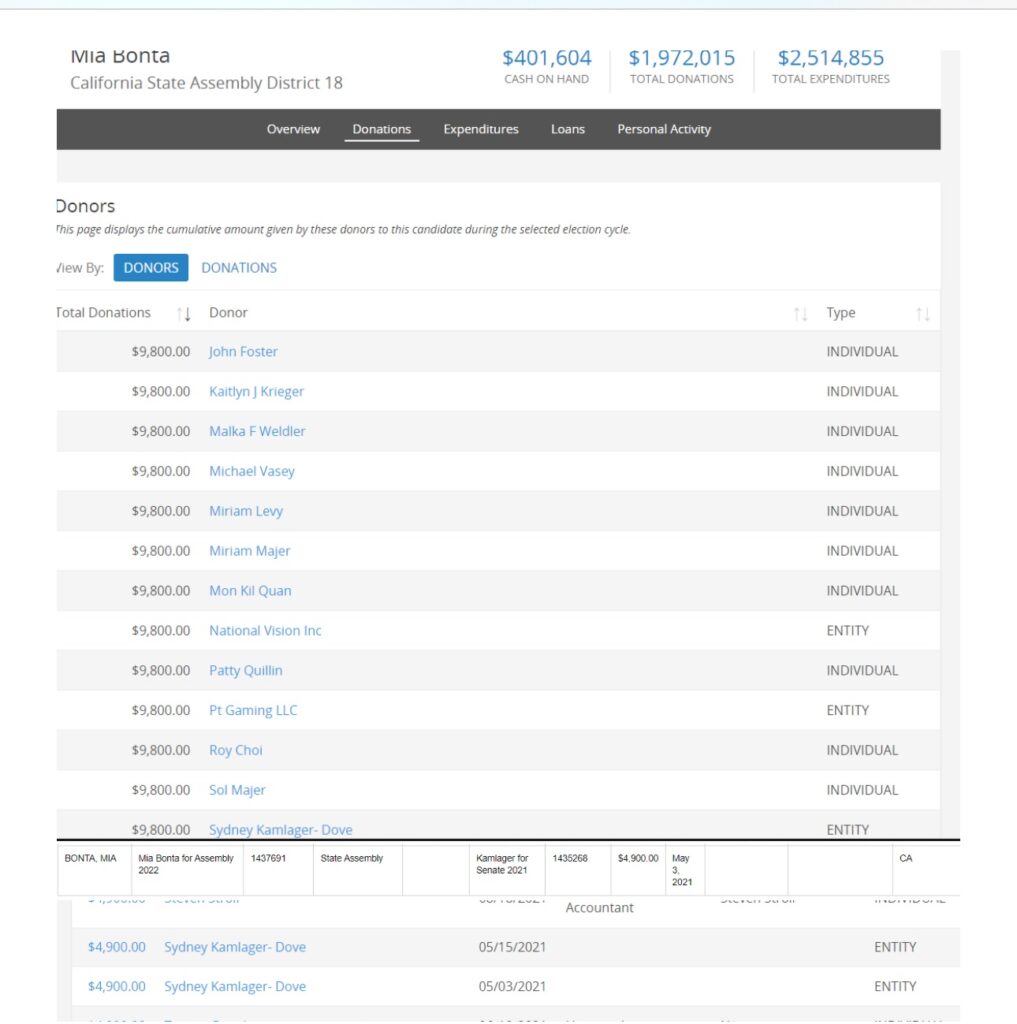
    But Dove’s entry wasn’t the only intervention that raised eyebrows. In the weeks following those warrants,  Congresswoman Sydney Kamlager-Dove – his wife and Holly Mitchell’s longtime protégé – made two strategically timed campaign contributions totaling $9,800 to Mia Bonta, wife of California Attorney General Rob Bonta, who was then running for State Assembly. At the time, Kamlager-Dove was publicly urging AG Bonta’s office to take over the Kuehl-Giggans investigation from the Sheriff’s Department.

    Sydney Kamlager-Dove, the last entry in this screenshot, donated $9800 to Mia Binta’s campaign while lobbying for her husband Attorney General Rob Bonta to take over the Kuehl/Giggans criminal case.

    The timing was politically explosive. The donations, made on May 3 and May 15, 2021, coincided precisely with Kamlager-Dove’s lobbying efforts. Within months, Bonta’s Department of Justice assumed control of the Metro investigation, effectively neutralizing the LASD’s inquiry into Kuehl and Giggans. For investigators familiar with the sequence of events, this was not coincidence, it was calculated damage control disguised as advocacy.

    The implications are profound. Dove, who had positioned himself as Giggans’ defense attorney in a criminal probe, would later reemerge as the lead plaintiff’s lawyer in the Cervantes civil case, securing one of the largest payouts in county history – approved by his wife’s political mentor. Meanwhile, his wife was donating to the spouse of the Attorney General who would later assume jurisdiction over the criminal case involving Dove’s own client.

    A national review of comparable police misconduct cases shows that the Cervantes settlement dwarfs similar payouts, which typically range between $3 million and $10 million. The staggering $25 million figure is nearly three times higher than comparable cases – and unlike those, it came with no policy reforms, no public hearings, and no acknowledgment of conflict-of-interest concerns.

    Now, in a stunning twist that revives the political intrigue of Los Angeles County’s 2022 sheriff’s race, newly uncovered records reveal that Supervisor Sheila Kuehl directed a campaign donation to challenger Robert Luna, shortly after a Los Angeles Times reporter tipped her off to an impending search warrant at her Santa Monica home tied to the high-profile public corruption investigation.

    During his campaign, Luna capitalized on the controversy, promising to “restore integrity” to the department by dismantling the Public Corruption Unit and shifting such investigations to federal or state authorities—a pledge that, to date, has produced no evidence of a single case being handed off.

    Fast forward to this week’s federal indictments of Shangri-La Industries executives, accused of embezzling millions in Project Homekey homeless housing funds through falsified documents and lavish personal spending, and the picture darkens further. The very same developers now under DOJ scrutiny had bankrolled Luna’s 2022 campaign with at least $4,500 and contributed thousands more toward his 2026 re-election bid, according to county finance records. Those donations continued even after Luna dismantled the unit tasked with rooting out pay-to-play corruption, effectively silencing one of the few internal watchdogs capable of exposing such schemes.

    With Luna’s re-election campaign underway and corruption scandals once again engulfing the county, one question looms large: Was the dismantling of the Public Corruption Unit a bold reform, or a strategic move to shield the sheriff’s political benefactors?

    What emerges is an unmistakable pattern – a political protection racket disguised as progressive governance, where campaign cash, connections, and calculated timing influence both criminal and civil outcomes.

    The newly created LA County Independent Ethics Commission may soon face its first major test. Under federal statute 18 U.S.C. § 666, the misuse or influence over county funds in exchange for political favor can rise to the level of bribery. Whether this case meets that threshold remains to be seen, but the optics are unmistakable: a multimillion-dollar settlement enriching the husband of a sitting congresswoman, championed by her longtime mentor on the very board entrusted with safeguarding taxpayer dollars.

    For Los Angeles County, long mired in corruption and cronyism, the convergence of the Cervantes payout and the Kuehl-Giggans cover-up exposes a recurring cycle: the same names, the same money, the same tactics. Each time, the political elite walk away protected, and the public pays the price.

  • Turbulence at LAX: Union Revolt Against Airport Police Chief Cecil Rhambo Exposes Leadership Crisis Ahead of World Cup and Olympics

    Turbulence at LAX: Union Revolt Against Airport Police Chief Cecil Rhambo Exposes Leadership Crisis Ahead of World Cup and Olympics

    The Los Angeles Airport Police Department (LAXPD) is in turmoil as Chief Cecil W. Rhambo Jr. faces mounting backlash from within his own ranks. The Los Angeles Airport Peace Officers Association (LAAPOA) has issued a sharp rebuke of Rhambo’s leadership, publicly calling for his replacement amid growing reports of operational dysfunction, plummeting morale, and allegations of erratic behavior that insiders describe as both behavioral and cognitive decline.

    Leadership Breakdown

    Rhambo, who previously ran for Los Angeles County Sheriff in 2022 before abruptly dropping out when his ties to deputy gangs forced candidate Matt Rodriguez to send LA Democratic Party officials an email exposing what they were likely already aware of about their chosen candidate shady history at LASD:

    “Cecil Rhambo was third in command during the most corrupt regime in the history of the Los Angeles County Sheriff’s Department.  Both of his bosses, Lee Baca and his best friend, Paul Tanaka went to federal prison.  Cecil Rhambo failed them. He has now recast himself as an outsider, who is best prepared to solve the internal problems plaguing the Sheriff’s Department.  There is no bigger insider in this race than Cecil Rhambo.  He was the Assistant Sheriff in charge of the Custody Division while inmates were being brutalized.  A preferred tactic was to shatter the inmate’s eye sockets with flashlights.  Cecil failed to quell the violence, hence the Federal Bureau of Investigation’s (FBI) need to infiltrate the jails to expose a pattern and practice of violence and brutality.  Our federal partners did not trust Rhambo enough to notify him of their intentions.  Ultimately, ten deputies were sentenced to federal prison.  Cecil Rhambo failed them too.  Although he claims to have been a whistleblower, I have yet to see one shred of evidence that shows he notified the Department of Justice (DOJ), or FBI, that his bosses and subordinates were corrupt.  It wasn’t until the FBI was knocking on his door that he testified about his observations.”

    Assistant Sheriff Cecil Rhambo throwing gang signs in uniform.

    has become a lightning rod for controversy once again. According to union officials, his tenure as Chief of Airport Police has been marked by a toxic management style, increasing hostility toward his command staff, and deepening resentment among rank-and-file officers.

    In recent weeks, LAAPOA’s social media platforms have amplified the unrest, drawing parallels between Rhambo’s demeanor and that of former Congresswoman Katie Porter – who was criticized for “aggressive behavior” toward her staff. “LAX has its own version of Porter in LAXPD Chief Cecil Rhambo,” the union wrote, accusing him of exhibiting the same volatile temperament and disregard for subordinates.

    Operational Collapse

    Sources within the department paint a dire picture of day-to-day operations. Equipment is breaking down, patrol vehicles are in disrepair, and staffing levels have reached a breaking point. Officers say they are struggling to keep pace with passenger volumes that continue to rise post-pandemic, let alone prepare for the influx expected during the 2026 World Cup and the 2028 Olympic Games.

    “Understaffing has reached crisis levels,” said one union source. “We’re barely holding the line as it is. If the city doesn’t act soon, the world will see how unprepared LAX really is.”

    Despite these warnings, Mayor Karen Bass—who oversees Los Angeles World Airports (LAWA), the city agency that manages LAX—has reportedly failed to address the department’s pleas for support. “The mayor is aware of the deteriorating conditions,” said a senior officer familiar with internal communications. “But every request for resources gets buried in bureaucracy. It’s like shouting into a void.”

    Fiscal Priorities and Public Safety

    Union leaders argue that while executive pay has ballooned, front-line officers are left to shoulder the burden with minimal resources. LAAPOA noted that morale and recruitment are at all-time lows even as top administrators enjoy salary hikes. Meanwhile, passenger satisfaction scores have dropped, and incidents requiring police response are rising.

    “Rhambo’s leadership is not only ineffective—it’s dangerous,” said one veteran officer. “When the Olympics arrive, the global spotlight will expose just how broken things are behind the scenes.”

    The Road to 2028

    With the World Cup less than a year away and the Olympics looming, the stakes for Los Angeles couldn’t be higher. LAX, one of the busiest airports in the world, serves as a critical gateway for millions of travelers. Yet insiders warn that under the current leadership, the department is “operationally fragile” and “psychologically fractured.”

    As pressure mounts, LAAPOA’s “no confidence” campaign has gained traction, signaling an open revolt within the ranks. Their message is clear: replace Rhambo before disaster strikes.

    Whether City Hall will heed the warning remains to be seen. But one thing is certain—if LAWA and the Mayor’s office continue to ignore the growing cracks in airport security, the consequences could extend far beyond political embarrassment.

  • The Shangri-La Scandal: How LA’s Homeless Crisis Fueled a Political Payoff Pipeline

    The Shangri-La Scandal: How LA’s Homeless Crisis Fueled a Political Payoff Pipeline

    In the heart of Los Angeles County’s sprawling bureaucracy, where federal land meets local ambition, a troubling pattern of influence-peddling has emerged, one that links multimillion-dollar housing projects for veterans and the homeless to campaign donations, backroom deals, and now, federal indictments.

    The recent federal charges against a key executive at Shangri-La Industries have pulled back the curtain on what critics describe as a classic pay-to-play scheme: developers funneling campaign cash to powerful local officials in exchange for lucrative public contracts and regulatory favors. The scandal is now directly tied to projects like the $20.5 million rehabilitation of Building 208 at the West Los Angeles VA Campus, where the Los Angeles County Board of Supervisors played a pivotal role in unlocking taxpayer funds, potentially rewarding their own political donors in the process.

    The Building 208 Project: Federal Land, County Control

    Building 208, a historic property at 11301 Wilshire Boulevard on VA land, was intended to serve as a sanctuary for veterans, offering supportive housing through a 2019 Enhanced-Use Lease (EUL) with the U.S. Department of Veterans Affairs. Shangri-La Construction, LP, a subsidiary of Shangri-La Industries led by CEO Andrew Abdul-Wahab (also known as Andy Meyers), served as the prime contractor, overseeing seismic retrofits, HVAC upgrades, and restorations alongside partners Veterans Housing Partnership, LLC, and Step Up on Second Street, Inc.

    Despite being located on federal property, Building 208 fell under Los Angeles County’s jurisdiction for permits, labor compliance, and land-use oversight, giving the Board of Supervisors unprecedented influence. By early 2023, the project’s costs had ballooned by nearly 20 percent, about $3 million, amid claims of pandemic delays and supply-chain disruptions.

    The financing structure was equally intricate. Through an April 2020 Interlocal Cooperation Agreement between the City and County of Los Angeles, the City issued $18.5 million in tax-exempt bonds and another $2.075 million in 2023, supplemented by $11.66 million from Proposition HHH funds. The Board’s swift approval under the federal Tax Equity and Fiscal Responsibility Act (TEFRA) was essential to release those funds. Without the signatures of Supervisors Kathryn Barger, Hilda Solis, Sheila Kuehl, Mark Ridley-Thomas, and Janice Hahn, the project could not have moved forward.

    This placed the County in a dual role, both gatekeeper and beneficiary, ensuring no progress without political blessing.

    The Fraud Unraveled

    The illusion of progress collapsed in October 2025 when federal prosecutors indicted Shangri-La Industries’ former CFO, Cody Holmes, on multiple counts of mail fraud. Prosecutors allege Holmes embezzled millions from California’s Project Homekey initiative, funneling taxpayer dollars meant for homeless housing into Birkin bags, private jets, and a $46,000-a-month Beverly Hills mansion.

    The indictment came nearly a year after California Attorney General Rob Bonta filed a sweeping civil fraud lawsuit against Shangri-La, accusing the company of defaulting on loans tied to seven motel conversions funded by Project Homekey. According to The Real Deal, the state’s complaint claimed Shangri-La breached its contracts to convert motels into permanent housing and committed outright fraud, leaving all seven properties “at risk of imminent foreclosure.” The company reportedly owed $41 million under delinquent debt as of December 2023.

    Shangri-La had been awarded a staggering $114 million in state grants to convert motels across California into supportive housing. Only two of the seven projects were completed. The rest remain shuttered or in disrepair—bleeding more than $41 million in taxpayer funds.

    Campaign Cash and County Influence

    Public records reveal that Shangri-La’s executives strategically donated thousands of dollars to LA County Supervisors and candidates in tandem with key project approvals. Records from the County’s TRACCER campaign finance database show donations to Supervisors Janice Hahn, Mark Ridley-Thomas, Sheila Kuehl, Hilda Solis, and Kathryn Barger, all of whom voted on housing bond and project funding measures benefiting Shangri-La.

    The pay-to-play pattern extended beyond the Board. Shangri-La’s top executives, including Abdul-Wahab donated $1,500 to Sheriff Robert Luna’s 2022 campaign, while CFO Holmes and company coordinator Skyler Modrzejewski gave $1,500 in 2022 and again in 2026.


    Within months of taking office, Luna disbanded the Sheriff’s Public Corruption Unit, citing budget issues, a move that has since raised serious questions about conflicts of interest given his donors’ growing criminal exposure.

    Yet amid the swirl of corruption, at least one high-profile official refused to be bought. Former Sheriff Alex Villanueva, who ran Los Angeles County’s largest law enforcement agency without accepting donations from Shangri-La or its affiliates, stood apart from the county’s political machine. His administration’s independence, often at odds with the Board of Supervisors, underscored his resistance to the campaign cash pipeline now under federal scrutiny.

    The Pattern – and the Fallout

    What’s emerging is a blueprint for systemic corruption: political donations timed with multimillion-dollar project approvals, inflated construction costs justified through bureaucratic red tape, and a revolving door between developers, nonprofits, and elected officials. In the case of Building 208, the County’s dual oversight of federal funds and local regulations allowed insiders to profit while veterans waited for promised housing.

    As federal and state investigations converge, the questions multiply. Were the escalating project costs legitimate, or were they padded to conceal kickbacks and campaign payoffs? Did elected officials trade approvals for donations? And will the County’s tangled web of political protection finally unravel under the weight of federal subpoenas?

    One thing is clear: this scandal has exposed a culture of entitlement and corruption within Los Angeles County’s political establishment, where even taxpayer-funded programs designed to house the most vulnerable became just another opportunity for profit and power.

    If the allegations hold, the Shangri-La affair is far more than a case of corporate fraud, it’s the first crack in a political dam that’s beginning to burst. The dominoes are already starting to fall, as investigators follow the money trail from failed homeless housing projects to campaign coffers, exposing how deeply entrenched pay-to-play culture has infected Los Angeles County’s power structure.

    What began as a housing scandal now threatens to topple the carefully constructed façade of integrity surrounding county leadership. In the end, the true test won’t just be whether the executives behind Shangri-La face justice, it will be whether Los Angeles County democratic leaders can survive the reckoning that’s coming.
     

  • Feds Indict Developer Tied to Sheriff Luna and LA County’s Political Elite

    Feds Indict Developer Tied to Sheriff Luna and LA County’s Political Elite

    A widening federal investigation into the misuse of millions in homeless housing funds has ripped through the upper echelons of Los Angeles County’s political and law enforcement circles. Federal authorities announced explosive arrests today, October 16, 2025, of individuals in Brentwood and Beverly Hills linked to a brazen scheme that siphoned public money meant for homeless housing into private luxury assets. At the heart of this scandal is Shangri-La Industries, a development firm accused of plundering state and federal housing dollars, and its executives’ calculated financial grip on local politicians, with continued focus on Sheriff Robert Luna, who is fiercely campaigning for re-election in 2026.

    Public records from the Los Angeles County Registrar-Recorder/County Clerk’s TRACCER system expose a decade-long trail of donations from Shangri-La’s CEO, Andrew Abdul-Wahab (professionally known as Andy Meyers), totaling at least $19,000 to various LA County supervisors and candidates. These include $3,000 to Janice Hahn for Supervisor in 2014, $2,000 to her 2016 campaign, $1,500 in 2020, $1,500 each to Mark Ridley-Thomas (2016), Sheila Kuehl (2018), Mark H. Hernandez (2020), Lindsey Horvath (2022), Hilda Solis (2022), and Herb Wesson (2020), $1,000 to Bobby Shriver (2014), and contributions to Kathryn Barger (2024). This sprawling web of payoffs reveals how Shangri-La has masterminded influence across LA County’s political elite, especially those controlling housing and enforcement. Yet, the most damning spotlight burns on Luna, whose campaign has shamelessly cashed in on Shangri-La’s largesse as he fights to cling to power.

    A Form 497 campaign filing from September 12, 2022, lays bare contributions to Luna’s initial 2022 election victory, including $1,500 each from CEO Andrew Abdul-Wahab, and former CFO Cody Holmes – now indicted for mail fraud – totaling at least $4,500 from key executives. These funds were funneled into the “Luna for Sheriff 2022” committee and stamped by the Los Angeles County Registrar’s Proposition Unit. The stranglehold tightens with additional backing, as Skyler Modrzejewski, a Shangri-La Development coordinator, chipped in $1,500 to Luna’s 2022 campaign and another $1,500 to his 2025 reelection efforts per recent TRACCER filings, potentially bolstered by family-linked support.

    These payouts are inextricably tied to explosive allegations of plundering funds from California’s Project Homekey program, which handed Shangri-La approximately $114 million in grants to transform motels into housing for the unhoused. Launched by Governor Gavin Newsom in 2020 as a fast-track response to the COVID-19 crisis, Homekey has awarded over $4 billion statewide for more than 15,000 units, but Shangri-La’s involvement has become a glaring symbol of its pitfalls. The company secured grants for seven motel conversions across California – including projects in Thousand Oaks, Salinas, King City, Redlands, San Bernardino, and two others – promising hundreds of affordable units. Investigators charge that executives hijacked these funds for personal enrichment, lavish spending, and political leverage, with Holmes’ case exposing $2.2 million squandered on Birkin bags, private jets, and a $46,000/month Beverly Hills rental. The timing of these contributions, syncing with the approval timeline of Shangri-La’s state contracts, screams questions about whether taxpayer money secretly bankrolled political favors. Of the seven funded projects, only two are completed, with five left in ruins or foreclosed, saddling taxpayers with over $41 million in losses. As one housing advocate told KCRW, “This isn’t just mismanagement; it’s a betrayal of the most vulnerable, turning emergency funds into executive perks while families sleep on the streets.”

    The influence game stretches beyond Luna. Modrzejewski’s donations also include $1,500 to Janice Hahn (2022), $1,500 to Kathryn Barger (2022), and to Mitchell Englander who was convicted of public corruption in 2020, though his network’s reach extends to other power players like Holly Mitchell ($1,500 in 2022) and Lindsey Horvath ($1,500 in 2022). Total contributions from Modrzejewski-linked donors, including family members, top $68,000 across multiple recipients per TRACER. Luna’s relentless collection of Shangri-La cash – especially as he battles for re-election – ignites fears of cronyism, given the Sheriff’s Department’s heavy hand in encampment clearances tied to these housing debacles.

    Shangri-La’s roots trace back to billionaire Steve Bing, who died by suicide in 2020 after founding the firm as an investment and entertainment empire with stakes in real estate, film, and philanthropy. Under Abdul-Wahab’s iron grip since 2017, it has morphed into a glaring emblem of California’s crumbling homelessness-industrial complex, steeped in corruption, abandoned projects, and federal indictments against executives like Holmes, though Wahab faces only civil suits, not criminal charges.

    This federal case lays bare how Los Angeles’s homelessness crisis has been hijacked as a cash cow for political gain. Shangri-La was entrusted with tens of millions to shelter the vulnerable, yet left projects in shambles, forcing taxpayers to foot the bill. Meanwhile, executives pumped money into Luna’s coffers and those of supervisors who greenlit housing budgets, fueling a firestorm of questions about access and accountability.

    The unholy alliance between Luna and his donors, including an indicted CFO, a CEO under civil scrutiny, and those under investigation, is a ticking time bomb – especially as he scrambles for re-election.

    Adding fuel to the fire, Luna disbanded the Sheriff’s Department’s Public Corruption Unit in early 2023, shortly after taking office, citing redundancy with other agencies and budget constraints, a move that critics argue gutted internal oversight of fraud and influence peddling at a time when such safeguards were most needed.

    Political insiders say these contributions reek of pay-to-play politics – a cash-for-influence pipeline disguised as campaign support. And for Sheriff Luna, the timing couldn’t be worse. With his administration already mired in scandal and operational chaos at LASD, the revelation fuels a growing perception that his leadership is compromised – setting the stage for an explosive showdown in the 2026 race.

    Could these campaign donations be the smoking gun – linking stolen taxpayer dollars straight to political power plays at the highest levels?