The Local Malibu recently confirmed at least two high ranking officers have been transferred from the Lost Hills Sheriff’s Department as a result of an Internal Affairs Investigation regarding the Malibu Creek State Park Shootings.
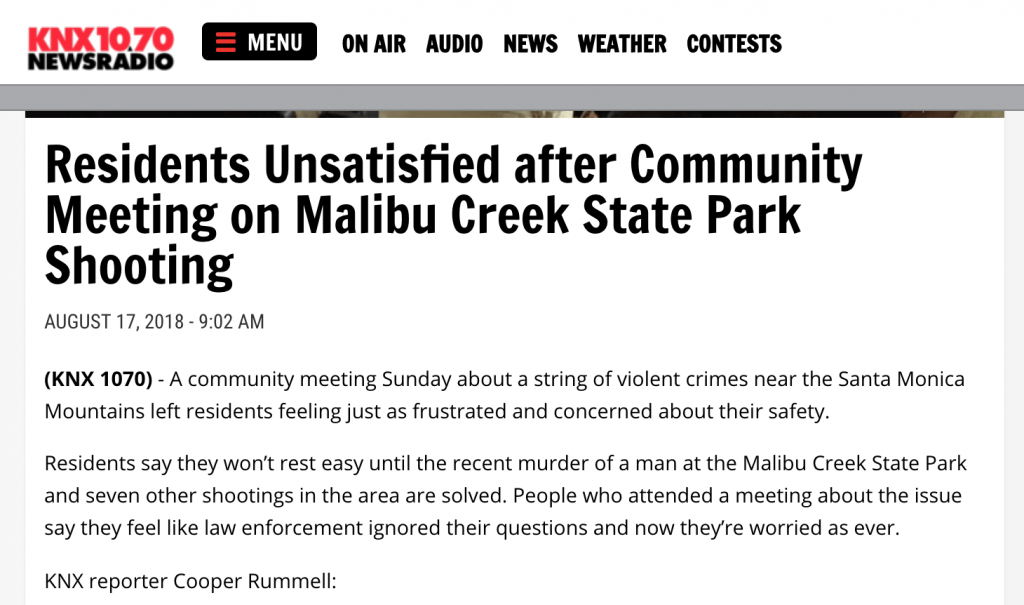
The officers, which we are choosing to keep confidential to allow the Internal Affairs investigation process to be completed without public scrutiny, are a part of an investigation regarding procedural issues involved in at least 5 attempted murder cases and the murder of Tristan Beaudette.
The Internal investigation also includes potential procedural errors on the day Anthony Rauda was arrested.
OVER AND OUT (for now…)
Last Tuesday, one of the high ranking officers involved in the investigation, wrote an email to his colleagues upon learning of his transfer to another department which some have referred to as a “demotion”.
“Late Tuesday I was advised by our acting unit commander, that there is an internal affairs (IA) investigation with possibly several department supervisors named as subjects.” said the officer to his team. “I have been led to believe this is administrative only and not criminal. I have NOT been relieved of duty.” the officer continued.
The shake-up at LASD headquarters started only a week into incoming Sheriff Villanueva’s four year term, and immediately after Beaudette’s widow filed a $90 million dollar lawsuit against LASD and the State.
Erica Wu, the widow of Tristan Beaudette, is suing LASD and State Parks for neglecting to inform the public of the crimes that were occurring at Malibu Creek State Park leading up to the murder of Beaudette on June 22nd, 2018. Wu’s lawyer said they “have confirmed there were aware of at least seven unsolved shootings in Malibu Creek State Park,” and that they “failed to care and provide a safe space for Beaudette and his children, instead causing his death.”
The high profile apprehension of Anthony Rauda on October 10th, 2018, one month before the Sheriff’s election, raised numerous questions as to the timing of and legitimacy of his arrest.
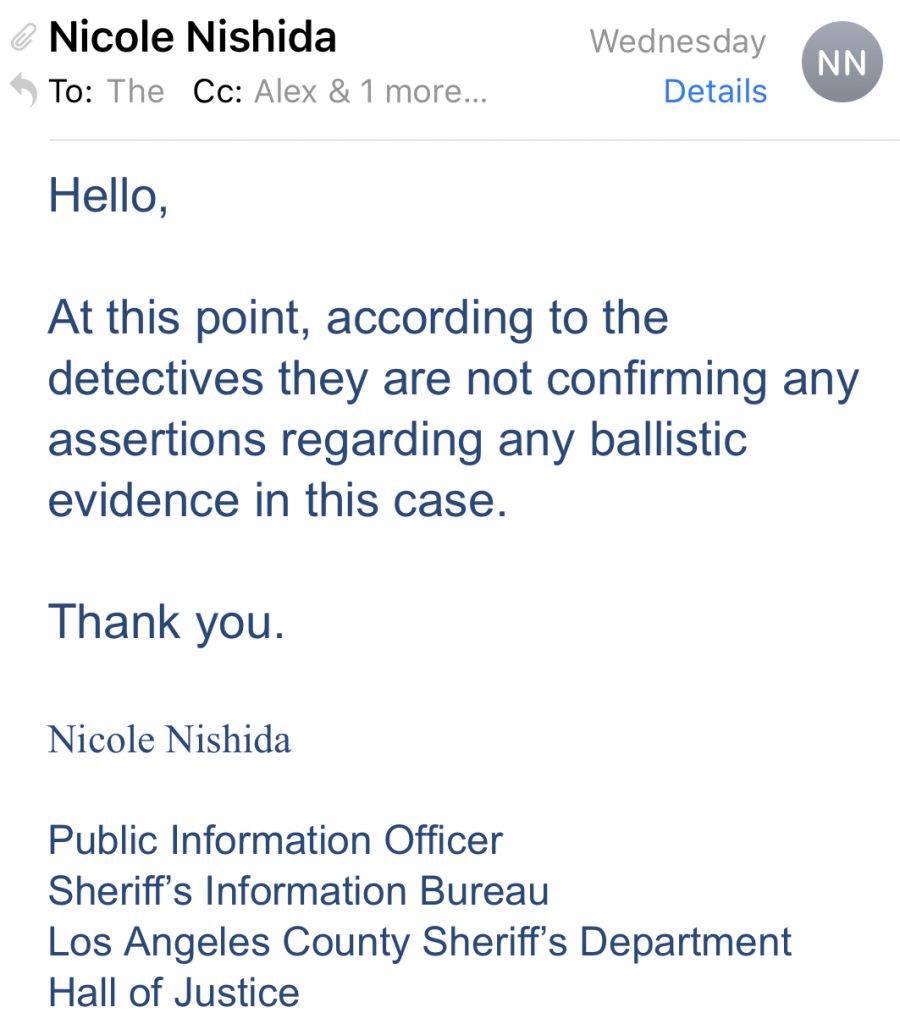
While LASD has continued to further the narrative that Anthony Rauda is indeed responsible for the shootings and the murder of Beaudette, they still refuse to confirm a ballistics match to the murder weapon. This narrative is misleading and the public continues to believe they are safe while the possibility of one or more shootersresponsible for these crimes may be at large.
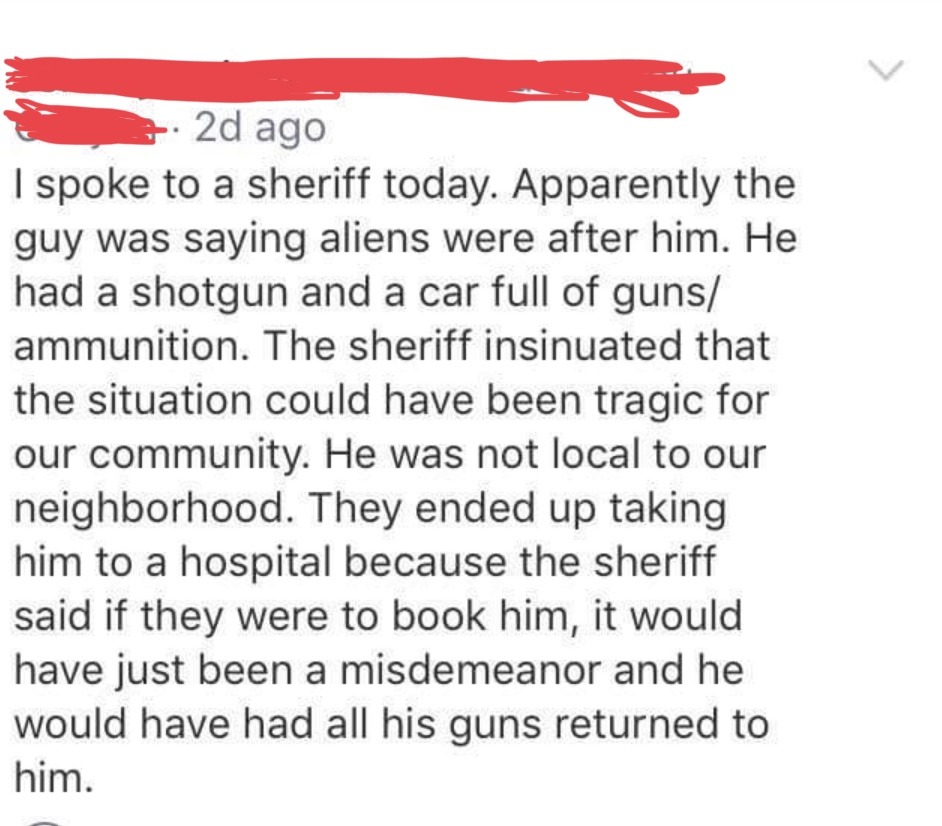
Last week, an incident involving a man with a shotgunand numerous weapons in his vehicle outside Erewhon Market in Calabasas. An employee, who was on break sitting on his car in the parking lot, saw the suspect and alerted authorities.
The man, described by law enforcement as “mentally unstable” was detained without incident, however, the officer did state this situation “could have been tragic for the community” (as reported on NextDoor by a resident who spoke to the officer).
Sudden Impact?
The question now is, how will the Internal Affairs investigation, which has had a profound impact on our local Sheriff’s Department (as well as at LASD Headquarters) impact the case against Anthony Rauda?
Rauda was charged with 10 counts of attempted murder and the murder of Beaudette on January 7th, 2019 – coincidentally the first day Sheriff Villanueva took office.
However, at this point, it looks like it is a case of smoke and mirrors… and like I said in my last article, the only thing that truly stopped the shootings was not the arrest of Anthony Rauda, but the devastating Woolsey Fire.
I just wanted to find out what happened. My confusion started Friday, Nov. 9th, the day fire came to Malibu and Point Dume. I walked to the firehouse on the corner of Zumirez and PCH, the one we always felt would be there for us when the day came we needed them. The guys who would run up and down the street and came to be part of the neighborhood. The guys who said they would be there for us – and who once told my wife we shouldn’t buy a pump and hose since they would come and do a much better job. And we didn’t.
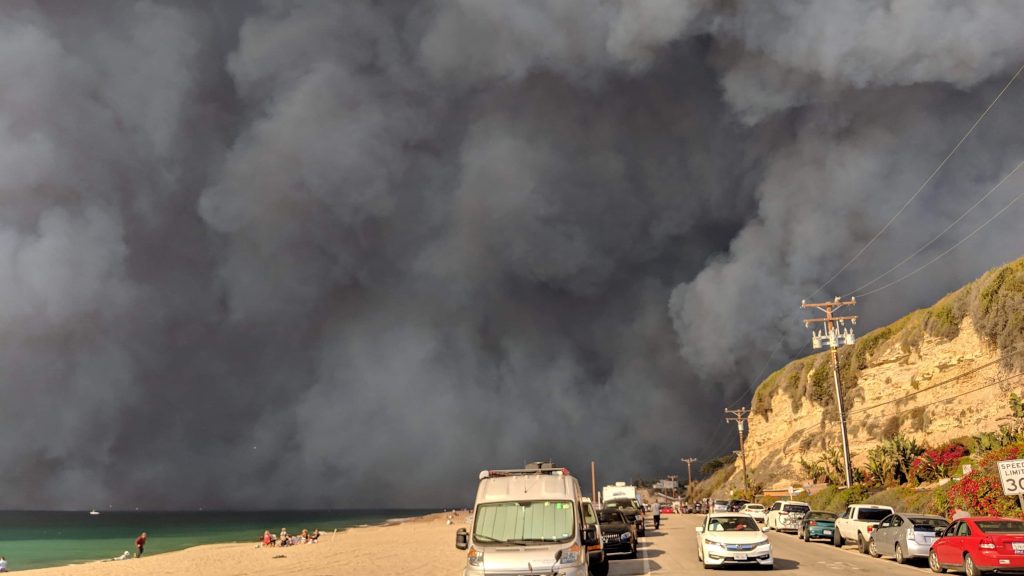
At first the firehouse appeared empty and dark, even though there was a fire truck inside. The hill above upper Zumirez was now ablaze as the fire crested the ridge, and a massive, special effects-like fire cloud loomed ominously above. The situation was looking very serious, PCH was locked with evacuees, and the word was it was 4-5 hours to Santa Monica.
I knocked to no avail, but then saw a man hurrying through the shadows. He saw I spotted him and he reluctantly came to the door, opening it just a crack.
I asked what should we do given PCH was a parking lot and the fire was approaching. “It’s a mandatory evacuation, you should go,” he said. I asked about what would happen if the fire came down to the highway and we were in our car. “Don’t worry, it should go right over you,” he said. I looked at the trees lining the highway and imagined them on fire and falling down on the parked cars, so it didn’t seem like a good idea. I asked, “Should we go to Zuma?” He said, “Yeah, that’s a good idea, too.” What about going to the beach lot at the end of Zumirez? “Yeah, that is a good idea, also,” he said. “Can we count on help coming?” I asked. “I wouldn’t count on it,” he said.
Then he closed the barely-open door and disappeared back inside.
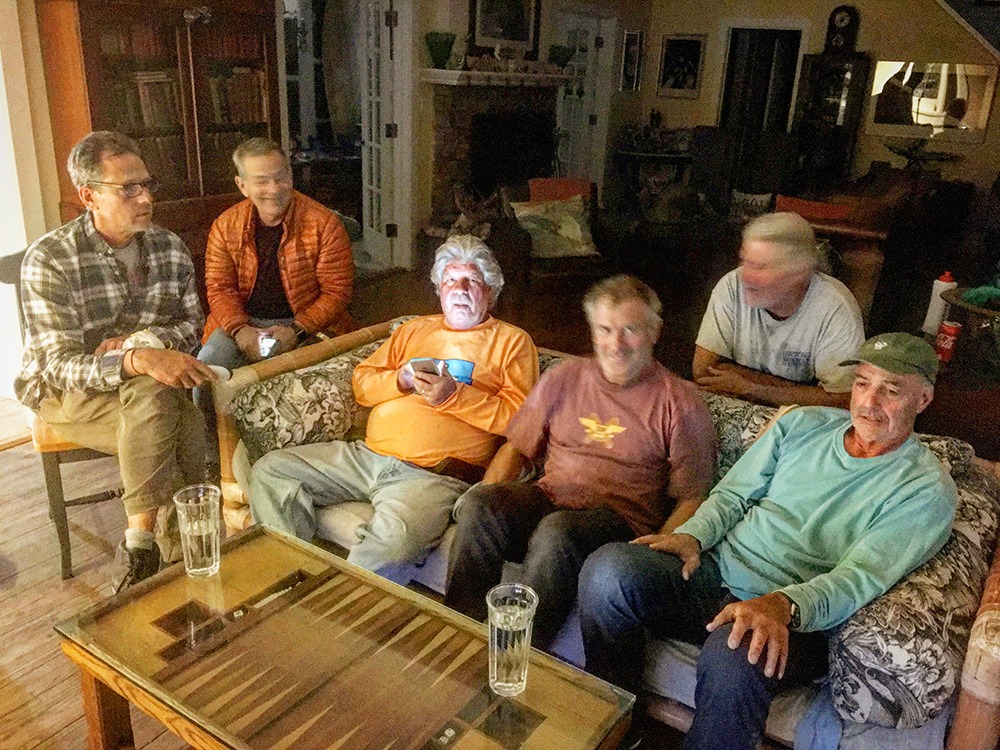
So when it was over – the days and nights of fighting fire — ill prepared and ill equipped, but my house saved, along with most on the street thanks to the adhoc Zumirez Drive (Fighting Alta Cocker Brigade) fire department (Mike Lansbury, James Respondek, Frank Kerze, John and Robbie Mazza, Mace and Mary Stanley and Randy Holland) — and after the days of lockdown, and finally repopulation — I felt compelled to brush off my old journalistic skills (I had written over the years from publications from The Washington Post to the Village Voice to Surfer, and now work as a two-time Emmy-winning documentary producer) I’d call the key players and ask: what happened? What went right and what went wrong with the agencies and politicians and city officials we pay to protect us?
The Zumirez Drive Fire Brigade, a.k.a. “The Fighting Alta Cockers” Photo: Paul Taublieb
The first thing I learned, which in retrospect seemed obvious, is that ‘our’ fireman who lived on our corner were not ‘ours’ at all. They were LOS ANGELES Fire Department fireman. And the sheriffs were not ‘ours’, they were LOS ANGELES sheriff department. But I would also learn that the City of Malibu contracts with those entities for services and they are legally obligated to deliver those services, or so I thought. Because like so many others on Zumirez, the cavalry never came, not during the fire and not after the fire. Something went wrong.
And it seemed the best way was to start with the two people who would be in the best position to know: Rick Mullen, not only our mayor but currently an LA fire chief, and Reva Feldman, who as city manager is the defacto CEO of the city. With Reva, my first email directed me to Rick and no response for a face-to-face, though I remained hopeful.
So with 600 or so homes burned, and virtually no fire trucks seen in Malibu and around Pt. Dume at the height of the incident, I naively thought that Rick would be able to provide candid, expert analysis.
So what went wrong, I asked. Where were the fire trucks, I asked?
Rick, as many would do after him, wanted to focus on the size and speed of the fire, pointing out how it was the biggest and fastest in recent history, if not of all time. His opinion of how the fire was handled? “People did a great job, given the circumstances.” he said. He would, as other would do, also say, paradoxically despite the ‘great job’ that was done, “We learned a lot about how to do things better and different in the future.” So you can do a great job, I guess, but that apparently includes doing things ‘greatly better’ in the future.
But what about the lack of response in Malibu and around Point Dume?
“I can’t speak for the fire department. If you’re interested in their performance, speak to them,” and wouldn’t comment further. Any insights into how the fire was fought? “No,” he said, “and no further comment as you need to talk to them,” he added.
What about the lack of support to the people who stayed behind and ignored the mandatory evacuation? “Direct those questions to the fire chief and sheriff. I have no other comment except a mandatory evacuation is designed to provide ease of movement and operation of emergency forces, and anyone not evacuating impacts that. If the fire department calls for evacuation, they know what they’re doing – evacuate.” Apparently mandatory evacuation is good for the goose, but not for the gander(though I’m not sure what a ‘gander’ is, I must confess). Rick’s son chose to stay behind and fight the fire.
When I did talk to an LA fire chief about this, he commented, “I can’t speak to an individual case, but the fact is anyone who stays behind is putting the life of a fire fighter at risk. It doesn’t matter how prepared you are, you can get in trouble. Firefighters die in fires, so anyone who chooses to remain behind is putting their own life at risk, as well as that of someone who might have to come to rescue him.”
So according to Rick, as best I can figure, mandatory evacuation is mandatory and should be followed, unless it’s someone in your family defending your own home.
After first saying hearing from the community and communicating his priorities, Rick was clearly anxious to get off the phone. But I had few more questions.
Were resources diverting en masse to Pepperdine, as I would later learn they were? Our fire chief cum mayor would only say, “They have a long-standing policy of sheltering in place, but I have no other comment.”
I also asked our mayor about the CERT program. “I’m very familiar with the program, and am an enthusiastic supporter,” he answered enthusiastically, finding ground to talk about with confidence. “It’s a great program.” But when I told him that I was heard from the head of Malibu CERT, Richard Greaves, that much of the contents of the containers were expired, and a lot of the non-expired contents were not what was actually needed by those behind the blockade, he said, “Was CERT used effectively? I don’t know. Don’t expect me to know what’s in every nook-and-cranny in what the city has. I don’t get into that kind of minutia. Okay, maybe it’s less than perfect, I don’t know.”
At this point, he was accusing me of trying to ‘spin’ the story – “I know what you’re doing, you’re going to write whatever you want” – but I told I was just trying to get some answers, and had a couple more questions. He reluctantly stayed on the line.
What about the massive traffic jam on PCH during the evacuation: “Great question – but if you want an answer contact someone from the sheriff department. I don’t know the answer for gridlock.” But then he added, “But yes, it’s something we need to look at in the future.” He wouldn’t elaborate.
Photo: Paul Taublieb
Lastly, I asked him why, at the time of our interview, city hall was still closed for safety reasons, but without any caveats the roadblocks had been taken down and people could freely return to their homes. How could it be too dangerous to open city hall – which wasn’t directly impacted by the fire — yet it was okay for residents to return to their homes? “No one is working at city hall until it’s deemed to be safe. In terms of repopulation, we’re just saying it’s okay to return to your homes, not that it’s safe.If you have any concerns, contact your insurance company.”
Then he was gone.
I really wanted to talk to Reva, and sent her another email. No response. But I did get through to Susan Duenas, Public Safety Manager for the City, who was quite willing to chat. One question I had was why wasn’t someone from the city on-site, in Malibu, during the crisis and the aftermath? Many people felt that you can’t really manage something like this from afar, let alone know what was happening and be able to share up-to-the minute info.
She said they had no choice as city staff. A mandatory evacuation order had been given, and as far as she knew it was a legal order that came from the city attorney, Christi Hogin. But what about all the people who stayed, without repercussions? Clearly, as the mayor was well aware, ‘mandatory’ is not ‘mandatory’. And wouldn’t it have been great to have someone on-site, particularly given city hall had electricity, water and internet and never was threatened?
“If the city says go, then we have to go,” she responded. “If anyone got sick, then they would look to the city.”
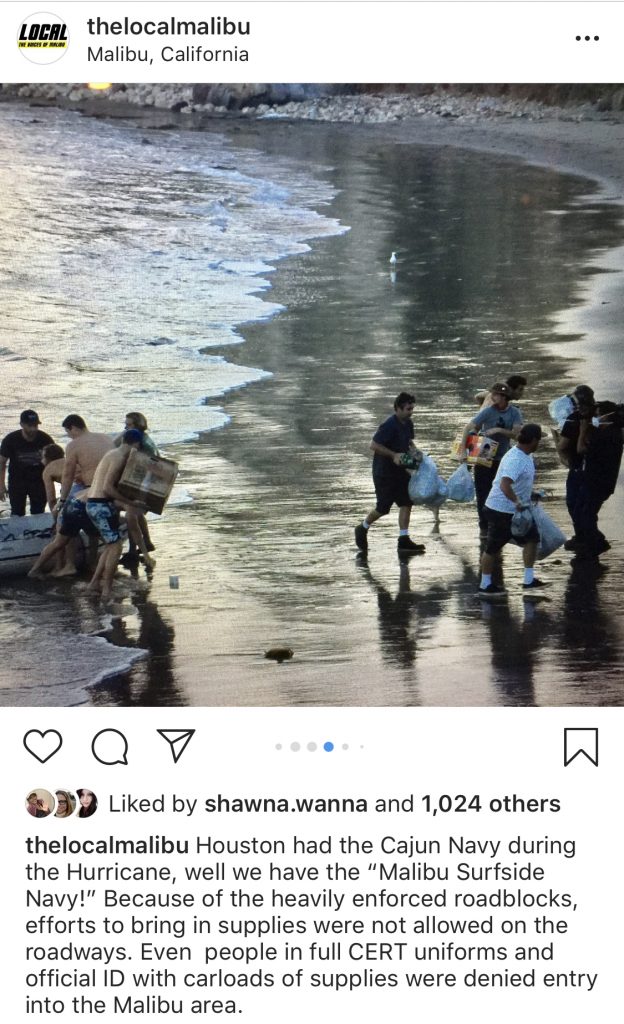
What about getting food, water and other relief goods past the blockade to the residents who stayed behind? Didn’t the city have an obligation of some kind – maybe making the dramatic relief-by-sea and paddle-through-surf unnecessary? A city council member would later rail against the sea-relief efforts. Lifeguard boats actually tried to stop it. And yet a couple of U-Hauls escorted in and out would have solved this?
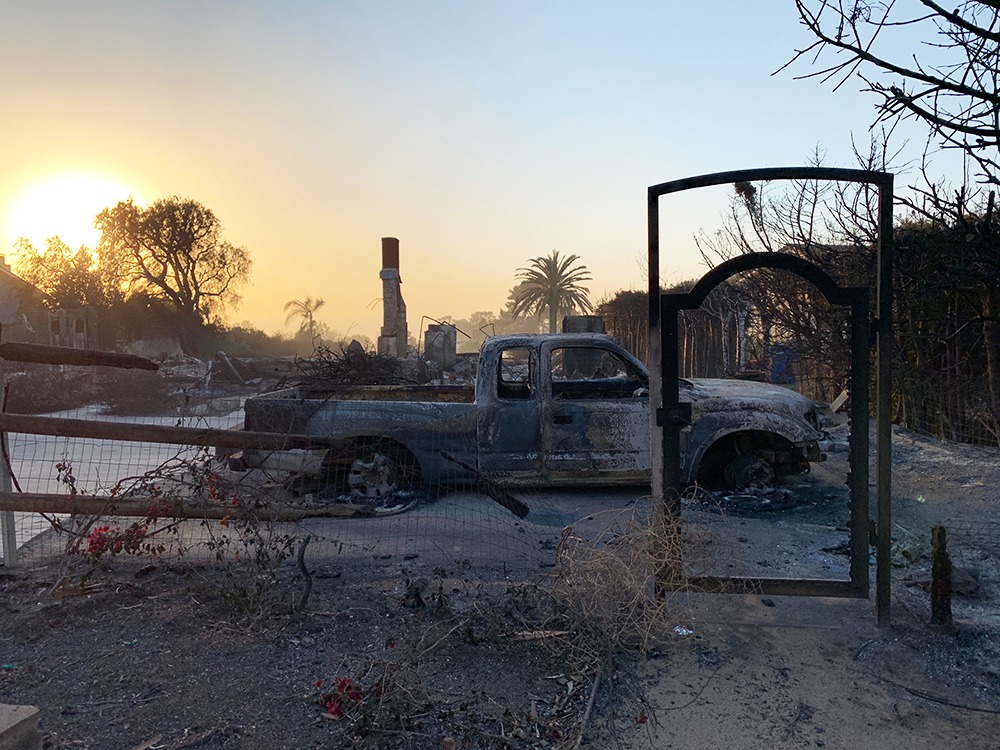
The morning after Woolsey’s wrath wreaked havoc over Malibu. Photo: Paul Taublieb
“We were forbidden because we would technically be breaking the law, and we have to abide with the sheriff’s department since it was a mandatory evacuation,” she said, even when the purpose was to help people who didn’t ‘mandatorily’ evacuate? Also, she said, “FEMA and the state look for reasons to deny money. If they can show you are not doing things by the book, they will deny relief dollars, and have very strict procedures. If we had broken the rules we might not get relief dollars.”
This seemed logical until I later learned that over in Thousand Oaks and other areas impacted by the fire, FEMA itself was “disobeying” the ‘mandatory’ orders in those areas and providing assistance, and when I spoke to a high-ranking official of a neighboring city who has dealt extensively with FEMA, he said, “That’s ridiculous. You’re not going to be penalized for helping citizens in a safe and responsible manner – it’s exactly what FEMA is supposed to do, and they would support a city that did this. And we know it was safe to drive up PCH from Santa Monica to Pt. Dume Marine Science or even to Zuma – they just would have had to take on the sheriffs to make it happen, and they clearly didn’t want to. It’s just the way Malibu operates – a failed bureaucracy, from the top down.” More from him later.
Total devastation on Point Dume. Photo: Paul Taublieb
Susan did explain, “You have to understand, it was a challenge from our side. We were working 24/7, remotely, at home with no makeup and in our pajamas.”
I also asked her about the parking-lot-on-PCH evacuation fiasco. “Oh, I’m really glad you asked that question. It was something we spent a lot of time discussing, but the way things happened just wasn’t something we anticipated in our planning. You would think opening one or both northbound lanes heading south would be possible, but there were many agencies involved and it’s really complex, and it’s something we need to think much more about beforehand if there’s a next time.”
Not a bad idea, I thought. Think about evacuation from an area with a history of fires more beforehand.
But still, I could tell Susan really did care and had tried her best. I needed to hear from Reva, who actually runs the city under the direction of the city council. I reached out to Matt Meyerhoff, the Public Information Officer for Malibu. He wanted to be helpful, but said, “It’s up to her if she wants to talk to the media. She’s under no obligation to do so. I’ll ask her again.”
One city official who would talk was city attorney, Christi Hogin. I asked her if Reva had an obligation to talk to the press. “All government is about communicating to constituents, and I don’t see how that happens without the press,” said Hogin. “But I don’t think Reva, or anyone else, has a legal obligation to speak to the press.”
And legally, I also wondered, what does ‘mandatory evacuation’ actually mean? “That’s an interesting question, and I’m not sure,” she opined. “I can tell you this – no one is going to arrest you for not evacuating.” (Note: later research revealed that it is a rarely, if ever, enforced misdemeanor, for not abiding by a mandatory evacuation order, but Is at most a small fine).
Regarding what was happening the days after the fire, Christi had some interesting insights as she was working out of the temporary offices set up in Santa Monica. “Priority for the city wasn’t to get relief to the people who stayed behind but reorganizing population. Hey, we saw on the internet they were actually doing pretty good, so we weren’t putting in any effort to try and create a supply line.”
“Our focus was to end the blockade, for repopulation, not relief. People were anxious to get back in, and our efforts were focused on ending the evacuation,” she added. “We wanted to get it open for everyone, that was the focus of our skeletal staff – not worrying about relief. ”
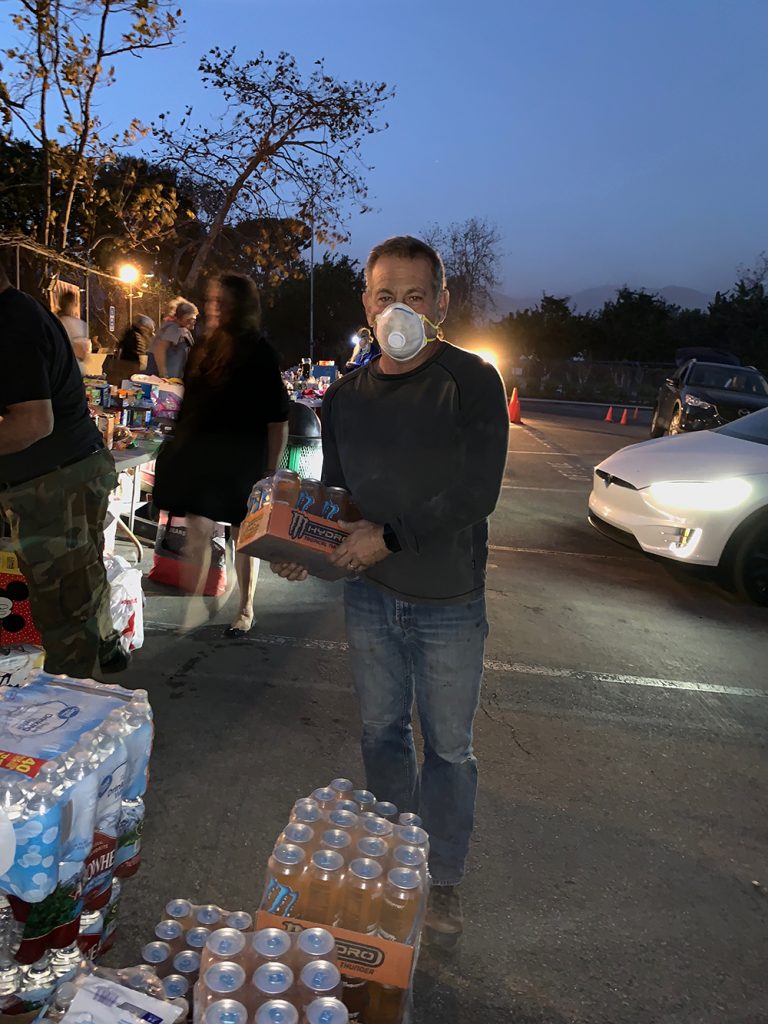
At the Point Dume Marine Science School Relief Center Photo: Ari Taublieb
She also added one intriguing concept, and conundrum. “The city is responsible for providing fire and police protection, that is an obligation we have and we contract for that with the county.” So if the city is responsible, where were the fire trucks that the citizens paid for, even if somewhat indirectly?“All I can say is Cal Fire took command, and they have their own criteria for dealing with the situation, particularly with a fast-moving fire like we had. Once an evacuation is declared and it’s an emergency situation, the city really has no role in that decision making, even if we’ve contracted with them.”
“There were plans, and I can’t understand why the right people who had the right equipment refused to provide aid,” she added, referencing the many accounts of fire trucks sitting idle. “In the future we have to figure out a way to have faith in each other, need to understand the thinking. We shouldn’t be defensive about it, we need to learn from it.”
But when I asked where were the fire trucks, and what about the problems with the Sheriff Department, her only answer was, “Cal fire took over command, and we followed the direction from them, the LA fire department and the Sheriff Department. We may hire the fire department and have an obligation to provide those services to the community, but once there’s a fire we have no control of the decisions the fire department makes.”
Kind of a curious conundrum. The city is legally obligated to provide fire services to the citizens, but once there’s a fire or other major event, the city has no ability to direct how they execute their services.
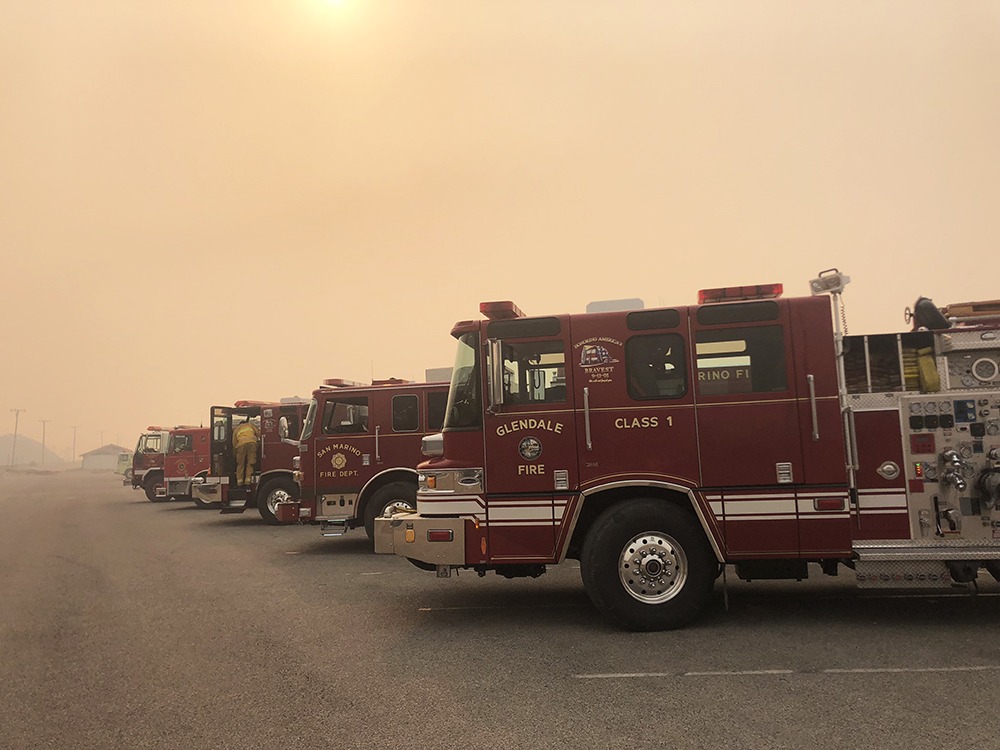
Fire trucks from all over LA County were sitting stationary at Zuma Beach in the early morning hours of November 10th. Photo: Cece Woods
With still no word back from Reva, my editor – the indefatigable Cece Woods, to whom I am indebted for putting me under the auspices of The Local for this crisis – did connect me to someone I confirmed was a high ranking official at a neighboring city which has suffered similarly to Malibu from the Woolsey fire.” He had quite a bit to say, even though he had to do it anonymously.
“In terms of the city of Malibu, speaking as someone who is a professional in city management, it was a total fail. Perhaps even negligent,”was his opinion.
“Now I have big love for the city of Malibu and have many friends there, and being in my position in my city government, a lot of people called me to find out what was going on, because they weren’t hearing anything from the city. And that’s inexcusable mismanagement. And if you’re asking my opinion, you have to question the job Reva did, because she’s in charge, and any problems are her responsibility,” he began.
“Where do I start? If city hall is not being used, why not open it up and use it as a shelter? People need a roof over their heads, and there was full electricity and internet. My city was open the whole time, and we had flames a block away, which never happened near Malibu city hall.
“Let me tell you about the evacuation – it was damn lucky only three deaths, not 300. It’s ridiculous they hadn’t anticipated the need to open all lanes south – that’s the responsibility of the city manager to do disaster planning – and this wasn’t hard at all to have gamed-out as a possibility.Our city manager has actual hands-on experience during a disaster, and that’s what is needed, and what Malibu didn’t have,” he explained.
“What Malibu also needs,” he continued, “is a public works department that can be onsite during a crisis and assist with knowledge of the area – which people from the outside can never do. And what Malibu needs is what we had –a city manager who is on-site, or at least coming every day to see what’s going on and manage a crisis with first-hand knowledge, not working remotely, because that’s the only way to really know what’s going on, and be responsive to the needs of the citizens,” he concluded.
Still trying to get in touch with Reva, I did hear back from Matt Meyerhoff, the Public Information Officer for the city, with no update on her speaking to me. But he reiterated Duenas’s position.
“We were told it was illegal to bring relief supplies, so we focused on repopulation, not resupply,” he explained. “We have to abide by what the sheriff was telling us, and advice of council,” even though city attorney, Christi Hogin wouldn’t confirm she had given that specific advice, Meyerhoff wouldn’t exactly confirm who directed things overall, either, as if maybe there was someone’s name he didn’t want to mention who might be culpable.
Meyerhoff also was both oddly proud, and also a little contrite, about the effectiveness of communication with the citizens, during and after the fire. “We put out constant updates and I really felt we were doing our jobs,” he said, “but I have heard people felt there wasn’t enough info. But hey, it was really hard since we weren’t on-site because the sheriffs said we couldn’t be there. Something to do better next time!”
“Matt Meyerhoff? Never heard of him,” began LA County Fire Chief Tony Imbrenda,when we began what was a long and disturbing conversation. “The city is supposed to send a PIO (Public Information Officer) to our command post and embed with our team to roll out the same message across all media to keep a unified message and have accurate information. The problem is people have egos and did their own reports that weren’t vetted. And there was no one from Malibu at our command.”
“I was at our command center the whole time, gathering information and sending information out,” continued Imbrenda. “Look, the first thing you have to understand is the size of this fire, over 14 miles wide, maybe up to 20 miles wide, with winds blowing as high as 85 miles per hour.
“And many of the strike teams were not from the region as we had to backfill after sending resources north,” Imbrenda explained. “So you had guys not knowing what to do is because without cell service –down because electricity was cut off – they had to try and go by Thomas Guides, and given the terrain there’s a big chance of entrapment and there not being an egress route, especially given the geography,” Imbrenda said, explaining why the response on-site seemed so scattered and hesitant to respond to requests from locals during the event.
“In the case of this fire, fire fighters were driving over downed power lines, had to do it constantly to try everything, which we never are supposed to do because we were trying. But I have to admit some guys were from out of the area and if they were asked to fight a fire or come to someone’s aid and didn’t, which I understood did take place, it’s probably because they were from out-of-town, were going by a Thomas Guide, and simply didn’t know how to respond properly. The fire department functions in a military fashion, and without coordination and proper orders they can’t, and won’t, just go on their own.”
“So yes, there was a breakdown somewhere, and it’s something we want to get to the bottom of,” he admitted.
He wanted to stress one point: “We will go out and risk our lives, but if you want to be safe and you want fire fighters to be safe, the one way you can guarantee you will survive is simple. Evacuate.”
When I mentioned there was, um, a bit of a problem with the evacuation, he acknowledged it. “I personally ordered evacuation over Twitter, and told all the residents to leave the area, and said this on all local media as well. But in retrospect, what you had was paralysis by analysis given what happened with the traffic.”
“I would have immediately opened all four lanes to get people out of there. There’s no excuse for people sitting there for that long,” he added.
I mentioned my experience of being told to get in line and evacuate, with the advice from a firefighter that if the fire came down to the road it would go over us. “Well, we have some people who are not very bright, and some of the people manning fire stations might not have been actual fire fighters. But I’m horrified that traffic situation took place – it could have been a disaster, a highway of death, and if anyone tells you differently, they don’t know what they’re talking about.
“The bottom line is we got lucky, very lucky, that hundreds of people didn’t die waiting to get out of Malibu,” he stated matter-of-factly.
He did add that “Part of the problem would have been eased if people left earlier when the word first went out. But everyone is conditioned that Malibu and Pt. Dume never burns, so they waited and then all left at once. But that’s no excuse for how it was handled – and the tragedy of what almost happened.”
I backed up and asked him when he said the whole ‘area’ was under mandatory evacuation, did that in his mind include Pepperdine?
“They should have evacuated, as far as I’m concerned because the only way to insure survival and safety is to leave. For people and firefighters. But the decision was made to shelter in place. I even asked another fire chief about this, as I couldn’t understand why they stayed. It meant lives were at risk, it’s as simple as that.
“I was told that a high level politician had made a call, that the school said they didn’t have resources to get everyone out, and the fire department was told to send resources.” Imbrenda explained.
“That meant five battalions, with each battalion being five fire-fighting trucks, plus a command vehicle” and some level of air resources, as anecdotally myself and others observed numerous helicopter runs over the campus dropping liquid (not just refueling or picking up water)”.
(Note: This was confirmed by Point Dume Bomber, Keegan Gibbs, who said, “I heard it over and over on the LA fire radio, which I was monitoring, for over two hours on Friday – send resources to Pepperdine. Life over property. Go now.”)
“Why those evacuations didn’t occur? All I can say is I agree it’s not fair, and I would like to know the discussion between the university president and our command and how that decision was arrived at. It’s a valid question – why that evacuation was not done. It’s a legitimate question that needs to be answered,” he said. “Why there was a lack of ground transportation, I find that unacceptable because it put lives at risk. The potential to move those students with vans or buses wasn’t there, but should have been.
“With students sheltering in place, there was no way we were going to let them die, but it’s a hard question to answer – why were so many resources directed to the university and what do we tell a resident who lost their single family dwelling because of it, what do we tell them?” he asked in conclusion.
I did some other research into the Pepperdine situation. Of course, I tried to reach Pepperdine for comment, but except for one short email, was denied any opportunity to talk to anyone, including the president’s office, where I left a number of messages. For an institution that claims to want to be part of the local community, it was sadly ironic they wouldn’t talk to The Local.
But this is what I did learn from eyewitnesses and other sources. On Friday afternoon of the fire, students were advised to “leave if possible,” which many, if not most, did. Then sometime late on Friday, the remaining students were told they couldn’t leave and should “shelter in place.” According to the university this was for their own safety, that they had no means of getting these remaining students out, that they had nowhere for these students to go.
According to a cynic, they were guarantees that, as fire chief Imbrenda said, “by them remaining, we were going to defend the University, even at the expense of single family homes.” Or to put it crassly, you might take some liberties and say they were human shields for the University property. One might.
A key question is how many students were remaining. According to a written statement by the University, it was between 1200 and 1500. However, according to the school’s own newspaper, the number was likely closer to 500. And of particular note, by Saturday morning – while homes in Malibu and Point Dume continued to light up and burn, and the 5 battalions remained at Pepperdine – the number of students on campus dwindled to as few as 100, according to eyewitness reports. So all day Saturday and all day Sunday, the university and a handful of students were protected, but Malibu burned. You can argue, as the university does, that there was nowhere to put these students, that they couldn’t just throw them to the wind on their own, and they say there was no way to get buses or vans to evacuate them even though, as I experienced on both these days with my press pass, it was clear and open sailing from Pepperdine down PCH to Santa Monica, with neither obstruction or threat.
Regarding the repopulation, Imbrenda said, “The check points should have been open faster and the whole situation handled better. There was a communication problem between so many entities, compounded by having guys at the checkpoints not being from the area. They always say it’s the fire department that keeps people out, but it’s not true. You have Edison, you have police, you have other entities. They all want it closed as long as possible. But I acknowledge the process was slow and cumbersome. I tried to relieve that, which would have alleviated a lot of suffering, but I didn’t have that power. “
Imprenda promised to learn, do a true post mortem, and do things better in the future, and at the very least, I believe he is sincere in his desire and intent, though whether things actually change remains to be seen.
I also found a sheriff with long standing experience in Malibu who asked to remain anonymous, and he put it this way, “It was an old fashioned cluster fuck. First when the fire started, besides how big it was, it crossed jurisdictions, so you had all kinds of brass trying to run things. Then what we call the ‘mother ship’ came in with the top guys and it became a bureaucratic mess. By the time the order came to evacuate, it was inaction by committee – too much talking and not enough action.”
With still no word from Reva, I reached out to Skylar Peak, who I’ve shared a few peaks with in the water at Dume. He was happy to talk about his role, which some found controversial, and said he would also try to get Reva to get on the phone or have a meeting.
“Look,” he began, “this was the biggest, fastest moving fire in history. And I think the city did a fantastic job given the circumstances.” During the period when the lockdown was on, Skylar drew attention for seemingly not supporting the influx of food, gas and survival supplies, though in our conversation he downplayed reports of being involved in trying to stop the relief effort. “I wasn’t against it, I was just very concerned about the gas being brought in as my main issue,” he said, not really addressing the other claims, with numerous accounts of him supporting the abbreviated effort by the lifeguards to block the effort to circumvent the blockade. But specifically, it was the gas, he said, was his concern: “It wasn’t being stored or managed properly, and imagine if the gas had spilled into the ocean!” he explained.
As someone who came in and out during the blockade, why, I asked, didn’t he organize a truck of relief supplies so the water mission wouldn’t have been necessary. “If you choose to stay behind, you need to be prepared to take care of yourself, and it’s not the city’s responsibility to help people who didn’t properly prepare, as I did.”
I asked him for help in sitting down with Reva, and soon afterwards, I received an email from her. I should send her a list of questions, and then she would respond in writing, she asked.I told her “No, I don’t do journalism that way. It’s not a take-home test”.
Skylar said he would see what he could do about a face-to-face.
While waiting, I spoke to a local volunteer sheriff, who stayed behind the whole time on patrol, and volunteered to talk as long as no name was used. This person had some interesting observations.
“I’m on the radio the whole time, hearing everything,” the volunteer began. “And I can tell you it was chaos, a catastrophic breakdown of communication. Firemen were asking for orders and not getting them. There was no information as to where to go, what houses needed help and where fire engines were supposed to go. I believe these out-of-town firemen wanted to help, but they weren’t getting orders or directions and they weren’t just going to freelance – particularly when they didn’t know the terrain.
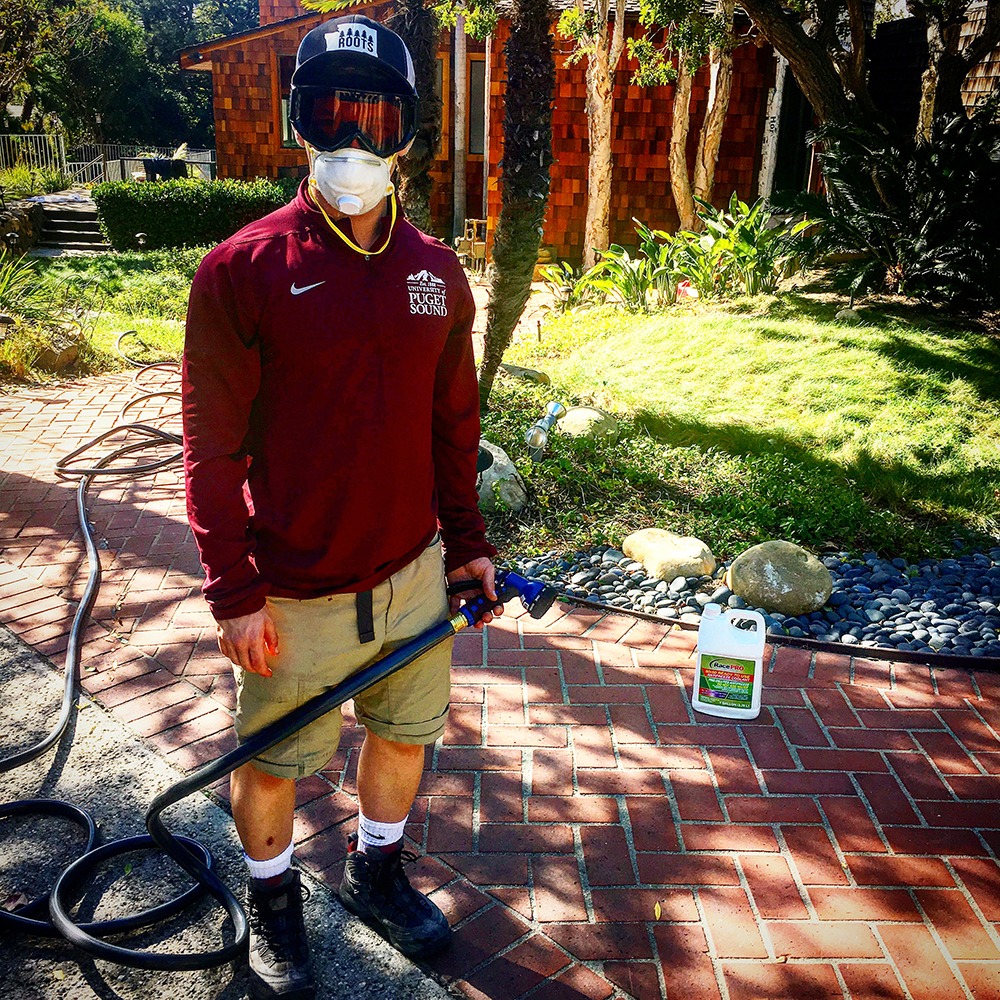
(We on Zumirez, btw, experienced this first hand during the fires. An fire truck cruised down our street as we attacked hot spots in the ravine behind houses on one side of the street using garden hoses, often with a weak stream of water. Here was deliverance, we thought. But when we asked them to come down in the gully, whatever little enthusiasm this out-of-town truck had immediately evaporated. Nope, they explained they don’t go down into gullies or ravines they don’t know as a matter of policy, and no amount of explaining it was really just people’s backyards and you couldn’t get trapped, was effective. They simply got back in their truck and drove away, leaving us slack jawed, disappointed, feeling left on our own and more resolved than ever to keep fighting fires and saving each other’s homes on Zumirez; 28 houses were saved, only two were lost.)
Ari Taublieb putting out spot fires on Point Dume. Photo: Paul Taublieb
“There were all these agencies not talking to each other” the sheriff’s volunteer continued, “and not getting anywhere.
“I’m a Malibu resident, and for days people were asking which houses were standing and which were not. As I drove around on patrol, I tried to answer as many people as I could, but the city itself did nothing in this regard,” the volunteer explained.
“But I’ll tell you what bothered me the most,” the volunteer stated. “During the entire event we had an office at Malibu City Hall. There was never a time city hall didn’t have electricity, internet, water and bathrooms. Land lines were working – why weren’t those doors flung open? Where was our mayor? Where was Sheila Kuehl? Where was our city manager? I don’t care what they say but there is no substitute for being fully onsite. There was a news trucks and media on every corner. But no city mayor, no head of emergency services, no city manager. It was complete radio silence from the city– and there should have been news hourly from the city – like what the community got from Cece and The Local,” the volunteer added.
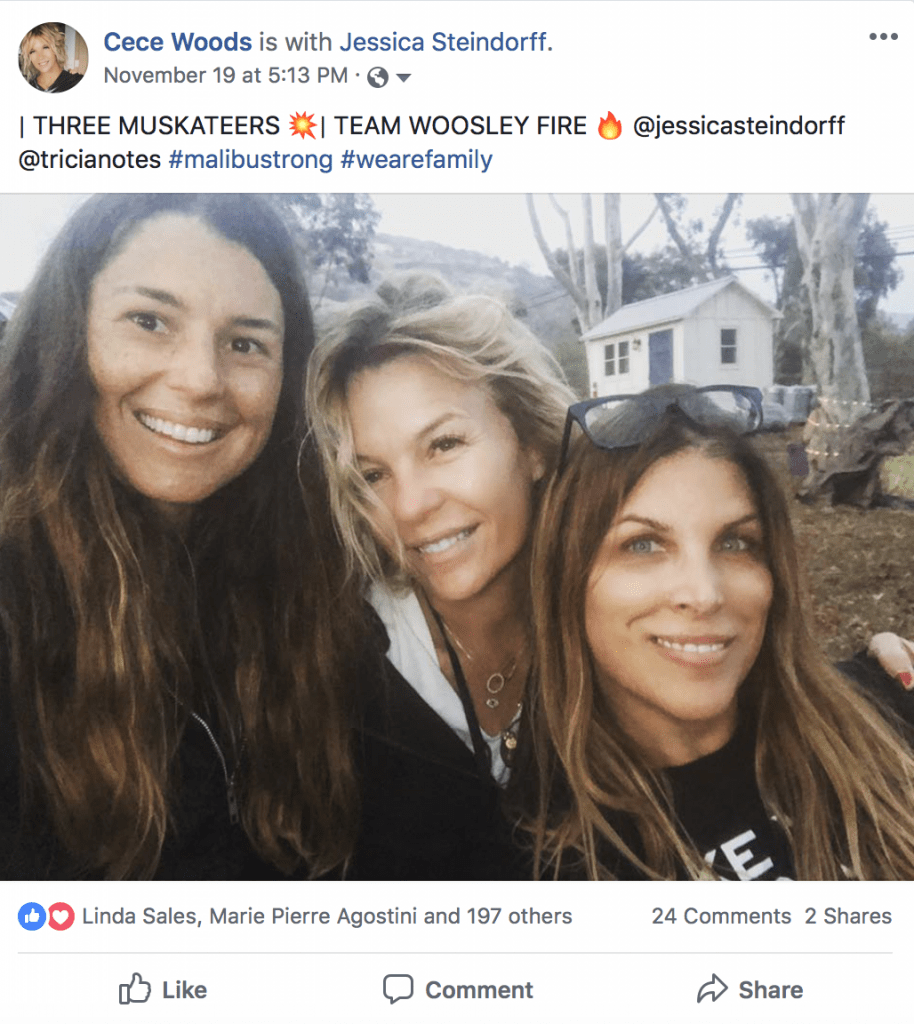
Team Woolsey Fire Community Communication Center was manned by Editor in Chief Cece Woods (center), Tricia Small (far right) and Jessica Steindorff (left).
”It was safe enough for us, if our leaders really cared, they would have been there,” the volunteer concluded. “No excuses.”
Then came the call from Skylar. Reva would meet at City Hall.
Skylar walked me down the hall to the meetings, and suddenly I saw the appeal of being a council member. In the modern, sleek offices, being a councilman was very much a role where as you walked past the various desks, there were murmurs of quiet respect.
We entered a conference room, myself, Skylar, Reva and an assistant.
“We were in the middle of a perfect disaster storm, beginning on Monday of that week,”Reva began, seeming as if she had prepared the statement and narrative, but leaving me a bit confused. Monday, I thought, the fire was pretty much over by then? Huh? As she continued, I got more confused, “There was a sheriff captain with a medical emergency and we were dealing with a new guy on Monday,” she continued, and now I was baffled.
“The next day we had an election, which was very demanding on our whole staff. And there was the shooting where a Pepperdine student was lost along with others and we and Lost Hills Sheriff Department were responding to that. So we were very stressed and had been working long days.”
What, I thought?
“Then I got the call about 5 am from Skylar about the fire,” she continued.
In other words, her narrative was that the week leading up to the fire was demanding and stressful, and the initially tepid response by the city was due to the busy, difficult week before, though candidly I failed to see how a new sheriff, a shooting outside of Malibu and doing the normal job of a city of holding an election, as done annually, could be used as an excuse for the city’s response. But that was her case, seconded by Skylar.
Next, came the description of the size, speed and scope of the fire, and how it was unprecedented and this was the real root cause of whatever shortcomings that ensued. I had heard this before.
Followed by praise. Of themselves.
“Hey, there were 60,000 houses in the fire zone,” Reva stated, expanding her prevue well outside of Malibu, “and only 1600 were lost, so people should be praised for that.”
In terms of the evacuation snafu, neither she nor Skylar saw it that way. “The evacuation worked,” said Peak. “Look, nobody died on the highway.”
“I will continually say that not one person died,” added Reva. “That’s a very good success, especially considering what happened at the Paradise fire.”
When asked about how close a disaster came, as the fire chief had said it was “potentially a highway of death,” both countered that it didn’t’ happen so what was the issue?
Now, both Reva and Skylar emphasized that the City of Malibu “Doesn’t have prevue over the sheriff department, fire department, Cal Fire or any other first responder.”
As to why they evacuated and didn’t manage the fire onsite, as a nearby city did, Reva explained, “We were given evacuation orders and we followed them, which is our protocol and the proper thing to do. We don’t question the fire department and police department when they issue orders.”
She refuted comments that the city didn’t do much to open all lanes going south. “CHP is responsible, they direct traffic. We were actively trying to get lanes open.” She did add, “OK, decisions were not made quickly enough, even though we had planned for something like this, if not this exactly”
“We sit and do these exercises and plan for scenarios like this,” she added, “and not one person died in the city,” she repeated.
Regarding the issue of Pepperdine, and the allocation of resources over Malibu, her only comment was “That’s not a city conversation. Talk to the fire department, I don’t know about taking a stand in that particular location.” Technically correct, if not legally, but sure seems like a dodge given Pepperdine’s proximity essentially within Malibu, and her previous concern over the tragic shooting event that took place there and the fact that the diversion to Pepperdine over Malibu residences may have cost many families – her actual constituency – their homes. Neither she or Sklyar would comment further or address any other question in this regard.
We had a limited window for this conversation, so I asked about why the city didn’t come more to the aid of the citizens who had stayed behind. Both she and Skylar were clear on this.
“Look at it this way,” she began. “We have 13,000 people in Malibu, all paying taxes and many who left were now paying for their hotels and other expenses. The 1,000 or so who decided to stay behind, they now want the city to come take care of them? That’s simply not fair.”
Skylar added, “It’s ridiculous to think that if there’s not going to be electricity or water you should stay in your home unless you’re prepared to survive on your own. If you can’t handle your own survival, you could consider leaving.”
“We did provide food and water to animals at Zuma for the first two days,” Reva added. “But after that people were on their own. After that, we did not feel it was our obligation to bring in further supplies after that. People were on their own as far as we were concerned. People who chose to remain need to take responsibility for their safety, and our focus after that was repopulation, which is actually more complex than many people understand as we’re talking about leasing land and making many other arrangements.”
“Yes there were some issues,” she concluded, “We have to change things in our plans to do things better, that’s my takeaway, but overall I think the city did a great job.”
And with that, she hurried off to another meeting.
Photo: Steve Woods
Here’s my conclusion. The city actually had a fairly low-bar to hit to handle this successfully.They are not the fire department or the sheriff’s department. During a crisis they actually have very little to do — just let people know what’s going on — and given that somewhere around 1,000+ people stayed behind, bringing a little relief in some trucks would not have been that difficult or expensive, even if meant bending some rules a tad.
But under pressure, a city manager who has a conservative bureaucratic, by-the-book orientation, a mayor who not only had a conflict of interest but was a hypocrite over evacuation, and city council members who didn’t know how to react, it was all just bungled. With a huge swath of your population staying behind, city hall could have easily been manned, and the much needed communication, which totally broke down, could have been addressed.
Cece Woods is a force of nature, but her efforts of letting people know what was going on could have easily been handled by the city if someone had simply driven up to Malibu on a regular basis and done basic reporting. And maybe the intervention of the city government on behalf of its constituency might have led to a different outcome at Pepperdine, or least the dignity of having tried.
Yes, the fire department and sheriff department might have objected to a relief effort, to manning city hall during an evacuation, to confronting them on access and repopulation, but no one would have gone to jail.
The shortcoming was not criminal malfeasance. It was insensitivity and ineptitude. Poor planning along with being overwhelmed by the magnitude of the event.
But, simply, if the city had responded in some kind of supporting, understanding way to the citizens, some quite brave, who stayed behind and not only saved their homes but the homes of neighbors who surrounded them, addressed the need for information that wasn’t provided, acknowledged the desire for people to return to their homes, our Malibu city government today might still have what is needed to effectively govern: the good faith that comes from credibility and respect.
To coordinate the disparate efforts that tragically failed the city in the Woolsey fire, the Malibu’s bungling bureaucracy wants to hire a specialist in fire safety and emergency preparedness. The item goes before the City Council next Monday.
The disaster prone city desperately needs mid-level, knowledgeable, personnel to serve and advocate for its residents. However, remaining at City’s Hall is City Manager Reva Feldman and her flailing, overpaid, underachieving entourage.
From my perspective as a venerable skeptic, City Hall has entered what I label the third stage of dubious governance: building a buffer zone. Some would call it a wall, a smoke screen, an attempt to cover their ass, or distance themselves as far as possible from the problems they are being paid the big bucks to confront.
This doesn’t mean we don’t need a disaster specialist. We most certainly do, to be sure, several.
But we don’t need a top-heavy administration that has sadly demonstrated that they first and foremost serve themselves rather than the public, and as of yet to apologize for its inaction and sorry excuses for failing Malibu miserably in the fire.
Having had a ringside seat and also have actually performed in the public circus, let me lend some perspective: grieving we are told comes in five stages: denial, anger, bargaining, depression and acceptance. There are as well similar stages in a bureaucracy suffering a hardening of administrative arteries, as does Malibu.
The first stage also is denial of doing anything wrong, in particular in the case of Malibu anticipating the fire and acting when it was at its most fearsome. Indeed, our city leaders actually had the temerity to congratulate themselves on the great job they had done, as claimed at the infamous meeting in Santa Monica after the fire hosted by Feldman. There even displayed a hypocritical flow of crocodile tears.
When that didn’t generate any sympathy, our city leaders moved into the second stage of bureaucratic exoneration: admitting there were failures. But quickly added that the city was not responsible for most anything, and was just acting as it should in an emergency, according to State regulations: yield all prerogatives to the fire and sheriff agencies, in effect excuse itself from the chain of command and not advocate for the city, or, god forbid, they might become ineligible for response related costs.
It was a bean counter’s escape hatch that our number one bean counter personified, Reva, jumped through. As for the mumbling Mayor Mullen during that critical time, he supposedly was fighting fires, and directing the defense of his home, and not coincidently having his family disobey the mandatory evacuation orders he was urging others to follow. That is when he was not giving interviews.
Standing out in an email during that time to Reva I viewed under a Freedom Of Information request, Rick didn’t ask how the city was fairing, but how he looked on television as mayor. Reva responded with an emoji of hands clapping.
This classic shibboleth of “I was only following order,” did get a few thumbs up from the usual local maladroit minions of servile realtors, would-be lawyers and inexpert journalists. But obviously more was needed to get City Hall off the hook, for as observed in a recent blog; the city has changed, and is mad as hell.
So it was onto stage three of bureaucratic stratagem: create a buffer. According to organizational theory, this makes it possible for those actually responsible to get out of the line of fire. In the Army this meant throwing people at the problem, to overwhelm whomever, or for the flunkies to perhaps come up with another tactic. Be heroes. Whatever, as long as the responsibility was handed off, and others could be blamed for any screw-ups. You just kept your head down.
In sum, we do need committed, plugged in personnel to facilitate our emergency efforts. What we don’t need is another layer of bureaucracy in a City Hall already fat with bean counters and paper shufflers. We primarily need to both rebuild the homes lost, and rebuild City Hall to serve us, in the next disaster sure to come.
The city is still in grief over the failed system that frankly became entrenched in decades past through the city’s collective apathy and cult of amiability that, because of greed and mismanagement, have subverted our mission statement. In more blunt terms, we as a city have been sadly scammed and hustled, by ourselves and others.
Yes, let’s hire the personnel needed to make us safe, and politely ask those who whether they want to admit their failures or not, to resign, and for that we would thank them and wish them luck. Maybe give them a Dolphin Award as they went out the door. But if they don’t, they should suffer the ignominy of being fired.
That’s being tough, I know having once been a sergeant. but the times call for it, certainly if you have been affected by the fire. It incidentally also could negate the need for an expensive and most likely divisive recall.
Malibu’s lush green hillsides are a welcome site after the devastating Woolsey Fire. However, to achieve those neon hues that are brightening up our local landscape, we have had to endure a powerful El Niño weather pattern that will persist at least through February and could conceivably last through even June experts predict.
According to the United Nations’ World Meteorological Organization (WMO), there is a 75-80 percent chance of an El Niño developing by February, and judging by the deluge of water we were hit with this month, El Niño is not only here, he’s planning on sticking around too.
Local meteorologist Jason Daniel Farhang has been watching weather models that suggest that a new pattern is just around the corner
“Latest solutions continues end dry weather by Superbowl 53! Southern CA needs to pay close attention for February 2019. Trending SuperBowl Of Storms in development.” wrote Farhang on his FB page … “… aggressive February storm continues to trend. Late next weekend atmospheric conditions will come into sync with return of rains for our region. Timing: February 3 – 8, 2019
Farhang explains the El Niño pattern weaver re currently experiencing more in-depth;
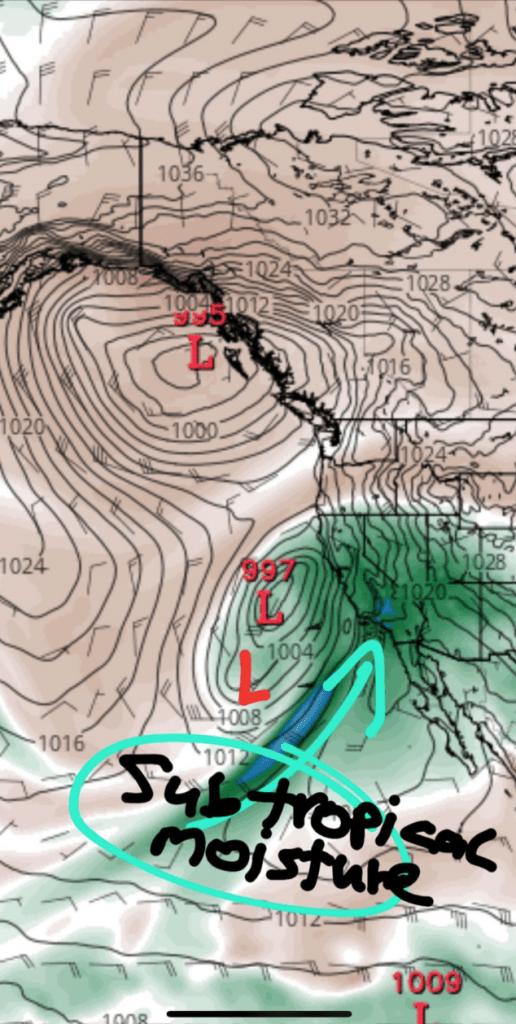
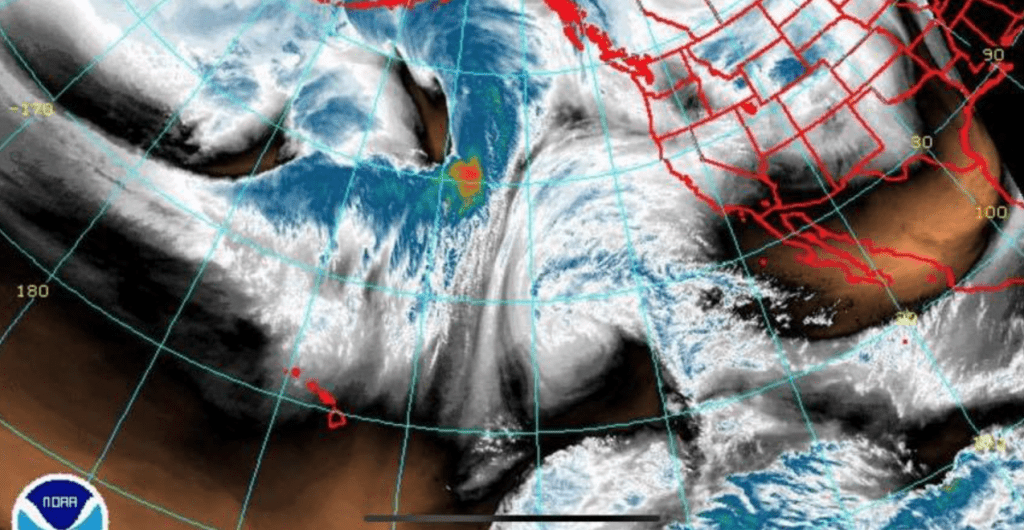
“We are in a classic El Niño weather pattern, the warming of Equatorial Pacific off coast of Peru and our coast. Warming off our coast 5 – 10 degrees warmer. Solutions since last week have been trending very wet and possibly above normal. The moisture is possibly coming from Hawaii origin. However this El Niño pattern is acting different. Most of the storms have been coming from the polar jetstream not the subtropical jetstream. That’s why we have a colder air-masses driving into U.S and Alaska. Placement of our high pressure has been acting erratic.”
Farhang weighed in on weather systems ready to strike our coastline; “Big PACIFIC Storms are waiting for February. Current Atmospheric conditions ready showing impressive system lurking waiting to strike Southern CA.”
In other words, get ready to be hit with another wave of wet weather. Also keep in mind that El Niño patterns typically start around Thanksgiving and can last all the way until June.
Woolsey fire burn areas are particularly at rick for extensive damage from these storm as we saw when the area was soaked by multiples systems passing through this month.
Many neighborhoods in Malibu are at significant risk for mudslides and in the path of debris flow. Be prepared for the possibility of more evacuations if you are in those high risk areas.
We’ll have more updates on these weather patterns as we get closer to Super Bowl weekend.
As 2018 came to a close, so did an era at the Los Angeles Sheriff’s Department…or so at least we thought until last Monday’s charges were filed against Anthony Rauda in the murder of Tristan Beaudette and the Malibu Creek State Park Shootings. Unfortunately, the new year is starting to look like former Sheriff Jim McDonnell’s legacy is going to live on a little longer than we want it to.
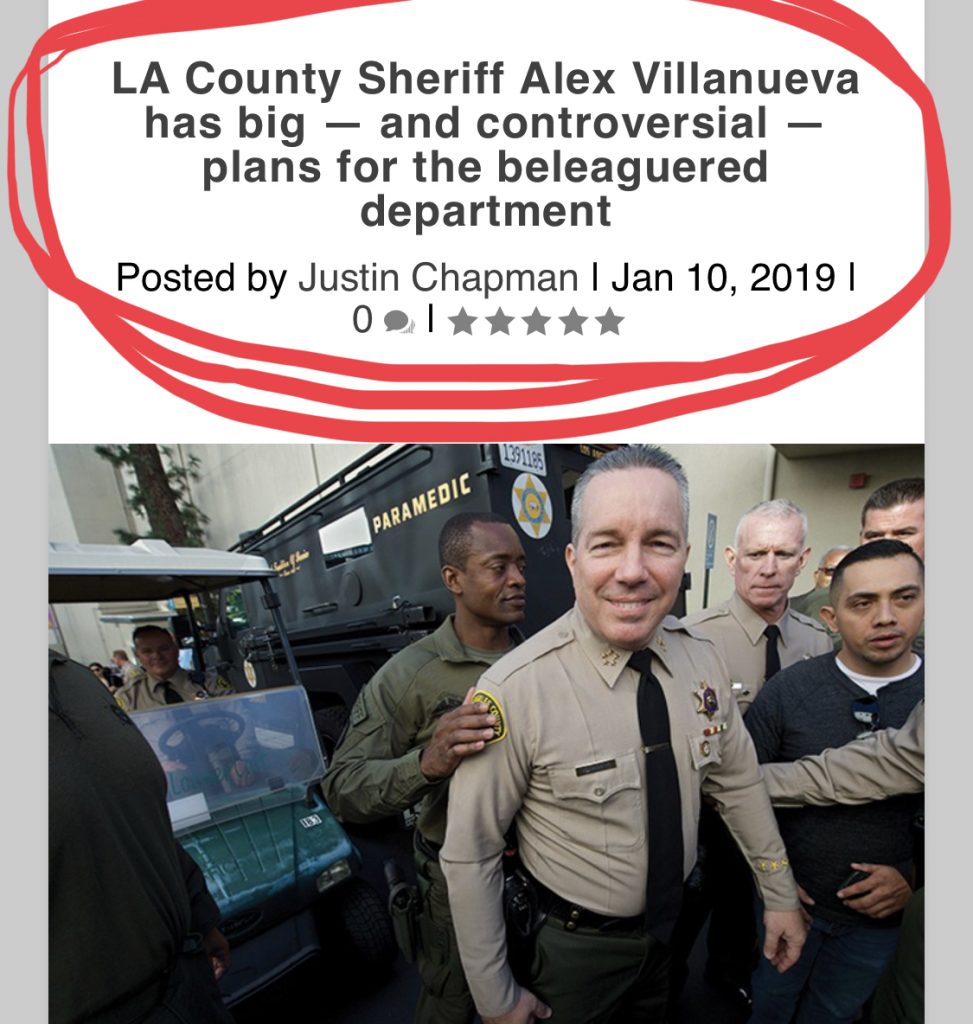
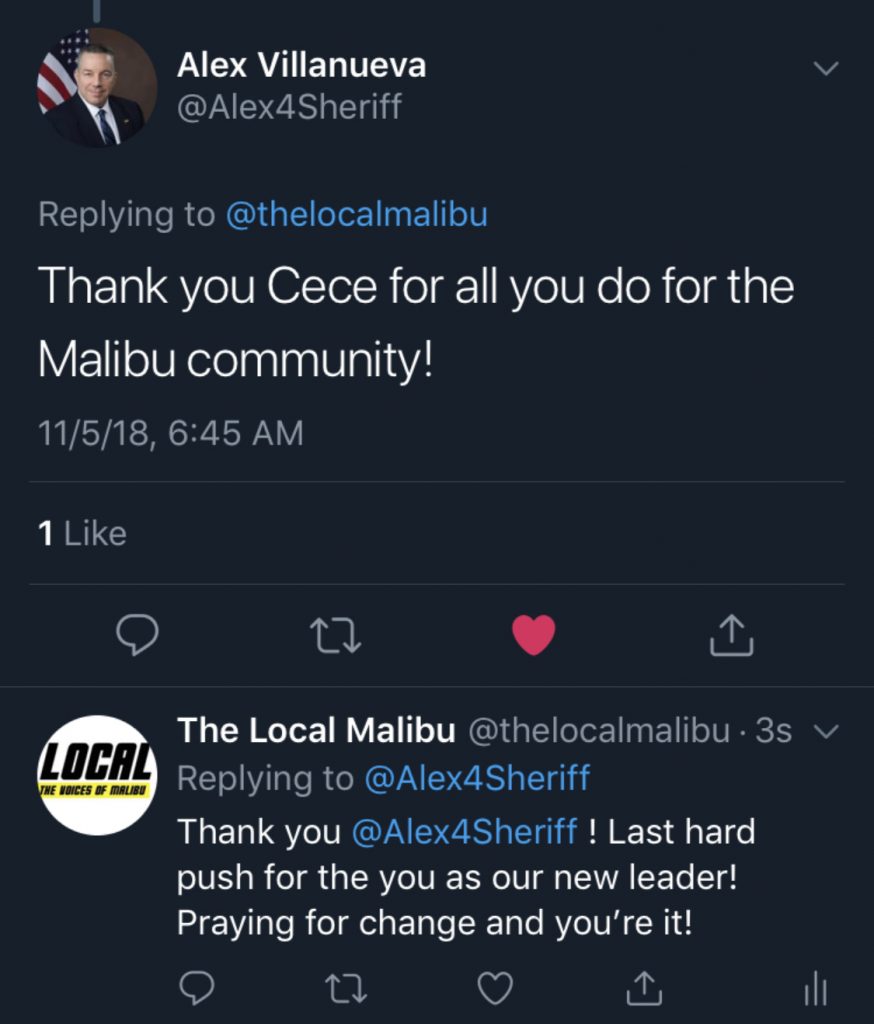
Last November, Alex Villanueva, our 33rd Sheriff of L.A. County, accomplished the impossible. He capitalized on the lowest morale in the history of LASD under the previous regime, along with a succession of bad decisions made by McDonnell (that I was happy to highlight during the months preceding the election), and came in for the win with an incomparable grass roots campaign to beat the incumbent. It was a nail biter to the bitter end.
However, the low morale might be lingering as Sheriff Villanueva’s first week at LASD started with the eyebrow raising charges filed against Rauda for 2 years worth of shootings that plagued the area until the shortly before the Woolsey Fire. Villanueva’s quotes to the press regarding the case indicates he isn’t quite up to speed on the details yet…
And don’t forget, the devil is in the details.
It also tells me Villanueva’s “Reform. Rebuild. Restore” platform he campaigned on is going to take a some time to put in place.
As one of Villanueva’s biggest supporters, I’m hoping it doesn’t take another three years.
BLOW BY BLOW
The Malibu community is also suffering from low morale currently after 2018 delivered one devastating blow after another.
The Malibu Creek State Park Shootings blindsided us last summer focusing unwanted, worldwide attention on our small rural community. It was followed by the LASD Political “Dog and Pony Show” leading up to Rauda’s high profile arrest (more unwanted attention and magically before the Sheriff’s election). The tragic Borderline Shootings happened shortly after, and the very next day the devastating Woolsey Fire ravaged the area. Now Rauda is back again in the global spotlight as he was formally charged last Monday with murder and shootings dating back to 2016.
It certainly looks like the new year is starting off with a bang.
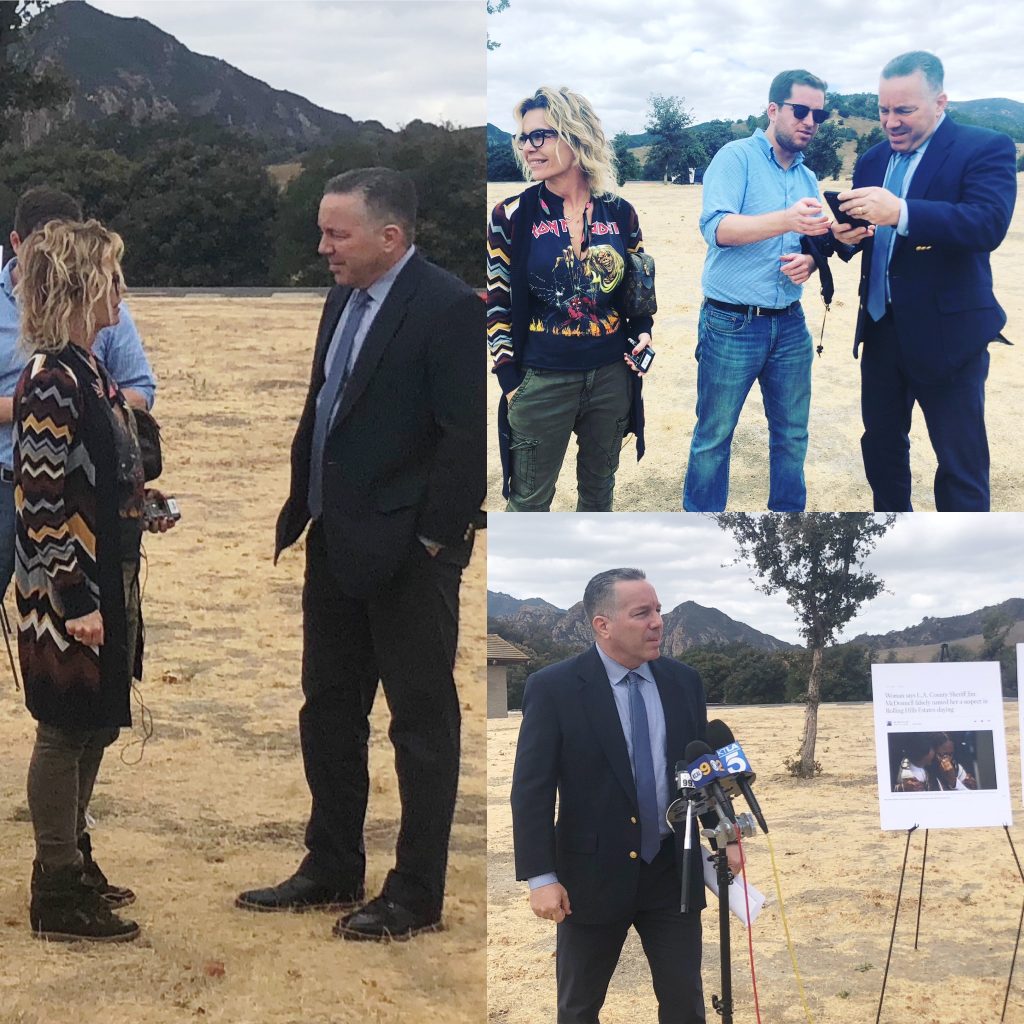
I had a long chat with new Sheriff Villanueva during his campaign (above) about how the Malibu Creek State Park Shootings investigation was going. We talked both privately and publicly, including during his press conference at Malibu Creek State Park where he openly stated that the SWAT productions were a “Dog and Pony Show” authorized by Sheriff McDonnell and nothing more than political grandstanding.
RUNNING FOR COVER
Malibu was barely a day into our busiest season as we were startled by the news of Tristan Beaudette’s murder on June 22nd. Little did we know, this event would be a turning point for our rural coastal town.
Beaudette, who was camping at Malibu Creek State Park with his 2 young daughters, was shot in the head at 4:44 a.m., in his tent, as his daughters lay next to him.
Residents were shocked by every aspect of the killing. A young father enjoying a family camping trip at the beginning of the summer is murdered in our local State Park while sleeping in his tent? It was unthinkable that a crime like this could happen in our community.
The night of Beaudette’s murder I received a message from a resident on The Local Malibu Facebook page. The message said a Tesla, belonging to a community member, was shot at on Malibu Canyon/Las Virgenes Rd. at approximately the same time, and the same place (just outside Malibu Creek State Park), 4 days before the murder.
Cropping out the identifying information to conceal the identity of the sender, I immediately posted it on our feed ( photo above) to warn residents of a potential sniper in the area.
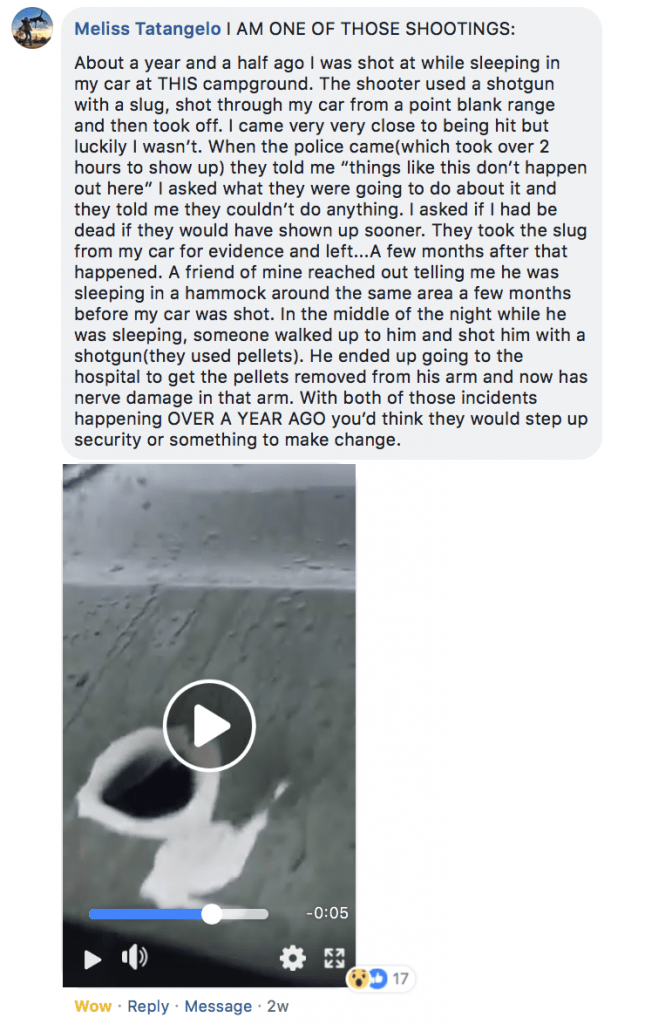
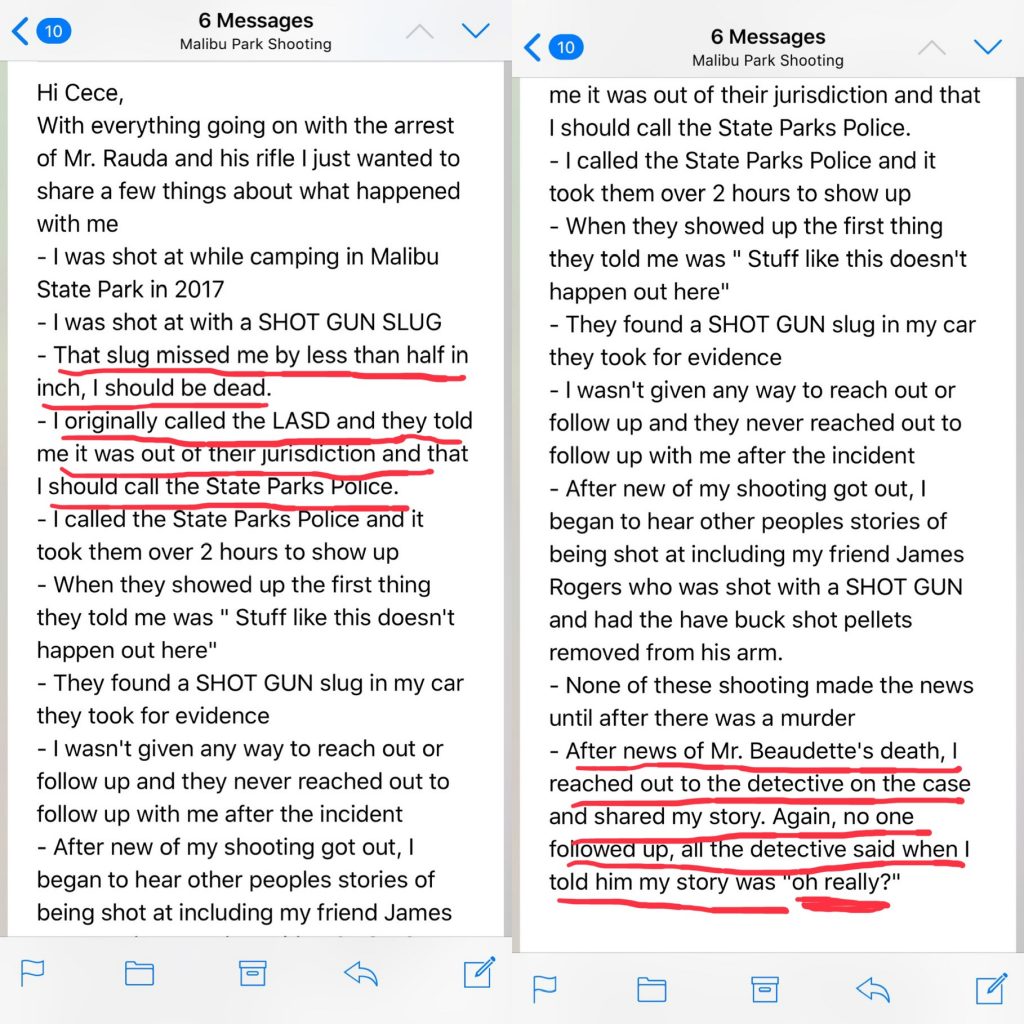
Clearly something was going on as that specific post took on a life of its own. Meliss Tatangelo was the first victim to come out on the thread (photo below) telling her harrowing story of being shot at in January 2017, at the campground in Malibu Creek State Park. The slug hit the car she was sleeping in with her boyfriend, coming within a half inch of killing her.
It also led to the discovery of other victims and to exposing these crimes being covered up State Parks officials and law enforcementgoing back to 2016. The community was literally, and figuratively left in the dark, with a predator, and no way to make an informed decision about our safety.
Meliss Tatangelo came out on The Local Malibu’s Facebook page as one of the victims of the shootings. Her car was hit with a shotgun slug in January 2017 and came within a half inch of killing her.
Including Beaudette, who may have made an entirely different decision as to his camping plans that night had he known about the shootings and still be a live today.
QUESTIONS BUT NO ANSWERS
As new information came to light regarding the shooting incidents, and that yet another law enforcement cover-up was in play, this cast an even larger, darker cloud of suspicion over the Lost Hills division of LASD. This cloud had already been ominous, hanging over them for the better part of 9 years playing a pivotal role in the high profile case of Mitrice Richardson.
Richardson was detained after failing to paying her bill at Goeffrey’s Restaurant in Malibu, and was released from Lost Hills Sheriff’s Department under very suspicious circumstances in 2009. Her body was found 10 months later near Monte Nido. The case is now scheduled to be re-opened under the new Sheriff.
Reporter Justin Chapman goes deep into department clean-up in and re-opening the Mitrice Richardson case in this interview with Sheriff Villanueva.
Which leads us to the questions mainstream media seems to be ignoring…
Why did State Parks and LASD hide these crimes from the public since 2016?
Why didn’t LASD get involved in these attempted murder cases from the beginning?
Why were the victims ignored by authorities?
Why wasn’t anyone, victims and the community, given answers?
Because they had none… or did they?
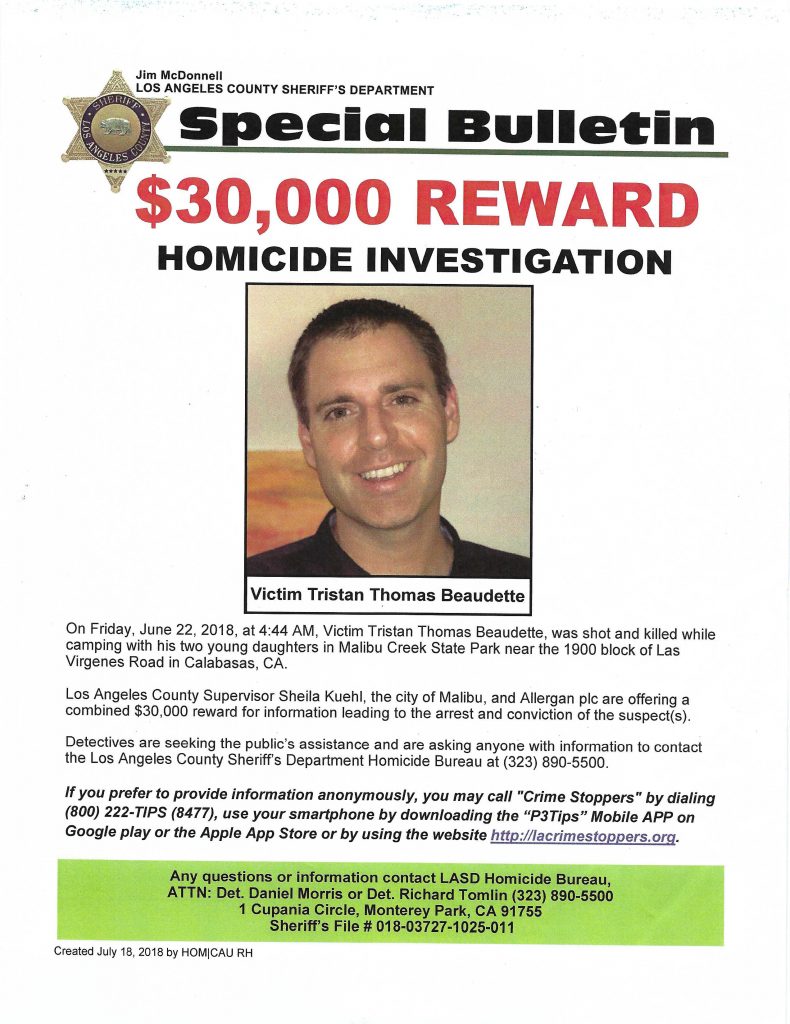
Almost a month after the murder, a flyer was distributed asking the public for help. According to inside sources leads had run cold and authorities had no description of the suspect (only a lot of speculation swirling around). Which would suggest they had no answers.
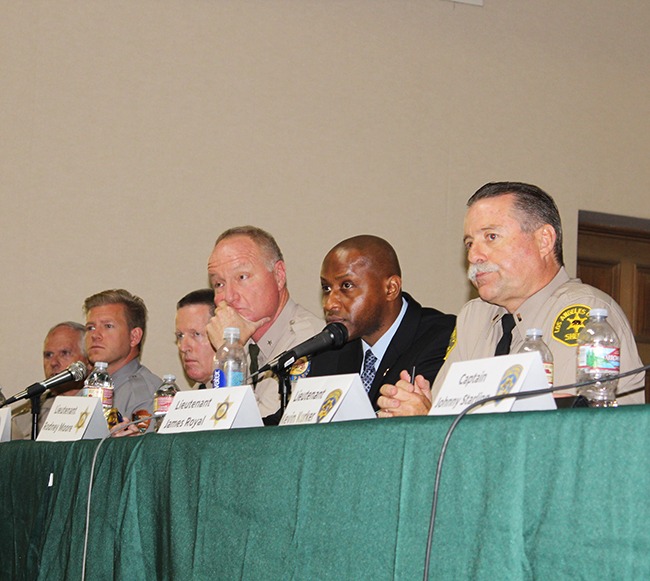
A few weeks later, on August 19th, Lt. Rodney Moore, head of LASD Homicide division told the crowd at the Public Safety meeting hosted by Senator Henry Stern (to address the shootings and safety in the Santa Monica Mountains) that they had “no known suspects at this time.”
Needless to say, residents left the meeting very unhappy campers (pun intended).
Law Enforcement’s cream of the crop showed up at King Gillette Ranch for the Public Safety Meeting hosted by Senator Henry Stern.
Yet, in this Oct. 12th article by ABC News, a family member was interviewed telling reporters Rauda had been living in the hills for the last 10 years. He also said authorities had Rauda in custody 4 months prior on trespassing.
Are we to believe that Rauda was right under our nose for the last 10 years and the community or law enforcement wasn’t aware of him?
It seems a little far fetched to try to pass that off as a believable scenario nowadays. There are way too many prying eyes around here for a killer/shooter/burglar to be on the move for 10 years, in our proverbial back yard, and not been seen (and information promptly distributed on social media) – especially since Rauda was found within a few mile radius of the murder scene (and close to the locations of approximately 6 other cases of attempted murders).
Is it really possible to think Rauda could get away with all these criminal acts, some even a stone’s throw away from from Lost Hills Sheriff’s Department? That’s quite a feat. Somehow I don’t think Rauda is that saavy – or that stupid in my opinion.
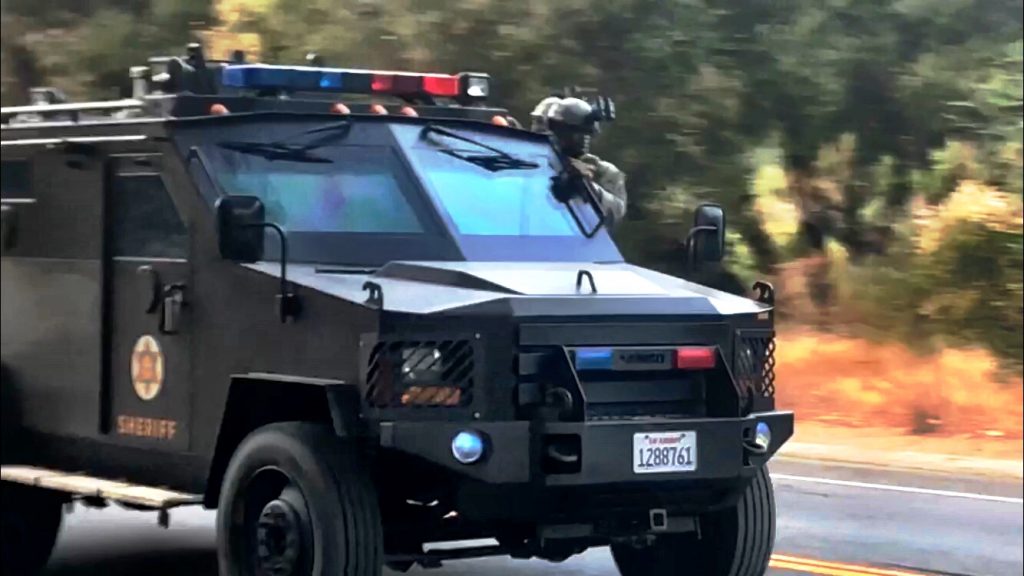
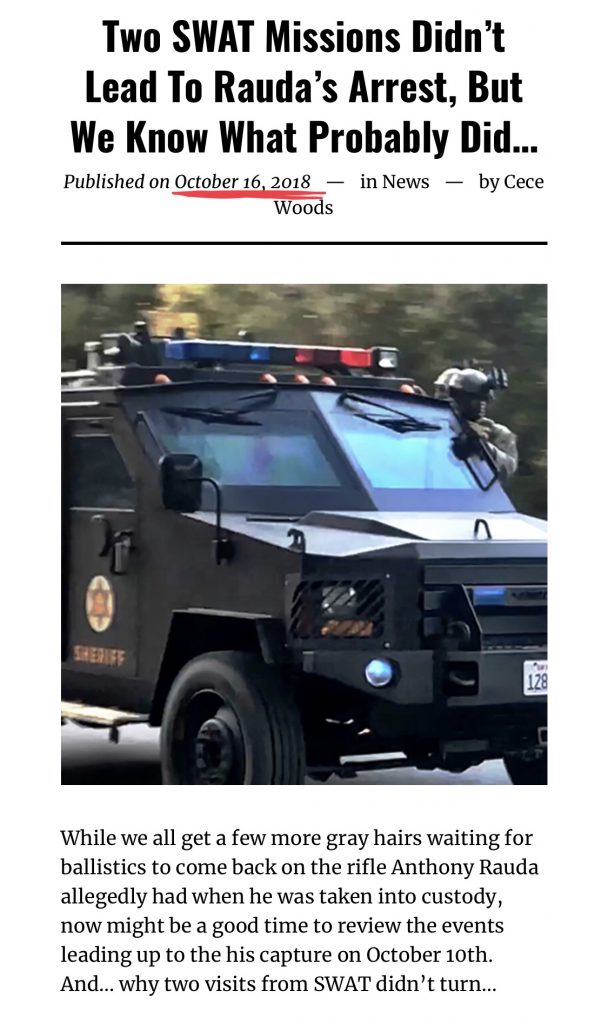
The shooter’s M.O. was to strike late at night of in the pre-dawn hours yet Rauda was found in the middle of the day, in a wide open field, complete with NBC hovering overhead, after two unsuccessful SWAT visits (a.k.a. Political Dog and Pony Shows) and conveniently scheduled weeks before the November election for L.A. County Sheriff.
That just seems a little out of character with the details of the crimes Rauda is alleged to have committed.
There is also the burning question of why the three tips (that have since been registered with the County) emailed to LASD, State Parks, and Malibu Search and Rescue the week before Rauda’s arrest were ignored. The tips were sent in by a longtime local who travels the canyons frequently and is an avid outdoorsman. The witness only started seeing Rauda around the time of the burglary at Malibu Valley Farms and had never seen him anytime before that.
The tips detailed the exact location of where law enforcement could find Rauda. The witness had seen Rauda in the same location multiple times the previous week. That information was in authorities hands when the SWAT team performed the show stopping search on Malibu Canyon Rd. on October 6th. Three days later, on October 10th, Anthony Rauda’s high profile arrest was executed in the exact spot detailed in the previously emailed tips.
SWAT en route on Malibu Canyon Rd. October 6th.
Another interesting tidbit to share is at the swearing in ceremony for new Sheriff Villanueva on December 3, I had the opportunity to speak to a few member of the SWAT team. Of course the topic was the Rauda case and one of them openly commented that he was shocked after seeing photos of Rauda after his arrest… “that was not the description of the suspect we were given” he said.
Let me expand on that. SWAT was given the description of male adult with red hair which fit the profile of someone law enforcement had been interested in at the beginning of the case but did not pursue. Yet, LASD forgot to add that important detail to their press release (see below) when describing the suspect they were seeking for the murder and shootings after the burglary video was released and SWAT was sent out (in full force) to capture for the shootings.
The LAPD release said “The suspect is described as a male adult, slender build, dark clothing.” the press release said.
Well, two out of three ain’t bad I guess.
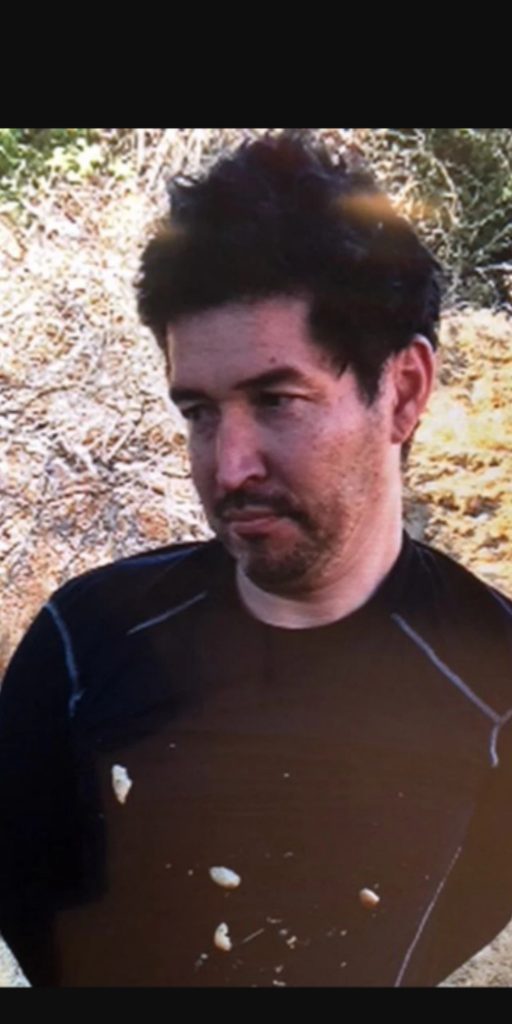
Rauda the day of the arrest. Hardly the survivalist/camper type with “no known address” (per LASD). But slender?
FAKE IT TIL YOU MAKE IT
How does the old saying go? A Bird in the Hand is Worth Two in the Bush?
Well, for quite some time it looked like LASD had none in the hand, the evidence was deep in the bush, and no one was chirping.
Months went by with no breaks in the case, yet multiple reports of shots fired were being reported in the area near the murder scene. Some of these incidents were investigated thoroughly (as reported by law enforcement), including helicopters, K-9s etc., yet yielded no hard evidence according to authorities (at least that’s what they said at the time, I’m expecting the story to change now).
Reports of shots fired trickled into Lost Hills Sheriff’s Department regularly, but now authorities were conveniently dismissing them as a firecracker, a transformer that blew, a car that backfired – even a back windshield blowout (first reported as road rage) was explained away as “extreme heat exposure”. They even provided this reporter with a google link to back up their claims.
DUE PROCESS
The DA moving forward and charging Rauda with Beaudette’s murder was no big surprise especially with all the fanfare leading up to and after his arrest (and knowing he was due to be released soon for time served in probation violations) however, the amount of charges stacked against him is another story.
Of the ten counts of attempted murder, most, will be next to impossible to convict Rauda on unless LASD has some magical way of collecting and processing evidence that has not been compromised either by the elements over the last two years, or the process in which it was collected in the first place – if it was even collected by State Parks or LASD at all.
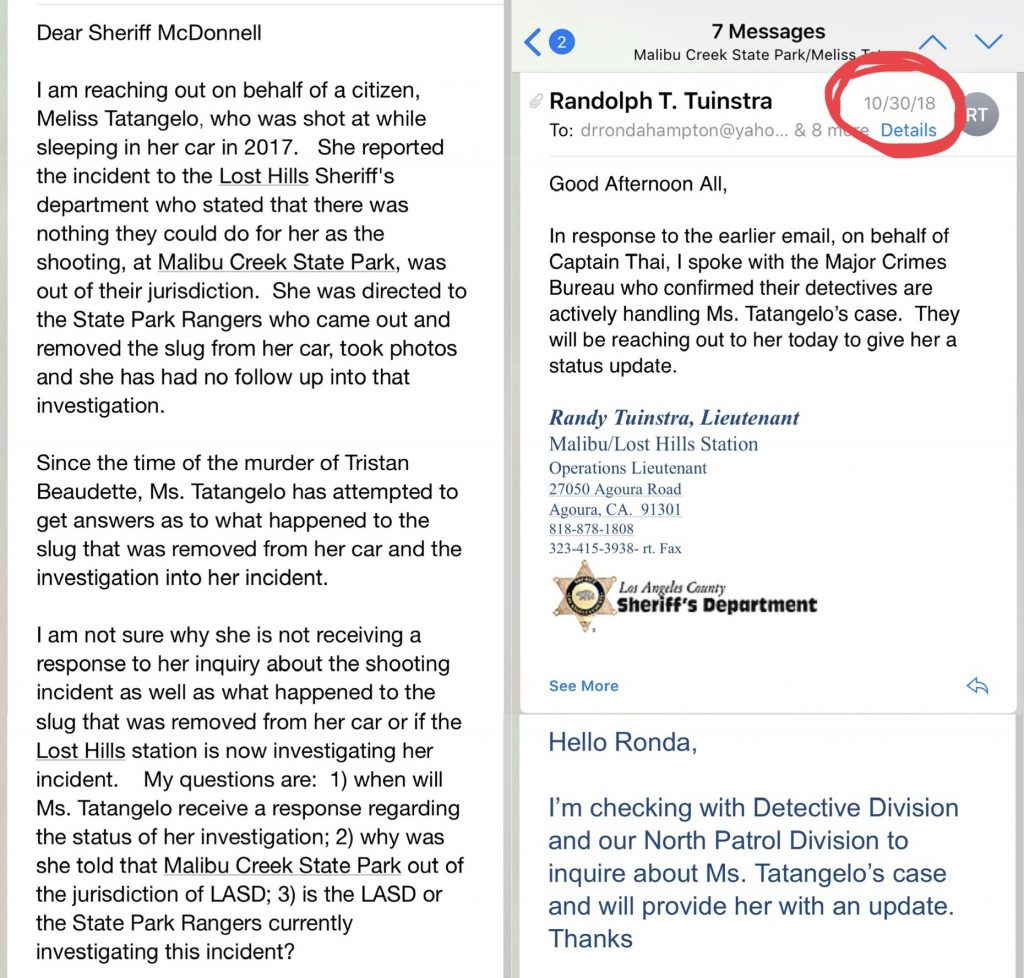
The email sent to me from shooting victim Meliss Tatangelo detailing her experience with State Parks and LASD.
From November 2016 to early 2017, witness statements and email communication with State Parks show that the victims contacted LASD with multiple incidents of attempted murder and were told it was “out of their jurisdiction” (see photo above). Instead, Park Rangers were sent to collect evidence, specifically in Tatangelo’s case, even though Malibu Creek State Park has no established, Crime Scene Investigation unit, accessible crime lab, or the facilities to store evidence.
Inquiries to State Parks regarding whether the slug from Tatangelo’s vehicle was turned over to LASD were ignored. My colleague Dr. Ronda Hampton and I decided to formally reach out LASD HQ on behalf of the victim to find out why they had not followed up on, or based on previous responses from LASD, taken her case seriously at all.
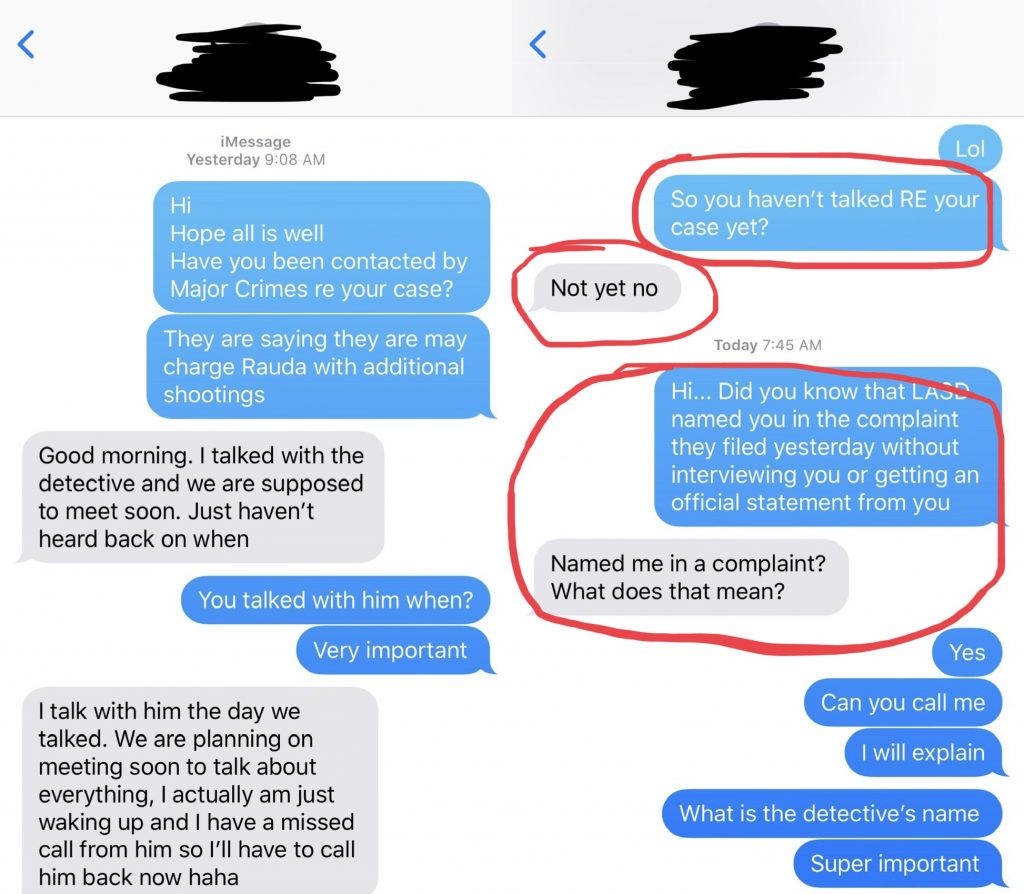
Up until October 30th, more than 4 months after the murder of Tristan Beaudette, the victims of the shootings in State Parks had not been contacted until Dr. Hampton and I initiated communication with LASD regarding these cases.
In fact, it came as a surprise to one of the victims I contacted on the day Rauda was charged that they were included in the complaint filed against Rauda since detectives from Major Crimes had not interviewed them or taken a statement.
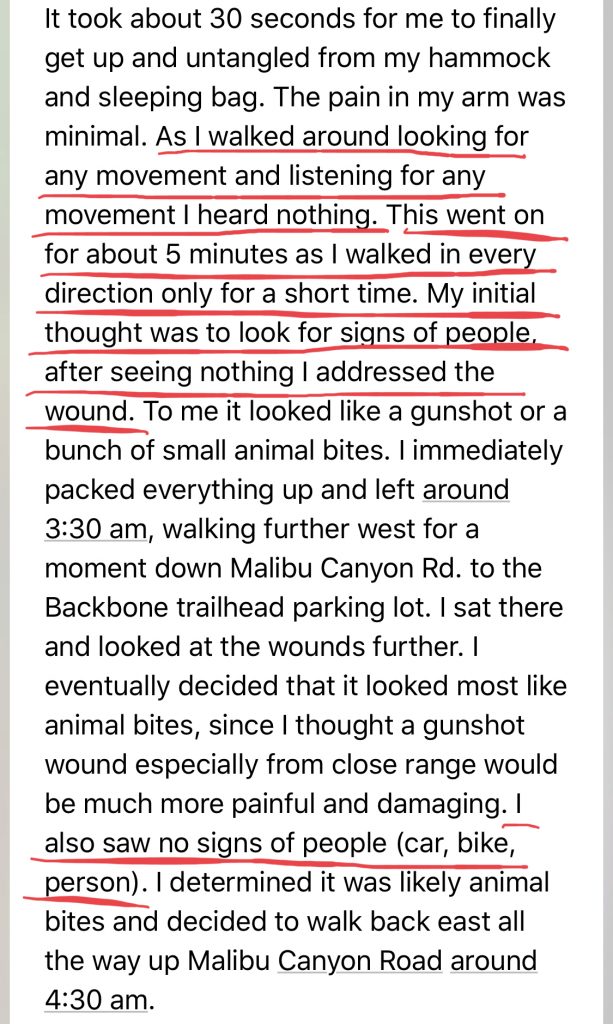
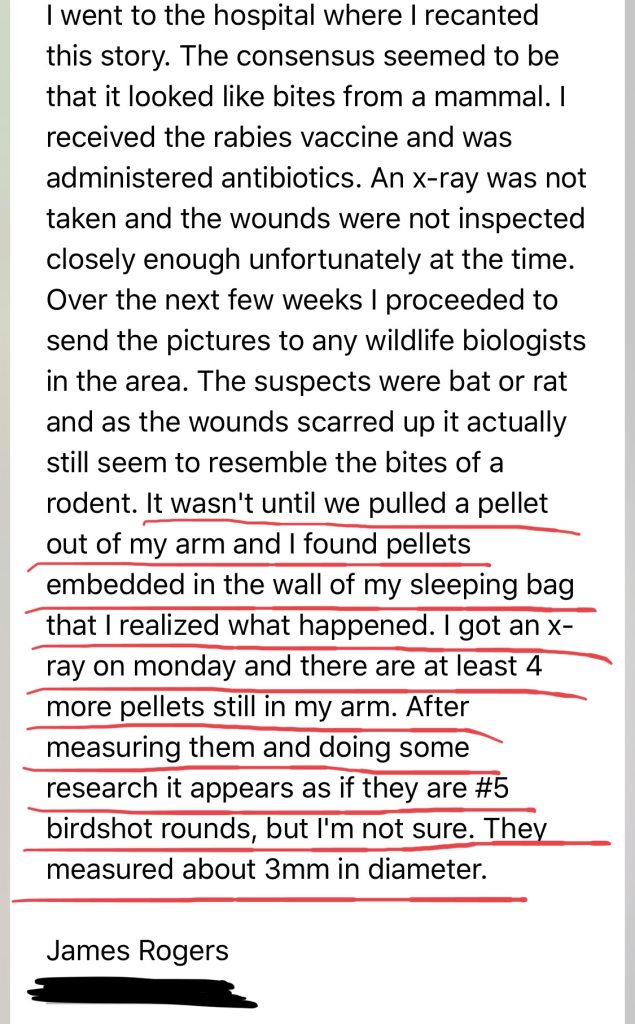
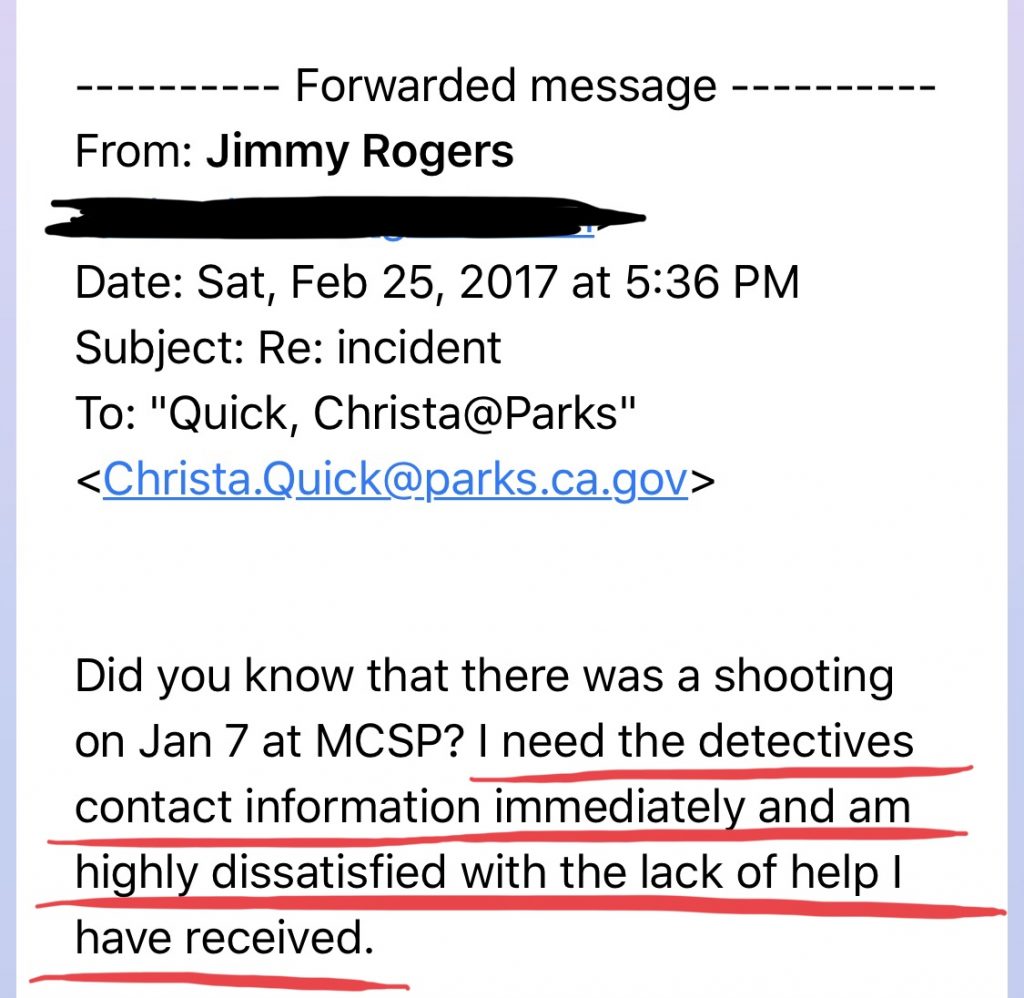
James Rogers is another victim listed in the DA complaint against Rauda. In November of 2016, Rogers was camping at Malibu Creek State Park when he was shot with 3mm birdshot at approximately 3 a.m.
As Rogers hammock fell to the ground, he untangled himself and felt stinging in his arm but dismissed it as rodent bites at first. He later went to Urgent Care where the doctors misdiagnosed him, also suspecting rodent bites, and he was given a rabies shot. Rogers later discovered a pellet lodged in his arm, more in his sleeping bag and immediately realized what truly had happened.
At the time I interviewed him, right after the murder, no evidence was processed and Rogers was extremely upset at how the entire incident was handled by State Parks.
Rogers forwarded me the communication with State Parks a little over a month after the incident.
Clearly State Parks were negligent in the handling of these cases of attempted murder and involving LASD in a formal capacity from the beginning. However, when LASD was contacted by the victims, they seemed just as disinterested in pursuing these attempted murder cases… at least until after the murder and the shootings were exposed, leaving LASD with no choice but to investigate them.
Based on victim interviews, evidence inside sources know they never collected, and witnesses they don’t have, LASD/LA District Attorney’s Office is going to have an exceptionally hard time prosecuting these cases. Specifically for the incidents including the shotgun.
In fact, there is a glaring discrepancy between the details former Sheriff Jim McDonnell gave to the media the day Rauda was captured and the testimony given by a detective at Rauda’s probation violation hearing in December.
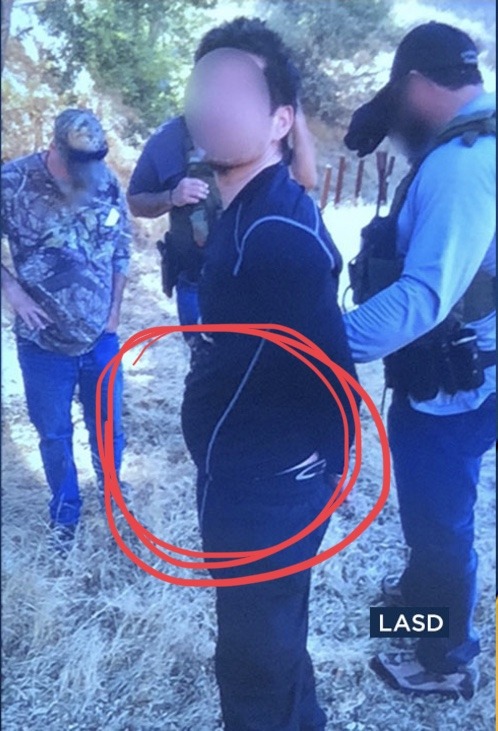
Mc Donnell shouted from the rooftops that the suspect had the (would-be) murder weapon in his hands and was ordered to “drop the rifle and surrender”.
The detective at the December 13th probation hearing testified Anthony Rauda had the rifle in his backpack.
So which is it? Hand or backpack?
So far Rauda hasn’t been allowed to speak in court so I don’t think we’ll hear his version any time soon. Rauda did not enter a plea last Monday , and I wouldn’t count on a confession either.
LASD has done a great job keeping up the theatrics portraying Rauda Hannibal Lecter style on display for the world to see attempting to further make the case he is a crazed killer. It seems a little over the top when in reality, he is the lamb being silenced.
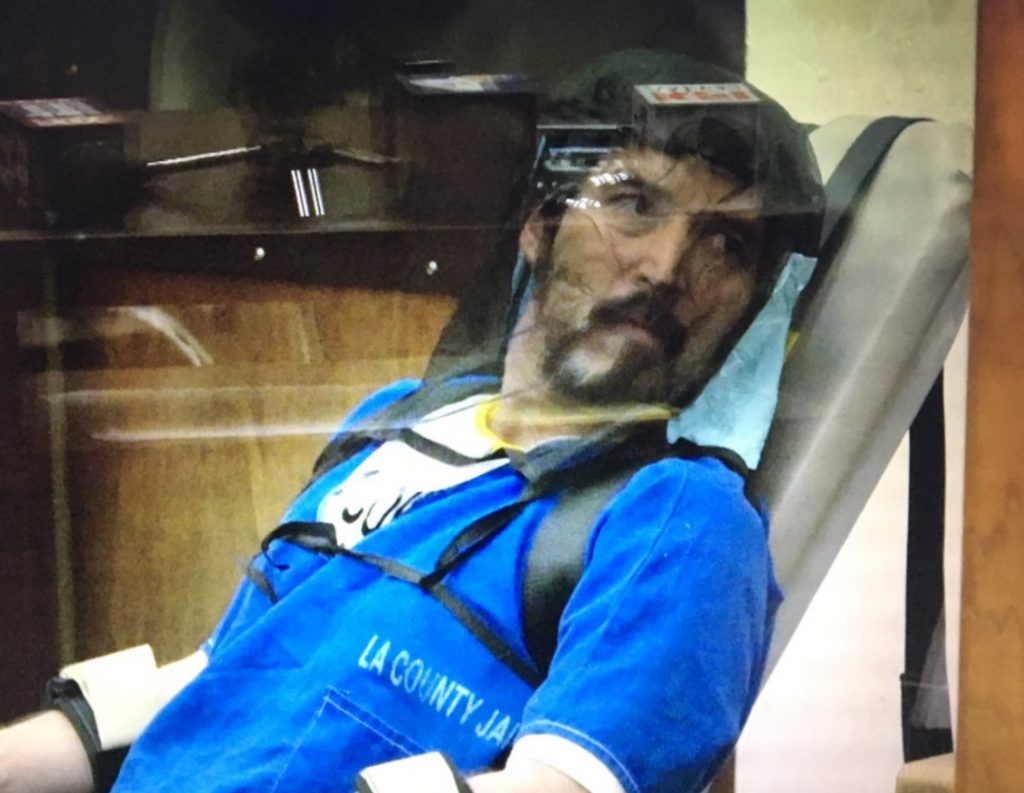
Anthony Rauda the day he was arrested, October 10th, 2018.Anthony Rauda in court recently.
Rauda’s outburst in court made national news, furthering LASD’s narrative that Rauda is crazy enough to kill, and yet many were unaware that he was roughed up pretty bad his first day in jail, and was being stripped of his rights to represent himself when he had already successfully beat his previous weapons charge in 2016.
Clearly, the fear of being potentially railroaded was looming large in Rauds’a brain based on his actions in court. Authorities need to clarify why Rauda was prevented from speaking in court, and why when he asked to have his attorney fired the court ignored him.
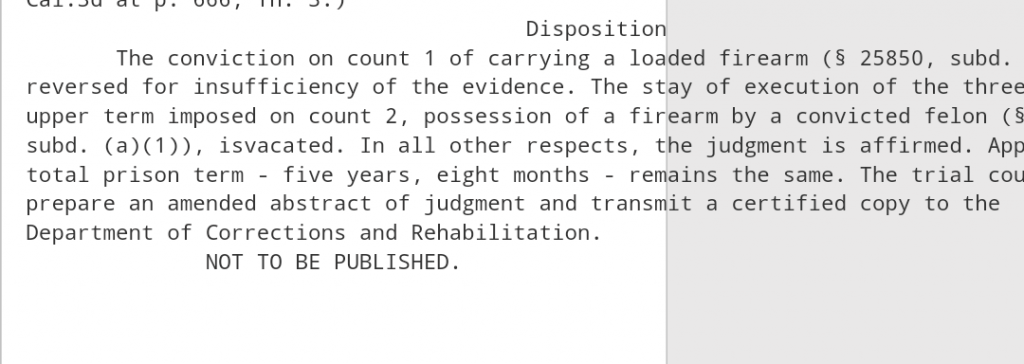
Court transcript from the weapons charge that was dismissed against Anthony Rauda in 2016. He represented himself.
Could Rauda be a really a bad guy the cops successfully got off the street? Maybe. But is he the murderer or the shooter responsible for these crimes?
If he is, it’s looking pretty weak right now and Rauda could eventually walk because of the cover-up and incompetence investigating this case from the very beginning.
DIG DEEP
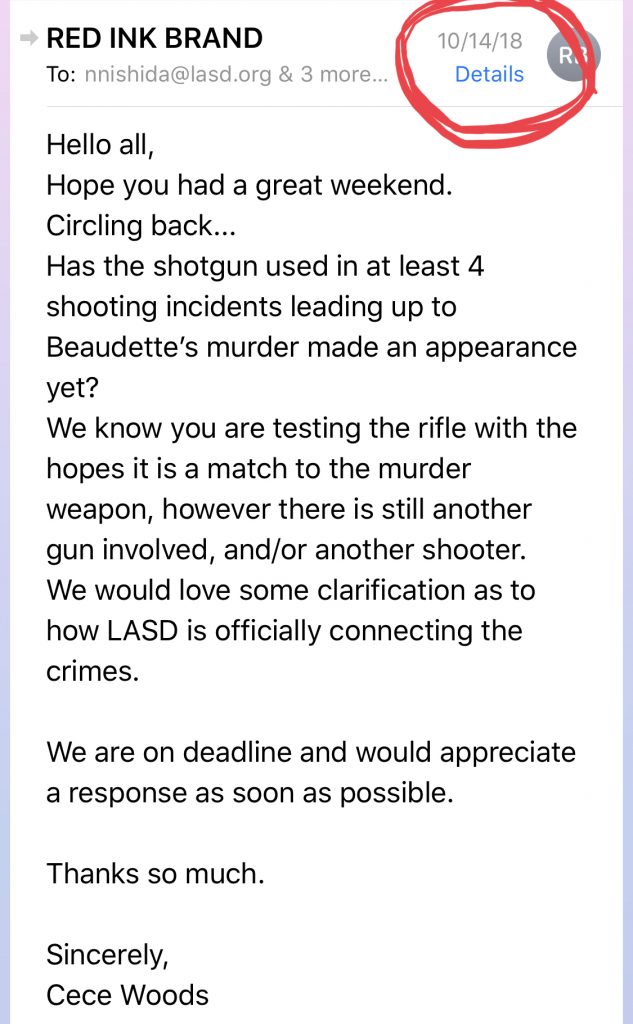
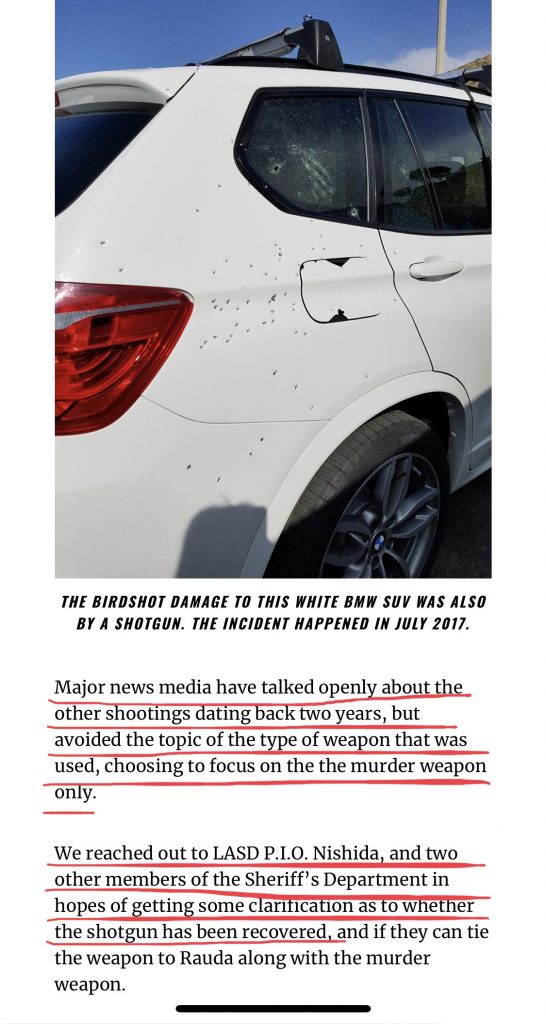
After Rauda’s arrest in October, and the subtle reveal by law enforcement that the murder weapon was in all actuality a rifle (as opposed to a shotgun used in the previous shootings as they would have the public believe), I made repeated inquiries to LASD as to the whereabouts of the shotgun.
The response I got from directly LASD? Crickets.
Indirectly, LASD spoke volumes in response to my inquiries regarding the shotgun.
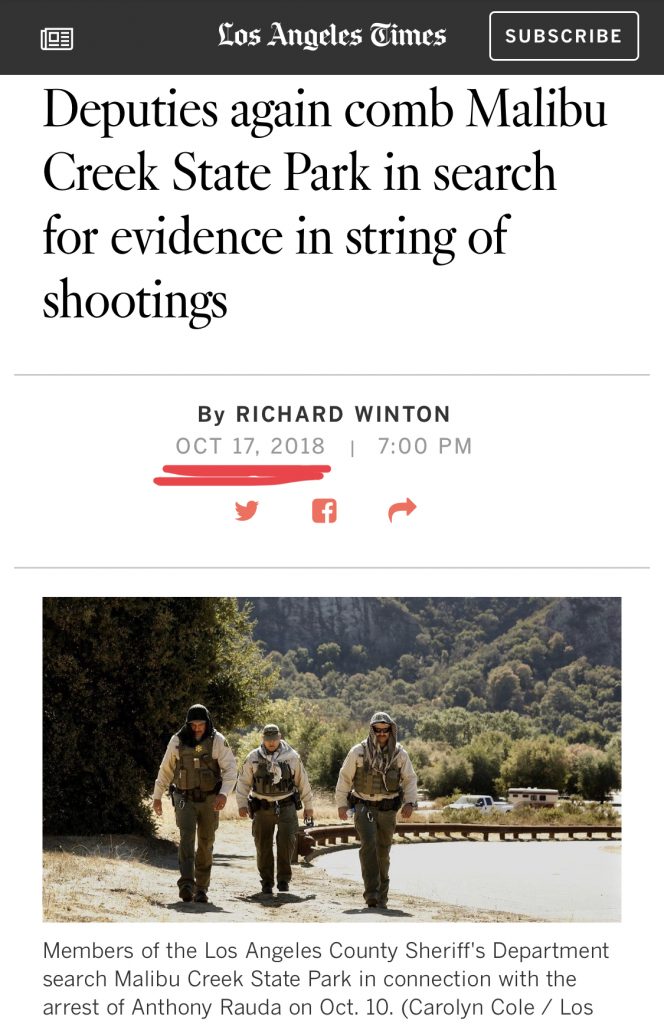
The morning after I released my article highlighting the shotgun used in at least four shootings, there was a massive search by LASD at Malibu Creek State Park and deputies diving into bushes “looking for additional evidence” complete with a news choppers overhead to catch the action.
According to inside sources, LASD “did not find what they were looking for”. When I asked for further clarification, I was told specifically LASD did not find the shotgun.
Of course… stories can change (especially after this article is released).
DENIED AND DISMISSED
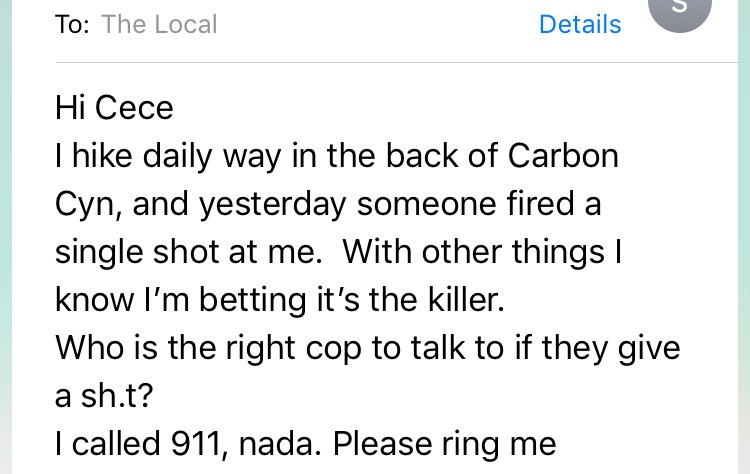
Shortly before the Political Dog and Pony Shows, and Rauda’s arrest, there was an incident in Carbon Canyon where a resident contacted our publication after a warning shot was fired at him. Once we received the details of the incident, we forwarded the information to two high ranking officers at Lost Hills Sheriff’s Department. The resident called 911 from his cell phone at the scene which in turn went to CHP voicemail (this is can happen as landlines are only designed to go to the main 911 dispatch and cell phones are re-routed to CHP). The resident did not receive a return phone call from 911 and headed back to his home to document the incident. He then promptly emailed our publication knowing how closely we have been following the shootings.
Email sent to me by the Carbon Canyon resident who was shot at in September, a few weeks before .
After forwarding the information, which included the approximate location of the shooter, type of weapon, which was thought to be a small caliber rifle, one of the high ranking officers called the resident a few hours later and reached his voicemail.
The message went something like this… “Hi, the is officer… from the Lost Hills Station. Here is my number and extension… If we don’t connect today, we will talk next week.”
Next week????
You have an active shooter in deep brush less than 24 hours before, with what LHSD knew could have been the shooter with the murder weapon (at this point only law enforcement – and the killer – knew it was a rifle) you might want to make it a priority right?
Thankfully, the officer and the resident connected later that day by phone and went out to the scene the following day. The report I received was the search came up empty handed for both the shooter and evidence.
Shortly before this incident, neighbors heard gunshots not far from the trail where the warning shot was fired. A caretaker of a ranch close by saw a tall, slender man in dark clothing with a backpack suited to carry a take-down rifle (one that disassembles) traversing the terrain in military fashion with dark scraggly hair. The same description that was distributed on NextDoor as other witnesses had seen him in the area as well. The description was much closer to the description in the press release sent out by LASD after the burglaries – and definitely not the description given to SWAT.
It is also important to note, this area was undisturbed by the Woolsey Fire.
WHERE THERE’S SMOKE…
The formal LASD press release distributed last Monday would have you believe there were no other shootings after Rauda was arrested on parole violation on October 10th, 2018. When in reality that is far from the truth.
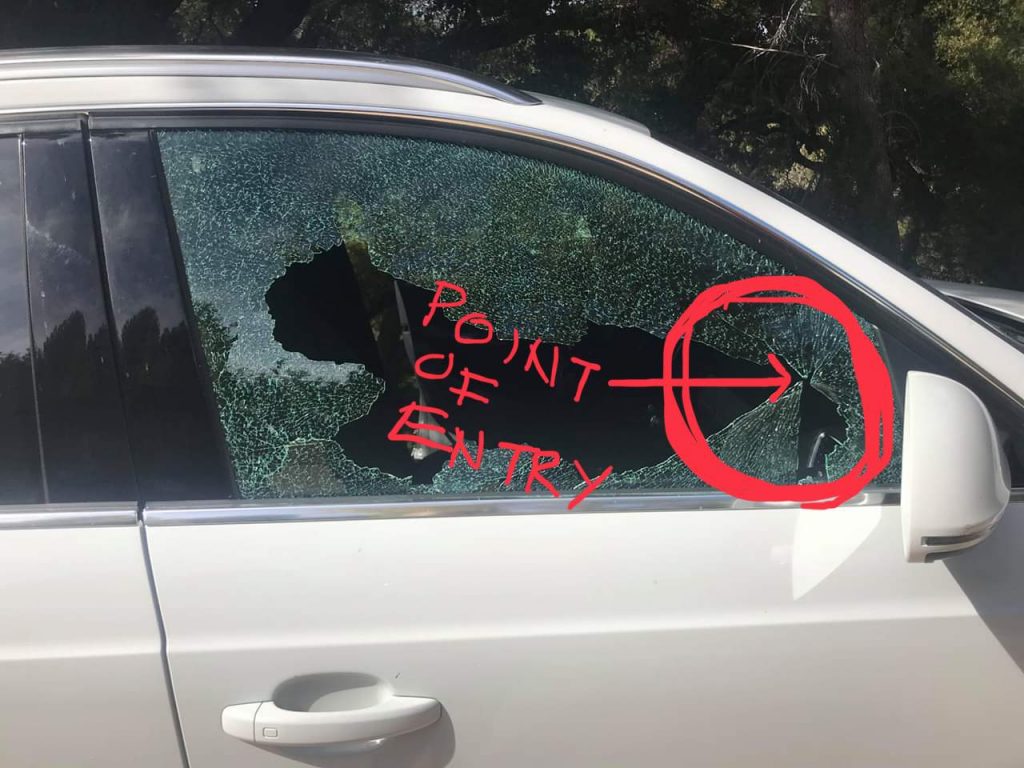
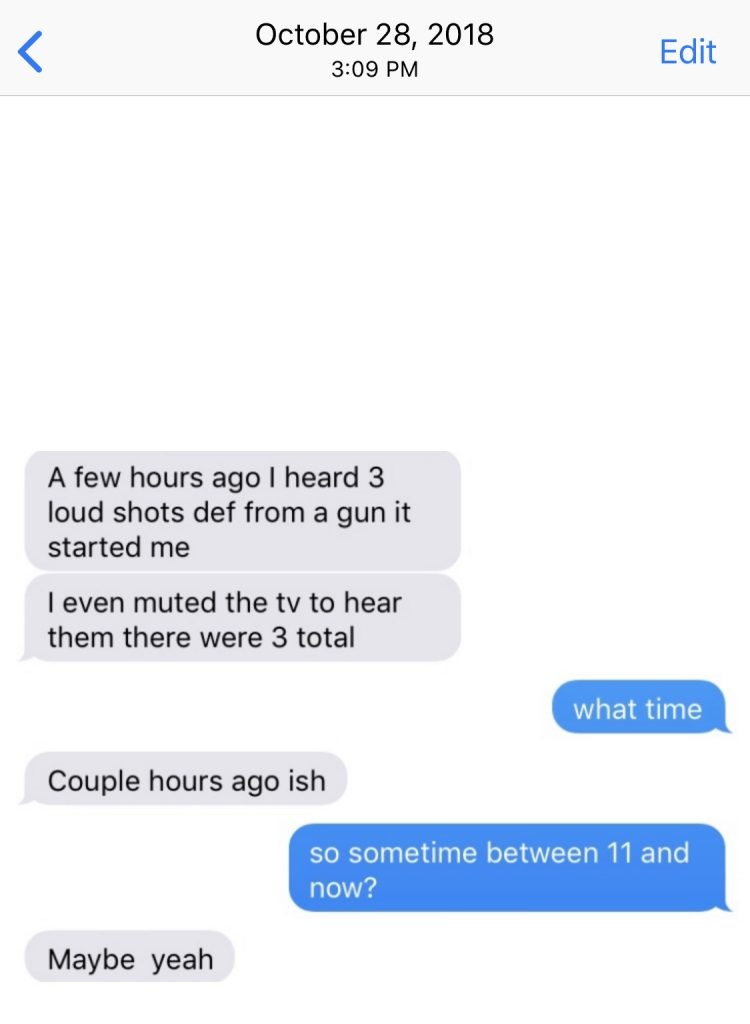
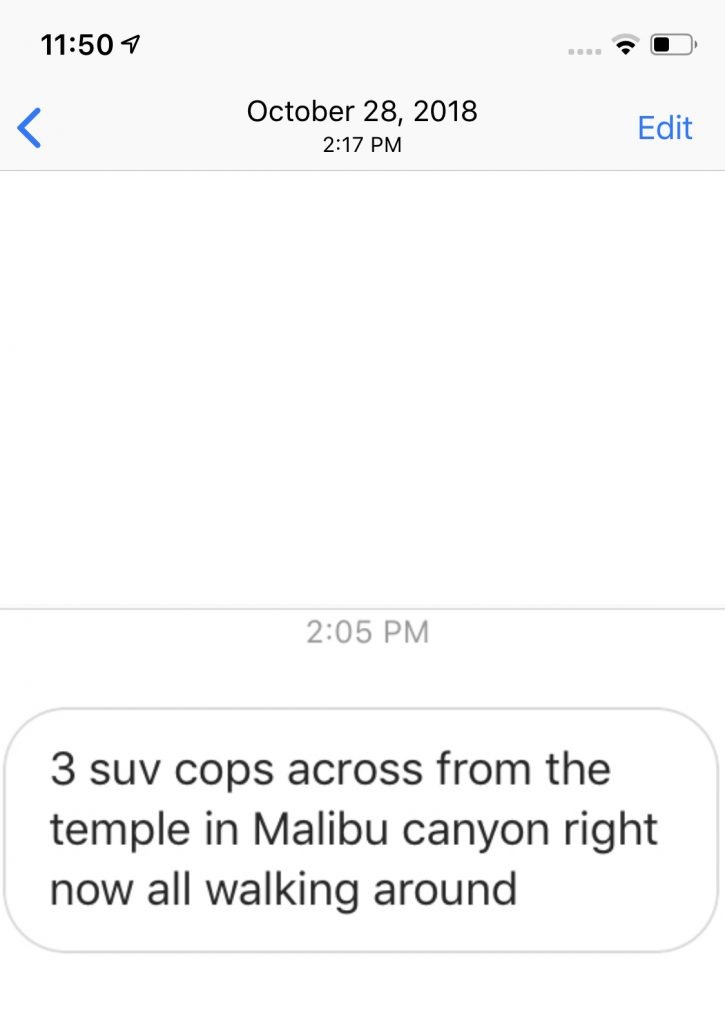
Not only were there multiple reports of shots fired after he was arrested, there were a few particularly scary incidents near Malibu Creek State Park on October 28th, one of which was a car shot at right in front of the Hindu Temple which Lost Hills Sheriff’s Department has determined as “unexplained”.
A young college student’s vehicle was hit in between 12 -1 p.m. October 28th.
A text message from a resident in the area confirming the gunshots she heard. There were three gunshots which has been a pattern heard since the murder.An Instagram message the same day from another local confirming Lost Hills Sheriff’s Department outside the Temple investigating. Reports are they came up empty handed.
A little over a week after this after this incident, the Borderline Massacre took the lives of over 20 students andSgt. Ron Helus of the Ventura County Sheriff’s Department taking our attention away from the Malibu Creek State Parks shootings.
The following day, the Woolsey Fire created another devastating distraction with the fire destroying a good portion of the area in and around Malibu Creek State Park.
It was also the only event to put a stop to the shootings, whereas Anthony Rauda’s arrest did not.
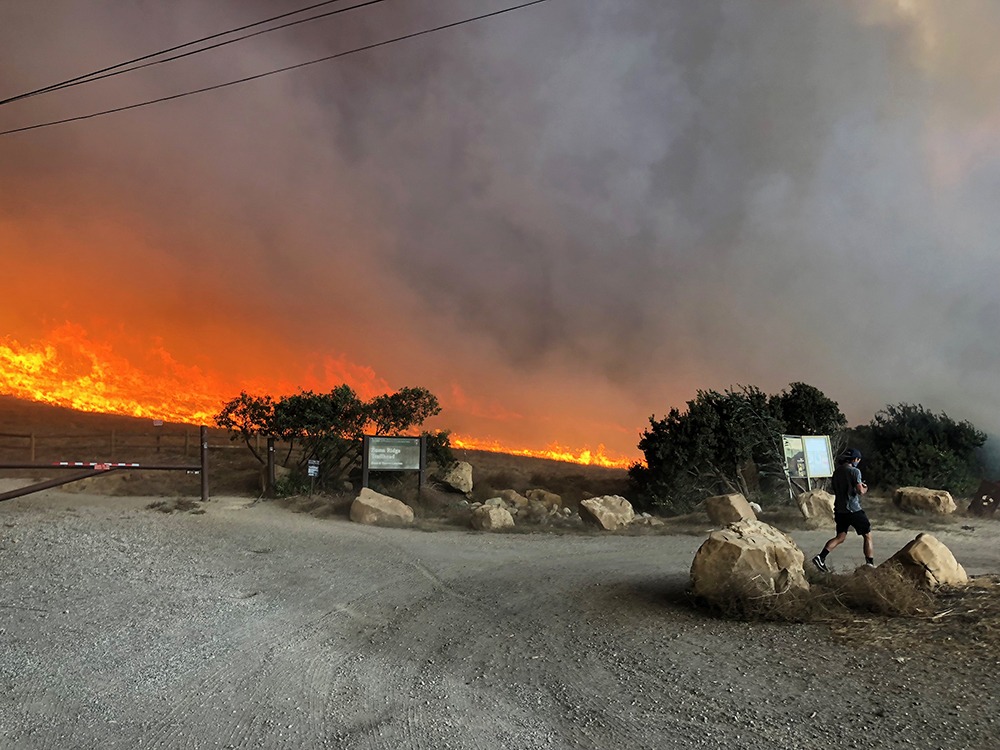
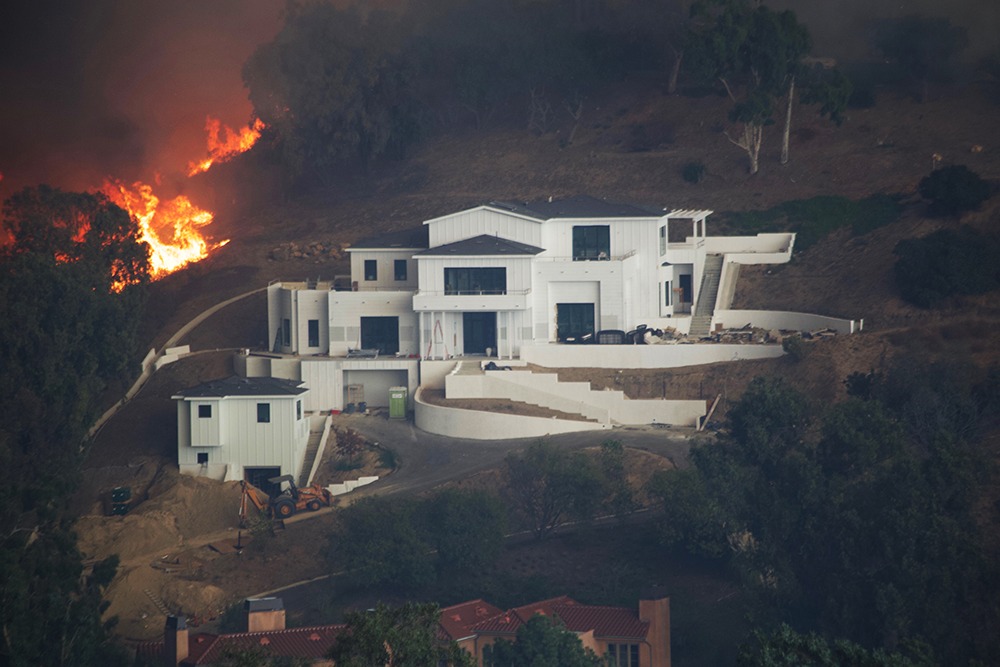
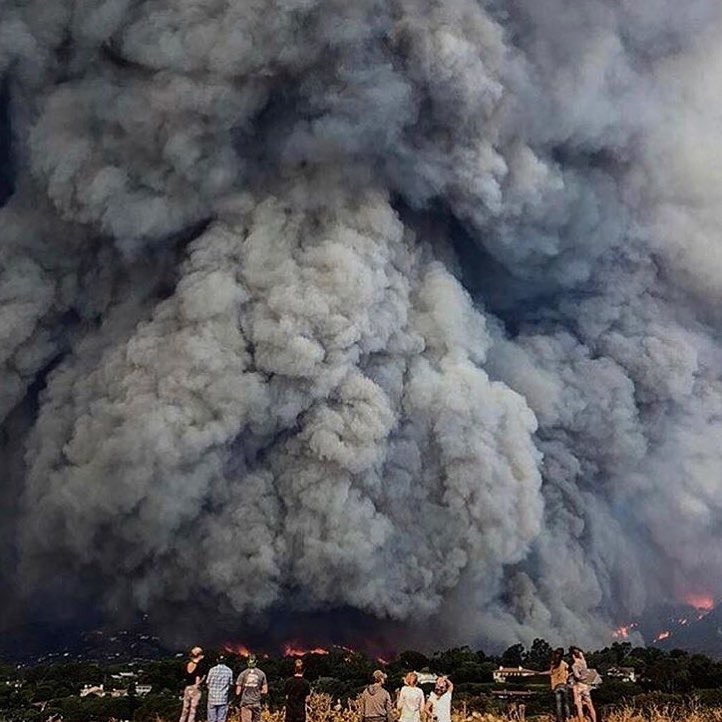
The Woolsey Fire, November 9th, 2018 was the only event that silenced the shootings. Photo: Paul Taublieb
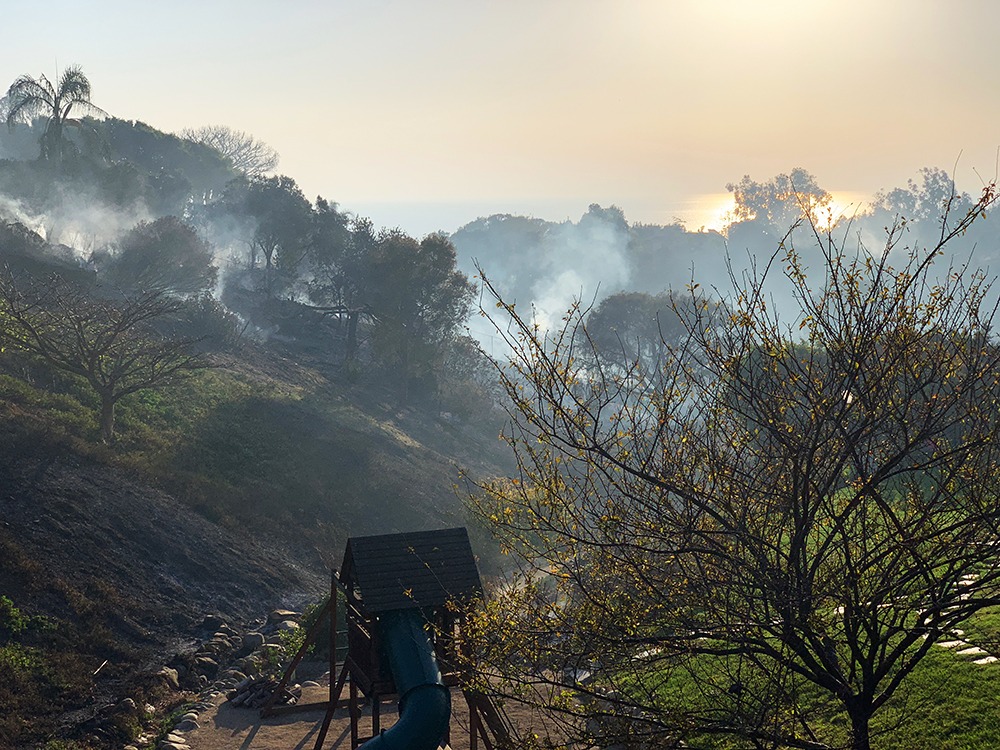
However, Monte Nido and Backbone Trail were miraculously spared by Woolsey’s wrath, the area plagued by many reports of shots fired in the months after Beaudette’s murder.
TERMS OF SERVICE
1. The contents of the Services, including the Site, are intended for your personal, noncommercial use. All materials published or available on the Services (including, but not limited to text, photographs, images, illustrations, designs, audio clips, video clips, “look and feel,” metadata, data, or compilations, all also known as the “Content”) are protected by copyright, and owned or controlled by The Local Malibu or the party credited as the provider of the Content. The Local Malibu also owns copyright in the selection, coordination, compilation, and enhancement of such Content (“Arrangement”). You shall abide by all additional copyright notices, information, or restrictions contained in any Content accessed through the Service.
2. The Services and Content are protected by copyrights, trademarks, patents, trade secrets, database rights, sui generis rights and other intellectual or proprietary rights therein pursuant to U.S. and international laws. You may not modify, publish, transmit, participate in the transfer or sale of, reproduce create new works from, distribute, perform, display (including framing and inline linking), communicate to the public or in any way exploit, any of the Content (or its Arrangement) or the Services (including Software) in whole or in part.
3. You may download or copy the Content and other downloadable items displayed on the Services for your personal use only, provided that you maintain all copyright and other notices contained therein. Copying or storing of any Content for other than personal use is expressly prohibited without prior written permission from The Local Malibu, or the copyright holder identified in the copyright notice contained in the Content.





 Cropping out the identifying information to conceal the identity of the sender, I immediately posted it on our feed ( photo above) to warn residents of a potential sniper in the area.