Month: April 2017

  • Truth and Tough Love

    Truth and Tough Love

    Always one to promote successes, I am equally one to own up to the failures – especially of those we fought so hard to support and lead our community, and in this issue, it’s time to dispense some truth and tough love.

    It seems two members of the pro-preservation majority on council have lost sight of their purpose, making some seismic missteps, and shaking the community’s con dence in the slate.

    Council member Skylar Peak, who ignored compelling arguments made by Mullen and Wagner toward the rule of law in the Sanctuary City decision, and the lack of impacts to implementation at the city level, was the deciding vote to make Malibu a Sanctuary City, resulting in local and global backlash with far reaching implications.

    Recently, council member Mullen took a particularly condescending tone with supporters of the Farmers Market for their use of the public comment platform, suggesting they were wasting the City’s time.

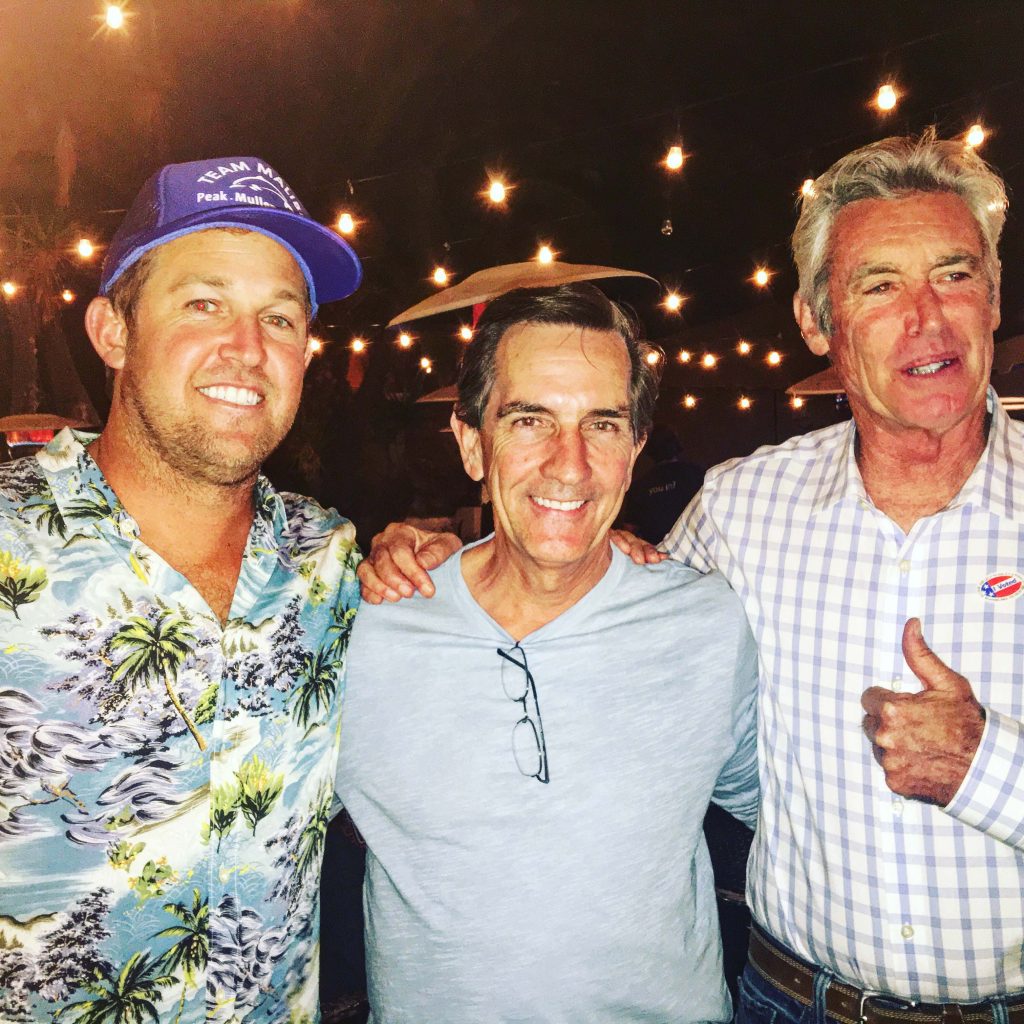
    The way they were. It didn’t take long for Peak and Mullen to separate from the pack. Wagner is now the lone wolf protecting this community.

    The market, who’s lease is still in limbo, continues to appeal to the council – and rightfully so – for the added muscle they need to keep the market in the civic center. To date, The Cornucopia Foundation has no long term lease in place despite             assurances the county has made on record to Malibu City Council.

    The Farmers Market is not only an important part of our community, it also represents our strongest adherence to the Coastal Commission requirements regarding public serving amenities and public access. Council absolutely needs to babysit this issue and see it through to completion.

    Granted, Mullen is new to public office, but in light of his recent actions (on more than one issue), it seems he is in need of proper guidance. It would serve him to spend more time studying the City Council Policy Handbook (and doing his home- work), instead of getting his Cliff Notes from the lame duck regime.

    Without question, two of the slate need to work on their loyalty and one, possibly two, need to work on respect.

    Thankfully, council member Jefferson “Zuma Jay” Wagner continues to be fiercely focused, with a clear understanding of public policy, staying on mission and true to the platform he campaigned on.

    As I look to his leadership for guidance on what we need to do to get the slate back on track, his loyalties remain unquestioned as he looked at me and said:

    “Keep holding our feet to the fire. You will end up being the glue that keeps us together.”

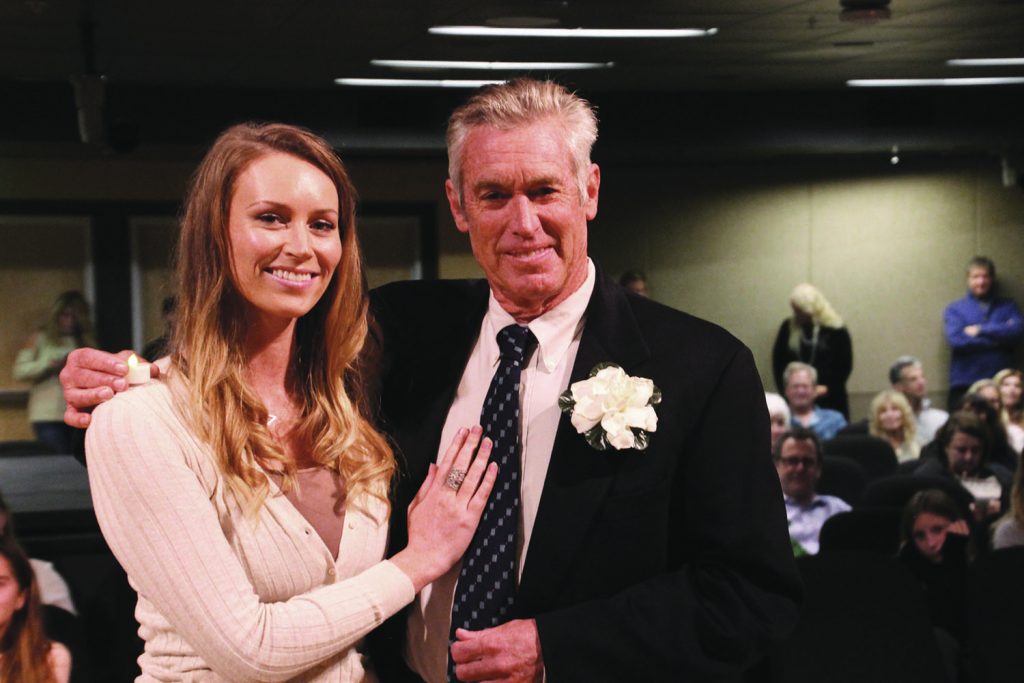
    Jefferson Wagner at the swearing in ceremony with daughter Ava.
  • California Strategies

    California Strategies

    Malibu has paid nearly $2 million over the last decade to a glad handing Sacramento consultant firm with minimal accountability, contrary to commonly accepted governmental practices,

    The firm of California Strategies and the city of Malibu City stated when queried that there have been no written reports or evaluations in the near- ly 13 year relationship, despite rising calls echoing locally and across the State for more public transparency.

    However, both firm principal Ted Harris and Malibu City Manager Reva Feldman declared that “updates and political context” have been provided verbally, with the Feldman stating in an e-mail that she “speaks with California Strategies multiple times a week.” Though she noted “we do not keep written logs of those calls or of meetings in Sacramento.”

    In reviewing the City Council’s past agendas, as well as extensive documents in Freedom of Information requests of the city, uncovered was an item dated June 18, 2013 submitted by then city manager Jim Thorsen requesting a contract with California Strategies providing “government relations consultation,” be renewed and amended to include lobbying.

    An attachment to the recommendation cited “vital” efforts by the firm on several pending State issues, and included monitoring Coastal Commis- sion actions. It concluded that the firm was “making friends in Sacramento” on the city’s behalf to obtain permits and grants. No follow could be located to the dated item.

    Meanwhile, the firm’s Harris declared in an email in reply to a city request I prompted for “any responsive records” to a Freedom of Information inquiry (3.13.17) that was attached, “we do not have a written list of the City’s goals, objectives, and priorities in our files.”

    In variance to the statement, Harris signature is on the firm’s recent contract with Malibu in which goals, objectives and priorities of the city are prominently listed. The executed contract further states “all files of the Consultant pertaining to the City shall be and remain the property of the City,” and “the consultant will control the physical location of such files.”

    While there was scant details what services were actually performed and achieved under the contract, California Strategies like clockwork sub- mitted invoices each month for $12,500, for the last 154 months since July 2004, and totaling $1,925,000. There was an instance of the firm double billing, but this was caught by a Malibu city clerk and corrected.

    In addition, a scan of reports obtained in the FOI request indicated tens of thousands of dollars have been expended by councilpersons Lou La Monte and Laura Rosenthal on numerous trips to mostly Sacramento, and also to San Francisco and Washington, D.C. Not found was any reference to California Strategies.

    While their expenses were documented, with every Starbuck’s coffee, gratuity and hotel bill listed, no notation could be further found indicating what particular venue visited, what was discussed, and how it might affect Malibu. There have been brief oral remarks at Council meetings, of events attended but no specifics recorded.

    In addition to the FOI request, the Internet was searched for any item involving the firm’s relationship to Malibu. Disclosed was an agenda item of a Council meeting several years ago in which the firm’s latest contract was up for renewal, and an earlier item, in 2004, when the original contract was announced and the firm promoted by then Mayor Sharon Barovsky.

    There was a news report revealing the firm’s representation of U2 guitarist David Evans, better known as the Edge, in his 2009 quest to build five homes on the bluffs overlooking the Malibu coastline.

    California Strategies also was under contract at the time with Malibu, which pressed by residents had added its voice in opposition to the project. A question of a conflict of interest was raised by Malibu, only to be rejected by the firm.

    More questionable is the lack of accountability and transparency in the relationship between the firm and the city, especially since their contract calls for weekly and biweekly updates. It is hard to fathom that there were no written reports and records of alleged conversations, which since there also were no recordings would have to be rejected as hearsay.

    My experience as a reporter for the New York Times, a federal regulatory agency official and later as a consultant to several firms and founda- tions, is that it was essential all correspondence and communications be at least dated and recorded, if only for billing.

    Also queried in confidence were several venerable consultants and administrators. They replied that reports to clients were generally written, and the few oral would be logged and usually documented.

    They added for the client this was what is called “a reasonable expectation of service, “ particularly in the public sector, which is more prone to inquiry. “Cover yourself,” is the guiding rule

    One public administrator observed in general, and without reference to Malibu, the problem in many small cities is that elected officials tend to be inexperienced and vain, and easily manipulated by consultants. He added in his extensive experience a few unfortunately had nefarious motives.

    As for staffs, he added that though possibly competent, they frankly tended to let consultants do their “heavy lifting” and anything that called for an extra effort, like advocating their city. He noted this has become a relatively simple matter in the age of the internet.

    “These small cities, especially the wealthy ones, have become a honey pot for termed out legislators and former agency heads haunting Sacra- mento, and I guess most other state capitols,” he concluded in candor. At the same time, he and others observed that lame duck officials alert to post public service employment opportunities tend to be friendly to well connected consultants.

    In conclusion, Malibu and the City Council should be concerned.

    Raised is the question how indicative is City Hall’s relationship with California Strategies of its administration; its liaison with other consultants; and its own operations?

    Needed to be addressed in particular is the contract with California Strategies. It has only a few months remaining, and can be suspended or terminated with five days notice, or amended to be more accountable.

    In addition, what could be described as road shows, or simply the perks of select councilpersons and administrators, be monitored as to their actual value to the city, and generally a stricter cost benefit analysis be applied to municipal initiatives.

    Meanwhile, the Council should review the prerequisite for diligent professional oversight of Malibu’s municipal operations and governance.

    IN CONCLUSION, MALIBU SHOULD BE CONCERNED.

    This report was prompted by a modest city press release announcing Mayor Lou La Monte, Council Member Laura Rosenthal and City Manager Reva Feldman “are heading to the state capitol to ensure that Malibu’s concerns are heard.”

    The release (1.18.17) detailed the three having been appointed to select League of California Cities committees, and listed other public posts require travel to Sacramento, San Francisco and Washington DC on behalf of Malibu.

    Noting that Malibu has a long-standing contract with the Sacramento-based consultant firm, California Strategies, for a broad scope of services involving governmental operations and representations, engendered several questions concerning city policy and priorities.

    Not recalling any relevant public discussions, or municipal oversight, I initiated a search as a credentialed journalist and concerned citizen. This included two detailed Freedom of Information requests to the city, protracted reviews of Council Agendas, the Internet, and select interviews.

  • Malibu Gets Punked: The Unofficial Sanctuary City Sign Takes Aim At Malibu Elite

    Malibu Gets Punked: The Unofficial Sanctuary City Sign Takes Aim At Malibu Elite

    On April 4th, mysterious “official” looking City signs appeared at both ends of Malibu. This obvious effort to humiliate the residents of Malibu after City Council voted 3-2 in favor of becoming a Sanctuary City and the L.A. Times article that sparked the original controversy.

    Resident Mikke Pierson’s quotes in the article were the obvious inspiration unfairly representing the majority of this community. The signs were taken down within hours of going viral on social media.

    The sign appeared at Leo Carrillo state beach on April 4th with the obvious intent of humiliating Malibu for becoming a Sanctuary City. Council member Rick Mullen told local news it was a “prank” and City Manager Reva Feldman said it would be moved immediately.


  • A Sanctuary To Threaten Our Sanctuary

    A Sanctuary To Threaten Our Sanctuary

    By Elisabeth Johnson

    On March 14, 2017, in a 3-2 vote, the Malibu City Council declared Malibu a sanctuary city. Martin Sheen initially proposed the idea to the City Council in December. The term sanctuary city is believed by most to mean that the city will not aid the federal government with the enforcement of immigration laws. However, the concept of a sanctuary city is often misunderstood. That misconception is due in part to the modern rhetoric associated with sanctuary cities, but also the lack of underlying knowledge about the processes of immigration and criminal law. The implica- tions of the city’s recent declaration are impracticable and pose legal, economic, and environmental complications. Furthermore, many of those implications are speci c to Malibu’s unique locality and culture. While the word sanctuary is de ned as a place of refuge or safety, it is also de ned as an oasis or nature preserve. Thus, we as citizens must balance the effect that the sanctuary city declaration has on undocumented persons against those that affect our home and environment . . . our sanctuary.

    In order to understand the legal implications of this declaration, it is important to understand the process that occurs when a city becomes a sanctuary. Local law enforcement is critical in assisting with federal immigration laws. However, to a certain degree, compliance at the local lev- el is not mandatory. When an individual is stopped and arrested by a city law enforcement of cer, that arrested individual is booked into a county jail. At the county jail, the individual’s ngerprints and background information are sent to the FBI who then sends the information to Immigration and Customs Enforcement (ICE). Federal law requires the sharing of this information between local law enforcement and the federal government. If the information submitted to ICE leads them to nd that the individual is undocumented, ICE requires the county jail to hold that person for an additional forty-eight hours. During this period, ICE will obtain a warrant and begin deportation proceedings. President Trump’s executive order allows ICE to begin the deportation process sooner. However, this is not required according to the Department of Homeland Security because it could be a violation of a person’s fourth amendment rights.

    Thus, the element of choice comes into play at the local level. A county is permitted to choose whether to comply with President Trump’s expe- dited deportation process. However, the sharing of an individual’s ngerprints and information with ICE and the forty-eight hour holding period are mandated by federal law and binding on individual localities. Because of this process, Malibu’s declaration of itself as a sanctuary city will likely have no effect on undocumented persons because the actual decision of whether to assist the federal government is the responsibility of the county jail and only follows a legal stop for a purpose unrelated to an individual’s citizenship status and comes after the forty-eight hour holding period. Malibu does not have a city police force, but is serviced by the Los Angeles Sheriff’s Department, Lost Hills Station #1010 on Agoura Road. However, even if Malibu had its own police force, the decision to comply with President Trump’s expedited deportation proceed- ings would begin at the county level with the Los Angeles County Sheriff’s Department. It is the responsibility of the LA County Sheriff, an elected of cial, to determine whether the county will comply with President Trump’s expedited deportation process. It is also unlikely that the Lost Hills Sheriff’s Department would inconsistently apply federal law across its jurisdiction. Even if the city’s declaration had legal footing, the Lost Hills Sheriff’s Department would not likely apply one law in Malibu and another in surrounding communities out of fairness to those that it services. President Trump has threatened to pull federal funding from cities that declare themselves sanctuary cities. In fact, on Monday, March 21, President Trump published a list of 118 sanctuary localities that refused to comply with the forty-eight hour holding process, which is mandat- ed by federal law. President Trump has full legal authority to withhold funding under the Supreme Court case, South Dakota v. Dole.[1] While proponents of the sanctuary city argue that Malibu does not receive enough funding from the federal government for this to be an issue, it is poor stewardship to disregard these funds as influential in our community, speci cally those regarding the environment. While it may be true that Mal- ibu does not need any federal funding to survive, more could be accomplished if federal funding was combined with local resources, especially regarding environmental issues. Thus, writing off the aid Malibu receives from the federal government as irrelevant is misguided. It should also be noted that President’s Trump’s ban on federal funding to sanctuary cities may prevent Malibu from being eligible for federal funding in the fu- ture, which would have a drastic effect if the city’s nancial position changes at any point. Furthermore, President Trump’s ban on federal funding to sanctuary cities would make Malibu ineligible for Federal Emergency Management Agency (FEMA) funding in the event of re, flood, or other natural disaster, which makes the sanctuary city declaration increasingly irresponsible. On Monday, March 27, Attorney General Jeff Sessions reinforced President Trump’s promise, adding that sanctuary cities should be punished and may be denied Justice Department grants for state and local law enforcement.

    Making Malibu a sanctuary city may have been done as an act of solidarity, however, the negative effects will be widespread. First and foremost, it is not always understood that a sanctuary city only affects an undocumented person after a legal stop and after mandatory sharing of informa- tion with the FBI. This also indicates that making a city a sanctuary has less effect on the children of undocumented persons than common rhet- oric might lead one to think. This lack of knowledge will attract undocumented persons to Malibu under the impression that they will be provided safe harbor, when in reality, this is not the case. That is, when undocumented residents recognize that Malibu is a sanctuary city, many are under the assumption that it means they will not be arrested or that their information will not be shared with the federal government at all. However, any person violating a United States or California law may be stopped and arrested and that person’s information will automatically be sent to the FBI. This misconception is extremely detrimental because as population increases in general, crime rates will also increase. The same will happen when the population of undocumented persons increases, even if temporarily. This is especially problematic in Malibu, because one source indi- cates that Lost Hills Sheriff’s Department may be underperforming on its contract with the city. Furthermore, the city is also without an Emergen- cy Services Coordinator. This is important because the Emergency Services Coordinator is “is responsible for maintenance and implementation of the City’s Emergency Operations Plan.”[2] This position has been vacant since the beginning of the year. Both of these issues pose serious threats to our community’s safety, especially when paired with an increase in population.

    Making Malibu a sanctuary city may have been done as an act of solidarity, however, the negative effects will be widespread.

    The city’s misconception of the implications of a sanctuary city disguised as an act of solidarity have a direct negative impact on Malibu voters. However, the negative impact spreads to other areas of the community such as residents that live in unincorporated Malibu, temporary resi- dents who own vacation homes, and students and staff of Pepperdine University. Thus, this decision will flow down to other members of our community who facilitate our economy by spending money in our city, whose children attend our schools, and who make other positive contri- butions to our community. This is especially an injustice to Pepperdine students and faculty because Pepperdine is not within the city’s juris- diction and residents of Pepperdine’s campus were not allowed to vote for the members of city council, yet city council members’ leadership is directly affecting and endangering Pepperdine students and residents, and members of the Malibu community in general. Thus, this detrimen- tal act of solidarity was not in the best interest of the community in its entirety.

    In fact, many Malibu residents are unhappy with the decision. Within seventy-two hours of the decision, over 100 residents contacted Coun- cilman Jefferson Wagner to voice their concerns. Wagner estimates that approximately 80-90 percent of those that contacted him were not in favor of the sanctuary city. Within three days of the vote, Wagner also received interview requests from three separate news agencies. Wagner interviewed with two of the three news agencies. Residents have also contacted Councilman Rick Mullen to express their dissatisfaction. This is not a party-line issue, but an issue that will affect everyone in our community regarding environmental, public safety, educational, and traf c issues, all of which were promised to be issues of immediate importance during the recent election.

    A local government’s primary responsibility is to serve the needs of its local community rst and protect the safety and well-being of the constituents in its jurisdiction. A local government’s job is not to make symbolic gestures on poorly-researched federal issues. Public service at the local level means using leadership, respect for the law, and good stewardship to serve members of one’s community. It does not mean making irrelevant federal party-line issues a part of local law at the expense of wasting time on more pressing local issues. James Madison said, “We are right to take alarm at the rst experiment of our liberties.” In this instance, as voting citizens and members of the community,
    we are right to take alarm at the fact that some of our city council members have chosen to make a decision that is not in the best interest of our citizens, and have also chosen to prioritize a federal issue with little legal effect over more pressing local issues for which they are directly responsible.

    [1] South Dakota v. Dole, 483 U.S. 203, (1987). [2] City of Malibu Website

  • The Cat That Changed America…and Malibu.

    The Cat That Changed America…and Malibu.

    By Steve Woods

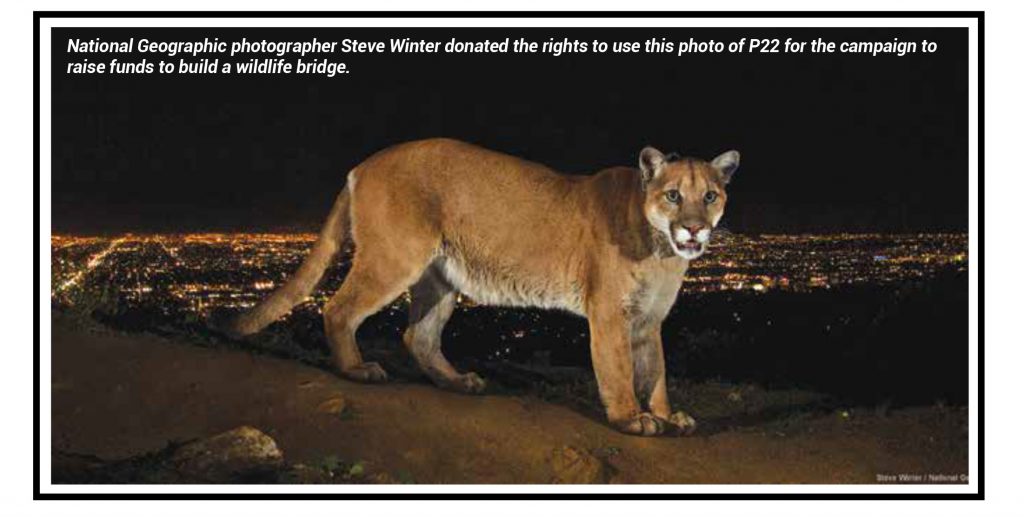
    If it was not for an untagged male mountain lion pressured out of our local Malibu mountains and pushed deeper into the small urban island of Grif th Park, there may not have been a Poison Free Malibu, a rodenticide ban or plans to build a wildlife corridor across the 101 Freeway, and certainly no famous picture of P-22 walking in front of the iconic Hollywood sign.

    A new lm documentary focuses on a mountain lion tagged P-22, the challenges Pumas are facing from the encroachment of suburban development across California wildlands and the plan to build the world’s largest wildlife crossing. This would help connect mountain lions to a larger genetic DNA pool along with other wildlife to one of the last undeveloped wildlife corridors that would connect spaces better suited for them.

    There is an urgency to get the crossing built as mountain lions are running out of time in California; they are threatened by urban sprawl, in- breeding, vehicles, rat poison and ultimately extinction. If they do not get the help they need now, they will most certainly be gone in 50 years.

    It may have been mountain lion P-45, a dominant male that challenged P-22 to get out of his territory surrounding Malibu and flee for his life. P-22 was pressured out of the frying pan and into the re of an urban landscape dominated by herds of fast moving metallic beasts traveling in concrete streams to the North, South and East. His choice? Santa Monica? No! To the northwest across the 101 Freeway into an area with other males or head East…East it was, into unmarked territory, free of any scents of other males but the open spaces ended at the 405, one of the busiest freeways in the world. Turn back and face P-45 or risk a crossing? Too many mountain lions have died crossing other roadways but P-22 did the impossible and survived crossing the 405. There were never any sightings of a mountain lion on the Bel Air side of the 405 nor anywhere on Mulholland Hwy.

    P-22 must have jumped over a thousand backyard fences in the heavily developed neighborhoods to the east with such stealth as to avoid detection but there may have been a few pets along the way that were detected missing.

    Pushing east through an endless maze of hillside communities with barking dogs, another formidable obstacle presented itself… the 101 Freeway. Nobody knows for sure but biologists believe he may have crossed the freeway over a bridge near Universal Studios in the Cahuenga Pass and scampered up into the open brush that networks into one of California’s largest urban parks named after Grif th J. Grif th. Grif th donated his land for the purpose of giving everyday hard working Angelinos a place to enjoy undeveloped nature.

    Though the 4,400-acre park was not the 200 square miles that are ideal for a mountain lion, P-22 claimed all for his lonely self along with the herds of healthy deer but unfortunately his diet also included raccoons, coyotes, rabbits and mice with dangerous levels of anticoagulant rat poison.

    P-22, the most famous mountain lion in the world, is both a celebrity and a messenger. So far he has managed to survive the deadly traf c of Los Angeles, stealthily navigate the city’s massive urban sprawl, and take up residence in an area that represents 3% of a normal size home range for a mountain lion. He also miraculously recovered from a potentially life-threatening case of rodenticide poisoning. For the most part P-22 has overcome the odds, but his story is a cautionary tale with an important message – one that is explored in the upcoming documenta- ry lm “The Cat that Changed America.”

    Being a long time Malibuite who has been hiking and mountain biking the hundreds of miles of Malibu trails for over 30 years, I have been fortunate enough to have had some rare visual encounters with these beautiful yet stealth cats who have witnessed me more times than
    I will ever want to know. For those who are fearful or squeamish about the idea of being in an area with or in close contact with mountain lions, please take note of the wildlife camera footage that takes a picture every 6 seconds. One camera is placed on a hiking trail and shows a mountain lion sitting on the trail. Every six seconds, for several frames, you see P-22 sitting. In the next frame, he has vanished. Six seconds later, a jogger runs by in the same spot that P-22 was sitting and the jogger never had a clue. P-22 has helped to create a movement that is shifting our view of mountain lions and, with effort on our part, we are learning to co-exist with this important keystone species. His story
    can be a catalyst to help change America and the rest of the world. Beth Pratt-Bergstrom, that smiling blonde who never travels without her life-size P-22 cutout, is the California Director of the National Wildlife Federation and is spearheading the efforts to raise $10 million in private funds to add to Cal Trans and other State and Federal Funding Grants to complete the $50 million dollar estimated project.

    For the sake of the Mountain Lions, let’s hope that California stakeholders do not lose federal funds because some California cities continue to defy federal law by claiming Sanctuary City status. $3 million has been raised by private donations so far and if you are interested in help- ing contribute to a great cause please contact Beth Pratt-Bergstrom of the National Wildlife Federation at www.nwf.org/california or email: prattBnwf.org

  • A Case For Big Clay

    By Janet Friesen

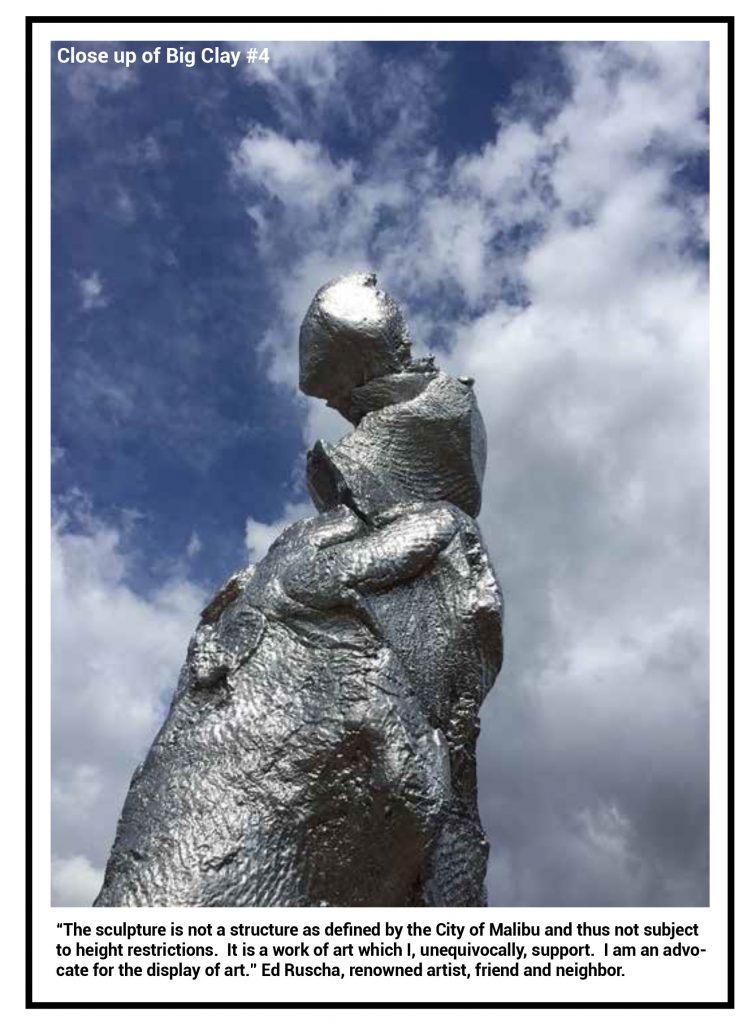
     I love art for all the positive energy it brings into our life, and I also love art for the controversy it can provoke. I decided to do an article on Big Clay #4, the 45-foot sculpture by Urs Fischer that Bill and Maria Bell own and display at their residence on PCH. Why did the City of Malibu determine that this sculpture must be taken down? I spoke to the artist, residents, city of cials and arts commission members to try to understand this complex and emotional issue.

    In March of 2016, the City Council ruling on an appeal by the owners, determined that Big Clay was a “structure” and must be taken down be- cause it was over the height limit of 28 feet, “Signi cantly “ obstructed public and private views” and had a foundation. Watch this link for more detailed info on City Council ruling. Staff reports call all art seen as public art. https://www.malibucity.org/AgendaCenter/ViewFile/Agenda/11142016-865

    As I asked questions, I learned that there is nothing in the municipal code that states a piece of art is a structure. And I’ve learned that the City has many sculptures which do not have CDP permits (Coastal Development Permits). It was pointed out to me by a city of cial (who wished to remain anonymous) that there are currently sculptures without CDP permits in Legacy Park.

    “ Big Clay is NOT a structure, it’s a sculpture, bottom line. That is what it was intended to be, and that’s what it is. You don’t inhabit it, you don’t use it, it doesn’t give you shelter. It doesn’t do anything. Art doesn’t make direct sense. Art doesn’t have a direct purpose, structures usually do.” -URS FISCHER

    I met Urs Fischer 6 years ago at a friend’s house in Malibu and recently spoke with him about the controversy surrounding his work. Here are some excerpts from that conversation:

    JF: Why in your opinion are the City and some residents making such a big deal over this?

    UF: Maybe they don’t want to see different people with different opinions. Sometimes people pay
    a lot of money for the homes they have and they fear their investment gets undermined. They don’t share the same values and there you have a problem.

    When I’m in Malibu and I look down, I see houses that don’t integrate that well into the beautiful landscape. They are a bigger eyesore to me. And let’s say a lot of cars that move down the street, or trucks, they’re as big as the sculpture, almost. They’re not very pretty either. If you come from an aesthetic point of view I would say that is a bigger issue.

    JF: How do you respond to your work being la- beled a structure?

    UR: Big Clay is NOT a structure, it’s a sculpture, bottom line. That is what it was intended to be, and that’s what it is. You don’t inhabit it, you don’t use it, it doesn’t give you shelter. It doesn’t do anything. Art doesn’t make direct sense. Art doesn’t have a direct purpose, structures usually do.

    JF: What would you like the outcome to be?

    UR: I’d like Big Clay to stay there and not be seen as an obstruction. There is nature and then there are man-made things.
    Of all man-made things that you can see in Mal- ibu, I don’t think it’s the “most obscene” to me. It’s closer to nature than some other ‘structures’ built by humans.

    Urs referred to the following letter he sent to the City:

    “I have gotten to know Bill and Maria Bell over many years as one of the world’s leading patrons of contemporary art. Their continuous support has been enabling many great things to happen for many artists. In 2013 I had a major retrospective of my work at the Museum of Contemporary Art in Los Angeles. At the time Maria Bell was the chairman of the board at the museum. The sculpture in question was an integral part of that show.

    To have this sculpture in their collection, parts of which are installed in the stunning building by the grandmaster of Japanese architecture, Tadao Ando at 27712 PCH means a lot to me.

    Mr. Ando’s framing of landscape heightens our experience of it the same way as a poem or an artwork reflects and helps us to see, to understand, what we experience. The low-lying building he created for the Bells, with its disciplined spatial gestures, faces west. It frames the view from the Paci c coast. At the other side of the Paci c lies Japan, the home of Mr.Ando, the home of his heritage he works from. This leap across the Pacif- ic is something to take into consideration to understand the ensemble that the building forms with my sculpture.

    Eastern calligraphy attempts to captivate, through the motion of the brush, a profound understanding that can be shared with everyone. In play with one of the most stunning landscapes in the world, Malibu and Mr.Ando’s almost invisible building, the very essence of my sculpture starts to unfold: our urge to hold on to and express the beauty we experience in life.

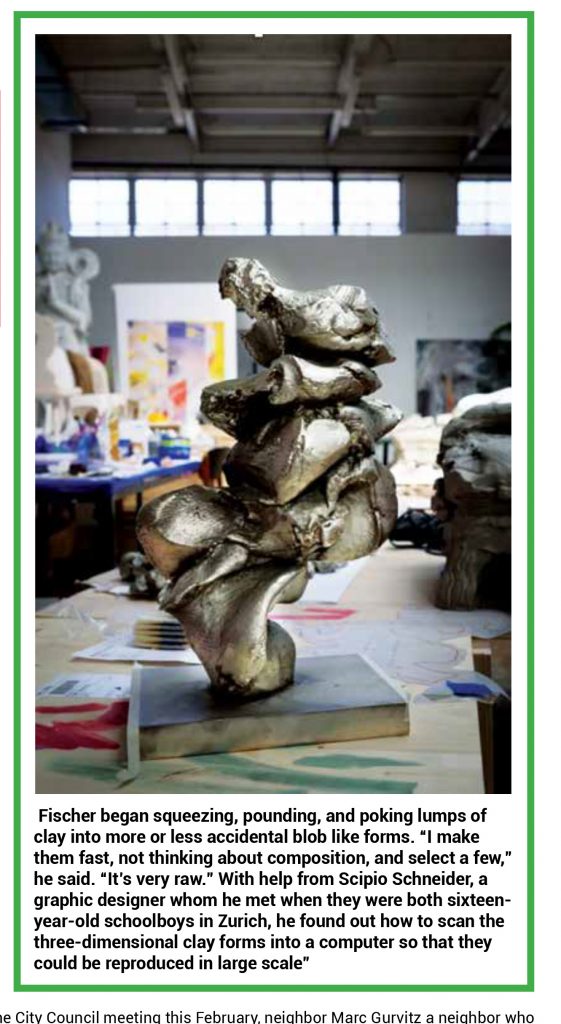
    The original clay model for the Big Clay sculpture comes from holding a portion of clay that ts in a palm. It is formed with both hands in a sensu- al and repetitive gesture, like a bodily motion. I stop before a conscious composition comes into play. In order to just represent a moment, before it represents something speci c. I made hundreds of small models, then I start the selection process, not unlike a talent show, by elimination. I continue until only one is left. This model gets enlarged through a series of technological means before it gets cast in metal.

    The final sculpture stands for a moment. A moment which we wish we could preserve. Like a sunset over the Paci c, the taste of a fruit, a smell or a human touch.

    One might ask why a sculpture, based on a simple gesture, has to be this big. My understanding is that, at rst glance, landscape is very elementary, like a draw- ing made by a child’s. Sky, mountain, ocean, sun. Big things. Big clay is nothing else than elementary.

    The longer we contemplate landscape we see details. Vegetation, animals, insects, rocks and structures. All of them build a big picture. Everything is the same, an oak tree is an oak tree, but each has its own expression. That is what makes life precious.

    My sculpture attempts to speak about that. The individual in the in nite variety that is life.

    To me, the situation of the remarkable landscape Paci c coastline, the building by Mr.Ando and my sculpture, form a coexistence that is not to be understood as an intrusive act but as one that seeks harmony with the landscape it sits in.

    Bill and Maria Bell’s dedication to Malibu and their extensive involvement in the visual arts are an enrichment to the community. It is not often that we meet such open minds, even rarer someone that acts on it. I have great admiration for them and their endeavors.

    I hope you will agree to allow Big Clay to stand where it is. I strongly feel that the piece found its home. Thank you,
    Urs Fischer

    In a Planning Commission meeting in March of 2016, John Mazza vice chair of the planning commission concluded that the sculpture is not a structure. He read the whole code and found nothing that would prevent Big Clay from remaining. Public views are the only thing that possibly came up. Because the piece is more than a 1000 feet from a private residence, a resident’s complaint is not valid. Big Clay is very dif cult to see from PCH so Mazza concluded it doesn’t obstruct the public’s view. Mazza reread the municipal code and found that there are zero requirements for regulating art.

    He said that unfortunately the art task force was ignored by the city council when they recommended that the city adopt regulations. Mazza concluded,“ I don’t see any regulation of public art in the history of Malibu.” He cited public art at the old courthouse and a 25 foot Tony Smith sculpture at a private residence as examples of art that have no permit. Mazza concluded ”I’m going to make the motion that this project does not require the Planning Commission to act on it. It’s not covered by Malibu codes or the LCP.” (Local Coastal Plan).

    David Brotman, head of planning, concluded, “This is a gray area we have here. Council set this thing up and it requires some legislation. There is enough history about artwork and the City’s desire to have artwork, that there is a hole there some- place and so I don’t think I can grant the variance but I don’t want to vote against this thing… the council has made such a big deal about public art. It is in some way public art … the artwork in this house is phenomenal; it takes your breath away. I’m sorry, there is a place for something like this in this world even in rural Malibu… I’m going to vote however I can to kick it upstairs.”

    (Watch this link for March 7, 2016 planning commission meeting http://malibu.granicus.com/MediaPlayer.php?clip_id=1173)

    Minutes from City Council meeting June 13th 2016
    MOTION
    Mayor ProTem La Monte moved and Councilmember Sibert seconded
    a motion to adopt Resolution No. 16-30 denying Appeal No. 16-002 and denying Administrative Plan Review No. 15-108 and Variance No. 15-047 for the after-the-fact-placement of a 45-foot tall art sculpture with a 20-foot by 20-foot base in the Rural Residential-Two Acre (RR-2) zoning district located at 27712 Paci c Coast Highway (Rosebud Ventures, LLC). The question was called and the motion carried 3-1-0, Councilmember Peak dissenting and Councilmember House absent.

    At the City Council meeting this February, neighbor Marc Gurvitz a neighbor who has complained about Big Clay said, “So at some point, it has got to come down, or I don’t think anyone in this room should even bother to apply for a permit,
    just do what you want, because no one is going to do anything about it any- way.” However for Gurvitz to have a valid complaint, his view obstruction must be within 1000 ft and block signi cant views of the ocean or canyons. Gurvitz

    is approximately 1,250 feet away. Another neighbor across the highway com- plained but did not have a view determination. He can not see Big Clay because of the trees. Big Clay is referred to as public art by some because it can be seen by the public.

    Concern came up in a conversation I had with a City Council member that if Big Clay fell down and possibly injured or kill someone, the City would be held responsible. I emailed Joseph Perazzelli, who did the structural engineering on the base for the sculpture: “The permanent foundation base for the sculpture is a 21’x23’ two way,
    12” structural concrete slab
    supported on four sides by 18” wide continuous footings embedded 24” into competent bearing soil.
    All concrete is 3000 psi, inspection required.
    The slab design is made to resist a combination of loads: Dead Load + Wind
    or Seismic.
    And the base dimensions are proportioned to contribute a 1.5 factor of safety against overturning.
    The 1” stainless steel sculpture base is connected to the concrete with 32- 7/8”diameter epoxy anchor bolts
    spaced approximately 12” of just within the cast aluminum shape to resist uplift and shear.” Aby Rosen,real estate investor and collector, installed a Big Clay in NYC.

    “It’s 2 feet high and weighs 20 tons. “I’m spending a million dollars to install it. It’s something that’s pushing the envelope.”

  • City Manager Contract Under Review

    The SHAKE-UP RUMORS ARE GETTING LOUDER Could change be in the air at City Hall?

    Over the past year, there has been a continuous cycle of disturbing changes at City Hall, which continues to struggle to get its bearings under the guidance of City Manager Reva Feldman who took over the position last May.

    The growing lack of clarity surrounding the day to day business of running this City is now being scrutinized, at length, as the City Manager’s contract is currently undergoing a review by City Council.

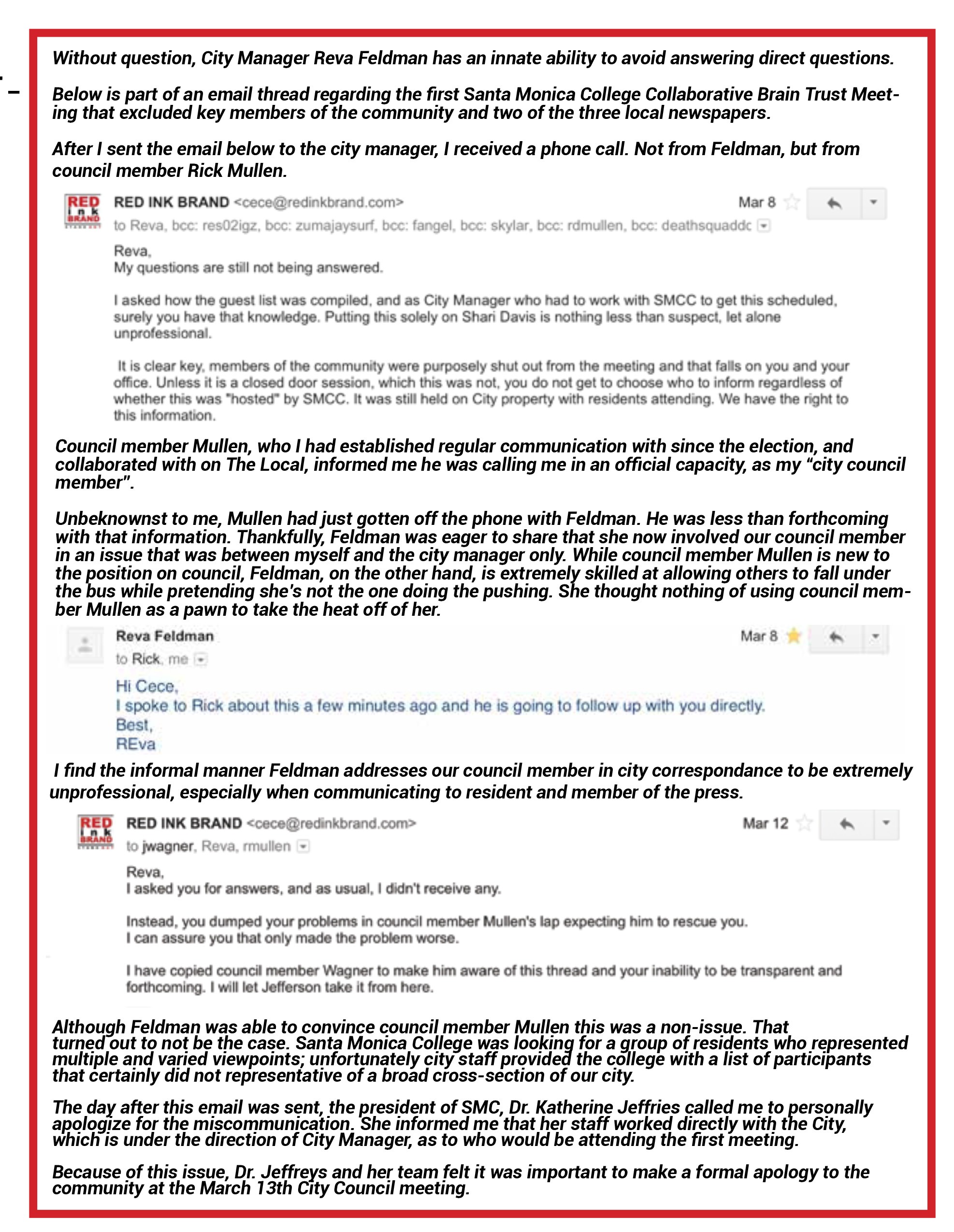
    Now approaching its second month of the process (which is highly unusual), it appears that Feldman could be finally be losing her grip on the “what happens behind closed doors stays behind closed doors” strategy she used to run the City over the last year. Her lack of transparency and inability to be forthcoming is being highlighted as council digs deeper into the discovery process.

    Could they be getting close to finding out where all the bodies are buried?

    Before the new council took to the dais in January, it appears the City manager and staff functioned with no real oversight. Council allowed them to slide on virtually every discrepancy.

    But now that the (presumably) pro-preservation slate,who campaigned on cleaning house at City Hall, has taken office, we’re hopeful Feldman has lost her golden parachute.

    Recently, when speaking with council member Rick Mullen about Feldman’s particularly poor job performance, he said: “Give me an example.”

    Well, here you go.

    Emergency Disservices

    From the moment Feldman stepped into the position as City Manager, the slow motion collapse of City Hall began.

    It’s no secret that Feldman is prone to forcing out and shuffling around her staff which has resulted in long-standing, devoted employees departing their posts with very real and detrimental effects on our City.

    The City’s first big loss under the new Reva regime, was Brad Davis, Emergency Services Coordinator. Davis was in charge of training and certifying resident volunteers as Emergency Responders (C.E.R.T), sending out emergency alerts to residents and other emergency services duties.

    Shortly after Feldman took over the role as City Manager, she put Davis on what was reported to be a forced “medical leave” with no second in command in place for this important public emergency position.

    Six months later, on December 22, 2016, Davis turned that “medical leave” into his official resignation. Immediately after his announcement. Davis landed a plum position in Foster City where they will undoubtedly benefit from Davis’s invaluable experience our city was fortunate to have for well over a decade.

    Unfortunately, Davis’s untimely “medical leave” happened to coincide with Malibu’s most dangerous season for weather conditions, and Feldman, to our knowledge, had no trained replacement for Davis’s position on staff, leaving the city in a very vulnerable position.

    Noticeable deficiencies were evident almost immediately.

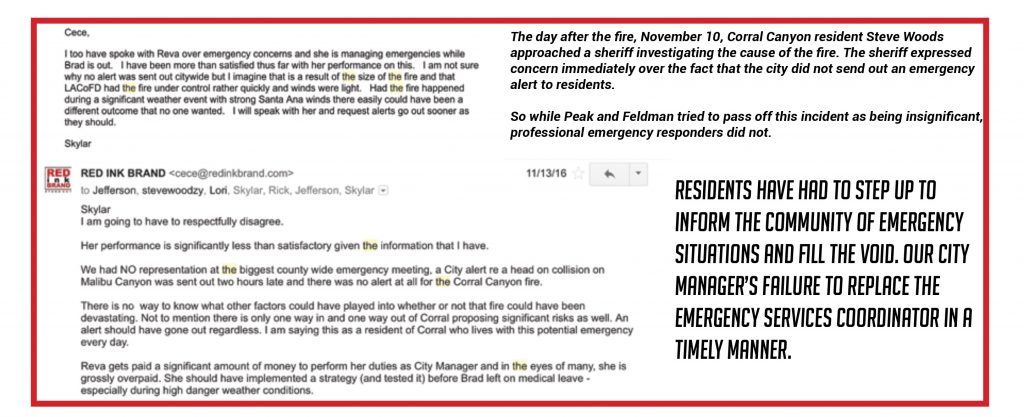
    Emergency alerts sent out through the City’s Nixle system were untimely or not sent out at all.

    On November 9, 2016, a fire broke out in Corral Canyon. This was a very hot night and any change in weather could have led to a devastat- ing outcome. Although the re was contained in approximately 20 minutes (thanks to L.A. County Fire Department) no alert was sent to residents from the city. Furious at the complete disregard for the safety of the residents of Corral Canyon, I contacted council member Peak. He assured me he would follow up with Feldman as to why the City alert was not activated. Feldman issued no apology, instead calling the fire “brief,” making the excuse it was “outside the city limits.” In other words, and in Feldman’s mind, the residents in unincorporated 90265 are not her concern, nor did she take into account that Corral Canyon has only one access road that runs through Malibu city proper. This fire was one wind gust away from potential disaster inside the city limits, similar to the 2007 re that destroyed over 50 homes.

    Yet Feldman told the community she “had it handled.”

    Instead of hiring an interim replacement for Davis to keep the Emergency Preparedness and CERT programs operational until she could find a permanent replacement, Feldman chose to take care of her needs first. She created a new position placing more burden on the city’s budget, by hiring yet another personal assistant, Assistant to the City Manager. She continued to leave the post of Emergency Services completely unmanned for the last six months.

    That’s right, six months.

    Of all the things a city manager could overlook, none touches in intensity and consequence as much as the absence of an Emergency Services co-ordinator, especially in a disaster-prone community like ours. The disconnect between the City Manager and her responsibility to protect the community was crystal clear with the city’s failure to participate in October 19th’s Great Shake Out exercise. This annual opportunity is for people in homes, schools, and organizations to practice what to do during earthquakes, and to improve preparedness. Shakeout.org reported that 10,667,89 Californians participated in this year’s life-saving drill, yet under Feldman’s rule, Malibu was a no-show.

    Protecting the public is the FIRST responsibility of government and the City Manager and, at this point, there is no question Feldman has been severely derelict in her duties with regard to the public safety of our town. This kind of city managing is undeniably dangerous.

    At press time, The Local learned that Feldman had passed over Malibu-based applicant David Saul for Public Safety Manager (which is now re-placing the Emergency Services Coordinator position). Having a local resident in charge of Emergency Services would have been the best decision for the community. This makes the most sense because of Malibu’s history of becoming isolated by weather-induced landslides ,earthquakes or other natural disasters. Saul received more than 30 letters of recommendation and is well respected in the community. He also intimately understands the local landscape and has close ties to emergency responders. This is not the first time Feldman has passed over a qualified resident in favor of an outsider for a city staff position.

    How long will it take for this department to run at full speed as it did when Brad Davis was at the helm? Only time will tell, but it doesn’t look promising based on Feldman’s track record. It is increasingly important to this community to have it running effectively and increasingly frustrating knowing that Feldman is in control.

    Conflict of Many Interests

    Feldman, who has been with the City since 2005, is no stranger to procedure and protocol. Yet city hall has become increasingly conflict-ridden under her supervision and this decision maker is making decisions that don’t seem to be in the broad public interest.

    Employee Turnover – Along with Brad Davis leaving his post as Emergency Services Coordinator, Barbara Cameron, Grants Acquisition Coordinator, Lisa Pope, City Clerk and Victor Peterson, the City’s longest employee, all suffered a similar fate under Feldman’s rule.

    Selective Code Enforcement – This is a big problem and has resulted in 4 lawsuits, so far, all currently in litigation with potentially disastrous outcomes. As long as the city staff continues to operate as they have under Feldman’s guidance, litigation will be ongoing and the city will be hemorrhaging money on legal fees.

    Failure to Review City Contracted Services – If city staff is enabling the contractor to get the work, how can they effectively audit the work? Where is the oversight by unbiased auditors reviewing outside vendors for performance quality assurances?

    Paying Contractors In their Personal Name – The City’s Warrant Register, the tabulation of payments the City makes twice monthly which is reviewed by and certified by Feldman, with the checks written to the business owner’s personal name (?) instead of the contracted business entity.

    The list of deficiencies is staggering.

    The Holy Grail of Non-Compliance

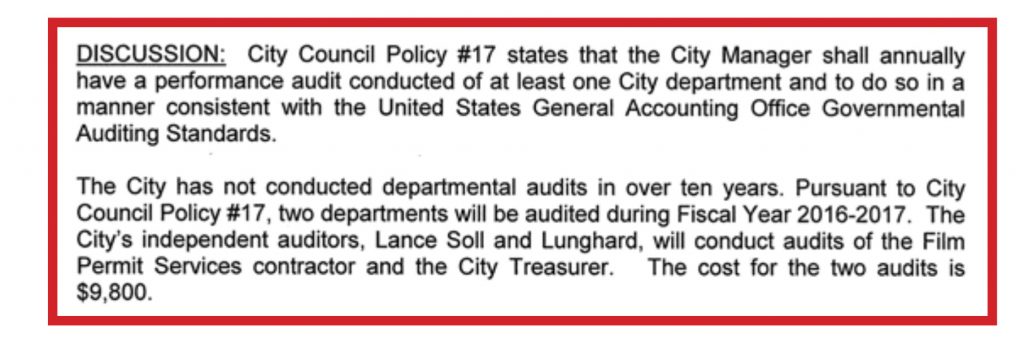
    Nothing screams derelict of duty more than staff being forced to admit the city hasn’t performed a performance audit for over ten years. In the Agenda posted on March 29, 2017, city staff requested $9,800 for two department performance audits, with no actual admission of lack of fulfilling requirements as per the Council Policy Handbook. At this rate of two performance audits per year can we expect compliance within another 10 years time?

    This issue only came to light after concerned resident, Ryan Embree addressed the Council directly during public comment. Embree exposed the ongoing violation ignored by the City Manager, forcing Feldman to comply.

    For many years, Feldman headed the Finance Department – during which not a single performance audit occurred.

    While most of the performance audits that were not conducted took place under Jim Thorson’s direction, Feldman held the position of assistant City manager and should have been well versed in this policy.

    It is high time that Council admit they have a serious problem employee on their hands. The professional negligence is staggering.

    If Feldman is not replaced, only failure and gridlock await.

    To BE CONTINUED.

    By Cece Woods